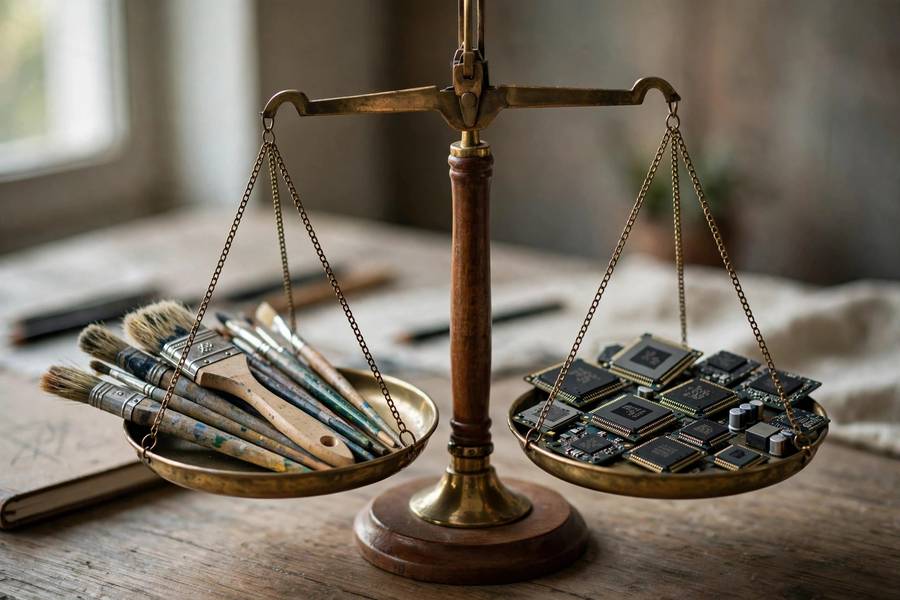
Most writing about AI art ethics comes in two flavors: outraged artists declaring it theft, or tech enthusiasts declaring it liberation. Both are reacting to something real, and both are missing half the picture. I’ve spent a lot of time with the actual arguments — the training-data fights, the labor questions, the disclosure debates — and the honest version is more nuanced than either camp admits. This guide maps the real ethical issues, steelmans the positions, and ends with practical guidance for using these tools responsibly. The creative-philosophy companion is can AI make art; this one is about right and wrong.
Table of Contents
- Issue 1: Training Data and Consent
- Issue 2: Artists’ Livelihoods
- Issue 3: Disclosure and Transparency
- Issue 4: Style Imitation of Living Artists
- Issue 5: Deepfakes and Deception
- Issue 6: Bias in Generated Imagery
- Issue 7: Environmental Cost
- Using AI Art Responsibly: A Practical Code
- Frequently Asked Questions
Issue 1: Training Data and Consent
The issue: Image models trained on billions of web-scraped pictures, including copyrighted work by artists who never consented, weren’t credited, and weren’t paid. The benefits — valuable products, subscription revenue — flow to AI companies.
Why it matters: Consent is a bedrock ethical norm. We don’t accept “we took it because we could” in other domains; the question is whether training ML models is relevantly different from other uses. Artists experience it as extraction: their collective labor converted into a product that then competes with them.
The counterpoint: Human artists also learn from others’ work without permission or payment — influence is the engine of culture. Defenders argue model training is closer to studying than to copying, and that requiring individual licenses for billions of images would make the technology impossible except for giants who can afford licensing departments.
Where I land: The “humans do it too” analogy is weaker than it looks — scale and commercial structure differ meaningfully. But retroactive consent for already-trained models is practically thorny. The constructive path forward is opt-out mechanisms with teeth, compensation frameworks for future training, and licensed-data models (like Adobe’s approach) as a viable alternative — not pretending the issue doesn’t exist.
Issue 2: Artists’ Livelihoods
The issue: Clients who once commissioned illustrators now generate “good enough” images in-house. Stock illustration, concept art, book covers, marketing graphics — the commercial middle of the illustration market is being hollowed out. Working artists report lost commissions and downward price pressure.
Why it matters: This isn’t abstract. It’s rent money for real people who spent years building skills. Technological displacement has happened before (photography vs. portrait painters, synthesizers vs. session musicians), but “it happened before” is cold comfort to the displaced — and past transitions were brutal for those caught in them.
The counterpoint: New tools also create new work: AI art direction, prompt craft services, curation businesses, hybrid workflows where artists use AI to multiply output. The artists thriving now are often those who adopted the tools early — the technology rewards adaptation, and adaptation is possible.
Where I land: Both things are true simultaneously: genuine displacement and genuine new opportunity. The ethical failure would be celebrating the opportunity while ignoring the displacement. Transitional support, honest client communication about what AI can and can’t replace (taste, art direction, and original vision still command premiums), and not using “adapt or die” as a way to dodge empathy — that’s the decent posture.
Issue 3: Disclosure and Transparency
The issue: Should AI-generated images be labeled as such? Contests have been won by undisclosed AI entries; clients have paid illustration rates for generated images; social media fills with AI images presented as photography.
Why it matters: Disclosure affects consent all down the line — a client’s consent to pay for human craft, a viewer’s consent to trust a photo, a contest’s consent to judge human skill. Undisclosed AI use is a truth-in-labeling problem, and it corrodes trust in visual media generally.
The counterpoint: We don’t label every tool — nobody discloses Photoshop use, camera brand, or reference-photo usage. Drawing the line at AI specifically can look arbitrary, and mandatory labeling schemes face real enforcement problems (detection tools are unreliable, and determined deceivers will strip labels).
Where I land: Disclose where the audience has a reasonable expectation otherwise: client work billed as illustration, contests judging human skill, photojournalistic contexts, marketplaces with AI-content rules. For casual personal sharing, the norms are still forming — but when in doubt, a simple “made with AI” costs nothing and builds the trust the whole ecosystem needs.
Issue 4: Style Imitation of Living Artists
The issue: Prompts like “in the style of [living illustrator]” let anyone generate pastiches of specific working artists — sometimes used to replace hiring them.
Why it matters: Style isn’t copyrightable, but a person’s distinctive visual identity is closely tied to their livelihood and reputation. Generating “their” style on demand, especially commercially, feels personal in a way generic style-mixing doesn’t — because it is personal. It’s their name, their look, their market position being simulated.
The counterpoint: Artistic influence has always worked this way — young artists emulate masters, genres form around shared aesthetics. No one owns a style, and attempts to fence styles would chill legitimate creative dialogue. The capability also enables homage, study, and play, not just replacement.
Where I land: This is the clearest ethical line in AI art, and it’s simple to respect: don’t use living artists’ names in prompts for commercial work. For personal study and play, the stakes are lower — but even there, consider whether you’d be comfortable if the artist saw it. Some platforms now block living-artist names; treat that as the norm catching up to decency, not as censorship.
Issue 5: Deepfakes and Deception
The issue: The same technology that makes pretty landscapes makes convincing fake images of real people and events — non-consensual imagery, political misinformation, fraud.
Why it matters: This is the highest-stakes ethical issue in the space, and it’s not really about “art” at all — it’s about the technology’s capacity for harm. Non-consensual intimate imagery is abuse. Fabricated “photos” of events corrode shared reality. The art-ethics conversation sometimes undersells this because it’s less philosophically interesting than consent theory — but it’s where real people get hurt.
The counterpoint (such as it is): There’s no serious ethical defense of deceptive deepfakes; the debate is about responses — watermarking mandates, detection tools, platform liability, criminal law. Everyone agrees on the wrong; they disagree on the fix.
Where I land: Support technical and legal countermeasures (provenance standards, criminalization of non-consensual intimate deepfakes), and personally: never generate images of real people without consent, never share synthetic images in contexts where they’ll be taken as real, and treat “it’s just a joke” as the red flag it usually is.
Issue 6: Bias in Generated Imagery
The issue: Models trained on internet imagery reproduce its biases — and amplify them. Prompt “a CEO” and you get a man; “a nurse,” a woman. “A beautiful person” skews young, thin, light-skinned, Western. The defaults reflect the training data’s skews, then present them as neutral.
Why it matters: Generated imagery increasingly fills our visual environment — marketing, illustration, media. If the defaults systematically underrepresent or stereotype groups, the technology quietly reinforces the biases it absorbed, at scale, invisibly.
The counterpoint: The bias is in the data, not (only) the model — it reflects real-world distributions and historical inequities. Some argue “fixing” outputs is itself a distortion. And users can always specify what they want; the defaults are starting points, not mandates.
Where I land: “The data made me do it” doesn’t absolve deployment choices — defaults are design decisions with consequences. Specify diversity in your own prompts (it’s good craft anyway: specific beats default), and favor tools that have done bias-mitigation work. The deeper fix is dataset curation, which is slow, unglamorous, and necessary.
Issue 7: Environmental Cost
The issue: Training foundation models consumes enormous energy; inference at scale (billions of generations) adds up. AI image generation has a carbon footprint.
Why it matters: Climate costs are real even when invisible. “It’s just a fun image” multiplied by billions of fun images is industrial-scale compute.
The counterpoint: Per-image inference energy is small (roughly comparable to a Google search or less, depending on estimates), model efficiency keeps improving, and the footprint should be weighed against displaced alternatives (photoshoots, shipping physical art supplies, etc.). Also, data centers increasingly run on renewables.
Where I land: Don’t generate a thousand variations when ten will do — the “draft low, finalize high” workflow (cheap settings for exploration, full quality for finals) saves money and energy. It’s a minor issue compared to training-data consent and livelihoods, but “minor” isn’t “zero,” and waste is waste.
Using AI Art Responsibly: A Practical Code
Distilling everything above into something you can actually use:
- Respect living artists. No “[living artist]” style prompts for commercial work. Study the dead masters freely; they’re the shared inheritance.
- Disclose where it matters. Client work, contests, journalism-adjacent contexts, platforms that require it. “Made with AI” is three words.
- Prefer licensed-data tools for commercial work when the option exists — it aligns your practice with the consent principle.
- Never generate real people without consent. No exceptions for “jokes,” no exceptions for public figures in deceptive contexts.
- Don’t present synthetic as real. Especially anything news-like, event-like, or person-like. The information environment is fragile; don’t be the one who breaks it further.
- Specify, don’t default. Counter bias in your own prompts with specific, diverse descriptions. Defaults are design choices — make yours deliberately.
- Be honest with clients. About AI involvement, about copyright limitations (you generally can’t transfer exclusive rights in AI-generated images), about what the human contribution was. Honesty is also good business — surprises kill client relationships.
- Support human artists. Hire illustrators for work where human vision matters. Use AI where it’s genuinely the right tool, not just the cheap one. The goal is a bigger creative economy, not a cheaper one.
None of this requires abandoning the tools. It requires using them like a thoughtful person — which, ethicists keep rediscovering, is most of what ethics ever asks. For the technology underneath these questions, what Stable Diffusion is and how Midjourney works cover the mechanics.
Frequently Asked Questions
The main issues are training-data consent (models trained on copyrighted work without permission), artists’ livelihoods (lost commissions), disclosure (undisclosed AI use in contests and client work), style imitation of living artists, deepfakes and deception, bias in outputs, and environmental cost.
Using the tools isn’t inherently unethical — the ethics live in how you use them. Avoid living artists’ names in commercial prompts, disclose AI use where audiences reasonably expect otherwise, never generate real people without consent, and prefer licensed-data tools for commercial work.
Disclosure is expected where audiences have a reasonable expectation otherwise: client work billed as illustration, contests judging human skill, photojournalistic contexts, and marketplaces with AI-content rules. A simple “made with AI” costs nothing and preserves trust.
It’s legally permitted (style isn’t copyrightable) but ethically contentious, especially for commercial work that could replace hiring the artist. The responsible norm: don’t use living artists’ names in commercial prompts; study historical masters instead.
Yes. Models reproduce and amplify training-data biases — defaulting to male CEOs, female nurses, young thin Western beauty standards. Counter it by writing specific, diverse descriptions in your prompts rather than accepting defaults.