
“Which AI course should I take?” is the question I get most often, and my honest answer is usually disappointing: it depends on what you want, and most of the courses marketed at beginners are optimized for enrollment, not education. The online AI course market is a gold rush — thousands of options, wildly varying quality, and marketing that promises you’ll “master AI in 4 weeks” (you won’t; nobody does).
But good courses exist, and knowing how to identify them matters more than any specific recommendation — because the specific best course changes yearly while the selection criteria don’t. This guide gives you both: the framework for choosing, and the categories of courses worth your time. For the broader landscape, see my overview of the best AI courses online.
Table of Contents
- The Honest Truth About “Beginner” AI Courses
- First: What Do You Actually Want?
- The Four Types of Beginner AI Courses
- What to Look for in Any Course
- Red Flags: Courses to Avoid
- Free vs Paid: What’s Worth Money
- A Sensible Learning Path
- How Long Does It Actually Take?
- The Mistakes Most Beginners Make
- Frequently Asked Questions
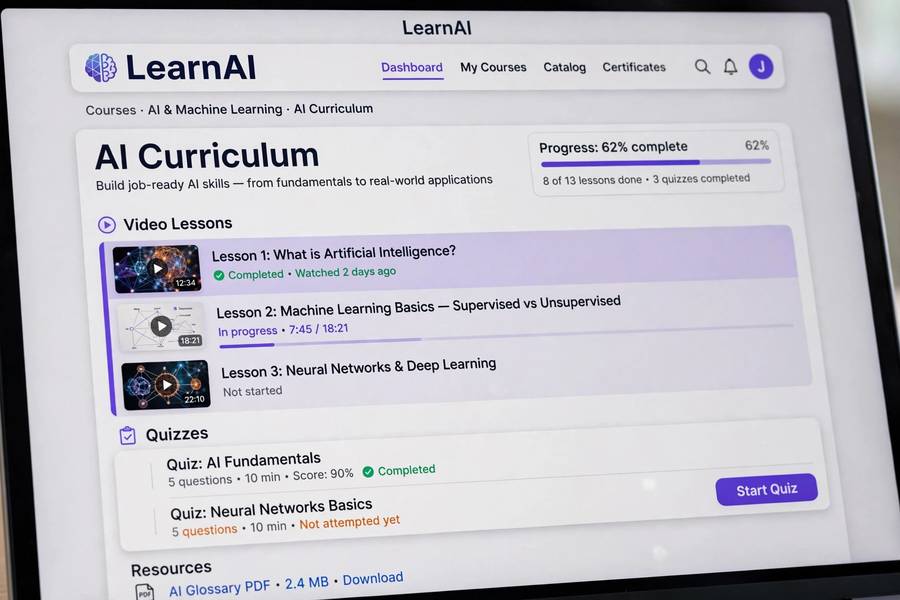
The Honest Truth About “Beginner” AI Courses
Most beginner AI courses fall into two traps. The first: they’re too shallow — a tour of buzzwords (machine learning! neural networks! ChatGPT!) that leaves you able to name concepts but not do anything. The second: they’re secretly not for beginners — “no prerequisites” followed by linear algebra in week two.
The good courses thread the needle: they assume no background but build real capability, usually through hands-on projects rather than lectures. They teach you to do things — use AI tools effectively, build simple applications, understand what’s happening under the hood at an intuitive level — instead of just teaching you vocabulary.
Here’s my filter: a good beginner course should leave you able to do something you couldn’t do before, not just know words you didn’t know before. If the syllabus is all nouns and no verbs, skip it.
First: What Do You Actually Want?
“Learn AI” isn’t a goal — it’s a direction. Pin down your actual goal first, because it determines everything:
Use AI tools better (at work or personally). You don’t need to learn machine learning — you need AI literacy: prompting, tool selection, workflow integration, understanding capabilities and limits. Shorter, practical courses. Weeks, not months.
Build AI applications. You want to make things with AI APIs and tools. Some coding helps enormously; the courses teach applied skills with real projects. This is the most popular path and the best-supported one.
Understand AI deeply (career change, technical foundation). The long road: math, programming, machine learning fundamentals, deep learning. Months of serious study. The payoff is real capability, not just familiarity.
Stay informed (manager, executive, curious citizen). You need conceptual understanding and strategic awareness, not technical skill. Different courses entirely — shorter, focused on implications.
Most people asking for “beginner AI courses” want path one or two but enroll in path three courses and drown. Match the course to your goal, not your ambition.
The Four Types of Beginner AI Courses
1. AI literacy / fundamentals. What AI is, how it works at a high level, what it’s good and bad at, how to use tools like ChatGPT effectively. No coding. Ideal first step for everyone — even future engineers benefit from the orientation. Usually 4–10 hours total.
2. Applied AI / building with APIs. Using AI services to build applications — chatbots, automation, content tools. Some Python. Project-based. This is where “I learned AI” starts feeling true, because you ship things. Usually 20–40 hours.
3. Machine learning foundations. The real technical base: how models learn, key algorithms, training and evaluation. Requires Python and some math comfort. This is the career-change path — substantial but genuinely transformative. Usually 2–6 months.
4. Specialized introductions. Beginner-friendly entries to subfields: prompt engineering, AI art, data science basics, AI for business. Narrower, faster, good for testing interest before committing deeper.
Start with type 1 regardless of your goal — it’s cheap, fast, and prevents expensive mistakes (like enrolling in a machine learning course when you wanted to learn prompting). Then branch based on what excited you.
What to Look for in Any Course
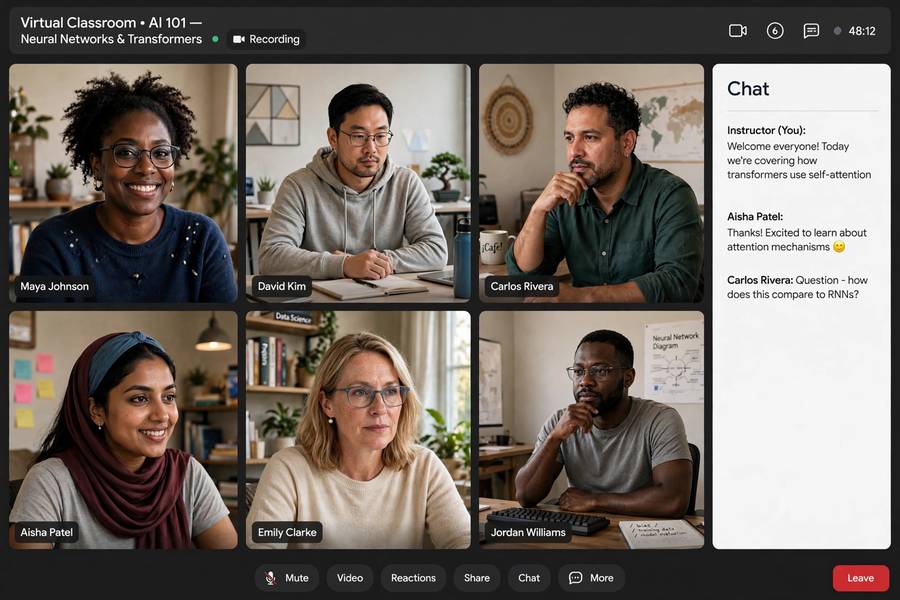
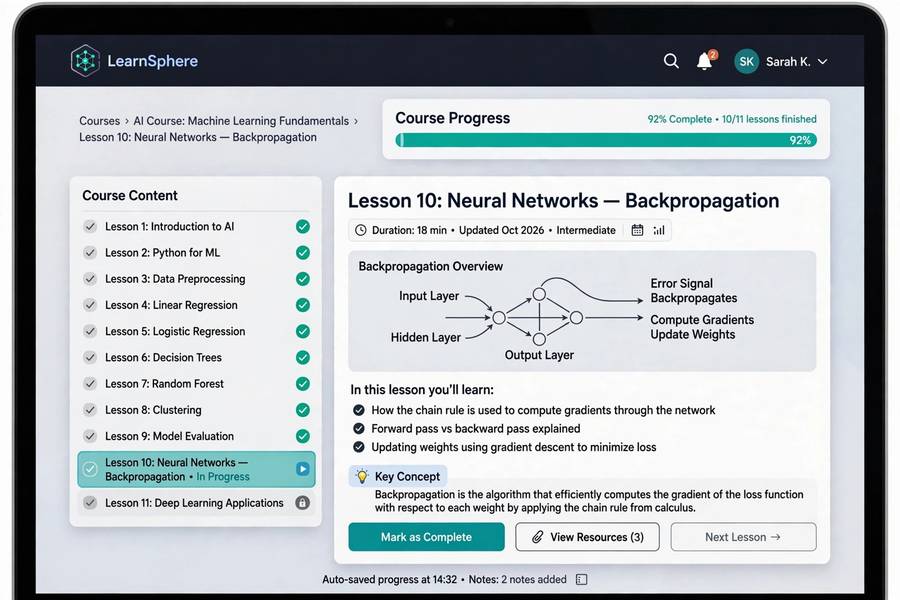
Hands-on projects. The single best quality signal. Courses where you build things beat courses where you watch things, decisively. Check the syllabus for project milestones, not just topic lists.
Recent content. AI moves fast — a 2022 course teaches a different world than a 2024+ one. Check update dates. Anything pre-ChatGPT-era (before late 2022) is historical document, not education, for applied topics.
Instructor credibility. Who teaches it? Practitioners with real experience beat professional course-creators. University affiliations help for foundations; industry experience helps for applied skills.
Reviews from completers. Not star ratings — written reviews from people who finished. “Changed how I work” beats “great instructor.” Look for outcomes, not vibes.
Right-sized scope. A course promising “everything about AI” in 6 hours is lying. Good courses have focused scopes and honest descriptions. Specificity is a virtue.
Community or support. Courses with active forums, Discord servers, or Q&A have dramatically higher completion rates. Learning alone is hard; learning with others is sticky.
Red Flags: Courses to Avoid
“Master AI in X weeks.” Mastery takes years. This is marketing, not pedagogy.
No syllabus preview. If they won’t show you what you’ll learn, they’re selling hope, not education.
Celebrity instructor, no substance. Famous name, vague curriculum, premium price. The content is usually repackaged basics.
100% tool-specific. A course that’s entirely “how to use [specific tool]” expires when the tool changes. Prefer courses teaching transferable concepts with tools as examples.
No free preview. Legitimate courses let you sample lessons. Refusing previews suggests the content doesn’t survive inspection.
Pressure tactics. Countdown timers, “only 3 seats left” for a digital course, aggressive upsells. Education doesn’t need dark patterns.
Free vs Paid: What’s Worth Money
The free tier of AI education is genuinely excellent now — university lectures, quality YouTube series, documentation, community tutorials. You can go far spending nothing.
Paid courses earn their price through: structure (a curated path beats self-directed wandering), projects with feedback (someone reviewing your work), credentials (certificates matter in some hiring contexts), and support (getting unstuck fast).
My rule: start free. If you complete free material and hit a wall that structure would solve — disorganization, no feedback, no credential for your goals — then pay. Paying before you’ve proven to yourself you’ll do the work is the most common waste in online education. The AI skills worth learning this year can guide what to prioritize once you’re ready to invest.
Don’t overlook best AI books for beginners either — a $30 book often delivers more depth per dollar than a $300 course, if you’re a reader.
A Sensible Learning Path
For the typical beginner wanting practical capability:
- AI literacy course (free, ~1 week). Understand the landscape.
- Prompting practice (free, ongoing). Use AI tools daily; skill comes from reps.
- One applied course with projects (~1 month). Build things with AI APIs.
- Specialize based on what excited you — or stop here with genuinely useful skills.
For the aspiring practitioner:
- Steps 1–2 above.
- Python if you don’t have it (~1–2 months).
- Machine learning foundations course (3–6 months). The real education.
- Specialize: NLP, vision, MLOps, research — pick a lane.
Both paths share the first steps. Don’t skip them — orientation prevents the most expensive mistake in learning, which is studying the wrong thing diligently.
How Long Does It Actually Take?
Honest timelines, assuming a few hours per week:
- AI literacy: 1–2 weeks to genuine understanding
- Practical tool proficiency: 1–2 months of regular use
- Building AI applications: 2–4 months from zero
- Machine learning foundations: 6–12 months of serious study
- Job-ready practitioner: 12–24 months (with projects and portfolio)
Anyone promising faster is selling something. But also: you don’t need the full journey. Enormous value lives in the early stages — most people’s goals are fully served by literacy plus applied skills, achievable in a few months of evenings.
The Mistakes Most Beginners Make
I’ve watched enough beginners start AI courses to see the same failure patterns repeat. Here are the ones that actually cost people months:
Course-hopping. Starting five courses, finishing none. The dopamine of “starting to learn AI” replaces actual learning. Pick one, finish it, then pick the next. Boring advice; it works.
Learning without doing. Watching 40 hours of video with zero practice. AI skill lives in your hands, not your eyes. If a week passes without you building or prompting something real, you’re consuming entertainment, not education.
Skipping the boring prerequisites. Jumping into machine learning before Python is comfortable. Every skipped foundation returns as confusion later, with interest.
Optimizing the choice instead of starting. Spending three weeks comparing courses instead of starting one. The difference between the 3rd-best and 8th-best beginner course is trivial; the difference between starting and not starting is everything.
Quitting at the first hard part. Every real course has a week where it stops being fun. That’s not a signal to switch courses — it’s the actual learning starting. Push through two hard weeks before judging.
Frequently Asked Questions
Start with an AI literacy course (no coding, 4–10 hours) to understand the landscape, then branch based on your goal: applied courses for building things, ML foundations for technical depth. Match the course to your actual goal, not your ambition.
Not for AI literacy or using AI tools — no coding needed. For building AI applications, basic Python helps enormously. For machine learning foundations and career change, Python is required. Start with your goal and add coding only if the path needs it.
Yes — the free tier of AI education is genuinely excellent. Paid courses earn their price through structure, feedback, credentials, and support. Start free; pay when you’ve proven you’ll do the work and hit a wall that structure would solve.
AI literacy takes 1–2 weeks; practical tool proficiency 1–2 months; building AI applications 2–4 months; machine learning foundations 6–12 months. Most people’s goals are served by the early stages — a few months of evenings.
Avoid “master AI in weeks” promises, courses with no syllabus preview or free sample, purely tool-specific content that expires, celebrity instructors with vague curricula, and pressure-tactic marketing. Look for hands-on projects, recent content, and completer reviews.