

The first time I heard the word “dissertation,” I was tutoring a high school senior, and she asked me if it was some kind of disease. Honestly? Given how stressed PhD students look when they say the word, I understood the confusion.
Here’s the thing nobody tells you: a doctoral dissertation sounds terrifying because academia loves making simple things sound complicated. But once you strip away the jargon, the idea behind it is pretty straightforward — and kind of beautiful, actually. A dissertation is a book-length piece of original research that says, “Here’s something the world didn’t know before, and here’s how I figured it out.”
If you’re a prospective PhD student trying to understand what you’re signing up for, a current grad student staring down the barrel of one, or just a curious reader — this guide is for you. No jargon, no intimidation. Just the real story.

Doctoral Dissertation: Definition in Plain English
A doctoral dissertation is a long, original research document that a PhD candidate writes to earn their doctorate. It’s the final and biggest requirement of most doctoral programs.
Let’s break that down, because every word in that sentence matters:
- Long: We’re talking book-length — typically anywhere from around a hundred pages to several hundred, depending on the field.
- Original research: This is the key part. A dissertation isn’t a book report. You can’t just summarize what other people found. You have to contribute something new — a discovery, a new method, a new way of understanding something.
- Final requirement: In most PhD programs, you take classes, pass exams, do research — and then the dissertation is the capstone. Finish it, defend it, and you earn the title “Doctor.”
Think of it this way: a dissertation is how the academic world makes sure that before someone gets to call themselves an expert, they’ve actually pushed the boundaries of what we know, even just a little. Your contribution doesn’t have to change the world. It just has to be genuinely yours and genuinely new.
I always tell students: the dissertation is less like a test and more like an apprenticeship’s final project. You’re proving you can do independent research at the highest level.
Dissertation vs Thesis: What’s the Difference?
This is the question I got asked most when I tutored college students, and the answer is annoying: it depends on where you are.
In the US: a thesis is the shorter research document you write for a master’s degree, and a dissertation is the longer, more original research document you write for a doctorate. The dissertation is bigger in every way — longer, deeper, and held to a higher standard of originality.
In the UK and much of Europe, it’s reversed: the PhD document is called a thesis, and “dissertation” usually refers to the shorter master’s-level project.
So if you’re reading advice online and something sounds off, check where the writer is based. That one detail clears up about half the confusion on this topic.
Why PhD Students Write One
Fair question — why does the system demand this enormous document? There are a few real reasons, and they’re actually good ones.
It proves you can do independent research. Coursework shows you can learn what others discovered. The dissertation shows you can discover something yourself. That’s the whole point of a PhD: training you to create knowledge, not just consume it.
It contributes to your field. Every dissertation adds a small brick to the wall of human knowledge. Most bricks are small. Some turn out to be load-bearing. You don’t know which yours will be until later.
It’s a professional credential. When you apply for academic jobs, research positions, or even some industry roles, people will look at your dissertation. It’s your calling card — proof of what you can do.
It teaches you to finish something enormous. Honestly, this might be the most valuable part. Learning to plan, execute, and complete a multi-year project is a skill that serves you in any career, academic or not.
I’ll be straight with you: the process is grueling. But every PhD holder I’ve ever talked to says the same thing — the person who finishes the dissertation is not the same person who started it. You come out tougher, sharper, and more capable.
The Standard Dissertation Structure
Here’s some good news: dissertations follow a pretty standard recipe. Once you know the structure, the whole thing feels much less mysterious. Most dissertations in most fields follow a five-chapter format (the exact names vary, but the skeleton is the same).

Chapter 1: Introduction
This is where you set the stage. You explain what problem you’re tackling, why it matters, and what your research aims to do about it. Think of it as the “here’s why you should care” chapter. It usually ends with your research questions — the specific questions your whole dissertation will try to answer.
Chapter 2: Literature Review
This is the “what’s already known” chapter, and it’s usually the longest one to write. You survey everything that’s been published on your topic — the major studies, the debates, the gaps. And here’s the trick: you’re not just summarizing. You’re building a case that there’s a hole in the existing knowledge — a hole your research is going to fill.
When I tutored students on research papers, I told them the literature review is like showing the judges you’ve read the whole playbook before calling your own play. It takes the most time, and it’s where most students get stuck. That’s normal.

Chapter 3: Methodology
This chapter explains exactly how you did your research. What methods did you use? Who or what did you study? How did you collect and analyze your data? It needs to be detailed enough that another researcher could repeat your study. In the sciences, this is very technical. In the humanities, it might describe your approach to texts or archives. Either way: no shortcuts here. Your methodology is what makes your findings trustworthy.
Chapters 4–5: Results and Conclusion
Chapter 4 presents what you found — the data, the analysis, the results, usually without much commentary. Just the facts. Chapter 5 is where you get to talk: what do the results mean? How do they answer your research questions? What are the limitations? What should future researchers look at next?
Some programs split these differently or add chapters, especially in the humanities where the structure can be more flexible. But this five-chapter skeleton is the default in most US doctoral programs, and knowing it exists takes a lot of the fear out of the process.
How Long Is a Dissertation?
The honest answer: it varies a lot by field. There’s no single official page count, and anyone who gives you one number is oversimplifying.
That said, here are realistic ballparks I hear from actual PhD students and faculty:
- STEM fields (science, math, engineering): Often on the shorter side — sometimes around 100 to 200 pages. The research is dense, but the writing is concise. Figures and data do a lot of the talking.
- Social sciences: Usually in the middle — roughly 150 to 300 pages. There’s more theory to explain and more literature to engage with.
- Humanities (history, literature, philosophy): The longest — it’s not unusual to see 250 pages and up. When your “data” is texts and ideas, you need more words to make your case.
Word counts follow the same pattern: a STEM dissertation might run 30,000 to 50,000 words, while a humanities dissertation can push past 80,000.
But here’s what I want you to hear: length is not the goal. A tight, original 120-page dissertation beats a bloated 300-page one every time. Your committee cares about the quality of your contribution, not the weight of the paper. Don’t pad. Ever.
How Long Does It Take to Write One?
Another “it depends,” but let me give you the real picture instead of the brochure version.
Most PhD students spend somewhere between one and three years on the dissertation itself — that’s after finishing coursework and exams. The full PhD journey (classes plus dissertation) typically runs four to seven years in the US, though some fields run longer.
Why does the writing take so long? Because “writing” is only part of it. You’re also:
- Reading hundreds of sources for the literature review
- Collecting data, running experiments, or doing fieldwork
- Analyzing results and realizing you need more data
- Revising — then revising again after your advisor’s feedback
- Formatting everything to your university’s exact specifications
The students who finish fastest tend to share a few habits: they write a little every day instead of waiting for inspiration, they meet with their advisor regularly instead of disappearing for months, and they protect their health. A dissertation is a marathon, and marathoners don’t skip rest. Keeping an exercise routine you can actually stick to and guarding your sleep will do more for your writing than any productivity hack.
My tutor-brain advice: if you’re starting a PhD, ask current students in your specific program how long dissertations usually take there. Program culture matters more than national averages.
The Dissertation Defense, Explained
After you finish writing, there’s one last hurdle: the defense. I know the name sounds like a trial, and honestly, it kind of looks like one — but it’s friendlier than it sounds.
Here’s how it usually works:
- You submit the finished dissertation to your committee — typically three to five faculty members, including your advisor.
- They read it (in theory, thoroughly) and prepare questions.
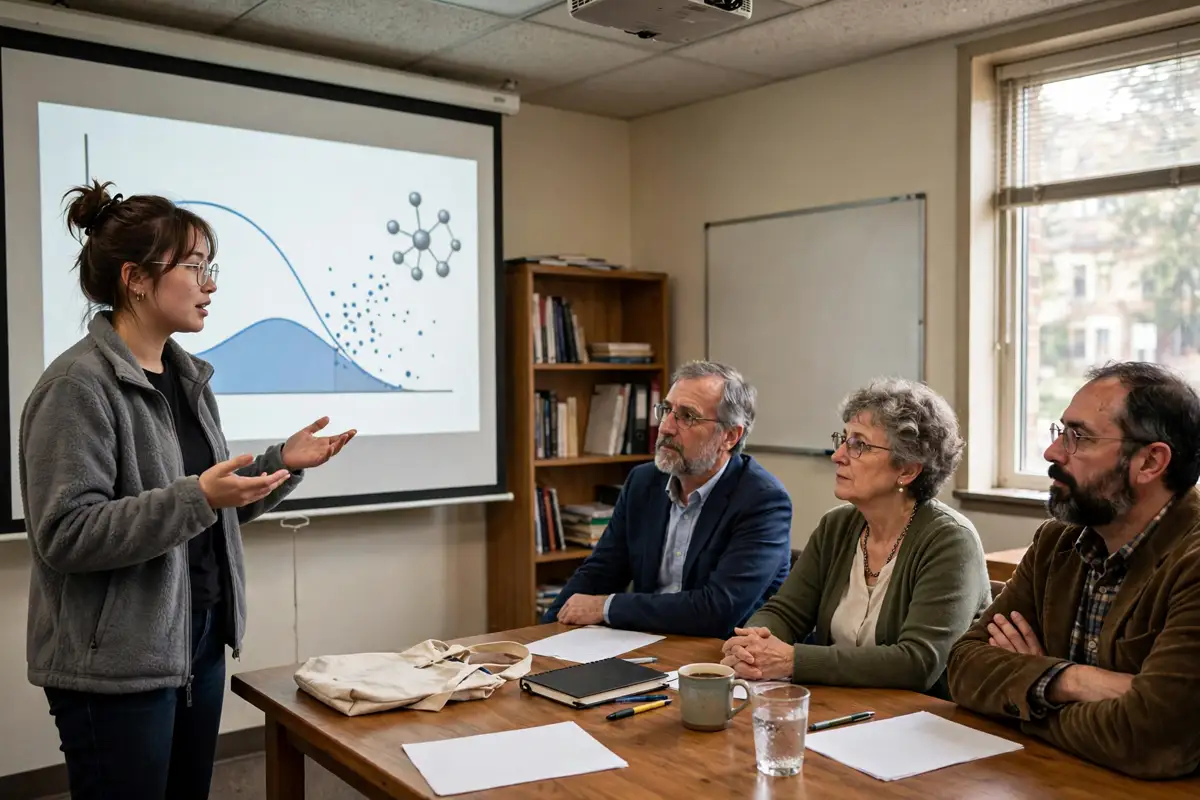
- You present your research — usually a 30- to 60-minute talk summarizing what you did and what you found.
- They question you — about your methods, your conclusions, the gaps, the implications. This can last one to three hours.
- You step out of the room while they deliberate.
- They call you back in with the verdict: pass, pass with revisions (the most common outcome), or — rarely — fail.
Most defenses end with “pass with revisions,” which means you passed, but you need to make some changes before the degree is official. The revisions can take anywhere from a few weeks to a few months.
Is it scary? Yes. Every PhD student is nervous. But here’s the secret: by the time you defend, you know more about your tiny corner of the topic than anyone else in that room. You’re the expert. The committee is there to make sure the work holds up, not to tear you down. Walk in prepared, and you’ll walk out a doctor.
If the idea of a dissertation still feels overwhelming, that’s okay — it should feel big. It’s supposed to be the hardest academic thing you’ve ever done. But it’s also just a series of steps: a question, some reading, some research, some writing, and one long meeting. Thousands of people finish one every year. With the right support and a steady pace, there’s no reason you can’t be one of them. For more education guides, keep exploring — learning shouldn’t feel like a punishment, and understanding the road ahead is the first step to walking it well.
A doctoral dissertation is a book-length document of original research that a PhD student writes to earn their doctorate. It’s proof that you can discover something new — not just learn what others already found — and it’s usually the final requirement of a PhD program.
In the US, a thesis is the shorter research document written for a master’s degree, while a dissertation is the longer, more original document written for a doctorate. In the UK and Europe, the terms are flipped: the PhD document is called a thesis. Always check where the writer is based.
It varies by field. STEM dissertations are often around 100 to 200 pages, social sciences roughly 150 to 300 pages, and humanities dissertations are frequently 250 pages or more. Length isn’t the goal — a tight, original shorter dissertation beats a padded long one.
Most US doctoral dissertations follow a five-chapter structure: Introduction, Literature Review, Methodology, Results, and Conclusion. Some fields and programs vary the names or add chapters, especially in the humanities.
Nearly all traditional research PhD programs require one — it’s the defining feature of the degree. Some professional doctorates use a capstone project or applied research portfolio instead, but for a standard PhD, the dissertation is mandatory.
Outright failure is rare. The most common outcome is “pass with revisions,” meaning you passed but must make changes before the degree is official. Committees generally won’t let you defend until they’re confident you’ll pass, so a well-prepared candidate almost always succeeds.