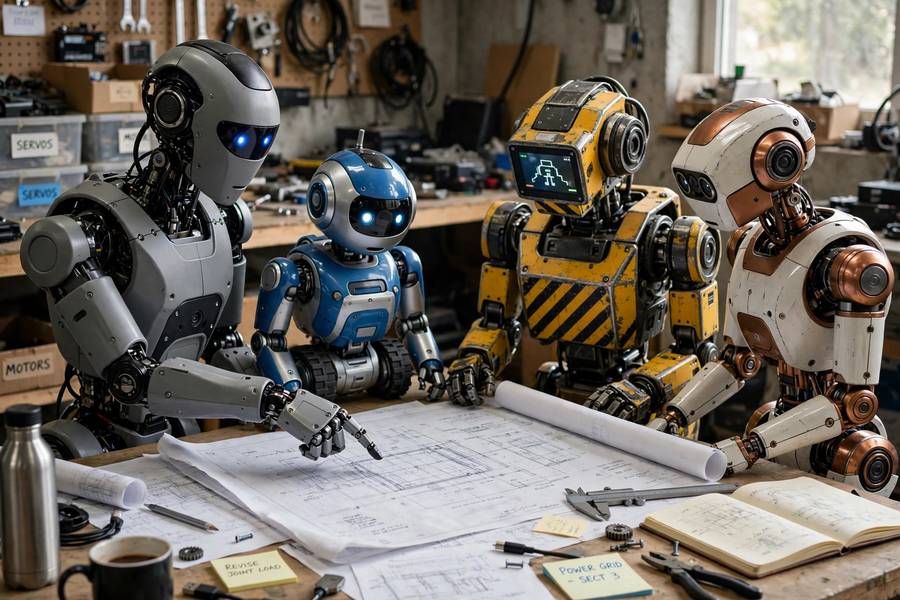
There’s a seductive idea floating around AI circles: that one superintelligent agent will do everything. I find the opposite idea more interesting — and more true to how the world actually works. Human civilization isn’t one genius doing everything; it’s millions of specialists coordinating. Multi-agent collaboration applies that insight to AI: instead of building one agent to rule them all, build several agents that are good at different things and let them work together.
Multi-agent collaboration is the practice of having multiple AI agents — each with its own role, capabilities, or perspective — cooperate on tasks too complex or varied for any single agent. This guide covers why it works, the collaboration patterns that matter, and the failure modes nobody warns you about. For the single-agent foundations, see my explainer on how AI agents work.
Table of Contents
- Why Multiple Agents Beat One
- Pattern 1: Divide and Conquer
- Pattern 2: Debate and Critique
- Pattern 3: Sequential Handoffs
- Pattern 4: Shared Workspace
- Communication: How Agents Talk to Each Other
- The Coordination Tax
- Failure Modes of Collaboration
- When Single Agent Wins
- Frequently Asked Questions

Why Multiple Agents Beat One
The case for multi-agent systems rests on three arguments:
Specialization. One prompt doing five jobs does them badly; five focused agents perform better — narrower context, clearer objectives, sharper behavior. Same reason human organizations have roles.
Perspective diversity. A critic catches flaws the generator is blind to — its prompt frames the task as finding flaws, not creating. Multi-agent debate research shows groups converging on better answers, because errors surviving one perspective get caught by another.
Parallelism. Independent subtasks run simultaneously. Three researchers covering three angles finish in roughly the time one would take. For time-sensitive work, this is a straightforward win.
But each benefit has a cost: specialization adds handoff friction, perspective diversity adds communication overhead, parallelism multiplies token spend. Multi-agent collaboration is powerful but never free — the rest of this article is about spending that budget wisely.
Pattern 1: Divide and Conquer
The most intuitive collaboration pattern: split the task, assign pieces, combine results. Researching a market? One agent covers competitors, another covers pricing, a third covers customer sentiment — then a synthesizer merges their findings.
This works when subtasks are genuinely independent. If the pricing agent’s findings should reshape the competitor analysis, you don’t have independent subtasks — forcing independence where it doesn’t exist produces three shallow reports instead of one deep one.
The synthesis step is where divide-and-conquer succeeds or fails: combining parallel outputs means resolving contradictions, weighting evidence, building a coherent narrative. Give the synthesizer a strong model and a clear mandate.
Practical rule: if you wouldn’t split it for a human team — because the pieces interleave too tightly — don’t split it for agents either.
Pattern 2: Debate and Critique
Agents argue: a generator produces an answer; a critic attacks it; the generator defends or revises; sometimes a judge adjudicates. Multiple rounds, adversarial energy, better outcomes.
Why debate works: models are better at generating plausible text than noticing their own errors. A separate agent with an adversarial prompt (“find every flaw in this argument”) is dramatically more effective — the critic isn’t invested in the answer, so it doesn’t rationalize. Same reason peer review works: the author can’t see what the reviewer sees.
Multi-agent debate demonstrably improves factuality and reduces hallucinations — error-correction through adversarial review, the oldest quality-control trick in human institutions.
But debate has failure modes: agents can converge on confident wrongness, debates can oscillate, and there’s the appearance of rigor — if both agents share the same blind spots, the debate is theater. Mitigate with diverse models or external verification.
Pattern 3: Sequential Handoffs
The assembly line: researcher hands findings to writer, writer hands draft to editor, editor hands final to publisher. Each agent transforms the work and passes it downstream. This is the crew-style pattern — see AI agent examples in real life — and it’s the most deployed multi-agent pattern in production, because it’s the most predictable.
Handoffs work when each stage’s output is well-defined. Ambiguous handoff formats produce friction — the writer wastes effort reformatting or misinterprets. Define the handoff schema (even informally: “the brief must contain claim, source, and confidence for each fact”) and half your collaboration problems disappear.
The structural weakness is error propagation: a flawed brief produces a flawed draft, and the editor polishes flaws rather than fixing them. Defenses: quality gates between stages, and occasional skip-level checks.
Tempo matters too: sequential means slow — total time is the sum of stages. Make each handoff earn its place.

Pattern 4: Shared Workspace
Instead of passing messages, agents collaborate around shared state — a blackboard they all read and write. One agent posts findings, another annotates them, a third organizes them into a structure, all working from the same evolving document.
This pattern shines for open-ended synthesis — market analysis, literature reviews, complex planning — where insights emerge from the interaction of pieces rather than a pipeline. Agents build on each other’s partial contributions fluidly.
The challenge is coordination without a conductor: successful systems define protocols — section ownership, status markers (draft / under review / final), edit rules. Same governance as any collaborative document, spelled out more explicitly.
Technically, this pattern maps well to graph-based frameworks where state is first-class — my explainer on how AI agents work covers the machinery. Think relay race (handoffs) versus barn raising (shared workspace).
Communication: How Agents Talk to Each Other
However agents collaborate, they must communicate. Three approaches dominate:
Natural language messages. Agents talk in prose — the conversational model compared in AI agent vs AI assistant. Flexible, legible, and expensive — every message consumes context in every recipient. Best when the collaboration needs nuance and the transcript itself is valuable (auditing, human oversight).
Structured handoffs. Agents exchange defined data — JSON briefs, scored evaluations, flagged issues. Efficient, parseable, and less flexible. Best when the collaboration shape is known and you want machine-checkable contracts between stages.
Shared state. Agents read and write common memory rather than messaging. Efficient for many-to-many collaboration, but requires the governance I described above.
Start with the most structured communication your task allows, and loosen only where structure chafes. Structure makes collaboration testable.
Communication topology matters too: fully connected is simplest and costliest, hub-and-spoke cheaper but bottlenecked, pipeline cheapest but most brittle. Match topology to pattern — debate wants full connectivity, handoffs want pipeline.
The Coordination Tax
The costs, quantified honestly:
Token costs scale superlinearly. Each agent needs context — instructions, shared history, others’ outputs. A five-agent collaboration often costs more than five times a single agent, because context is duplicated. Measure per-collaboration cost early.
Latency accumulates. Sequential patterns sum latencies; even parallel ones wait for the slowest participant. If responsiveness matters, parallelism and streaming help — but there’s no free lunch.
Non-determinism compounds. Each agent is stochastic; collaborations are more stochastic than any part. Test distributions and properties, not exact behaviors — reliability engineering for multi-agent systems is genuinely difficult.
Debugging is social. When a collaboration fails, diagnosing “who dropped the ball” means reading transcripts like a manager, not an engineer — slower than debugging single-agent traces.
None of this is fatal — multi-agent collaboration must earn its complexity. For many tasks it does; for many others, a well-designed single agent is the better choice.
Failure Modes of Collaboration
The specific ways collaborations break:
Sycophancy cascades. Agents agree excessively — the critic praises instead of critiquing. Common when agents share an RLHF-tuned base model. Fix: adversarial prompts with teeth, and different models for generator and critic.
Responsibility diffusion. No agent feels responsible for final quality — each assumes another will catch problems. Fix: name an owner whose prompt explicitly owns final quality.
Conversation drift. In conversational collaborations, the topic wanders. Fix: aggressive termination conditions, a coordinator that refocuses, and prompts that define done crisply.
Context overload. As collaboration proceeds, shared context grows until agents can’t attend to what matters. Fix: summarization checkpoints, structured state instead of raw transcripts, and scoping each agent’s view to what it needs.
Tool conflicts. Two agents writing to the same system step on each other. Fix: ownership, locking (even informal “claim before acting”), idempotent operations.
When Single Agent Wins
The counter-case — single agents win when:
The task fits in one head. If the whole problem fits comfortably in one agent’s working memory, splitting adds coordination tax for no benefit. Many tasks that feel complex are just long, not wide.
Latency is critical. Every additional agent is additional round trips. Real-time applications often can’t afford collaboration’s tempo.
The quality bar is moderate. Collaboration’s quality gains matter most at the high end — catching subtle errors, synthesizing deeply. For “good enough” outputs, a single agent is cheaper and faster.
You’re still learning the problem. Start single, split when you can name exactly what each agent adds.
Default to the simplest architecture that meets the quality bar, and let measured failures drive you toward multi-agent designs. The best multi-agent systems were extracted from working single-agent ones, not designed upfront.

Frequently Asked Questions
Multi-agent collaboration is the practice of having multiple AI agents — each with distinct roles, capabilities, or perspectives — work together on complex tasks. Agents coordinate through patterns like divide-and-conquer, debate, sequential handoffs, or shared workspaces.
Multiple agents enable specialization (focused prompts perform better), perspective diversity (critics catch what generators miss), and parallelism (independent subtasks run simultaneously). The tradeoff is a coordination tax: higher token costs, more latency, and harder debugging.
Multi-agent debate has agents argue: a generator produces an answer, a critic attacks it, the generator revises, sometimes with a judge. It improves factuality and reasoning through adversarial error-correction — though agents sharing a base model can converge on shared blind spots.
Through natural language messages (flexible but costly), structured handoffs like JSON briefs (efficient and testable), or shared state workspaces (good for many-to-many collaboration). Start with the most structured option your task allows.
When the task fits in one agent’s working memory, when latency is critical, when the quality bar is moderate, or when you’re still learning the problem. Default to the simplest architecture that meets the quality bar; let measured failures drive you toward multi-agent designs.