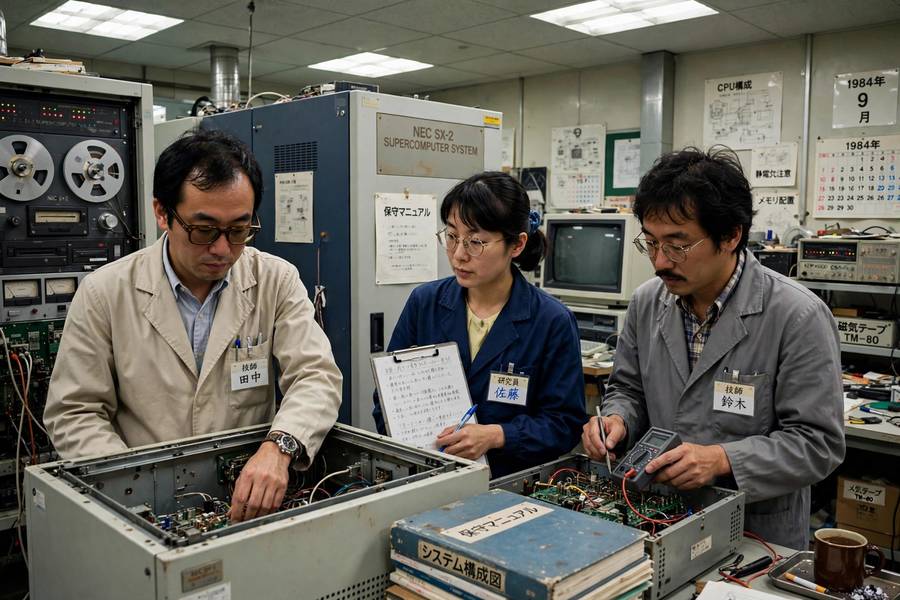
In 1982, Japan announced one of the most ambitious technology projects in history: a ten-year, government-funded mission to leapfrog the world in computing by building “fifth generation” computers — machines designed from the ground up for artificial intelligence. The West panicked. America and Britain launched crash programs in response. And then, a decade later, the project quietly ended having achieved almost none of its goals.
The Fifth Generation Computer Project is AI’s great “what if” — a moonshot that missed. But calling it a simple failure misses the point. It failed for fascinating reasons, and its failure shaped AI policy worldwide for decades. For the broader context, see my history of artificial intelligence.
In This Guide
- The Five Generations: What “Fifth” Meant
- 1982: Japan Announces Its Moonshot
- The Vision: Logic Programming for Everything
- Why the West Panicked
- What the Project Actually Built
- Why It Failed
- The Unintended Consequences
- Lessons for Today’s AI Race
- Frequently Asked Questions
The Five Generations: What “Fifth” Meant
The project’s name came from a generational taxonomy of computing:
- First generation — vacuum tubes (1940s–50s)
- Second generation — transistors (1950s–60s)
- Third generation — integrated circuits (1960s–70s)
- Fourth generation — microprocessors (1970s–present)
- Fifth generation — ???
The first four generations were defined by hardware. The fifth would be defined by purpose: machines built for knowledge processing and AI. Instead of number-crunching, fifth-generation computers would reason — manipulating symbols, proving theorems, understanding language, and running expert systems at massive scale.
It was a bold reframing: the next leap wouldn’t be faster chips but a fundamentally different kind of computing.
1982: Japan Announces Its Moonshot
The project was launched by MITI (Japan’s Ministry of International Trade and Industry) with an initial budget of around ¥50 billion (roughly $400 million at the time, more in today’s money). A new institute, ICOT (Institute for New Generation Computer Technology), was created to coordinate research across Japanese companies and universities.
The timing was deliberate. Japan had conquered consumer electronics, automobiles, and semiconductors. Computing was the next summit, and the Americans owned it. Rather than competing on America’s terms (faster conventional computers), Japan would define the next paradigm and own it from the start.
The announcement included startlingly specific goals: by 1992, machines performing 100 million to 1 billion logical inferences per second, with natural language interfaces, expert-system capabilities, and parallel architectures. It read like science fiction with a government budget.
The Vision: Logic Programming for Everything
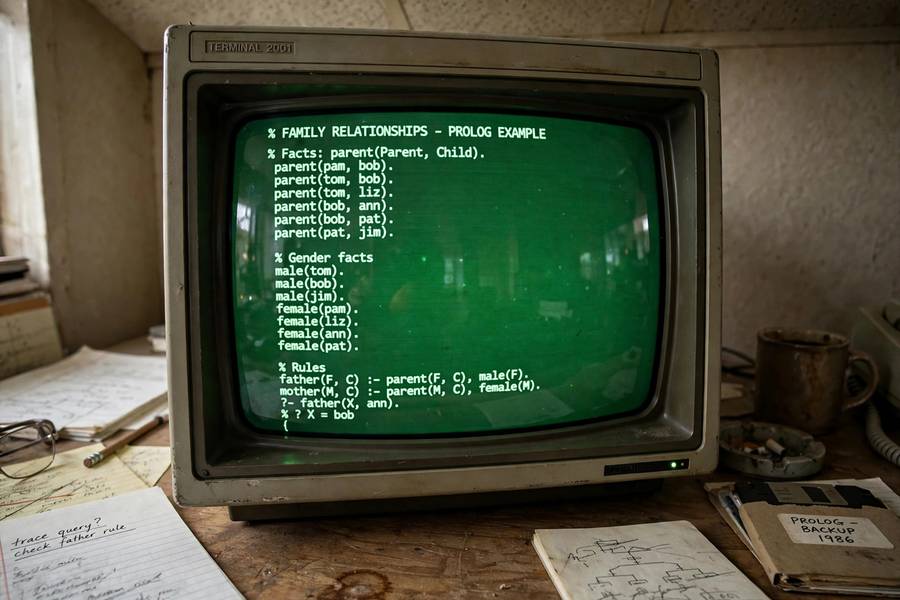
The project’s technical bet was logic programming — particularly Prolog, a language where you declare facts and rules and the system derives conclusions. The visionaries, led by Kazuhiro Fuchi, believed:
- Human knowledge could be encoded as logical statements
- Inference (deriving conclusions from premises) was the core operation of intelligence
- Massively parallel hardware could perform logical inferences at unprecedented speed
- Therefore: parallel logic machines = artificial intelligence
This was the expert-systems philosophy scaled to national ambition. If intelligence is reasoning, and reasoning is logic, then building a giant parallel logic engine gets you to AI. The project aimed to make Prolog the machine language of the future — as fundamental as binary arithmetic was to previous generations.
In retrospect, the bet had a fatal flaw: it assumed the symbolic AI paradigm was correct. The future belonged to learning from data, not hand-coded logic — the approach behind today’s large language models, which learn patterns rather than following logical rules.
Why the West Panicked
The announcement triggered genuine alarm:
In the United States, it was seen as another Japanese industrial challenge — following the shocks in automobiles, steel, and semiconductors. The response included the creation of the Microelectronics and Computer Technology Corporation (MCC) in 1982 — America’s first major computer research consortium — and increased DARPA funding for AI, including the Strategic Computing Initiative (1983), a billion-dollar program partly motivated by the Japanese challenge.
In Britain, the Fifth Generation announcement helped reverse the post-Lighthill hostility to AI. The Alvey Programme (1983) committed £350 million to advanced computing research, explicitly framed as a response to Japan.
The irony: the West mobilized massively against a threat that never materialized. But the mobilization itself funded a generation of AI research. Japan’s project failed, yet succeeded in scaring its competitors into investing — arguably its most significant achievement.

What the Project Actually Built
Ten years and hundreds of millions of dollars produced real, if unglamorous, results:
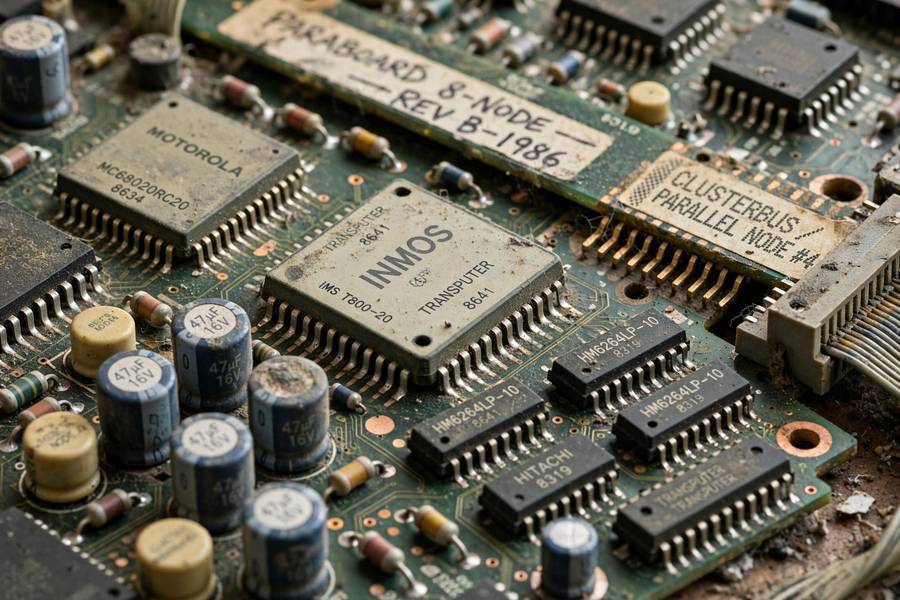
- Parallel inference machines — the PIM series, genuinely innovative parallel architectures for logic programming
- KL1 and Concurrent Prolog — advanced parallel logic programming languages
- Large-scale knowledge bases — including an experimental legal reasoning system
- Hundreds of trained researchers and a substantial body of published work on parallel computing and logic programming
What it did not produce: the intelligent machines it promised. No natural-language breakthroughs, no expert systems revolution, no commercial fifth-generation computers. By the early 1990s, the computing world had moved to workstations, PCs, and eventually the internet — none of which needed parallel Prolog machines.
Why It Failed
The failure had multiple layers:
Wrong paradigm. The deepest cause: symbolic logic programming wasn’t the path to AI. The project bet everything on one approach just as the field was discovering that learning from data worked better. A moonshot aimed at the wrong moon.
Top-down rigidity. The ten-year plan was set in 1982 and couldn’t adapt when the field shifted. By the late 1980s, neural networks were reviving and workstations were transforming computing — but ICOT was locked into its original vision. Central planning is bad at pivoting.
The hardware bet lost. Custom parallel Prolog machines were overtaken by general-purpose workstations and microprocessors, which got faster and cheaper through sheer market scale. Specialized hardware couldn’t compete with commodity hardware riding Moore’s law — a lesson that echoes in today’s AI chip debates.
Knowledge acquisition, again. Like all expert-system-era efforts, the project hit the wall of encoding human knowledge as rules. The legal reasoning demo was impressive but didn’t scale — the same bottleneck that doomed expert systems generally.
Commercial irrelevance. Japanese companies participated politely but never committed commercially. The project produced research, not products. When the money ran out in 1992, there was no industry to continue the work.
The Unintended Consequences
Here’s the twist: the project’s failures were productive.
- It forced the US and UK to fund AI research through the 1980s, sustaining the field through what could have been a deeper winter
- Parallel computing research from ICOT influenced later architectures
- Logic programming found lasting niches (it still powers some industrial systems)
- Most importantly, it became the canonical case study in how not to run national technology programs — cited in every subsequent debate about government AI investment
There’s a pattern in technology history: ambitious failures often contribute more than modest successes. The Fifth Generation Project’s real legacy isn’t in what it built but in what it taught.
Lessons for Today’s AI Race
The parallels to today’s national AI programs are hard to miss:
Don’t bet the nation on one paradigm. The project assumed symbolic AI was the answer. Today’s programs risk the same error if they assume current deep learning paradigms are final. The history of AI is the history of paradigms being overturned.
Build for adaptability, not ten-year plans. Technology moves faster than bureaucracy. Programs that can pivot survive; rigid ones become museums.
Beware the announcement effect. Japan’s announcement was partly theater — and it worked, terrifying competitors into action. Today’s AI announcements deserve the same skeptical reading: what is this for?
Commercial grounding matters. Research without a path to products dies when funding ends. The most durable AI advances have been those industry wanted to continue.
Japan’s Fifth Generation Project aimed at the stars and hit a very educational patch of empty sky. A decade, a fortune, and some of the best minds of a generation — spent proving that intelligence wouldn’t come from logic engines. We know that now because they tried. Sometimes the most valuable experiments are the ones that fail clearly.
Frequently Asked Questions
A 1982-1992 Japanese government initiative (run by ICOT under MITI) to build a new generation of computers designed for artificial intelligence, based on parallel logic programming. It aimed for machines performing up to a billion logical inferences per second.
It bet on symbolic logic programming just as data-driven machine learning was proving more effective; its rigid ten-year plan couldn’t adapt; custom hardware lost to commodity workstations; and encoding human knowledge as logical rules hit the same bottleneck that doomed expert systems.
First: vacuum tubes; second: transistors; third: integrated circuits; fourth: microprocessors. The “fifth generation” was Japan’s proposed next leap — computers architected for AI and knowledge processing rather than just faster calculation. The term never caught on commercially.
The US created the MCC research consortium and launched DARPA’s billion-dollar Strategic Computing Initiative; Britain launched the £350 million Alvey Programme. Ironically, fear of Japan’s project funded Western AI research through the 1980s — its most lasting impact.
Yes — advances in parallel computing architectures, parallel logic programming languages, and a generation of trained researchers. But it produced none of its headline goals: no AI breakthrough machines, no commercial fifth-generation computers, no natural language revolution.