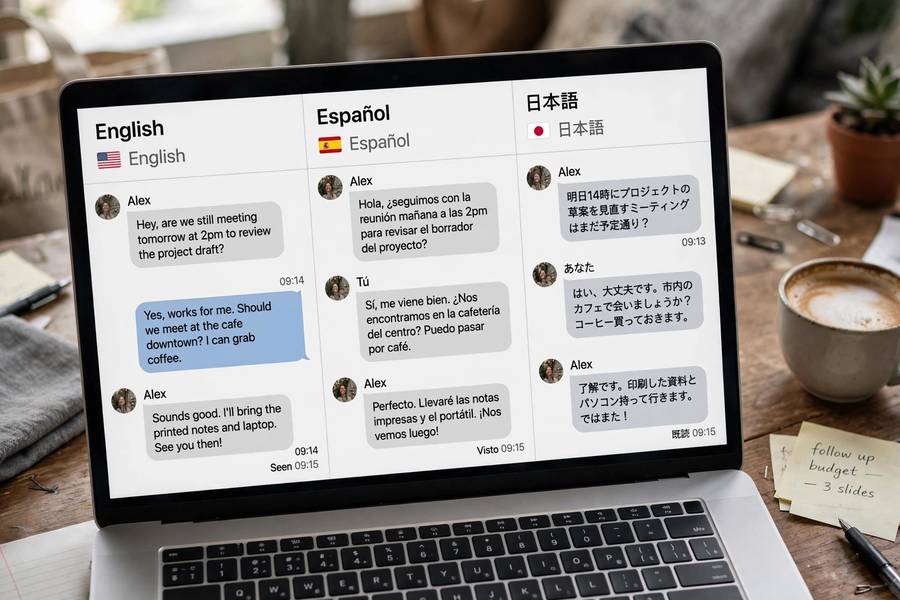
Ask ChatGPT a question in Spanish, Urdu, or Japanese, and it answers — fluently, in the same language. It can translate, explain idioms, even write poetry in dozens of tongues. But the quality isn’t equal across languages, and the reasons reveal fascinating things about how these models actually work.
ChatGPT wasn’t “taught” languages the way you were — no grammar lessons, no vocabulary lists. Its multilingual ability emerged from training data patterns, and that origin story explains both its surprising breadth and its uneven depth. For the general mechanics, see my guide on how does ChatGPT work.
In This Guide
- The Short Answer: One Model, Many Languages
- How Training Creates Multilingual Ability
- Why English Dominates
- The Tokenization Problem
- Cross-Lingual Transfer: The Surprising Part
- Where Multilingual Quality Breaks Down
- Translation: How Good Is It Really?
- Tips for Non-English Use
- Frequently Asked Questions

The Short Answer: One Model, Many Languages
ChatGPT is a single multilingual model, not a collection of language-specific models. The same neural network handles English, Spanish, Mandarin, Arabic, and dozens more — switching languages based on your input, with no mode change.
This works because the model learned statistical patterns across all languages mixed together in training. It doesn’t have an “English module” and a “French module” — it has shared representations where concepts learned in one language partially transfer to others.
How many languages? Dozens work well, over a hundred work at least basically. But “works” covers a wide range — from near-native fluency to barely-functional. The distribution is brutally uneven, and English sits alone at the top.
How Training Creates Multilingual Ability
Nobody sat ChatGPT down with language textbooks. Here’s what actually happened:
The training data was multilingual. The web-scale text used for training contains massive English, substantial Spanish/French/German/Chinese/Japanese, moderate amounts of dozens more languages, and trace amounts of hundreds. The model absorbed all of it simultaneously.
No language labels. Crucially, the model wasn’t told “this is Spanish” — it just saw patterns. It learned to continue Spanish text in Spanish and English text in English because that’s what the data did. Language identification emerged implicitly.
Shared representations. Because concepts appear across languages (“water,” “agua,” “水” in similar contexts), the model developed overlapping internal representations. The concept of water-ness lives in shared parameter space, accessible from any of its linguistic labels.
The result: a model that “thinks” (if we can use the word loosely) in a language-agnostic conceptual space and renders output in whatever language the context demands. It’s why ChatGPT can take an idea expressed in English and express it in Urdu — the idea and the language are partially disentangled internally.
For the architectural basis, my explainer on what a large language model is covers how these representations form.
Why English Dominates
The uncomfortable truth: ChatGPT is an English-first model that happens to know other languages, not a truly balanced polyglot. The reasons are all about data:
- Volume: English dominates web text, books, and code by an enormous margin. Estimates suggest the majority of training tokens are English.
- Quality: English web content includes more of the high-quality text (books, papers, documentation) that builds capability.
- Feedback: RLHF (reinforcement learning from human feedback) was done overwhelmingly in English, tuning the model’s behavior, helpfulness, and safety primarily for English interactions.
- Evaluation: benchmarks and testing focus on English, so improvements target English performance.
The practical gap: for complex reasoning, nuanced writing, or technical accuracy, English output is noticeably better than other languages. The model literally reasons better in English — a finding confirmed by multiple studies. This isn’t a small effect; for hard tasks it can be dramatic.
What this means for you: if you’re comfortable in English, you’ll get better results using English even when your target output is another language (ask in English, request output in your language). It’s an odd workflow, but it works.
The Tokenization Problem
Here’s a technical quirk with real consequences: the tokenizer was optimized for English.
Tokens are the chunks the model processes. In English, a token averages ~4 characters — efficient. But:
- In many languages, the same text requires 2–10x more tokens — costing more, filling context windows faster, and slowing responses
- Some scripts (certain Asian languages, emojis, rare scripts) tokenize character-by-character or worse
- Agglutinative languages (Turkish, Finnish) and languages without spaces (Chinese, Japanese, Thai) tokenize less efficiently
Why it matters beyond cost: the model literally sees these languages differently — fragmented into awkward chunks rather than natural units. This degrades performance in ways that have nothing to do with training data. It’s an architectural bias toward English-shaped text.
The fix (ongoing): newer tokenizers are more multilingual-aware, and the gap is narrowing. But it remains a structural disadvantage for non-English languages.

Cross-Lingual Transfer: The Surprising Part
The most fascinating finding in multilingual AI: capabilities learned in one language transfer to others — sometimes dramatically.
Examples researchers have documented: – A model trained mostly on English can answer questions in languages it barely saw, by transferring the reasoning patterns – Instruction-following learned in English works in other languages with minimal additional data – Factual knowledge encoded from English sources becomes accessible via non-English queries
Why it happens: if concepts live in shared representation space (as discussed above), then learning how to reason in English partially wires up reasoning for all languages. The language is the interface; the cognition is shared.
The limits: transfer is strongest for reasoning and knowledge, weakest for cultural nuance, idiom, and language-specific craft (poetry, wordplay, formal registers). A model can transfer logic across languages far better than it transfers soul.
Where Multilingual Quality Breaks Down
An honest map of the weak spots:
Low-resource languages. Languages with little web presence (many African, Central Asian, and indigenous languages) get poor performance — sometimes barely coherent. This is a data problem with equity implications: AI’s benefits skew toward languages that are already digitally dominant.
Cultural nuance. Idioms, humor, politeness norms, cultural references — the model often translates the words but misses the world. A joke explained isn’t a joke understood, and the model frequently doesn’t understand.
Formal and literary registers. Casual conversation in major languages: good. Literary translation, formal business correspondence, poetry: uneven. The training data skews informal and web-like.
Code-switching. Mixing languages mid-conversation (common in multilingual communities — “Spanglish,” “Hinglish,” Roman Urdu) confuses the model more than it should. It handles clean monolingual input best.
Right-to-left and complex scripts. Arabic, Hebrew, and scripts with complex rendering (Devanagari, Thai) have historically seen more glitches — improving, but still behind Latin-script languages.
Translation: How Good Is It Really?
ChatGPT is a strong translator for major language pairs — often matching or beating dedicated translation tools for nuanced text. But know the limits:
Where it excels: capturing tone, handling informal text, translating with context (“translate this for a business email” vs. “for a friend”), explaining why a translation choice was made.
Where dedicated tools win: consistency across large documents (terminology management), very low-resource pairs, and real-time translation at scale.
The verification problem: if you can’t read the target language, you can’t verify the translation — and the model knows it can’t be checked. For anything consequential, have a native speaker review. This is the same trust principle as all AI output, amplified by the language barrier.
My workflow for important translations: ChatGPT for the draft (with context about audience and tone), then a native speaker for review. The AI does 80% of the work; the human provides the judgment.
Tips for Non-English Use
Practical advice for getting the most out of multilingual ChatGPT:
- Consider English-first prompting. Ask in English, request output in your language — often better for complex tasks.
- Specify the variant. “European Portuguese” vs. “Brazilian Portuguese,” “Modern Standard Arabic” vs. dialect — the model defaults to the most common variant otherwise.
- Provide cultural context. “This is for a formal business email in Japanese business culture” — the model needs what native speakers know implicitly.
- Watch token costs. Non-English text costs more tokens — relevant for API users watching budgets.
- Verify with natives. For anything public-facing or consequential, native review is non-negotiable.
- Learn the model’s strengths in your language. Test it on tasks you can judge — you’ll quickly map where it’s reliable and where it isn’t for your specific language.
For general techniques to improve results in any language, my guide on how to get better answers from ChatGPT applies universally — good prompting transcends language.
ChatGPT handles multiple languages through a single multilingual model whose abilities emerged from mixed-language training data — brilliant in English, capable in dozens of languages, weak in hundreds more. The unevenness isn’t a bug to be patched but a reflection of the data it learned from. Use it with that map in mind: English for the hardest thinking, your language for everything else, and native eyes on anything that matters.

Frequently Asked Questions
It’s a single multilingual model trained on mixed-language text. Concepts are stored in shared representations accessible from any language, so it can understand and generate dozens of languages — switching based on your input with no mode change.
Dozens work well and over a hundred function at a basic level. But quality is steeply uneven — English is far ahead, major European and Asian languages are capable, and low-resource languages may be barely coherent.
Training data is overwhelmingly English, human feedback tuning was done mainly in English, the tokenizer is English-optimized, and evaluation focuses on English. The model literally reasons better in English — a documented, significant effect.
Strong for major language pairs, especially with tone and context awareness. Weaker for low-resource languages and formal/literary registers. For consequential translations, use it for drafts and have a native speaker review — you can’t verify what you can’t read.
For complex tasks, prompting in English often yields better results even when you want output in another language — ask in English, specify the output language. For simple tasks, your native language works fine.