Every couple asks “DJ or band?” — but if your wedding is outdoors, the real question is “DJ or band outdoors?” Open sky changes everything: power, sound, weather, space, curfews — the factors that barely matter in a ballroom become the whole game.
I’ve planned outdoor weddings where a DJ was pure magic and others where a band made the night unforgettable — and watched couples learn the expensive way that what works indoors doesn’t automatically work outside. This is the outdoor-specific breakdown, so you decide with the full picture.
Table of Contents
- Why “Outdoor” Changes the DJ vs. Band Question
- The Outdoor Factors That Decide for You
- The Real Cost Math (Outdoor Changes the Numbers)
- The Case for the DJ Outdoors
- The Case for the Band Outdoors
- The Hybrid Option Most Outdoor Couples Overlook
- Questions to Ask Your Venue Before You Decide
- Jessica’s Decision Framework: 6 Questions
Why “Outdoor” Changes the DJ vs. Band Question
Indoors, this debate is mostly about vibe and budget. Outdoors, it’s about physics and logistics: sound dissipates without walls, so you need more of it, aimed carefully; electricity is a question, not a given; and weather is a variable that can end your vendor’s night early.
If you haven’t read the general comparison yet, start with our DJ vs band for a wedding guide for the baseline — then come back, because everything below is what changes when you take that debate outside.
The Outdoor Factors That Decide for You
Power and Electrical Access
A DJ needs one or two standard circuits — speakers, mixer, laptop, lights. A five-piece band needs three to four dedicated circuits: instruments, amplifiers, monitors, mixing board, stage lighting.
Here’s what couples miss: many outdoor venues have limited or distant power. Running power 200 feet to a ceremony site means generators or long cable runs — and generators mean noise, fumes, and cost ($300–$800). Ask your venue exactly what power is available at the spot where the music will be, not “on the property.” If the answer is “we’ll figure it out,” budget for a generator now.
Advantage outdoors: DJ, slightly — smaller power footprint, easier to run on limited circuits or a single small generator.
Sound Carry, Wind, and Noise Curfews
Without walls, sound spreads and fades — a band that fills a ballroom effortlessly can sound thin across a 150-person lawn. Wind makes it worse, carrying sound away from your guests and toward your neighbors, which brings us to the real outdoor killer: noise curfews.
Many outdoor venues have hard noise cutoffs — often 10 PM. A DJ can adjust volume precisely and keep the energy up at lower volumes; a live band has a volume floor — they can only play so quietly before the performance suffers. If your venue has a strict curfew or decibel limit, this single factor may decide for you. Get the exact rule in writing before you book.
Advantage outdoors: DJ — precise volume control adapts to curfews and wind conditions.
Stage, Space, and Setup Footprint
A DJ fits in a 10×10-foot space. A band needs a stage — 16×12 feet minimum — plus room for gear, cases, and a changing area. Outdoors, that stage needs a tent or cover (weather protection isn’t optional for $20,000 of instruments), level ground, and vehicle access for load-in.
On a sprawling estate, space is no issue — but in an intimate garden, on a rooftop, or on a beach, a full band may physically not fit, or may eat the space your guests need. Walk the site with your planner and pace out the footprint: I’ve seen couples realize at the final walkthrough that the band’s stage would block the sunset view.
Advantage outdoors: DJ — dramatically smaller footprint.
Weather Backup Plans
This is the one that keeps planners up at night. A DJ’s gear can be covered or moved under a tent in minutes. A band’s instruments are weather-sensitive and expensive, and most band contracts have explicit weather clauses: if it rains with no covered stage, they don’t play. You still pay.
Your contract with either vendor should spell out the rain plan: who decides, what the covered alternative is, and what happens to your deposit if weather cancels the performance. Pack your wedding day emergency kit accordingly: clear umbrellas for photos are charming; a drowned mixing board is not.
Advantage outdoors: DJ — faster to protect, fewer weather clauses, simpler backup.
The Real Cost Math (Outdoor Changes the Numbers)
A professional wedding DJ runs $1,000–$2,500; a quality live band $3,500–$10,000+. But outdoors, both numbers grow:
DJ outdoor add-ons: upgraded speaker system for open-air coverage ($300–$600), generator if power is limited ($300–$800), tent/cover for the setup ($200–$500), lighting for after dark ($300–$800). Realistic outdoor DJ total: $1,800–$4,000.
Band outdoor add-ons: everything above, plus a larger stage with cover ($800–$2,000), additional sound engineering for open air ($500–$1,000), and potentially higher fees — many bands charge an outdoor premium because of the weather risk and harder load-in. Realistic outdoor band total: $5,000–$13,000+.
The Case for the DJ Outdoors
Let’s be fair to the format that wins most outdoor comparisons on practicality:
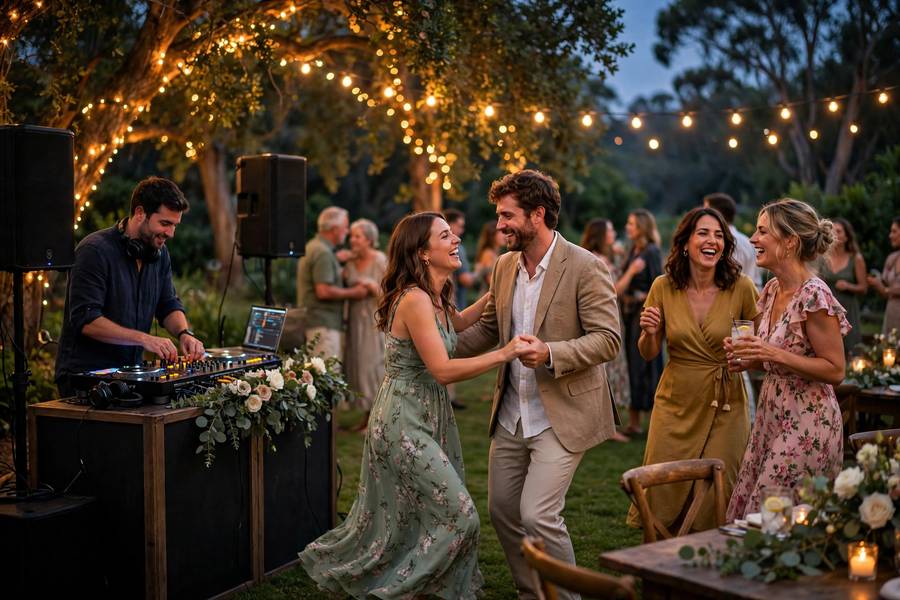
- Song variety is unmatched. Any song, any genre, any era, on request, instantly. For mixed-age outdoor crowds, this matters enormously.
- No breaks. A DJ plays continuously for four-plus hours; bands take 15–20 minute breaks every hour, and a silent dance floor while the sun sets is a momentum killer.
- Volume precision. Quieter during dinner under the stars, louder when the dancing starts, dialed back instantly if the venue manager appears with a decibel meter.
- Simplicity. One vendor, one setup, one timeline. On a wedding day with a hundred moving parts, simplicity is a feature.
- MC services. Most wedding DJs double as your emcee — announcements, first dance, toasts, send-off. Outdoors, a good MC holds the evening together.
The honest downside: a DJ doesn’t give you the visual spectacle of live musicians, and for some couples, that live energy is the whole point. Which brings us to…
The Case for the Band Outdoors
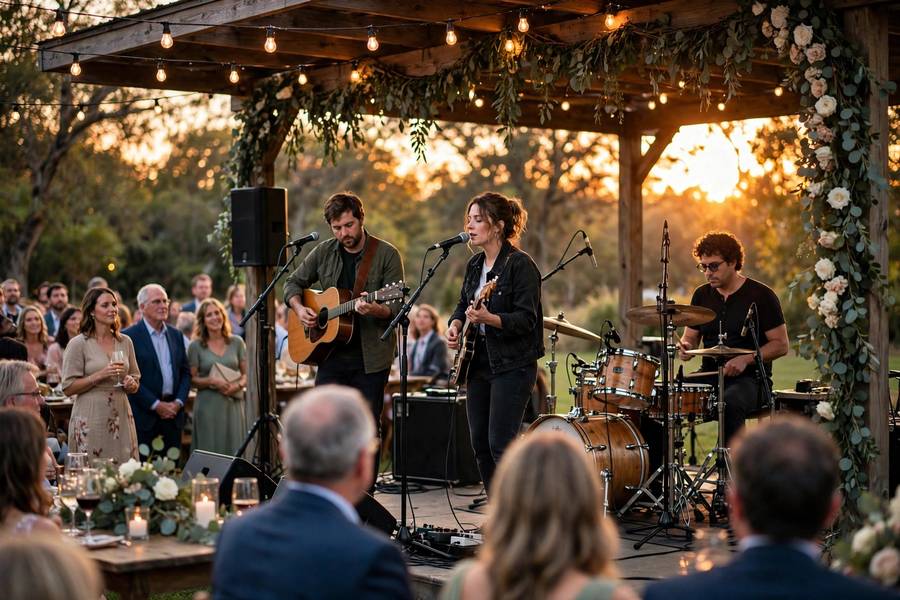
When a band works outdoors, it’s transcendent — a horn section at sunset, an acoustic guitar during golden hour, something no speaker system reproduces. If live music is central to who you are as a couple, the logistical hurdles are worth clearing.
Bands also read a room in a way playlists can’t: a great bandleader watches your crowd and shifts the energy in real time. And for guests, a band is entertainment even when they’re not dancing — people watch a band.
The outdoor band checklist: covered stage (non-negotiable), confirmed power, a sound engineer experienced with open-air venues, a weather clause you understand. Ask for references from outdoor weddings specifically — it’s a different skill.
The Hybrid Option Most Outdoor Couples Overlook
Here’s the move I suggest more than any other for outdoor weddings: live musicians for the ceremony and cocktail hour, DJ for the reception.
A solo guitarist, string duo, or acoustic trio for the ceremony is intimate, photogenic, weather-flexible (small footprint, easy to move under cover), and relatively affordable ($500–$1,500). Then the DJ takes over for dinner and dancing — full song variety, no breaks, precise volume control, lower cost.
You get the live-music magic where it matters most (walking down the aisle to a real violin hits differently than a recording) and the DJ’s practicality where the party needs it — often at a total cost between DJ-only and band-only bookings.
Questions to Ask Your Venue Before You Decide
Ask these before you sign any entertainment contract — the answers will often make the decision for you:
- What power is available at the exact performance location, and how many circuits?
- Is there a noise curfew or decibel limit? What time, and how is it enforced?
- What is the rain backup plan for entertainment — specific location, not a concept?
- Is there a covered stage area, or do we need to rent a tent for performers?
- What are the load-in logistics — vehicle access, distance to the performance area, setup time windows?
- Are there any vendor restrictions — approved vendor lists, insurance requirements, sound ordinances?
Jessica’s Decision Framework: 6 Questions
Answer these honestly, and your choice will be clear:
- Is your budget under $4,000 for entertainment? → DJ. The outdoor add-ons alone make a band unrealistic at this budget.
- Does your venue have a noise curfew before 11 PM? → DJ, unless the band is acoustic.
- Is live music non-negotiable for you emotionally? → Band (or hybrid). Don’t let logistics talk you out of the thing you’ll regret missing.
- Is your guest count over 120 with mixed ages? → DJ’s song variety wins for diverse crowds.
- Is your venue logistically complex (beach, rooftop, remote estate)? → DJ for simplicity, or hybrid.
- Do you want the dance floor packed all night with zero gaps? → DJ.
There’s no wrong answer — only the wrong answer for your venue, your budget, and your priorities. The couples who regret their choice picked based on a Pinterest fantasy instead of their actual site.
When you’re building the rest of your reception plan, our guide on how to choose wedding music covers song selection, and the wedding reception song list will give you a head start on must-plays — whichever format you choose.
For most outdoor weddings, a DJ is the more practical choice — smaller power needs, precise volume control for noise curfews, tiny footprint, and simpler weather backup. A band is worth it if live music is emotionally non-negotiable for you and your venue can provide a covered stage, adequate power, and a real rain plan.
A professional wedding DJ typically costs $1,000–$2,500 (rising to $1,800–$4,000 outdoors with extra speakers, generator, and lighting). A quality live band runs $3,500–$10,000+, reaching $5,000–$13,000+ outdoors once you add a covered stage, extra sound engineering, and weather contingencies.
Only under a proper covered stage — and most band contracts state explicitly that they won’t perform in rain without one. Instruments and electrical equipment can’t get wet. Always have a covered backup location in the contract, and understand the weather clause before you sign: you may still owe the fee if the band can’t play.
Yes. Without walls to reflect sound, audio dissipates quickly outdoors — you typically need a more powerful system than the same guest count indoors, plus careful speaker placement (and sometimes satellite speakers for cocktail hour in a separate area). Budget $300–$600 extra for upgraded open-air sound.
Many outdoor venues enforce hard noise cutoffs — often 10 PM — due to local ordinances or neighbors. A DJ can dial volume precisely to comply; a live band (especially with drums) has a minimum volume that may violate the limit. Always get the venue’s exact noise rule in writing before booking entertainment.
Yes, and it’s a popular outdoor-wedding solution: live musicians (guitarist, string duo) for the ceremony and cocktail hour, then a DJ for the reception. You get live-music magic where it counts and the DJ’s variety and reliability for the dance party — often at a total cost between DJ-only and full-band pricing.