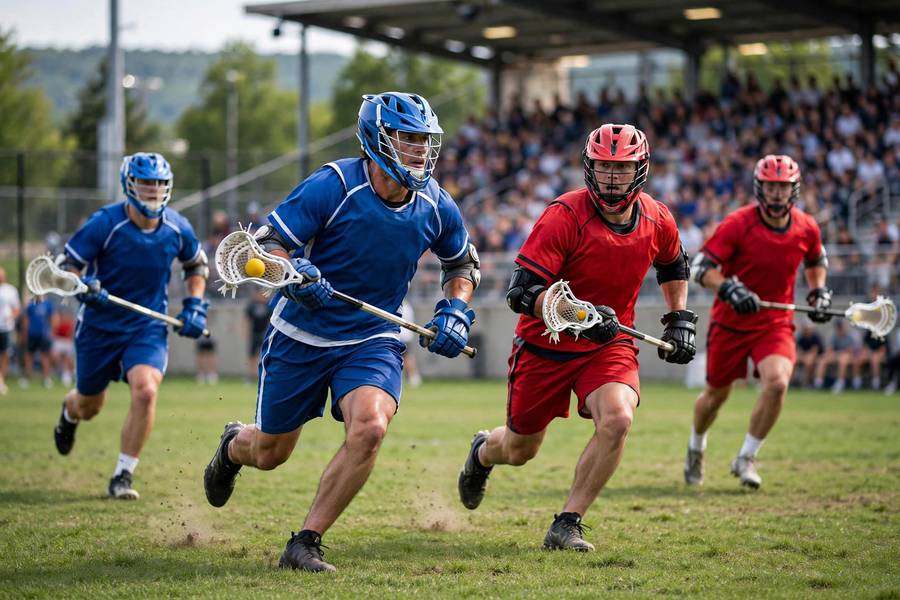
I’m Ryan. I played sports competitively through college, and I still can’t watch a game without taking notes. Last spring I filled half a notebook on one playoff game — half of it was penalty flags. Lacrosse is one of the fastest games on turf, and if you don’t understand what’s happening when that flag goes down, you’re missing half the story.
This is my full breakdown of lacrosse penalties: personal fouls vs technical fouls, how long each one lasts, what “man-down” means for the scoreboard, and the rule quirks that decide games. If you want the full game structure first, our general lacrosse rules guide has you covered — this one is the penalty manual.
Table of Contents
- Why Lacrosse Penalties Matter More Than You Think
- Personal Fouls vs Technical Fouls: The One Distinction to Know
- Releasable vs Non-Releasable Penalties: The Box-Time Loophole
- The Slow Whistle: Why the Ref Lets Play Go On
- Man-Down, Man-Up: The Numbers Behind the Penalty Box
- Foul Accumulation: How Players Get Ejected
- Men’s vs Women’s Lacrosse: Different Games, Different Penalties
- Frequently Asked Questions
- The Bottom Line From My Notebook

Why Lacrosse Penalties Matter More Than You Think
In most sports, penalties are interruptions. In lacrosse, they’re opportunities — a typical game gives each team three to five extra-man chances, and converting them often decides the game. When a team goes man-down, it isn’t just losing a player: it’s playing a different game for 30 seconds to three minutes, with compressed slides, scrambled rotations, and a superhuman goalie.
I track this stuff. In the notebook I mentioned, the team that won went 4-for-5 on the man-up. The losing team? 1-for-4. Final score was 11–9. You do the math.
Personal Fouls vs Technical Fouls: The One Distinction to Know
Every lacrosse penalty falls into one of two buckets — the single most important thing to learn. Personal fouls are safety and conduct violations punished with 1 to 3 minutes in the box. Technical fouls are unfair-advantage violations: 30 seconds if the fouled team had possession, or a change of possession if they didn’t.
These are the ones that get crowds on their feet. Every personal foul sends the offender to the box for one to three minutes, the ref picking the duration based on severity.
Slashing. The big one: any hard, uncontrolled stick check that hits the opponent’s body anywhere other than the gloves or stick. A legal check goes at the stick or gloved hands — the moment that stick travels to the helmet or down the back with force, flag. There’s a fine line between an aggressive check and a slash, and refs live on it.
Cross-checking. Using the shaft of the stick — the part between the two hands — to make contact. Push an attackman with the middle of your stick instead of your gloved hands? Full minute, almost every time.
Illegal body check. A body check becomes illegal when delivered to a player without the ball (and not within five yards of a loose one), after the opponent has passed or shot, or from behind, below the waist, or above the shoulders. The late hit drives me crazy — ball’s gone, you still level the guy? Enjoy the box.
Tripping. Using your stick or body to trip an opponent. Legs go flying, flag goes down.
Unnecessary roughness. The judgment call: excessive contact beyond what’s needed. This is what refs reach for when something was technically checkable but delivered with way too much force.
Unsportsmanlike conduct. Trash-talking, arguing with officials, taunting after a goal. Accumulates fast in rivalry games — discipline is a stat too, even if it doesn’t show up in the box score.
Illegal stick. Too short (generally under 40 inches), pocket too deep, strings out of spec. Preventable — the ref checks sticks, and it’s an automatic foul.
Technical Fouls: The 30-Second (or Possession) Calls
The penalty for technicals depends on possession: if the fouled team had the ball, the offender sits 30 seconds. If not, the fouled team just gets the ball.
Pushing. Pushing from the front or side is legal — pushing from behind is a foul. When a defenseman shoves an attackman and no flag comes, watch the angle: it was probably a legal side push.
Holding. Using your hands or stick to impede an opponent’s movement — grab a jersey, hook a stick, pin an arm. One of the most-called technicals in tight games.
Warding. Using your free hand or arm to push or hold an opponent’s stick when you have the ball. Ball carriers do it instinctively — stiff-arm the defender’s stick away. Instinctive, yes. Legal, no.
Interference. Impeding an opponent who doesn’t have the ball. The classic version: an attackman “sets a pick” but moves into the defender instead of standing still — a moving screen, basically.
Offside. A team must keep at least three players on its attacking half and at least four on its defensive half. (Compare how the offside rule in soccer works — different sport, same instinct.) It usually happens on fast breaks — a middie doesn’t get back — and it’s a completely avoidable flag.
Face-off violations. Moving early or clamping illegally at the X. Face-offs are already 50/50 — a violation just hands the ball over.
Goalie interference and crease violations. The crease is the goalie’s sanctuary: attackers can’t enter it, and contact with the goalie inside it is an automatic call. Crease dives — where a shooter launches into the crease while shooting — are among the most controversial calls in the sport. I love the frame-by-frame stuff.
Releasable vs Non-Releasable Penalties: The Box-Time Loophole
Not all penalties work the same way once the clock starts — here’s the detail most explainers skip.
Releasable penalties end early if the opposing team scores. Serving a one-minute slash and the other team buries a goal 20 seconds in? You’re released. This is why man-up offenses push for quick goals: a fast strike erases the penalty, not just the lead.
Non-releasable penalties do NOT end early, no matter how many goals are scored. The full time must be served — they’re assessed for more severe or repeated infractions.
This distinction changes strategy completely. If a penalty is releasable, the man-down defense can play conservatively and kill the clock; if non-releasable, the full sentence runs regardless. Listen for the ref’s announcement — releasable or not changes everything.
The Slow Whistle: Why the Ref Lets Play Go On
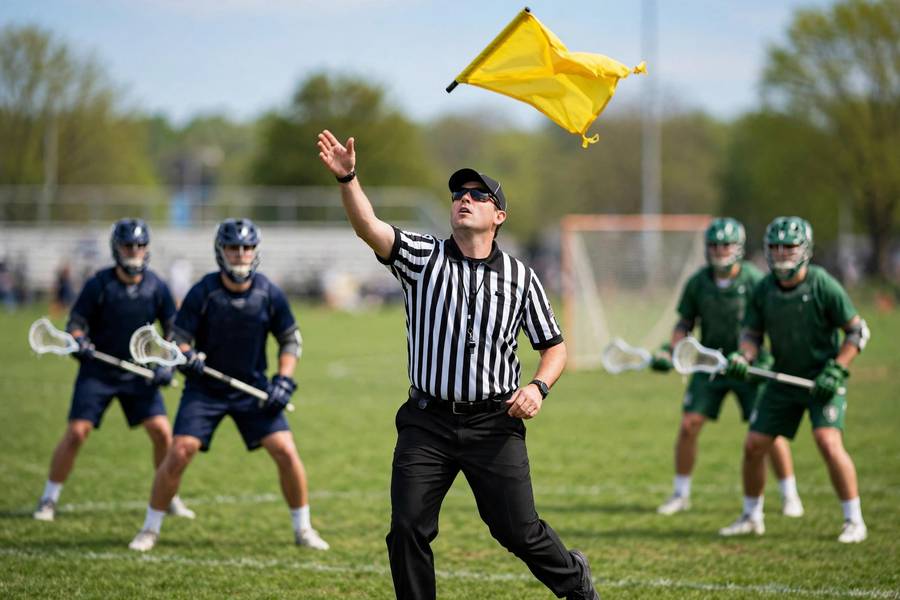
You’ve probably seen it: the ref throws the flag, the play keeps going, and everyone’s confused. That’s the slow whistle (also called a flag-down), and it’s one of the smartest mechanics in any sport.
When a foul occurs but the fouled team still has possession and a scoring chance, the referee holds the whistle. The flag goes down, but play continues — the fouled team finishes its attack. The whistle only blows when the chance ends: goal, shot, turnover, or out of bounds.
Why? Stopping play immediately would punish the fouled team — they earned a scoring chance, and the rulebook says they keep it. If they score, the penalty is still enforced afterward; if they don’t, the whistle blows and the penalty is served.
Man-Down, Man-Up: The Numbers Behind the Penalty Box
When a penalty is served, the penalized team plays man-down (one fewer player on the field) and the other team is man-up — also called the extra-man offense or EMO.
Tactically, the man-up team spreads the field, moves the ball fast, and looks for the open shooter — six against five means someone is always open, and ball rotation finds him. The man-down defense packs in, rotates aggressively, and tries to force bad shots while the goalie stands on his head.
The numbers I obsess over: most games give each team three to five extra-man opportunities, and a good EMO converts around a third or more. Over a season, the penalty box is worth multiple wins — undisciplined teams lose not from lack of talent, but from handing the other team a man advantage.
Multiple simultaneous penalties get interesting: two players in the box means playing two men down, and the player whose penalty expires first comes out first.
Foul Accumulation: How Players Get Ejected
A player who racks up personal fouls gets ejected — typically at five, though some leagues use six. An ejection for fighting or a flagrant foul often carries a suspension for the next game too.
Unsportsmanlike conduct stacks differently: repeated instances can get a player — or even a coach — ejected on the spot, without waiting for a foul count. One bad argument with a ref can end your night.
Men’s vs Women’s Lacrosse: Different Games, Different Penalties
Quick but important: the women’s game handles penalties differently — body checking isn’t allowed, so fouls generally result in free-position shots from the 8-meter or 12-meter arc depending on severity.
Everything here describes the men’s field game — the version with the penalty box. Same stick, same ball, very different rulebook.
Frequently Asked Questions
Personal fouls (slashing, cross-checking, illegal body check) carry 1 to 3 minutes in the box. Technical fouls (pushing, holding, offside) carry 30 seconds if the fouled team had possession, or just a change of possession if they didn’t.
Personal fouls are serious safety or conduct violations (slashing, cross-checking, unnecessary roughness) drawing 1-3 minute penalties. Technical fouls are less serious rule violations (pushing, holding, warding, offside) drawing 30-second penalties or loss of possession.
The penalized team plays man-down with one fewer player, while the other team plays man-up (extra-man offense) with a numerical advantage — spreading the field and rotating the ball to find the open shooter.
A releasable penalty ends early if the opposing team scores. A non-releasable penalty must be served in full no matter how many goals are scored, and is assessed for more severe or repeated infractions.
The slow whistle is when the referee throws the penalty flag but lets play continue because the fouled team still has possession and a scoring chance. Play goes on until the chance ends, then the penalty is enforced.
A player is typically ejected after five personal fouls, though some leagues use six. Repeated unsportsmanlike conduct can also bring immediate ejection, and flagrant fouls may carry a suspension for the next game.
The Bottom Line From My Notebook
Penalties are the part of lacrosse that new fans treat as background noise and experienced fans treat as the main event. The box score tells you who scored; the penalty sheet tells you why. Personal fouls vs technical fouls, releasable vs non-releasable, the slow whistle, the man-up numbers — once you see the game through that lens, you can’t unsee it.
Next time you watch, keep a tally in the margin like I do. You’ll start calling the flags before the ref throws them — and that’s when the game gets really fun.
And if you enjoy sports where the rulebook has real teeth, the physical battles in our rugby rules breakdown and the non-stop action of water polo rules are worth your time too.