How to Write a Bucket List You’ll Actually Finish

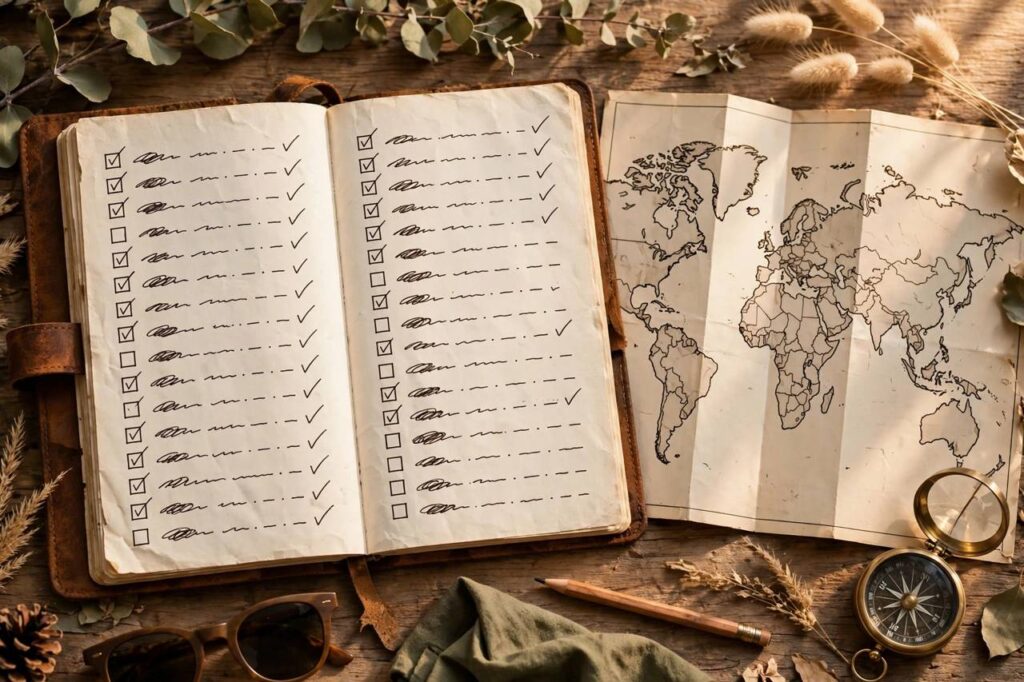
Most advice on how to write a bucket list produces the same thing: a napkin of vague fantasies — “travel more,” “learn French,” “be happy” — that sits in a drawer until it feels like an accusation. I know because I wrote one of those at 25 and found it at 32, untouched and faintly depressing. The second version I wrote used a completely different method: categories instead of a random list, each item sharpened into something actionable, and a yearly review ritual. Eight years later, about half of it is done — and the doing changed how I plan my years. Here’s the method.
The Category Framework: Think in Life Areas, Not Random Dreams
A flat list of 50 random wishes is overwhelming; four focused lists are a plan. Brainstorm within these four categories — they cover the dimensions of a full life without letting one area (usually travel) eat everything:
Adventure: things that scare you a little
The experiences that stretch you: hiking a famous trail, sleeping under the stars in a desert, taking a solo trip, learning to sail. Adventure items are the ones you’ll remember on your deathbed — be generous here, and include at least one that feels slightly unreasonable.
Learning: skills and knowledge
The person you want to become: speak conversational Italian, play three songs on guitar, understand basic investing, take a pottery class, read the complete works of one author. Learning items are wonderfully cheap and schedule-friendly — many cost nothing but evenings.
Giving: contributions beyond yourself
The mark you want to leave: mentor someone, volunteer regularly for a cause, plant a garden that outlives you, write letters to your grandchildren. Giving items age the best — they’re the ones that still feel meaningful decades later.
People: relationships to deepen
The connections to prioritize: take your dad on that fishing trip, host a reunion, have a real conversation with your grandmother about her life, forgive someone. People items are the most commonly regretted when left undone — and the cheapest to start.
Aim for 5–10 items per category. Write fast, dream big, and don’t filter yet — filtering comes next, and premature practicality is the enemy of a good bucket list.
SMART-ify Each Item: From Dream to Plan
Here’s where bucket lists die or come alive. “Travel more” is a wish; “Spend two weeks in Japan during cherry blossom season before I’m 40” is a plan. Take each item and sharpen it with three questions:
What exactly? Name the specific thing: not “learn an instrument” but “play ‘Hallelujah’ on guitar at the family Christmas.” Specificity lets you price it, schedule it, and recognize when it’s done.
By when? Give it a horizon — this year, by 40, before the kids leave home. No deadline means no priority, and no priority means it loses to the urgent-but-unimportant every time.
What’s the first step? Every item needs a starter action so small it feels silly: “research trails tonight,” “download the language app,” “text Dad about dates.” A bucket list without first steps is a wish list; with them, it’s a project plan.
You don’t need to SMART-ify all 30 items at once — do your top five, the ones that make your pulse quicken. The rest can wait for the yearly review. And if you want ready-made inspiration for the adventure category, these summer bucket list ideas are a great starter pool — including the summer bucket list for kids if you’re planning adventures the whole family can share.

The Birthday Review Ritual
A bucket list without a review ritual is a time capsule; with one, it’s a compass. Once a year — your birthday is the natural moment — sit down with the list and a drink and do three things:
1. Celebrate what’s done. Check off completed items properly — ceremony matters. I cross mine out with a ridiculous gold pen. Notice how good it feels; that feeling is the fuel for next year.
2. Promote and prune. Move 2–3 items into “this year” status with real first steps and rough timing. And remove items without guilt — the scuba certification that excited you at 28 but bores you at 36 doesn’t belong on the list of the person you are now. A bucket list should shrink as well as grow.
3. Add what’s new. Every year teaches you something about what you actually want. Add the 2–3 items this year revealed. The list stays alive because you stay honest.
Keep the list somewhere you’ll actually see it — the front of a journal, a note on your phone, a framed print. Out of sight is out of mind, and this particular list deserves better than a drawer.
Bucket List Mistakes That Kill the Magic
Making it all travel. Travel items are expensive and schedule-heavy; a list of 40 trips is a fantasy, not a plan. Balance with learning, giving, and people items that fit ordinary weeks.
Keeping it secret. Tell people. Saying “I’m learning Italian” out loud recruits accountability and — surprisingly often — invitations, tips, and travel companions.
Only adding big things. Mix in small delights: see the sunrise from a specific hill, try the famous bakery across town, stargaze properly once. Small items get done, and done items build momentum.
Treating it as a race. It’s not a checklist to optimize; it’s a reminder of what matters. The point was never to finish — it’s to live pointed in the right direction.
And remember the deeper purpose: a bucket list is really a values document in disguise. The items you keep returning to reveal what you actually care about — which is why the practice sits so well alongside slower, more intentional living. The hygge lifestyle emphasis on savoring ordinary moments is the perfect counterweight to a bucket list’s big dreams: chase the extraordinary, but don’t sleepwalk through the everyday while you do.
How to Write a Bucket List on a Tight Budget
The fantasy version of a bucket list costs a fortune — safaris, expeditions, sabbaticals. The real version doesn’t have to. When money is tight, lean the list toward the categories that cost nothing: learning (library books, free online courses, skill swaps with friends), giving (volunteering, mentoring, writing the letters), people (the long-overdue visit, the honest conversation, the reunion you organize yourself), and local adventure (every region has a famous hike, a strange museum, a sunrise spot you’ve never visited — the adventure is in the doing, not the distance).
For the big-ticket dreams, use the “fund it” reframing: instead of a vague “travel to Japan,” make it “save $50 a month toward Japan” — the item becomes a savings goal with a dream attached, which is both more honest and more likely to happen. And remember that constraints breed creativity: some of my favorite completed bucket items cost under twenty dollars — the meteor shower watched from a hill, the fancy restaurant’s lunch menu instead of dinner, the free walking tour in my own city taken like a tourist. A budget doesn’t shrink a bucket list; it focuses it.
Bucket List Ideas for Every Decade of Life
The list should evolve with you — here’s what tends to matter most at each stage. Your 20s: collect experiences and skills — solo travel, learning a language, saying yes to the weird opportunity. This is the decade for the slightly unreasonable adventure items. Your 30s: balance ambition with roots — career milestones, the trip with old friends before life scatters everyone, starting the traditions you’ll keep. Your 40s: depth over breadth — master something properly, take the trip you’ve postponed three times, invest in the friendships that survived.
Your 50s: give back and go far — mentoring, the big journey while health is strong, the project that outlasts you. Your 60s+: savor and share — write the family stories down, take the grandkids somewhere magical, learn the thing you always said you’d learn “someday.” The pattern across decades: adventure items dominate early, giving and people items dominate late — and the people items are the ones nobody ever regrets.
Turning Bucket List Items Into This Year’s Goals
The birthday review promotes 2–3 items to “this year” — but promotion without a plan is just a nicer-looking wish. For each promoted item, do three things: name the first physical action (not “research Japan” — “spend 30 minutes Saturday comparing flights”), put a date on the calendar for that action (undated intentions lose to everything with a deadline), and attach a cost (even a rough one — pricing an item converts it from fantasy to project and tells you whether it needs a savings plan).
Then protect the items like appointments: a quarterly check-in (15 minutes — am I on track?) keeps them warm without obsessing. And build in a buddy for at least one item — the trip, the class, the challenge. Shared bucket items get done at dramatically higher rates than solo ones, partly accountability and partly because anticipating it together doubles the joy. A bucket list item with a date, a cost, and a companion stops being a dream. It’s a plan with a pulse.
Start tonight. Not the whole list — just the categories, four headings on a page, and whatever comes out in twenty unfiltered minutes. The list doesn’t need to be complete to be powerful; it needs to exist. A year from now, you’ll either have a page of dreams with checkmarks appearing — or another year of “someday.” The pen is in your hand. Write the first one.
Frequently Asked Questions
How many items should be on a bucket list?
Aim for 5–10 per category across adventure, learning, giving, and people — roughly 20–40 total. Enough to dream big, few enough to stay actionable.
How do I make bucket list items actually happen?
Sharpen each one: name the specific thing, set a horizon date, and define a tiny first step. Then review yearly and promote 2–3 items to ‘this year’ status with real timing.
Should I remove items from my bucket list?
Yes — without guilt. Interests change, and a list that doesn’t evolve becomes a burden. Prune yearly during your review; the list should shrink as well as grow.
What’s the difference between a bucket list and goals?
Goals are usually achievement-oriented with deadlines; a bucket list is broader — experiences, relationships, and contributions — and it’s reviewed yearly rather than tracked quarterly.
When is the best time to review a bucket list?
Your birthday is ideal: celebrate completions, promote 2–3 items to this-year status, prune what no longer fits, and add what the past year taught you.