How to Fold a Fitted Sheet Hack (It Finally Works)


Here’s the how to fold a fitted sheet hack that finally made it click for me — after years of the wad-and-shove method that turned my linen closet into a fabric crime scene. I’ll be honest: I resisted learning this for an embarrassingly long time. It seemed like one of those skills for people with too much time on their hands. Then a friend showed me the corner-tuck trick in about ninety seconds, and I genuinely laughed at how simple it was. This is that trick, broken down so slowly you cannot mess it up, plus the variations for when the basic version fights you.
Why Fitted Sheets Are So Annoying (It’s Not You)
A fitted sheet is, geometrically, a hostile object. It’s a rectangle with elastic gathered corners — which means it has no stable flat state and actively resists being folded. Every other piece of bedding is a simple rectangle you can fold in halves and thirds. The fitted sheet springs back, bunches up, and mocks you. Understanding this helps: the difficulty is structural, not a personal failing. Nobody folds these intuitively. Everyone learns a trick.
How to Fold a Fitted Sheet Hack: The Corner-Tuck Method
This is the method. It takes about a minute once you’ve done it three times.
Step 1: Hold it by the two top corners
Stand holding the sheet inside-out, with your hands inside two adjacent corners along one of the long edges — like a puppet. Let the rest hang down. The elastic should be facing you.
Step 2: Bring your hands together
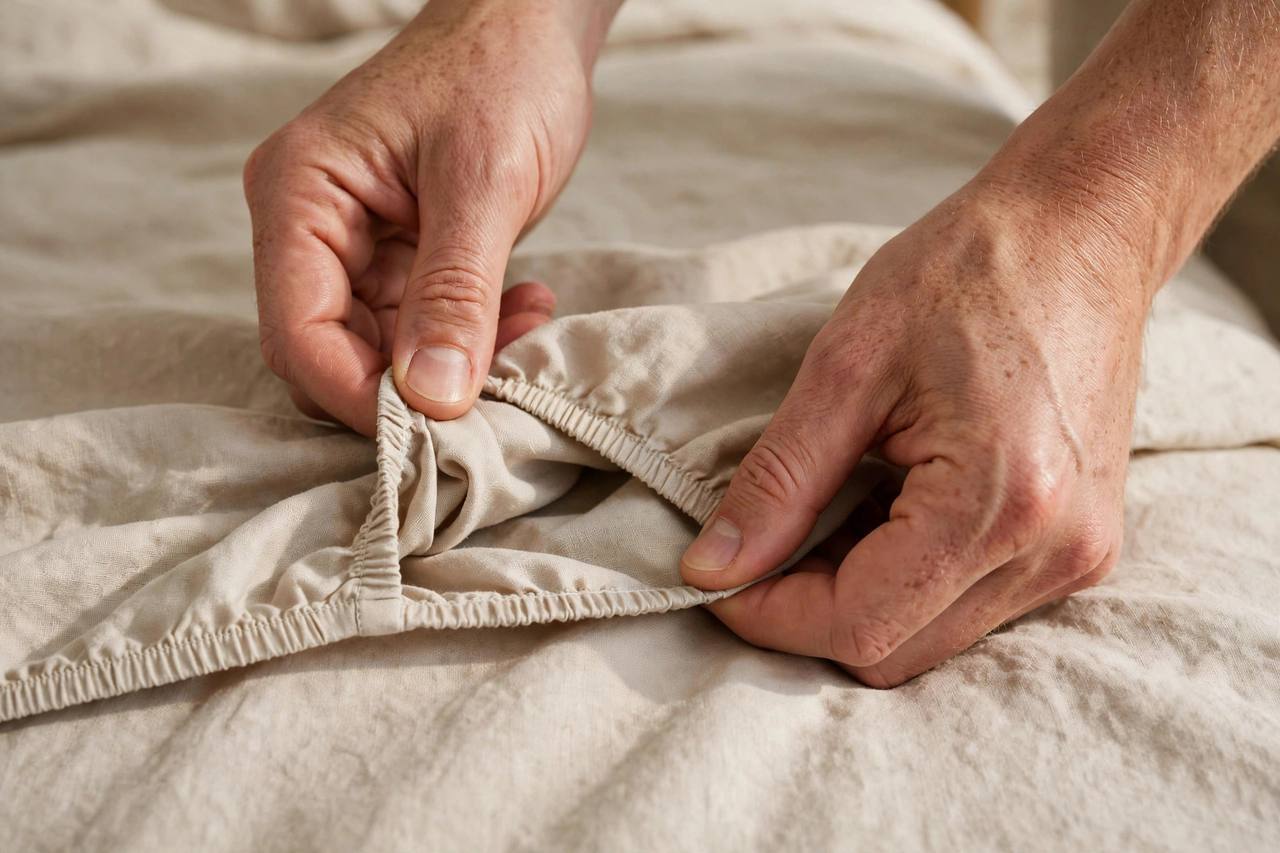
Bring your right hand to your left (or vice versa) and fold the corner in your right hand over the corner in your left hand — tucking one corner inside the other. The elastic edges should now line up. This is the magic move: you’ve just turned two corners into one neat pocket.
Step 3: Pick up the bottom corners
With the two top corners now nested in one hand, reach down with your free hand and pick up the two bottom corners. Bring them up and tuck them into the nested top corners the same way. Now all four corners are nested together in one hand, and the sheet hangs in a roughly rectangular shape.
Step 4: Lay it down and straighten
Lay the sheet on a bed or table with the gathered elastic edge to one side. Smooth it into a rectangle — it won’t be perfect, and it doesn’t need to be. Fold the elastic edge inward so you have a clean rectangle.
Step 5: Fold into thirds, then in half
Fold the rectangle into thirds lengthwise, smoothing as you go, then fold in half or thirds again until you have a neat packet. Done. It should look like a slightly puffy envelope — not a ball.
If you want a visual walkthrough of the fundamentals, our guide on how to fold a fitted sheet covers the standard method this hack is based on — useful if any step above feels unclear.
The “Burrito” Variation for Deep-Pocket Sheets
Deep-pocket sheets — the ones for thick mattresses and toppers — have extra fabric that makes the standard method fiddly. For these, try the burrito:
Do the corner-tuck through step 3, then instead of laying it flat, lay the sheet down and roll it tightly from one end like a sleeping bag, smoothing the elastic in as you roll. The roll compresses the extra depth instead of fighting it. Tuck the end under and you’ve got a tidy roll that stacks beautifully on a shelf. Rolls also make it easy to see which size is which — no unfolding required.
The Two-Person Method (Fastest of All)
If someone else is around, the two-person fold takes twenty seconds. Each person holds two adjacent corners, you bring your hands together to nest the corners on each side simultaneously, then fold the resulting rectangle together in halves. It’s the same geometry as the solo method, just with four hands instead of two. This is how hotels do it, roughly — speed through teamwork.
Troubleshooting: When the Hack Fights Back
- The corners won’t stay nested. You’re probably trying to fold right-side-out. The sheet needs to be inside-out for the corners to tuck into each other cleanly. Flip it and try again.
- It’s still lumpy. The elastic edge is the culprit — fold it inward toward the center before your final folds, so it gets buried inside the packet instead of creating bumps.
- Deep pockets keep unfolding. Use the burrito roll variation above. Some sheets are just built for rolling, not folding.
- You can’t tell which corners are which. Tag one corner with a small safety pin or a stitch of colored thread on the inside. Sounds silly; saves minutes every laundry day.
- It looks good but won’t stay flat on the shelf. Store sheet sets inside one of their own pillowcases — the whole set becomes one neat package that can’t unfold itself.
Storing Folded Sheets So They Stay Folded
Folding is half the battle; storage is the other half. The pillowcase trick above is the single best storage hack: fold the fitted sheet, the flat sheet, and one pillowcase, then slide the whole set inside the second pillowcase. Your linen closet becomes a row of labeled packages instead of a avalanche zone.
Store sets vertically, like files in a filing cabinet, rather than stacking them. You can see and grab any set without disturbing the others. And keep only the sets you actually use — most households need two per bed, three at most. The fourth set is just clutter with elastic.
One more organizational upgrade: keep a small label or a strip of masking tape on each shelf noting the bed size (twin, queen, king). When every set looks like a neat pillowcase package, the sizes blur together, and you’ll thank yourself the first time you grab the right one without unfolding three wrong ones. It takes ten seconds with a marker and saves that little burst of laundry-day frustration permanently.

Folding Other Awkward Bedding With the Same Logic
Once the corner-tuck clicks, you’ll notice the same principle works on other annoying linens. Duvet covers: turn inside out, reach in to grab the two far corners, grab the duvet’s corners through the fabric, then flip the cover right-side-out over the duvet — the “burrito” method, same nesting logic. Mattress protectors with elastic skirts fold exactly like fitted sheets, just thicker. Even tablecloths with elastic edges (yes, those exist) surrender to the same tuck.
The general principle: whenever elastic or gathering fights you, nest the problem corners together first, then treat the result as a flat rectangle. It’s a small mental model, but it generalizes surprisingly well across the whole linen closet.
Teaching the Hack to Kids (or Skeptical Partners)
The fastest way to make this stick in a household is to teach it once, patiently, to whoever else does laundry. Kids as young as eight or nine can learn the corner-tuck — make it a game the first time (“tuck the corners like a taco”), and praise the result. Skeptical partners respond better to a 90-second demo than to a lecture; just fold one in front of them without commentary. The visual does the persuading.
Fair warning: the first attempt always looks worse than the demo. That’s normal. The muscle memory kicks in around the third or fourth try, and by the tenth it’s automatic. Don’t let a lumpy first attempt convince anyone the method doesn’t work — it works; the hands just need reps.
Do You Even Need to Fold Them? The Honest Alternatives
Let me be real for a second: the only reason to fold a fitted sheet neatly is shelf aesthetics and space efficiency. If neither matters to you, there are honest alternatives:
- The smooth wad: Lay it flat, fold in half twice, roll it up. Not pretty, but compact and functional.
- Leave it on the bed: If you wash and immediately remake the bed, folding never enters the picture. This is the highest-efficiency system of all.
- Sheet suspenders or clips: If your actual problem is the sheet popping off the mattress corners at night, that’s a fit problem, not a folding problem — deeper pockets or corner straps solve it.
But if you’ve ever opened a linen closet and felt a small surge of satisfaction at the neat rows — that’s what the corner-tuck hack buys you. Ninety seconds, a few times a month, for a closet that looks like you have your life together. And honestly? On a busy laundry day, that tiny hit of order is worth more than the technique itself. Small systems, consistently applied, are what keep a household running smoothly — this one just happens to involve elastic corners.
Frequently Asked Questions
What is the easiest hack to fold a fitted sheet?
The corner-tuck method: hold two adjacent corners inside-out, tuck one corner inside the other, repeat with the bottom corners, lay flat, and fold into thirds. It takes about a minute once learned and produces a flat rectangle instead of a ball.
Why won’t my fitted sheet stay folded?
Usually the elastic edge is the problem — it springs the folds open. Fold the elastic edge inward toward the center before your final folds so it gets trapped inside. Storing the folded set inside a pillowcase also prevents unfolding.
How do you fold a deep-pocket fitted sheet?
Use the burrito variation: do the corner-tuck to nest all four corners, lay it flat, then roll it tightly like a sleeping bag instead of folding. Rolling handles the extra fabric depth better than flat folding.
Is there a trick to telling fitted sheet corners apart?
Mark one inside corner with a safety pin or a stitch of colored thread. It sounds fussy, but it eliminates the most confusing part of the whole process — figuring out which corner goes where.
How should you store folded fitted sheets?
Fold the full set (fitted sheet, flat sheet, one pillowcase) and slide it all inside the second pillowcase, then store the packages upright like files. This keeps sets together, prevents unfolding, and makes the right size easy to grab.