How to Get Rid of Ants in the Kitchen Naturally

Nothing ruins a peaceful morning like a conga line of ants marching across your counter toward the honey jar. If you’re wondering how to get rid of ants in the kitchen naturally — no harsh sprays, nothing you wouldn’t want near your food — the good news is that the natural approach isn’t just the gentler option. It’s often the smarter one. Killing the ants you see does nothing about the colony; the trick is understanding how ants navigate, then turning their own biology against them. Here’s the food-safe three-step method that actually works: trace the trail, break it with a natural spray, and seal the doors they came through.
Why Ants Invade Kitchens (It’s Not About Cleanliness)
First, a small mercy: an ant invasion doesn’t mean your kitchen is dirty. Ants are scouts running a remarkably sophisticated logistics operation. A single forager finds a crumb, then lays down a pheromone trail on the way home — a chemical breadcrumb path that recruits nestmates. Within hours, that one scout becomes a highway.
This is why squishing the visible ants never ends the problem. You’re removing workers; the colony just sends more along the same chemical highway. To win, you have to erase the highway, remove the reason for the trip, and close the on-ramp. That’s the whole strategy, and every step below serves it.
Step 1: Trace the Trail
Before you clean anything, play detective for ten minutes. Watch where the ants are going — not just where they are. Follow the line in both directions:
- Outbound: what are they after? Usually it’s sugar (honey, jam, fruit bowl), grease (stove hood, behind the toaster), or water (a slow drip under the sink).
- Inbound: where are they coming from? Check window frames, baseboards, pipe penetrations under the sink, gaps around the dishwasher, and where cables enter the wall.
Mark the entry point with a small piece of tape — you’ll need it for Step 3. And resist the urge to spray the trail with cleaner just yet; first remove the food source, or new scouts will simply re-establish the route.
Step 2: Break the Trail With a Natural Spray
Ants navigate by smell, so the goal is to destroy the pheromone trail. You don’t need anything exotic:
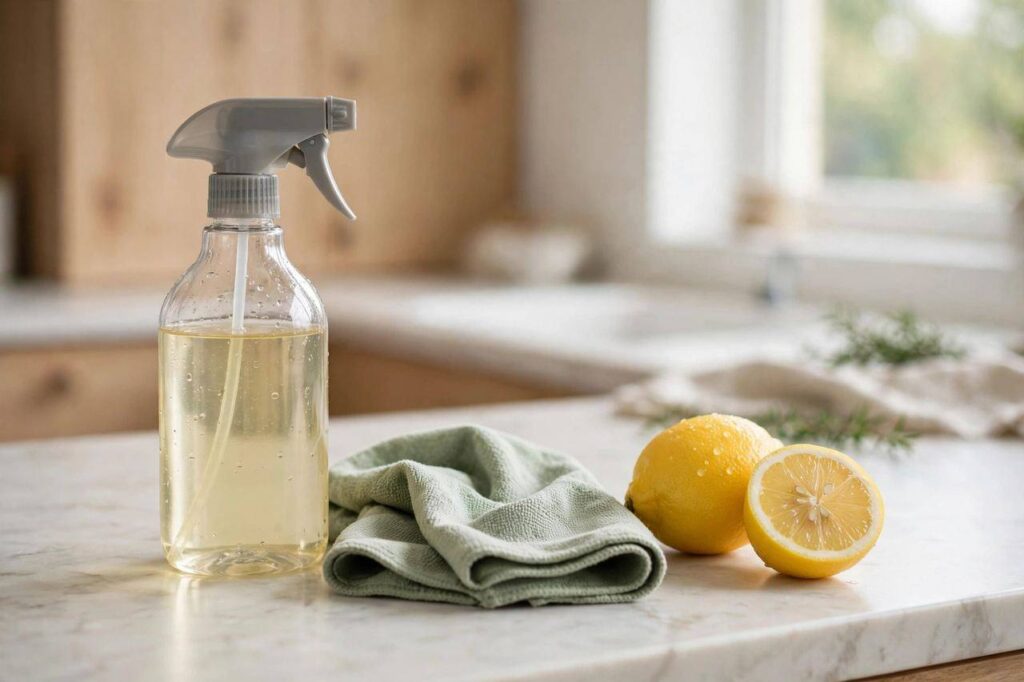
- White vinegar + water (1:1). The workhorse. Spray directly on the trail, wait a few minutes, wipe thoroughly. The acetic acid disrupts pheromone chemicals. Safe on counters; avoid natural stone, which vinegar can etch.
- Dish soap + water. A few drops of plain dish soap in a spray bottle of warm water. The surfactants break down the ants’ waxy coating and erase the scent trail. Wipe, don’t just spray.
- Lemon juice. The citric acid and strong scent mask the trail. Good for entry-point areas; less practical for large surfaces.
- Essential oils (peppermint, tea tree, or citrus). A dozen drops in water, sprayed along baseboards and entry points. Ants dislike strong scents. Keep away from cats — tea tree oil in particular can be harmful to them.
Spray the full trail — the counter path, down the cabinet side, along the baseboard — then wipe it all away. Half-erased trails get rebuilt by morning.
Step 3: Seal the Entry Points
This is the step everyone skips, and it’s the one that makes the fix permanent. Remember that piece of tape? Now’s its moment:
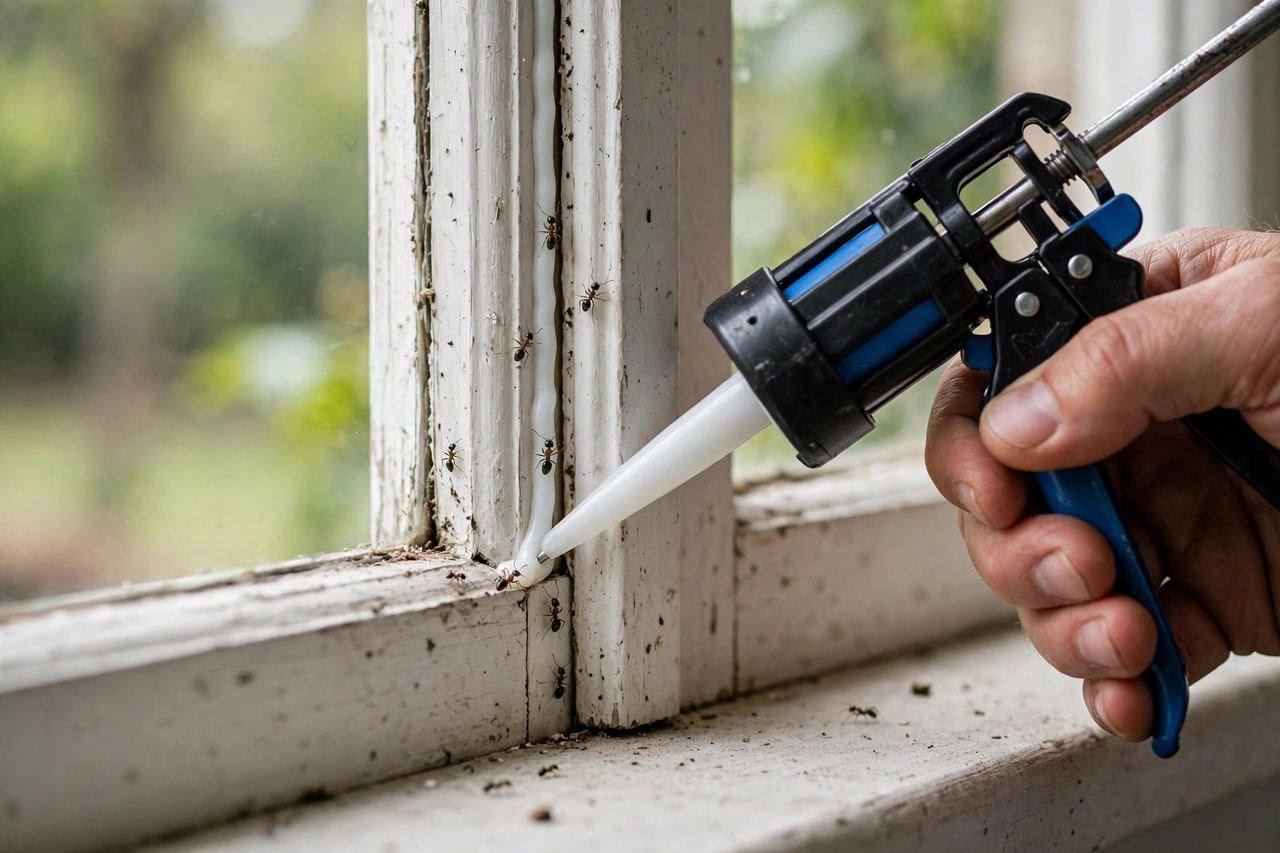
- Caulk the gaps. Window frames, baseboard seams, and pipe entries are classic ant highways. A tube of silicone caulk costs little and closes them for years.
- Fix the attractants. Store sugar, honey, cereal, and pet food in sealed glass or hard-plastic containers. Wipe the stove and range hood — grease buildup is ant paradise. Fix dripping faucets; ants need water too.
- Take out trash nightly during an active invasion, and rinse recyclables. A sticky soda can is a five-star ant restaurant.
- Check the fruit bowl. One overripe banana can sustain a colony’s interest for a week. Compost it or refrigerate it.
Natural Baits: When Sprays Aren’t Enough
Sometimes the colony is large or hidden inside a wall, and trail-breaking alone won’t cut it. That’s when baits earn their place — and the natural versions work on the same principle as commercial ones: the workers carry the bait home and share it with the colony, including the queen.
- Borax + sugar water. Mix a teaspoon of borax with sugar water, soak cotton balls, and place them on small lids near (not on) the trail. The sugar attracts; the borax does the rest back at the nest. Important: keep borax baits completely away from children and pets — it’s low-toxicity, not non-toxic.
- Diatomaceous earth (food grade). A fine powder of fossilized algae that damages insects’ exoskeletons on contact. Dust it thinly along baseboards and behind appliances — never on food surfaces, and wear a mask while applying since the dust irritates lungs.
- Cornmeal or coffee grounds. Folk remedies with mixed evidence. They won’t hurt, but don’t rely on them alone for a serious invasion.
With baits, patience is the active ingredient. You’ll see more ants at first — that’s the bait working, as foragers recruit nestmates to the feast. Give it several days before judging.
What NOT to Do
- Don’t spray insecticide on the trail. It kills the workers you see but leaves the colony intact — and it contaminates the area so baits won’t work afterward.
- Don’t use bleach on counters as pest control. It’s a food-contact surface; the residue risk isn’t worth it, and it doesn’t deter ants any better than vinegar.
- Don’t ignore outdoor nests pressed against the house foundation. Trim back vegetation touching the walls and consider treating exterior entry points.

How to Get Rid of Ants in the Kitchen Naturally: The Prevention Checklist
Getting rid of the current invasion is only half the battle — the other half is making your kitchen boring to future scouts. Run through this checklist once the trail is gone:
- Seal the pantry like a vault. Transfer flour, sugar, cereal, rice, and pet food into airtight glass or hard-plastic containers. Cardboard boxes and rolled-up bags are ant suggestions, not ant barriers.
- Degrease the forgotten zones. Behind the toaster, under the microwave, the stove hood filter, the crumbs in the cutlery drawer — the places you don’t see are exactly where scouts feast undisturbed.
- Manage moisture. Fix dripping faucets and sweating pipes. A pet water bowl left out overnight is a desert oasis; consider picking it up after evening feeding during ant season.
- Create a perimeter. A thin line of food-grade diatomaceous earth or a wipe of peppermint oil along exterior door thresholds and window sills discourages scouts before they get inside.
- Inspect groceries. Ants hitchhike in on produce bags, cardboard boxes, and potted herbs. A quick shake-out before things go in the pantry prevents importing the problem.
- Seasonal timing. Most invasions spike in spring when colonies expand and in late summer when outdoor food dries up. A preemptive caulk-and-clean session each spring pays for itself.
When Natural Methods Aren’t Enough
I’ll be straight with you: natural methods handle the vast majority of kitchen ant problems, but not all of them. Call a professional if you see carpenter ants (large, dark ants, especially with sawdust-like frass — they excavate wood and can damage your home), persistent re-infestation after two full rounds of the bait-and-seal method (the nest may be inside a wall void you can’t reach), or pharaoh ants (tiny yellow ants that \”bud\” — split into multiple colonies — when stressed, making DIY treatment backfire).
Even then, you can ask for the least-toxic effective option: many pest companies now offer integrated pest management (IPM) programs that prioritize baits and exclusion over broadcast spraying. And everything in the prevention checklist above still applies — a pro treatment plus sealed entry points is the combination that actually ends the war.
A Quick Note on Ant Species
Not all ants are the same opponent. The tiny sugar ants raiding your honey jar (usually odorous house ants) respond well to the bait-and-seal method. Carpenter ants are bigger, often nocturnal, and excavate wood — if you see large dark ants plus fine sawdust, skip the DIY and call a pro, because the issue is structural. Pharaoh ants are tiny and yellowish; disturbing their trails can cause the colony to split into several new ones, so bait patiently and don’t spray. Knowing which ant you’re fighting takes one photo and a quick image search — and it determines the entire strategy.
Frequently Asked Questions
What kills ants instantly but is safe for kitchens?
Boiling water kills on contact and leaves no residue — useful for a nest you can reach, less so for counter trails. For surfaces, soapy water spray kills the ants present while you wipe away the pheromone trail. “Instant kill” matters less than colony elimination, though.
Why do ants keep coming back to my kitchen?
Three reasons, usually in combination: the pheromone trail wasn’t fully erased, a food or water source remains accessible, or the entry point is still open. If you’ve sprayed twice and they return, the entry point is almost certainly still open — go back to Step 3.
Does vinegar really get rid of ants?
Vinegar disrupts the pheromone trails ants use to navigate, which breaks the foraging cycle — but it doesn’t kill the colony. Think of it as cutting the supply line rather than winning the war. Pair it with sealing entry points for lasting results.
Are natural ant remedies safe around pets?
Mostly, with caveats. Vinegar and soapy water are fine. Keep essential oils (especially tea tree) away from cats, store borax baits where no pet or child can reach them, and apply diatomaceous earth only in cracks and crevices, never where pets walk or food sits.
How long does it take to get rid of ants naturally?
Trail-breaking shows results within a day; baits need three to seven days to reach the queen and collapse the colony. If there’s no improvement after a week of consistent effort, the nest may be inside a wall void — that’s when calling a professional makes sense.
Do ants ever just leave on their own?
Sometimes a scouting party finds nothing and moves on — which is exactly why removing every food source matters. But an established trail to a reliable food source won’t fade on its own; the colony has no reason to abandon a working supply line.