Tips for Traveling with Kids on Planes: The Age-by-Age Survival Guide

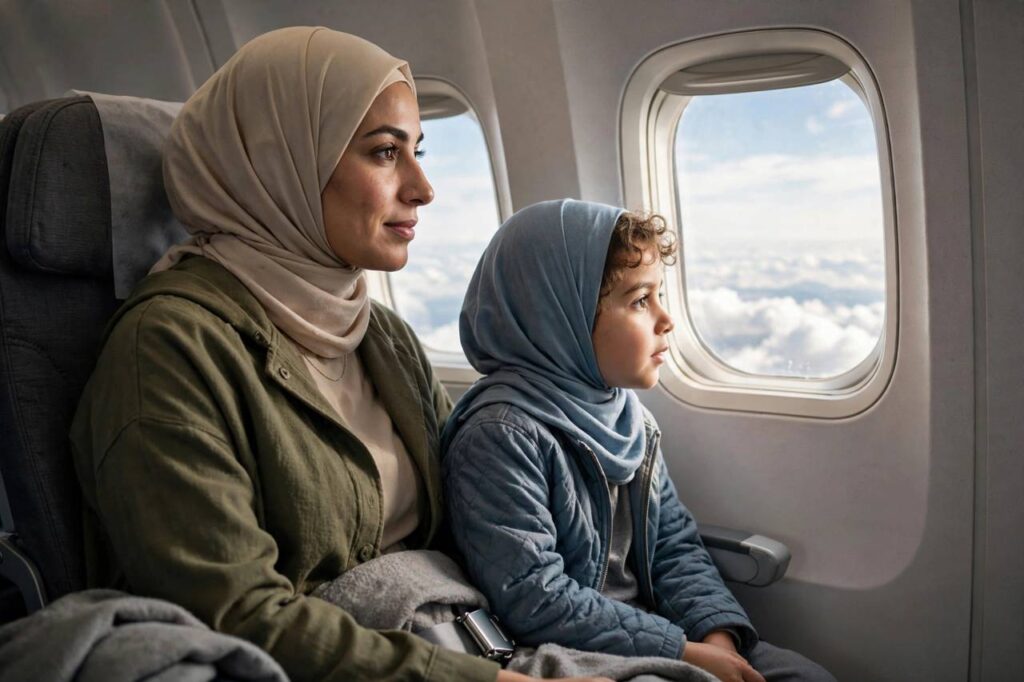
I have flown with a screaming infant, a feral toddler, and — my personal Everest — both at once, on a six-hour flight with a layover. I have also had flights so smooth that fellow passengers did not realize there was a baby in the row behind them until we landed. The difference was never luck. It was preparation. These tips for traveling with kids on planes are everything I learned the hard way, organized by age — because a strategy that works for a lap infant is useless for a four-year-old, and vice versa. Flying with kids is absolutely doable. It is just a different sport than flying alone, and it rewards people who pack like it.
The mindset shift that changed everything for me: your job on the flight is not to keep the child quiet — it is to keep the child occupied. Quiet is a byproduct of occupied. Every tip below serves that goal. And the golden rule of flying with kids: new beats good. A cheap new toy outperforms a beloved old one, because novelty buys attention and attention is the currency.
Tips for Traveling with Kids on Planes: Babies (0–18 Months)
Counterintuitively, young babies are often the easiest flying companions — they sleep a lot, they do not have opinions about entertainment, and their needs are simple: fed, dry, held. The challenges are pressure changes and logistics.
Ears on takeoff and landing: the pressure change hurts, and babies cannot equalize deliberately. Nurse, bottle-feed or offer a pacifier during ascent and descent — swallowing opens the Eustachian tubes. Time it: start as the plane begins its takeoff roll, not before, or the milk is gone before the climb. For descent, begin when you feel the plane start down (the crew usually announces it).
Seating: bulkhead rows with bassinets (book early — airlines have few) are wonderful on long hauls. Otherwise, a lap infant is fine for short flights; for long ones, consider buying the seat and bringing the car seat — safer, and the familiar seat often triggers nap mode. Diapering: pack double the diapers you think you need, plus a full change of clothes for the baby and for you (ask me how I know). Airplane changing tables are tiny — practice the one-handed maneuver at home.
Schedule hacking: book flights around nap time or bedtime when possible. A baby who sleeps through the flight is the dream scenario, and red-eyes with infants are genuinely easier than midday flights. Feed right before boarding so you board with a drowsy, full baby.
Toddlers (18 Months–3 Years): The Containment Challenge
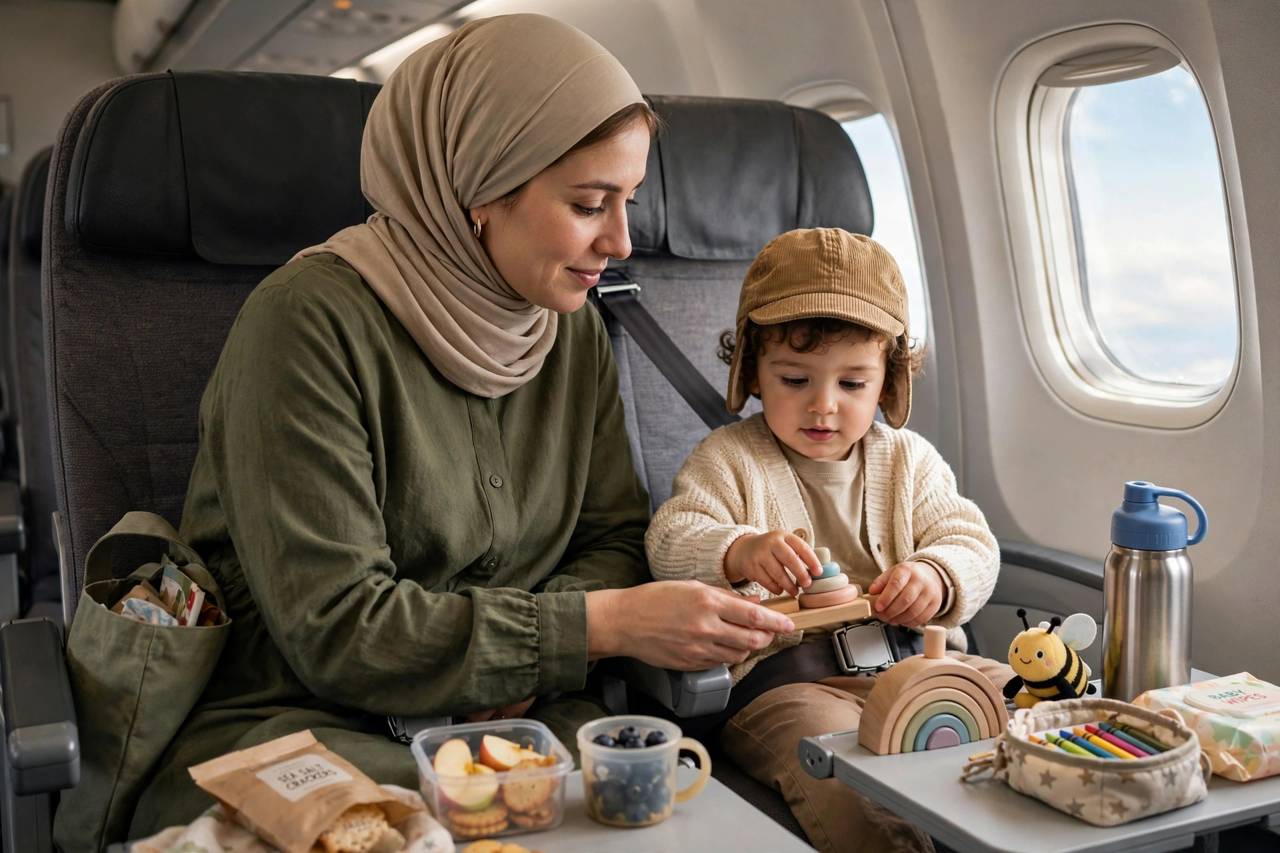
Toddlers are the boss level. They do not sleep on command, they have discovered autonomy, and they consider the airplane aisle their personal runway. Strategy: novelty, snacks, and movement in rotation.
The activity kit: pack a small backpack with 8–10 new, cheap, quiet items, wrapped individually if you are feeling ambitious (unwrapping buys five minutes per item — it adds up). Winners: sticker books, water-reveal coloring pads (no mess), pipe cleaners, small figurines, a snack-trap cup. Introduce one item at a time, only when the previous one loses its power. Do not dump the whole kit in minute ten.
Snacks as entertainment: snacks are not food here — they are activities. Pack a grazing assortment in small containers: puffs, crackers, fruit pieces, cheese. The act of picking items out of containers occupies hands and minds. Lollipops for takeoff and landing double as ear-pressure helpers (sucking and swallowing). Bring more than seems reasonable. Snack math on planes follows no earthly logic.
Movement breaks: walk the aisle every 45–60 minutes before restlessness peaks — preemptive walks beat reactive ones. Let them stand on your lap and look out the window. A toddler who has moved is a toddler who can sit. And screen time rules are suspended: download favorite shows offline, bring kid headphones, and feel zero guilt. The other passengers prefer the iPad to the alternative. Everyone does.
Preschool and Up (4+): Junior Travelers
Older kids are collaborators — bribe-able, distractible, and capable of understanding the mission. Give them a job: official photographer, snack distributor, map-reader with the in-flight tracker. Responsibility is engrossing.
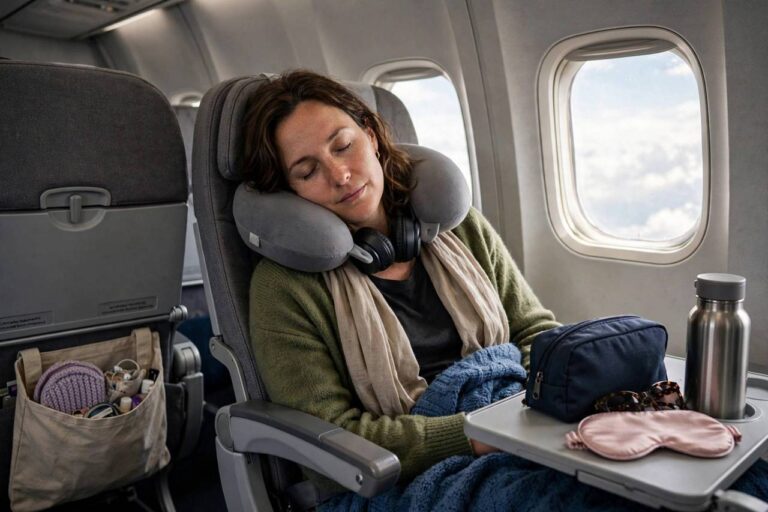
Entertainment: a loaded tablet (shows, games, audiobooks — download everything offline; airplane wifi is a gamble), plus one analog backup (activity book, card games, a journal for the trip). Comfort kit: their own neck pillow, a familiar blanket or stuffed animal, and headphones that fit. Familiar sleep cues trigger naps even in strange environments.
Brief them like adults: explain the plan — “we board, we find seats, then takeoff, then snacks, then a movie, then we land.” Kids handle waiting far better when they can see the sequence. And build in the airport as part of the adventure: arrive with time to spare, let them watch planes at the windows, ride the tram twice. A child who has burned energy in the terminal boards calmer.
Packing List: The Carry-On That Saves Flights
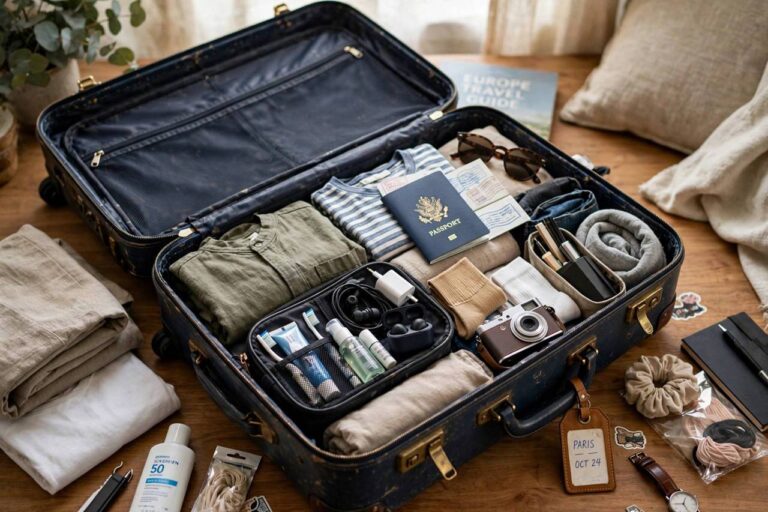
Checked bags can be delayed; the carry-on is the mission-critical kit. For the kids: diapers/pull-ups (double estimate), wipes (the universal tool), full change of clothes per child plus one for the adult, activity kit by age, downloaded entertainment + headphones + charger, snacks (more than reasonable), lollipops or gum for ears, comfort item, empty sippy cup/bottle (fill after security), and any medications. Logistics: passports/IDs, a printed itinerary backup, a small first-aid pouch, plastic bags (for the unthinkable — trash, wet clothes, motion sickness), and sanitizing wipes for the tray table and armrests.
Pack the kids’ essentials in your bag, not theirs — you need access without negotiating with a small person. And keep the liquids bag and documents in the same outer pocket every time; airport security with kids is stressful enough without a document hunt. For beach destinations specifically, a toddler beach packing list covers what the plane kit does not.
Seat Strategy and Booking Smarts
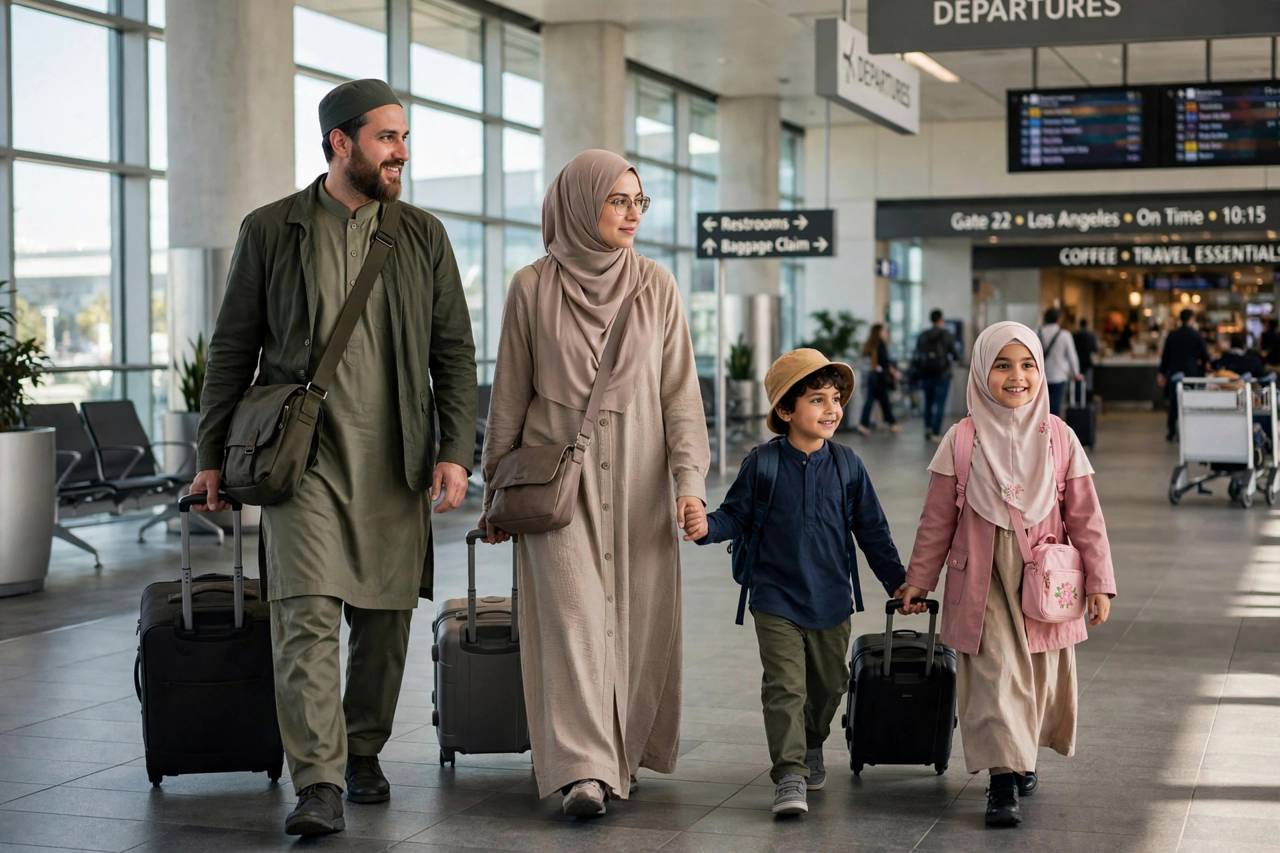
Book early-morning flights when kids are freshest and delays are rarest. Nonstop beats layovers with small children almost every time — a layover is not a break, it is a second boarding process with tired kids. If you must connect, allow generous time; sprinting through terminals with a toddler is nobody’s idea of fun.
Seat selection: window seats contain toddlers (wall on one side, parent on the other) and provide the window distraction. Aisle seats give you escape access for bathroom runs and walks — with two adults, take window and aisle and hope the middle stays empty; with one adult and a lap infant, the aisle is usually the better call. Bulkhead rows offer legroom but armrests do not lift — worse for spreading out with kids, despite the reputation.
Fare hunting with kids has its own logic: flexible dates matter more (school calendars constrain you, so book the constrained dates early), and the cheapest fare is not always cheapest once you add seat selection fees for the whole family. Finding cheap flights strategically — fare alerts, nearby airports, shoulder seasons — matters more with kids because you are multiplying every saving (or surcharge) by three or four.
Surviving Delays and Layovers with Kids
No plan survives contact with a three-hour tarmac delay — so plan for the plan failing. The delay kit: keep the activity kit’s “reserve” items unopened for exactly this scenario; a fresh toy during hour two of a delay is worth ten used ones. Terminal strategy: scope the play areas (many large airports have them — check the airport map while taxiing), find the empty gate areas for running-around space, and locate family restrooms early. Food: eat at the first sign of delay, not when everyone is already melting down — hunger makes everything worse and airport food lines get longer as delays cascade. Rebooking with kids: if a connection is missed, get in the rebooking line (or on the phone with the airline) immediately while one adult entertains the kids — speed matters because family-friendly routings vanish first. Pack one “emergency only” snack you never otherwise allow — its novelty buys twenty minutes when you need it most. And reframe it for the kids: “we get extra airport adventure time” lands better than visible parental panic. Children take their emotional cues from you; if the delay is an adventure, it is an adventure.
Frequently Asked Questions
What age is hardest to fly with?
Most parents agree: 18 months to 3 years. Babies sleep and older kids can be reasoned with; toddlers have energy, opinions and no interest in sitting still. The novelty-rotation strategy (new toys, snacks, movement breaks) is designed specifically for this age.
How do I keep my baby’s ears from hurting on a plane?
Feed (nurse, bottle or pacifier) during takeoff and landing — swallowing equalizes ear pressure. For toddlers, lollipops, chewy snacks or drinking through a straw work the same way. Time it to the actual ascent/descent, not before.
Should I buy a seat for my infant?
Under-2s can fly as lap infants domestically, but buying the seat and bringing an FAA-approved car seat is safer and often more comfortable — many babies sleep better in their familiar seat. On long-haul flights, it is usually worth it; on short hops, lap is fine.
What snacks are best for toddlers on planes?
Small, slow-to-eat, low-mess items in individual containers: puffs, crackers, dry cereal, fruit pieces, cheese cubes. Avoid anything sticky, crumbly or strong-smelling out of respect for neighbors. Pack roughly twice what seems reasonable.
How early should I arrive at the airport with kids?
Add 30–60 minutes to the usual recommendation — so about 2.5–3 hours for international, 2 hours domestic. The extra time is not wasted: it becomes terminal play time that burns energy before boarding, which pays off enormously in seat behavior.
The Bottom Line
Tips for traveling with kids on planes, distilled: match the strategy to the age (milk and motion for babies, novelty rotation for toddlers, jobs and briefings for big kids), pack the carry-on like a survival kit, book nonstops and mornings, and remember that occupied beats quiet every time. It is not the serene travel of your pre-kid days. It is louder, messier and — once you have the system — genuinely enjoyable. The window-seat wonder on a four-year-old’s face at takeoff is worth every packed ziplock.