

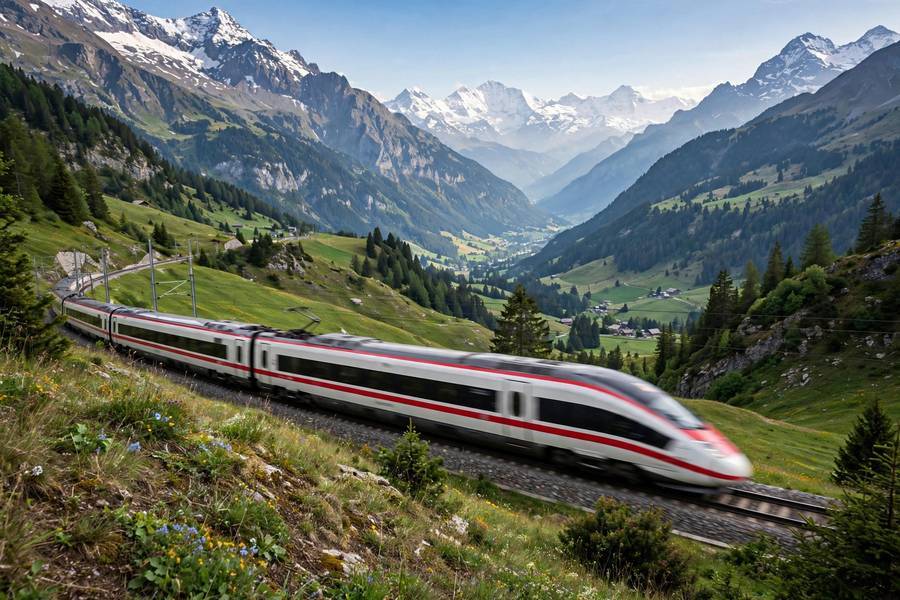
The Eurail Pass has a mythology problem. People imagine flashing it like a magic wand and gliding onto any train in Europe. The reality is better in some ways and more complicated in others — and the complications are exactly what this guide clears up.
I’ve crossed Europe by rail more times than I can count — night trains through the Alps, high-speed dashes from Paris to Barcelona, slow regional crawls through the Balkans. The Eurail Pass (for non-Europeans; Europeans buy the identical Interrail Pass) can be the best travel deal in Europe or a waste of money. Which one it is depends entirely on understanding how it actually works.
Table of Contents
- What a Eurail Pass Actually Is
- Which Pass to Buy
- Is It Worth It? Do the Math
- How to Activate Your Pass
- How Travel Days Work
- Seat Reservations: The Part Everyone Gets Wrong
- Using the Pass Day to Day
- Common First-Timer Mistakes

What a Eurail Pass Actually Is
A Eurail Pass is a ticket package that gives you a set number of travel days on trains (and some ferries and buses) across 33 European countries. It’s sold to non-European residents; if you live in Europe, the same product is called Interrail.
Key things it is and isn’t:
- It IS flexible: travel days can be non-consecutive (on flexi passes), and you can decide your route as you go.
- It ISN’T a reservation: the pass covers the fare, but many trains (especially high-speed and night trains) require separate seat reservations costing extra.
- It ISN’T valid on every train: some private railways, most airport expresses, and certain scenic lines are excluded or discounted rather than included.
The pass lives in the Eurail app as a mobile pass (paper passes still exist but mobile is standard now). Everything — activation, travel days, reservations for many trains — runs through the app.
Which Pass to Buy
Global Pass vs. One Country Pass: The Global Pass covers 33 countries and is what most multi-country itineraries need. One Country Passes are cheaper and make sense for deep single-country trips (though frankly, point-to-point tickets often win for single countries — do the math).
Flexi vs. Continuous: Flexi passes give you a number of travel days within a validity window (e.g., 7 days within 1 month, 15 days within 2 months). Continuous passes cover every day in the window. For most travelers, flexi is the sweet spot — travel days on moving days, no pass needed on stay-put days.
First vs. Second Class: Second class on European trains is excellent — this isn’t flying. First class buys wider seats and quieter cars. My rule: second class for day trains, consider first for long hauls if the price gap is small.
Youth (under 28) and Senior (60+) discounts are substantial — check eligibility before buying adult.
Is It Worth It? Do the Math
This is the step everyone skips, and it’s the most important. A Eurail Pass pays off when:
- You’re traveling in expensive-train countries (Switzerland, Germany, UK, Scandinavia) where walk-up fares are brutal.
- You’re taking many long-distance trains — roughly, the pass breaks even around 4–6 long hauls for a 7-day flexi pass.
- You value flexibility — hopping on a train without advance booking has real value.
It usually does NOT pay off when:
- You’re in cheap-train countries (Spain, Italy, much of Eastern Europe) where advance tickets cost €15–30.
- You’re taking few trains — 2–3 journeys rarely beat point-to-point prices.
- You’re mostly on high-speed routes requiring reservations — the reservation fees (€10–35 each) erode the savings.
How to check: Price your actual itinerary’s legs on national rail sites or Omio, add realistic reservation fees, and compare against the pass price. Fifteen minutes of math can save (or cost) you hundreds. This is slow travel economics — the flexible journey has value, but only you can price it.
How to Activate Your Pass
- Buy on eurail.com or an authorized reseller. You’ll get the pass in the Eurail app.
- Link it to your Eurail account and add it to a trip in the app.
- Activate before your first travel day — activation sets the start date of your validity window. You can activate in advance (choose a future start date) or on the day.
- Add your passport number — the pass is tied to your ID, and conductors check.
Important: Activation starts the clock on your validity period. Don’t activate until you’re ready — a 1-month pass activated on the 1st expires on the 31st whether you travel or not.
How Travel Days Work
On a flexi pass, a “travel day” runs from 00:00 to 23:59 CET. Any train you board during that window is covered — you can take five trains in a day and it counts as one travel day.
To use a travel day: in the app, add your journey to “My Trip,” then toggle on the travel day with the slider before boarding. This is critical — the ticket is only valid once the travel day is activated in the app. An inactive travel day is the most common reason for fines.
Overnight trains have a friendly rule: board after 19:00 and only the day of departure counts as a travel day (arrival day is free). Night trains are the budget traveler’s hotel — book a couchette and wake up in a new country.
Seat Reservations: The Part Everyone Gets Wrong
This is where first-timers stumble. The pass covers your fare. A reservation (specific seat on a specific train) is a separate thing, required on:
- Most high-speed trains: TGV (France), AVE (Spain), Frecciarossa (Italy), ICE Sprinter (Germany, some routes) — typically €10–25
- Night trains: €15–60+ depending on seat vs. couchette vs. sleeper
- Scenic premium trains: Glacier Express, Bernina Express (reservation mandatory, passes often only cover part)
And NOT required on most regional and intercity trains in Germany, Switzerland, Austria, the Netherlands, and Scandinavia — you just board with your activated pass.
How to book reservations:
– Through the Eurail website/app (reservation service, small booking fee)
– At station ticket counters (often cheapest, no fee)
– On national rail websites (SNCF, Trenitalia, etc. — look for “Interrail/Eurail reservation” options)
Book ahead for: night trains (sell out), summer Friday/Sunday high-speed routes, and the famous scenic trains. For ordinary daytime regional trains, just show up.
Using the Pass Day to Day
The rhythm becomes second nature quickly:
- Plan the next day’s journey in the app (it shows timetables and which trains need reservations).
- Activate the travel day before boarding.
- Add each leg to My Trip in the app.
- Show the app’s ticket + your passport when the conductor comes.
Keep your phone charged — a dead phone means no ticket. I carry a power bank as non-negotiable rail gear. For the full packing system, see what to pack for international travel.
Delays and missed connections: Your pass covers alternative routings — just add the new legs in the app. EU passenger rights apply to pass holders too.
Common First-Timer Mistakes
- Assuming no reservations needed anywhere. France and Spain will humble you. Check every leg.
- Not activating the travel day. The app slider must be ON before boarding. Conductors fine for this.
- Buying the pass for a cheap-train itinerary. Spain and Italy advance fares can undercut the pass badly.
- Over-scheduling. Four countries in seven days by rail is possible and miserable. Two countries well is better.
- Ignoring the 7 p.m. night-train rule. Board after 19:00, save a travel day.
- Forgetting ferries. The pass covers several ferry routes (Greece–Italy, Sweden–Finland, and more) — sometimes with small port taxes. Check the benefits list; these crossings are hidden gems of pass value.
The Eurail Pass at its best is freedom in an app — wake up in a hill town, decide over coffee to be in a different country by dinner, and just go. Understand the reservation system, do the value math honestly, and Europe’s railways become the trip itself rather than just the way between trips.

Frequently Asked Questions
It depends on the train. Most high-speed trains (France, Spain, Italy) and all night trains require separate seat reservations costing €10-60. Most regional and intercity trains in Germany, Switzerland, Austria, and Scandinavia need no reservation — just board with an activated travel day.
It pays off for multi-country itineraries in expensive-train countries (Switzerland, Germany, Scandinavia) with 4+ long-distance journeys, where it typically breaks even against walk-up fares. For cheap-train countries (Spain, Italy, Eastern Europe) or 2-3 total journeys, advance point-to-point tickets usually win. Price your actual itinerary before buying.
They’re the same product: Eurail is sold to non-European residents, Interrail to European residents. Prices, validity, and rules are essentially identical — it’s purely a residency distinction.
A travel day runs midnight to midnight CET. Any trains boarded within that window count as one day, no matter how many. You activate each travel day in the app before boarding — an inactive day means no valid ticket. Night trains boarded after 7 p.m. only consume the departure day.
Yes — the pass covers the fare, and you pay a separate reservation fee for your berth (€15-60+ for seats, couchettes, or sleepers). Board after 7 p.m. and only the departure day counts as a travel day, making night trains one of the pass’s best values.
Several ferry routes are included or discounted: Greece-Italy crossings, Sweden-Finland, and others across 33 countries. Some charge small port taxes. Check the Eurail benefits list for your route — these crossings are among the pass’s most underused perks.