How to Unclog a Drain With Baking Soda and Vinegar (Honest Guide)

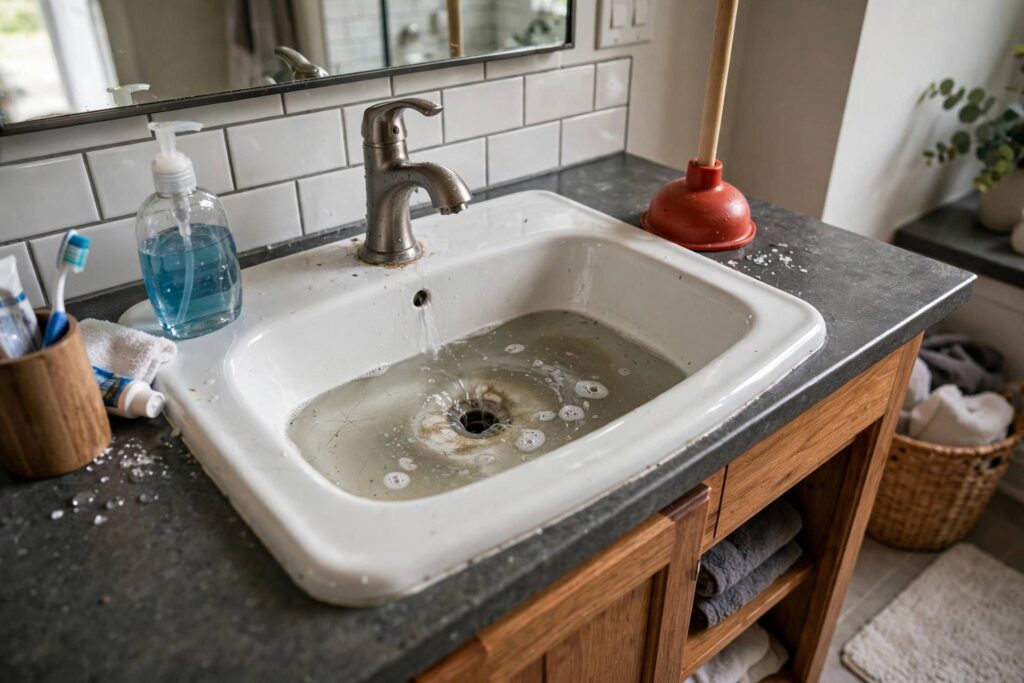
Let me give you the honest version of how to unclog a drain with baking soda and vinegar, because most articles will not: it works on mild, slow-draining clogs — the kind caused by soap scum and light buildup near the surface. It does not work on serious clogs. It will not dissolve a wad of hair three feet down the pipe, it will not cut through grease, and the satisfying fizz is mostly theater. I am telling you this upfront so you do not waste an evening, and so you know exactly when to try it and when to skip straight to what actually works.
I have been doing home repairs for twenty years, and I have nothing against this method — I use it myself as maintenance. It is cheap, it is safe for your pipes (unlike chemical drain cleaners, which I will get to), and for the right clog it genuinely helps. You just need realistic expectations and a clear escalation plan. Here is both.
When Baking Soda and Vinegar Can Work
Try this method when:
- The drain is slow but still moving water — not fully stopped.
- The problem is recent — days, not months, of slow drainage.
- You suspect soap scum, toothpaste, or light residue (bathroom sinks are the best candidates).
- You want monthly maintenance to prevent clogs from forming.
Skip it and go to the escalation section when:
- The drain is completely stopped with standing water.
- Multiple drains are slow at once (that suggests a main-line problem — call a plumber).
- You smell sewage or see water backing up in other fixtures.
- The clog is clearly hair or grease — the two things this method cannot handle.
The Method: Step by Step
Do it right and you maximize what little power this has:
- Clear the drain opening. Remove the stopper or strainer and pull out any visible hair or gunk with tweezers or needle-nose pliers. This alone fixes a shocking number of “clogs.”
- Flush with boiling water first. Pour a kettle of boiling water down the drain to soften surface buildup. (Skip boiling water on PVC pipes if your plumbing is older — very hot water can soften PVC joints. Hot tap water is the safe alternative.)
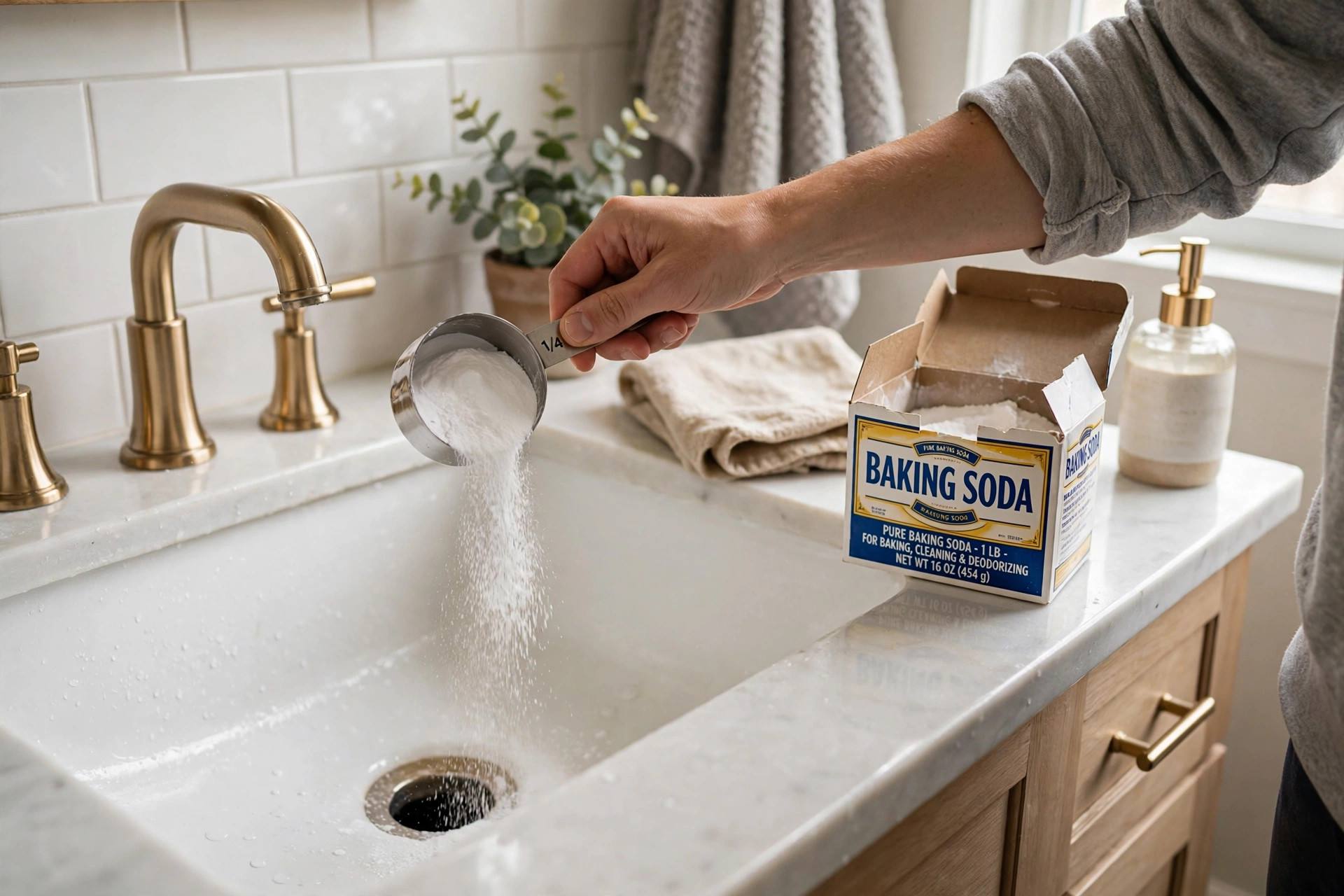
- Add 1/2 cup of baking soda. Pour it directly into the drain, working it down with a spatula if needed. You want it in the pipe, not sitting in the basin.
- Add 1/2 cup of white vinegar. Pour it in right after. It will fizz — that is the acid-base reaction. It looks dramatic; chemically, it is mild.
- Cover the drain for 15–30 minutes. Plug it with a rag or stopper. The theory is that containing the fizz forces it downward against the clog instead of up into your face.
- Flush with hot water. Remove the cover and flush with a kettle of hot (not necessarily boiling) water for a minute or two.
- Test. Run the tap and watch. Improved? Great. Unchanged? Do not repeat endlessly — move to escalation.
One round is a fair test. If one round did nothing, a second round will also do nothing — the chemistry does not accumulate. This is the point where most articles tell you to repeat, and I am telling you to stop.
Why the Fizz Is Mostly Theater
I want to be straight about the chemistry, because understanding it saves you from the internet’s mythology. Baking soda (a base) plus vinegar (an acid) produces carbon dioxide gas, water, and sodium acetate. The fizzing is real. But the cleaning power is modest — the reaction is brief, the pressure is low, and neither ingredient is a strong solvent for hair, grease, or soap curds.
What actually helps in this method: the hot water flushes (doing most of the work), the mechanical agitation of the fizz (minor), and the mild deodorizing (legitimate — it does freshen a smelly drain). It is a decent maintenance routine and a reasonable first attempt on a mild clog. It is not a drain-clearing powerhouse, and anyone telling you otherwise is selling pageviews.
Escalation: What to Try When It Doesn’t Work
When the gentle method fails, escalate in this order — cheapest and safest first:
1. Plunger (the right kind)
A cup plunger (the classic sink shape, not the flange toilet shape) with the overflow hole blocked by a wet rag. Fill the basin with enough water to cover the plunger cup, then plunge vigorously — 15–20 hard strokes. The hydraulic pressure dislodges clogs that chemistry cannot touch. This fixes more drains than everything else on this list combined.
2. Drain snake / hair tool
A $5 plastic hair snake with barbs pulls out the hair wads that cause most bathroom clogs. Push it in, twist, pull — brace yourself, it is disgusting, and it works. For deeper clogs, a 25-foot hand-crank drum auger ($25–35) reaches what the plastic tool cannot.
3. Remove and clean the P-trap
Put a bucket under the sink, unscrew the curved P-trap, and clean it out by hand. Most sink clogs live right here. It is a fifteen-minute job, it is not difficult, and it is deeply satisfying. Just remember how the washers and nuts were oriented when you reassemble.
4. Call a plumber
Call a professional when: multiple fixtures are affected, you suspect the main sewer line, the clog is beyond your snake’s reach, or you have tried the above and the drain is still dead. A plumber’s visit for a simple clog typically runs $100–$250 — expensive compared to baking soda, cheap compared to a burst pipe from misused chemicals.
A Warning About Chemical Drain Cleaners
Since we are being honest: skip the caustic chemical drain cleaners (the lye and acid-based ones) unless you know exactly what you are doing. They can damage older pipes, they create toxic fumes, they can cause chemical burns, and if they fail — which they often do on hair clogs — you are left with a sink full of caustic water that makes every subsequent fix dangerous, including for the plumber you eventually call. Enzyme-based cleaners are the gentler alternative: slower (overnight), safer, and genuinely decent for organic buildup as maintenance.
How to Unclog a Drain With Baking Soda and Vinegar Safely
The method is gentle, but “gentle” still deserves safety specifics — especially because people combine it with other cleaners in ways that are genuinely dangerous. Read this section once and you will never make the mistakes that send people to urgent care.
Never mix with chemical drain cleaners. This is the big one. If you have already poured a caustic or acidic drain cleaner down the drain, do NOT follow it with baking soda and vinegar — or anything else. Mixing acids and bases with commercial chemicals can produce toxic fumes, violent reactions, or heat that damages pipes. If chemicals are already in there, either wait them out fully (flush extensively with water) or call a plumber and tell them exactly what you used. Plumbers need to know before they open a trap full of caustic water.
Respect your pipe material. Baking soda and vinegar are safe for all common pipe types — PVC, copper, cast iron, galvanized steel. The caution in this method is about the hot water flushes, not the baking soda: avoid pouring fully boiling water into old PVC drains (it can soften joints over time — hot tap water is the safe substitute), and go easy on boiling water with porcelain-coated sinks (thermal shock can crack the coating; use hot, not boiling).
Protect yourself during the process. The fizzing reaction is harmless, but covering the drain concentrates it — when you remove the cover, step back for a second rather than leaning in for a close look. If you are working under the sink on the P-trap afterward, wear gloves and eye protection; drain water is biologically unpleasant and old traps can splash. None of this is dramatic — it is just the basic hygiene of working with drains.
Know when the gentle approach is the wrong approach. Baking soda and vinegar will not harm your plumbing, but relying on it for months while a real clog worsens can. A slow drain that does not respond to one round is telling you something — listen to it and escalate to mechanical methods rather than repeating the chemistry weekly. The safest drain-clearing strategy is not the gentlest chemical; it is the correct tool for the actual clog, applied promptly.
Frequently Asked Questions
How long do you leave baking soda and vinegar in the drain?
Fifteen to thirty minutes with the drain covered is plenty. Longer does not help — the chemical reaction finishes within minutes. Anything beyond half an hour is just waiting for no reason.
Can baking soda and vinegar damage pipes?
No — this is one of the method’s genuine advantages. Both are mild and safe for all common pipe materials, including PVC, copper, and old iron. The same cannot be said for chemical drain cleaners, which is a real point in the baking soda method’s favor.
Will it work on a garbage disposal clog?
Sometimes, for mild odor and light buildup — but never put your hand in the disposal, run cold water when operating it, and if the disposal hums but does not spin, use the hex key on the bottom reset before anything else. A disposal that is jammed mechanically needs the jam cleared, not chemistry.
Why is my drain still slow after trying everything?
If plunging, snaking, and trap-cleaning all fail, the blockage is deeper in the line — possibly in the main drain or sewer lateral. That is plumber territory: they have powered augers and cameras that reach 50–100 feet. Do not keep pouring things down hoping for a miracle.
How often should I do baking soda and vinegar maintenance?
Monthly is reasonable for bathroom sinks prone to soap scum. Honestly, though, a monthly flush of very hot tap water does most of the same preventive work. The baking soda and vinegar version mainly adds deodorizing.
The Honest Summary
How to unclog a drain with baking soda and vinegar: try it once on a mild, slow drain — it is cheap, safe, and sometimes enough. If it does not work, do not repeat it; escalate to the plunger, the snake, the P-trap, and then the plumber, in that order. The method deserves its place as step one. It just does not deserve to be steps two through ten.