How to Start a Blog and Make Money: The Honest Playbook

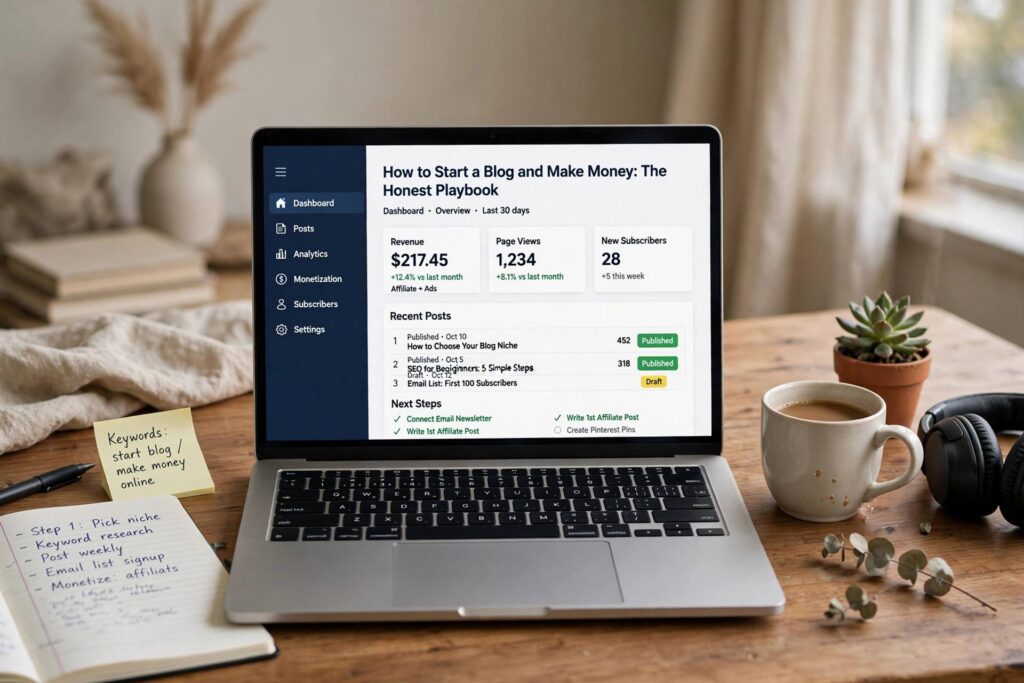
Everyone wants the short version of how to start a blog and make money, so here it is: pick a topic people already search for, publish genuinely useful articles on a steady schedule, build an audience, and monetize once the traffic arrives. That is the entire formula. The part nobody tells you upfront? It takes months of unpaid work before the first real income shows up — and the bloggers who succeed are simply the ones who kept publishing through that quiet stretch.
I have watched friends launch blogs in every niche imaginable, and the pattern is always the same. The winners treat the blog like a small business from day one: they learn basic SEO, they write for readers instead of themselves, and they track what works. This guide gives you that honest, step-by-step playbook — niche selection, setup, content, traffic, and the monetization methods that actually pay — without the “make six figures in 30 days” nonsense.
Set Honest Expectations Before You Start
Learning how to start a blog and make money is less like flipping a switch and more like planting an orchard. Most blogs earn nothing for the first three to six months. A realistic milestone looks like this: months 1–3 for setup and your first 20–30 articles, months 4–6 for traffic to start compounding, and sometime in months 6–12 for meaningful income if you publish consistently and target the right keywords.
Why the delay? Search engines need time to trust a new site, and you need a library of content before any single article can rank reliably. Bloggers who quit at month three usually quit one month before things would have turned. Going in with honest expectations is not pessimism — it is the single biggest predictor of whether you will still be publishing a year from now.
One more truth: the income ceiling is real, but so is the floor. Plenty of bloggers earn a few hundred dollars a month as a side project, and a smaller number build it into a full-time living. Aim first for your first $100 month. That proof of concept teaches you more than any course.
Choosing a Niche That Can Actually Pay
Your niche — the specific topic your blog covers — determines everything downstream: who reads, what you write, and which monetization methods fit. The sweet spot sits at the intersection of three things: you know (or can learn) the topic, an audience actively searches for it, and advertisers or buyers exist in the space.
Practical niches that consistently monetize include personal finance, home cooking, parenting, fitness, travel, tech tutorials, and hobby deep-dives like gardening or photography. Notice these all share a trait: readers arrive with intent — they want to solve a problem, buy something, or learn a skill. Intent is what advertisers pay for.
Validate before you commit. Search your niche topic and check whether real businesses advertise there, whether affiliate programs exist for its products, and whether forums and subreddits buzz with questions you could answer. If you cannot find a single company spending money in the space, that is a warning sign, not a blue-ocean opportunity.
Then narrow it. “Food” is too broad to compete in; “weeknight dinners for picky eaters” is a niche you can own. A tight niche lets a new blog rank for specific searches while the giant sites fight over the head terms.
The Technical Setup (One Weekend, No Coding)
Setting up the blog itself is the easiest part of the whole journey — do not let it eat a month of your momentum.
Pick a domain name. Short, memorable, and brandable beats keyword-stuffed. Check that the matching social handles are free, then register the .com if you can. Your domain is a business asset; treat the $12 or so as your first investment.
Get hosting and install WordPress. Self-hosted WordPress (WordPress.org, not .com) is what most money-making blogs run on, because you own the site and can monetize freely. Most hosts offer one-click installs; the whole process takes under an hour. If you are weighing the technical side, this walkthrough of starting a blog from scratch covers the setup decisions in more detail.
Install the essentials, then stop. You need: a clean, fast theme; an SEO plugin; a backup plugin; and a contact form. That is the list. Every extra plugin slows your site and adds maintenance. You can add fancy features later, when traffic justifies it.
Write your core pages. Before your first article, publish an About page (who you are and who the blog serves), a Contact page, and a Privacy Policy page. These take an afternoon and make the site look legitimate to readers and ad networks alike.

How to Start a Blog and Make Money With Content That Ranks
Content is where blogs live or die, and the bloggers who earn treat every article as a product designed to rank and help. The operating principle is simple: one keyword, one article. Each post targets a single specific search query and answers it better than anything else on page one.
Start with low-competition keywords. A new blog cannot outrank established sites for “best credit cards,” but it can absolutely win “best credit cards for college students with no credit history.” Free keyword tools and Google’s own “People also ask” boxes are enough to find these longer, specific queries in your niche.
Structure every article for both readers and search engines: a clear title containing the keyword, an introduction that states the answer quickly, descriptive subheadings, short paragraphs, and a conclusion with a next step. Add original photos or screenshots where they help — original media is one of the few advantages a small blog has over content mills.
Publish on a schedule you can sustain for a year. Two excellent articles a week beats five rushed ones that burn you out by March. Consistency compounds: each article is a lottery ticket that keeps working for you, and a hundred tickets outperform ten.
Getting Traffic: The Three Channels That Matter
Traffic is oxygen, and for a new blog, three channels do nearly all the work:
Search (SEO). Your primary channel. Target specific keywords, write genuinely complete answers, and build internal links between your articles so readers (and search engines) discover more of your site. This channel is slow to start and then snowballs — the classic blog growth curve.
Pinterest. For visual niches — food, home, fashion, crafts, parenting — Pinterest acts as a visual search engine that can send meaningful traffic to new blogs far faster than Google. It rewards fresh pins and consistent posting.
Email. From day one, offer a simple freebie (a checklist, a template, a short guide) in exchange for email signups. Social algorithms change; your email list is an asset you own. Even a list of 500 engaged subscribers can drive your first affiliate sales.
Notice what is not on the list: going viral. Viral traffic is a sugar rush — exciting and gone by Tuesday. Search and email compound. Build the boring channels.
The Monetization Methods That Actually Pay
Once traffic flows, income comes from a handful of proven methods. Most successful blogs stack two or three of these:
Display ads. Networks place ads on your pages and pay per view or click. Entry-level networks accept smaller sites; premium ones require tens of thousands of monthly sessions. Ads are the most passive income but also the lowest-paying per visitor.
Affiliate marketing. You recommend products and earn a commission on resulting sales. This pays far better than ads when your content targets buying intent — reviews, comparisons, and “best of” lists. Only recommend products you would genuinely stand behind; reader trust is the actual asset.
Sponsored posts. Brands pay you to write about their products. These deals arrive once your traffic and authority are established, and they pay well — but disclose them clearly and turn down sponsors that do not fit your audience.
Digital products. Ebooks, templates, courses, and printables carry the highest margins because you create them once and sell them forever. Many bloggers find their first product — even a $19 template pack — out-earns months of ad revenue.
Services. Consulting, freelance writing, or coaching in your niche. Unscalable, but it pays immediately and deepens your expertise, which feeds back into better content.
Match the method to your niche: a cooking blog thrives on affiliates and digital cookbooks; a finance blog leans on high-paying affiliate programs; a craft blog sells patterns. And remember that audio is an option too — many bloggers eventually explore how podcasts make money as a companion channel once their audience grows.

Mistakes That Keep Blogs Broke
Writing about everything. A blog that covers fitness, finance, and film reviews confuses both readers and search engines. One niche, deeply covered, wins.
Publishing sporadically. Ten posts in January and silence until June tells search engines the site is abandoned. A sustainable rhythm beats bursts.
Monetizing too early. Slapping ads on a site with 200 monthly visitors earns pennies and slows the site down. Build the audience first; monetize when traffic justifies it.
Ignoring email from day one. Bloggers who wait a year to start a list always regret it. The signup form costs nothing to add early.
Copying competitors instead of out-teaching them. If your article says the same thing as the top five results, there is no reason to rank it. Add the example they skipped, the screenshot they did not take, the mistake they did not warn about.

Your First 90 Days, Mapped
Days 1–7: niche validation, domain, hosting, WordPress, essential plugins, core pages. Publish article one.
Days 8–30: publish 8–12 articles targeting low-competition keywords. Set up analytics, an email signup form, and a Pinterest account if your niche fits.
Days 31–60: keep publishing twice a week. Start internal linking between related posts. Create your first simple freebie for email signups. Study which articles get early traction and write more like them.
Days 61–90: you should have 25–35 articles live. Apply to an entry-level ad network or join two or three affiliate programs relevant to your best posts. Keep publishing — this is the stretch where most people quit, and quitting is the only guaranteed way to fail.
After that, it is refinement: double down on what ranks, update old posts, and add your second monetization method. The bloggers earning real money are not geniuses. They are the ones who treated month four like month one and kept going.
Frequently Asked Questions
How much does it cost to start a blog?
You can launch properly for under $100 in year one: a domain (roughly $12), basic hosting ($3–$10 per month), and a free theme. Everything else — premium themes, email tools, courses — is optional until the blog earns.
How long until a blog makes money?
Most blogs see their first income between months 6 and 12 with consistent publishing. Some niches and strategies are faster, but anyone promising income in 30 days is selling you something, not teaching you something.
Can you start a blog for free and still make money?
Free platforms limit your monetization options, design control, and ownership — the platform can change rules or shut down your site. Self-hosted WordPress costs little and keeps you in control, which is why nearly all earning bloggers use it.
Do I need to be an expert to start a blog?
You need to be one step ahead of your reader, not a world authority. Many successful bloggers document their learning journey openly. What matters is thorough research, honest experience, and writing that genuinely helps.
How many articles do I need before applying to ad networks?
Entry-level networks typically want 20–30 quality articles and some steady traffic; premium networks require much more (often 50,000+ monthly sessions). Focus on publishing and traffic first — the applications are easy once the numbers are there.