
I used to tell myself I didn’t have time to read. Then I checked my screen time and discovered I had roughly two hours a day I was spending on absolutely nothing — not rest, not connection, just the frictionless scroll. The time was there. It was being spent on things I’d never remember.
That was three years ago. Last year I read 34 books — not by finding more hours, but by changing where the existing hours went and, just as importantly, by changing what “reading” meant to me. No speed-reading tricks, no 5 a.m. wake-ups, no guilt. Just a handful of small, honest adjustments that fit into a life with a job, a household, and limited energy. Here’s what actually worked.
Table of Contents
- Stop Treating Reading Like Homework
- Find Your Hidden Reading Time
- Always Have the Next Book Ready
- Count Audiobooks (Yes, Really)
- Read in Every Format Without Snobbery
- Quit Books Freely
- Make Reading the Easy Choice
- Frequently Asked Questions

Stop Treating Reading Like Homework
The biggest obstacle to reading more isn’t time — it’s the moral weight we’ve attached to books. Somewhere along the way, reading became a virtue and not-reading became a failure, which turned the whole thing into homework. And homework is the last thing a tired adult reaches for at 9 p.m.
So the first step is to take reading off the pedestal. You are not becoming a better person by reading; you are entertaining and feeding yourself. Read what you actually enjoy — thrillers, romances, memoirs, the weird nonfiction about lighthouse keepers. The “right” book is the one you’ll pick up. The person who reads 30 page-turners a year is a reader. Full stop.
This matters more than any tactic below, because every tactic fails if reading still feels like an obligation. Give yourself permission to read for pure pleasure, and the rest gets much easier.
Find Your Hidden Reading Time
You don’t need to find an hour. You need to find the ten-minute gaps that already exist and put a book in them. Ten minutes, three times a day, is thirty minutes — at average speed that’s roughly a book every two weeks, or 25 books a year, from time you were previously spending waiting.
Where the gaps hide:
- The commute. Train, bus, or passenger seat. If you drive, this is audiobook time — more on that below.
- The lunch break. Twenty minutes with a book beats twenty minutes of scrolling, and you’ll go back to work with a clearer head.
- Waiting rooms, lines, appointments. The phone comes out by default here. Put a book (or e-reader app) on the home screen where the social apps are.
- The morning coffee. Fifteen pages before the day starts. It’s quiet, your mind is fresh, and it sets a tone that no headline ever will.
- Exercise equipment. A book propped on the treadmill or a novel on the stationary bike turns dull cardio into the part of the day you look forward to.
Do a quick audit of your own day for one week. You’ll be surprised how much waiting your life contains — and how much of it currently goes to your phone. Students get a bonus here: the same gaps work for textbooks and course reading. The techniques overlap more than you’d think — I covered the study-specific side in how to study for final exams.
Always Have the Next Book Ready
The number one killer of a reading habit isn’t boredom — it’s the gap between books. You finish a great one on Sunday night, you mean to find the next one, life happens, and suddenly it’s been three weeks and you “fell out of reading.” You didn’t fall. You just didn’t have a book.
The fix is embarrassingly simple: always have the next two books ready before you finish the current one. Keep a running list — on your phone, on paper, wherever you’ll actually look at it. When someone recommends something, write it down immediately; recommendations evaporate within hours.
Good sources for the list:
- Friends whose taste you trust. One good recommender beats a hundred algorithm suggestions.
- The last pages of books you loved. Authors thank and mention their influences; follow those threads.
- Library staff picks and displays. Librarians are the original recommendation engines, and they’re free.
- Your own past. The author whose book you loved five years ago has probably written two more since.
The library deserves a special mention here: it’s free, the wait lists create pleasant anticipation, and returning books on time adds a gentle deadline that keeps you moving. I get most of my books from the library, and the due date has finished more books for me than willpower ever did.

Count Audiobooks (Yes, Really)
Let’s settle this: audiobooks count. The idea that listening “isn’t really reading” is gatekeeping with no basis — studies consistently show comprehension and retention are comparable between listening and reading for most material. Your brain processes the same story, the same ideas, the same sentences.
More importantly, audiobooks unlock time that print can’t touch: driving, cooking, cleaning, walking the dog, folding laundry. These are hours your eyes are busy but your mind is free. I “read” about a third of my yearly total this way — memoirs read by their authors are especially good, because the performance adds a layer the page can’t.
A few practical notes:
- Speed it up gradually. Start at 1x, work up to 1.25x or 1.5x. Your brain adapts faster than you’d expect.
- Match the book to the format. Plot-driven fiction, memoirs, and narrative nonfiction shine in audio. Dense reference material belongs in print.
- Use the library app. Libby and similar apps give you free audiobooks with your library card. Keep several holds active at once, since wait lists are the only downside.
- Double the payoff. If you’re studying another language, listening to books in that language builds ear and vocabulary at once — it pairs beautifully with how to learn a new language faster.
If you’ve been resisting audiobooks out of principle, consider this your permission slip. The goal is more books in your life, not more books in one specific format.
Read in Every Format Without Snobbery
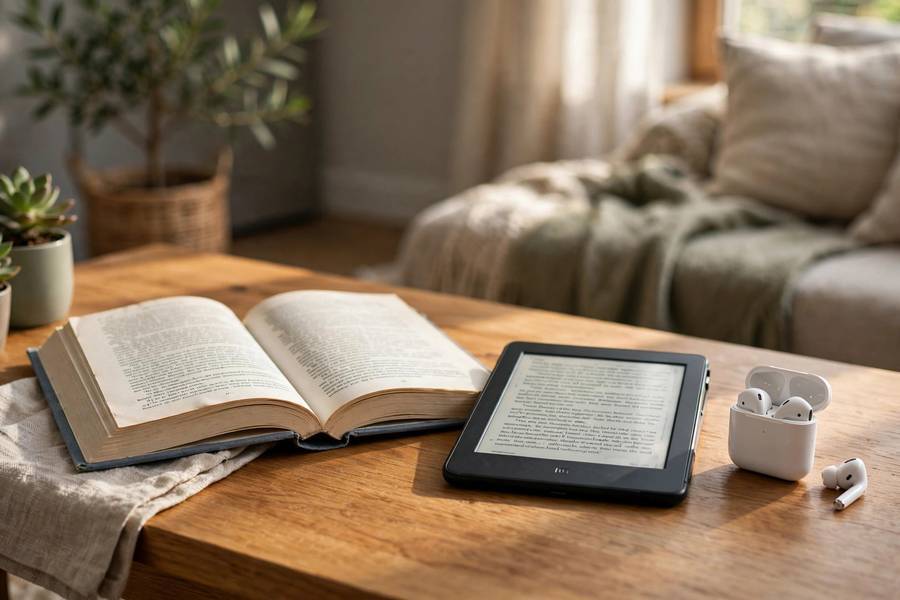
Print, e-book, audiobook — the format wars are a distraction. Each has a job:
- Print for the deep, slow reads — the ones you want to underline, lend, and keep.
- E-books for travel, for bed (backlit screen, one-handed), and for the 99-cent experiments you’re not sure about.
- Audio for the busy-hands hours.
I usually have one book going in each format, matched to the situation. It sounds like a lot, but it actually removes friction: there’s always a right book for the moment you’re in. Waiting for the dentist with ten minutes? E-book on the phone. Driving to the store? Audiobook resumes mid-sentence. Winding down at night? The paperback on the nightstand.
The snobbery to drop: that e-books are lesser, that audiobooks are cheating, that re-reading is a waste when there are new books. Re-reading a beloved book counts double — it’s reading plus the pleasure of an old friend. Some of my best reading years included three or four re-reads.
Quit Books Freely
This is the rule that changed everything for me: if you’re not enjoying a book by page 50 (or 20%, for the precise), put it down and move on. Life is too short and the to-read list too long for books that feel like chores.
We were all taught to finish what we start, and it’s a fine rule for vegetables and work projects. For leisure reading, it’s a trap. Every book you force yourself through is time stolen from a book you’d love — and worse, it teaches your brain that reading is a slog, which makes you reach for it less.
Quitting isn’t failure; it’s curation. I quit roughly one in five books I start, and my reading life is dramatically better for it. The book isn’t bad — it’s just not for you right now. Maybe in five years. Maybe never. Both are fine.
A corollary: stop buying books out of guilt or aspiration. The unread stack of “should” books on your shelf is a monument to obligation. Donate them. Keep the ones that excite you. Your shelves should look like an invitation, not an assignment.
Make Reading the Easy Choice
Willpower is unreliable; environment is not. The final piece is arranging your surroundings so that reading is simply the easiest thing to reach for.
- The book goes where the phone was. Nightstand, bag, coat pocket. If the book is closer than the phone, the book wins more often than you’d think.
- Charge the phone outside the bedroom. This one change protects both your sleep and your evening reading hour. An alarm clock costs almost nothing.
- Make a reading spot. It doesn’t need to be fancy — a chair with good light and a blanket. A designated spot creates a ritual cue: sit here, read.
- Track it lightly. A simple list of finished books — in a notebook or an app — gives you the quiet satisfaction of progress. Don’t set punishing goals; a gentle target (“a book a month”) is plenty.
- Tell people you’re a reader. It sounds silly, but identity is powerful. When “I’m reading something good right now” becomes part of how you describe yourself, you’ll protect the habit without thinking about it.
None of this requires becoming a different person or finding hours you don’t have. It’s just redirection: the same gaps, the same evenings, pointed at books instead of the scroll — a small, steady piece of how to balance work and personal life. Start tonight — pick the book, put it on the pillow, and let the phone charge in the kitchen.
Frequently Asked Questions
Use the ten-minute gaps that already exist: commutes, lunch breaks, waiting rooms, morning coffee, and exercise time. Ten minutes three times a day equals about 25 books a year. You don’t need new hours — you need to redirect the waiting time you already spend on your phone.
Yes. Research shows comprehension and retention are comparable between listening and reading for most material. Audiobooks also unlock time print can’t touch — driving, cooking, cleaning, walking — making them one of the most effective ways to fit more books into a full life.
There’s no magic number. A gentle target like one book a month builds the habit without pressure. Reading ten minutes three times daily gets you to roughly 25 books a year. The goal is a sustainable reading life, not a number to report.
Absolutely — quitting is curation, not failure. If you’re not enjoying a book by page 50, put it down. Forcing yourself through books you dislike teaches your brain that reading is a chore and steals time from books you’d love.
Keep a running list of recommendations from friends whose taste you trust, follow author acknowledgments in books you loved, and browse library staff picks. Most importantly, always have your next two books ready before you finish the current one — the gap between books is where reading habits die.
Change your environment, not your willpower: put the book where the phone was, charge your phone outside the bedroom, and create a small reading spot with good light. When reading is the easiest thing to reach for, you’ll reach for it.