How to Build Muscle Without Gym: The Complete Home Program

You don’t need a gym membership to build real, visible muscle. I know the fitness industry wants you to believe that gains only happen under a barbell in a commercial gym — but some of the strongest, most athletic people I know built their foundation with bodyweight training at home. Gymnasts do it. Military personnel do it. Prisoners famously do it. Your muscles don’t know where you are; they only know tension, fatigue, and recovery. Here’s how to give them all three without ever swiping a membership card. This guide shows how to build muscle without gym using bodyweight training, progressive overload, and smart nutrition.
The Science: Why It Works
Muscle growth (hypertrophy) happens when you subject muscle fibers to enough mechanical tension to cause microscopic damage, then let them recover and rebuild stronger. The key variable is proximity to failure — how close you push a set to the point where you can’t do another rep with good form — not the equipment you use.
Research consistently shows that muscle grows similarly whether you use heavy weights for few reps or lighter resistance for more reps, as long as sets are taken close to failure. Bodyweight exercises absolutely qualify — you just need to choose challenging variations and progress them over time. A standard push-up taken to near-failure builds chest, shoulders, and triceps just as surely as a bench press does. The mechanism doesn’t care about the logo on the equipment.
The one honest caveat: legs are harder to load heavily without equipment. Your upper body has dozens of effective bodyweight progressions; your legs will need creativity (single-leg work, high volume, explosive movements). It’s very doable — it just takes more planning, which is exactly what this guide provides.
The Foundational Movements (Master These First)
Every effective no-gym program is built on six fundamental movement patterns. Master these before anything fancy:
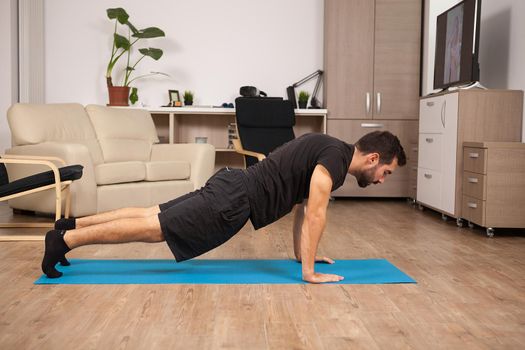
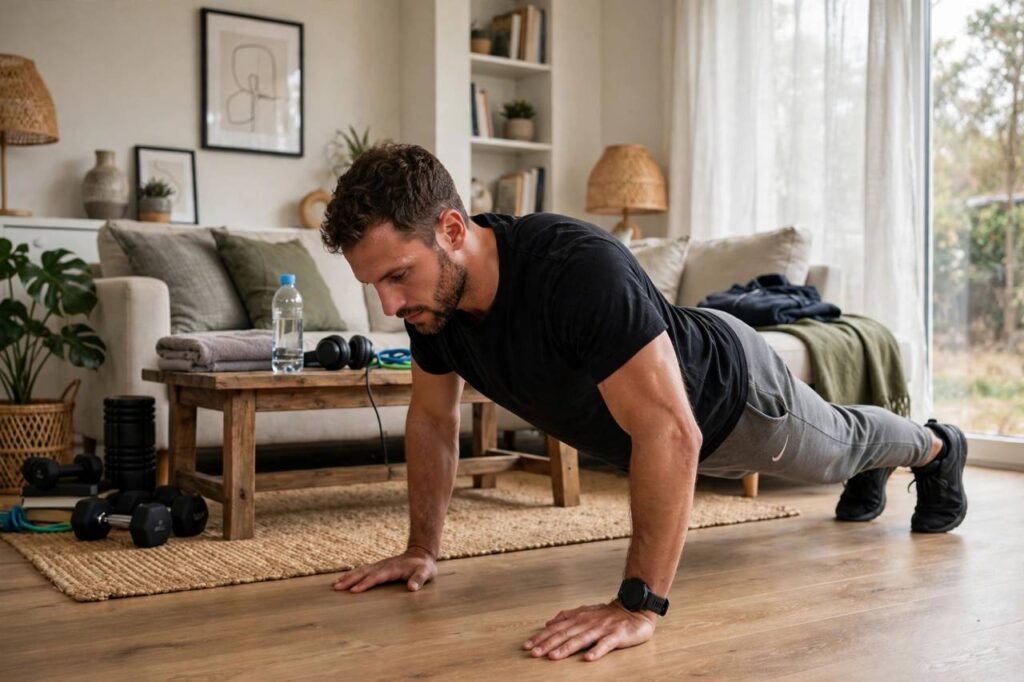
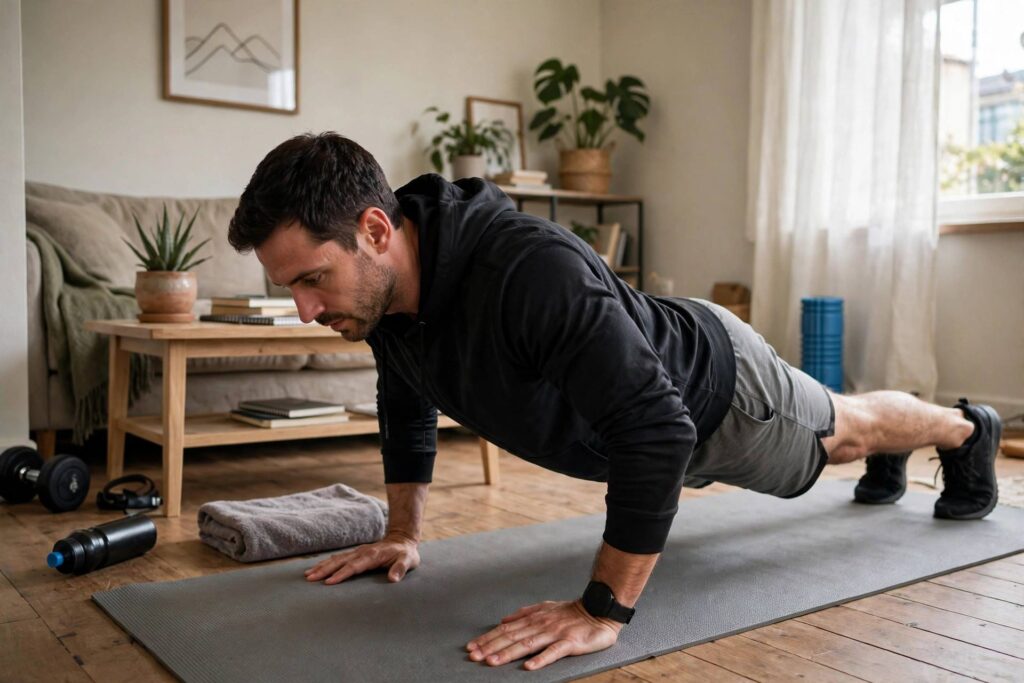
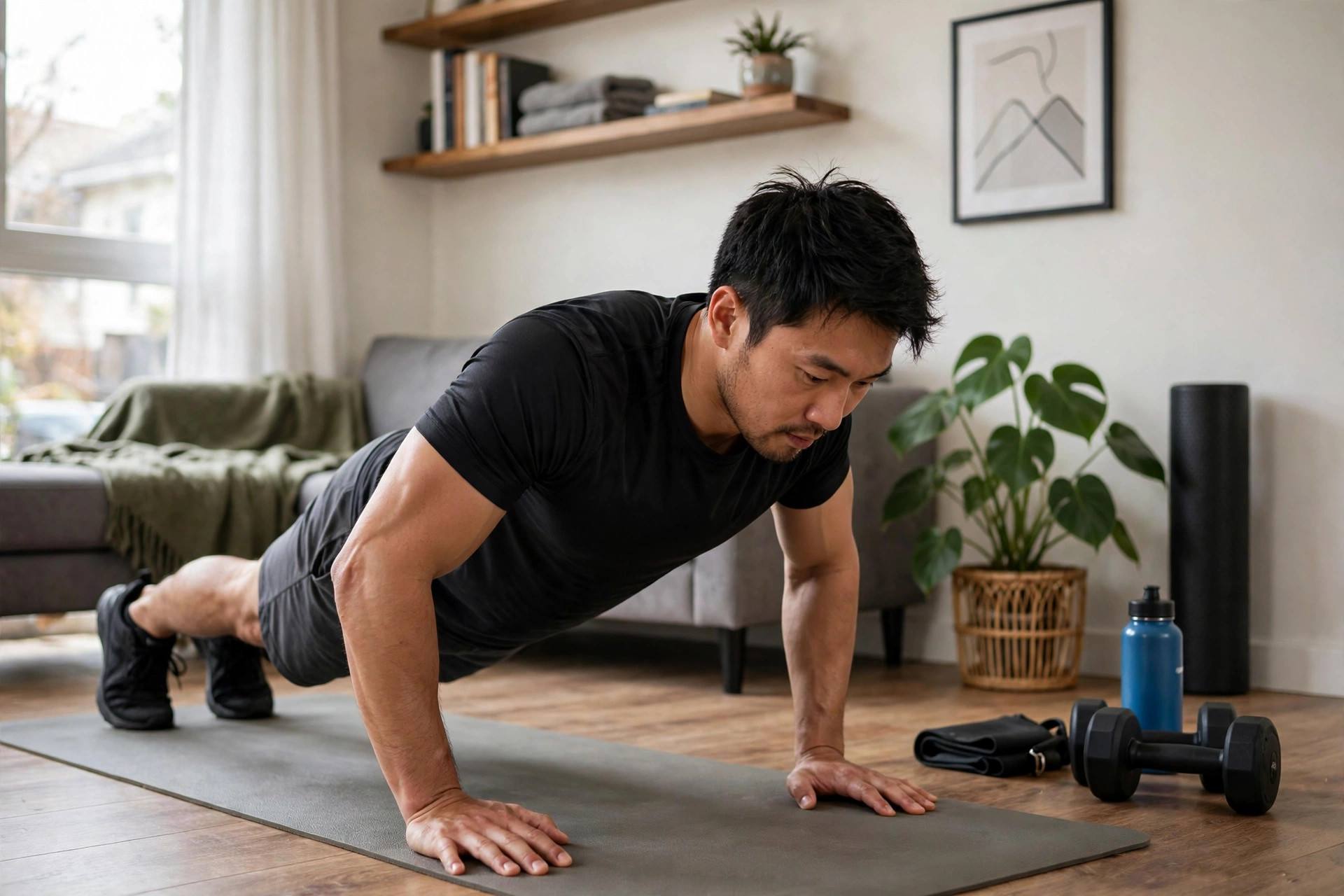
1. Push-up (horizontal push). The king of home chest training. Start with incline push-ups (hands on a sturdy table or counter) if full push-ups are too hard. Progress to standard, then decline (feet elevated), then archer push-ups, then single-arm progressions. Each step increases the load on the working muscles.
2. Pike push-up / handstand push-up progression (vertical push). Pike push-ups (hips high, pressing at an angle) build shoulders effectively. Elevate your feet to increase difficulty; work toward wall handstand push-ups over months, not weeks.
3. Bodyweight row (horizontal pull). The most-neglected home movement — and the most important for posture and back development. Use a sturdy table: lie underneath, grip the edge, and pull your chest to it. A doorway pull-up bar (the kind that braces in the frame, no screws needed) is the single best home-gym investment you can make.
4. Pull-up / chin-up (vertical pull). The ultimate upper-body builder. Can’t do one yet? Start with dead hangs (build grip and shoulder stability), then negatives (jump up, lower slowly), then assisted variations. Your first real pull-up is a genuine milestone — celebrate it.
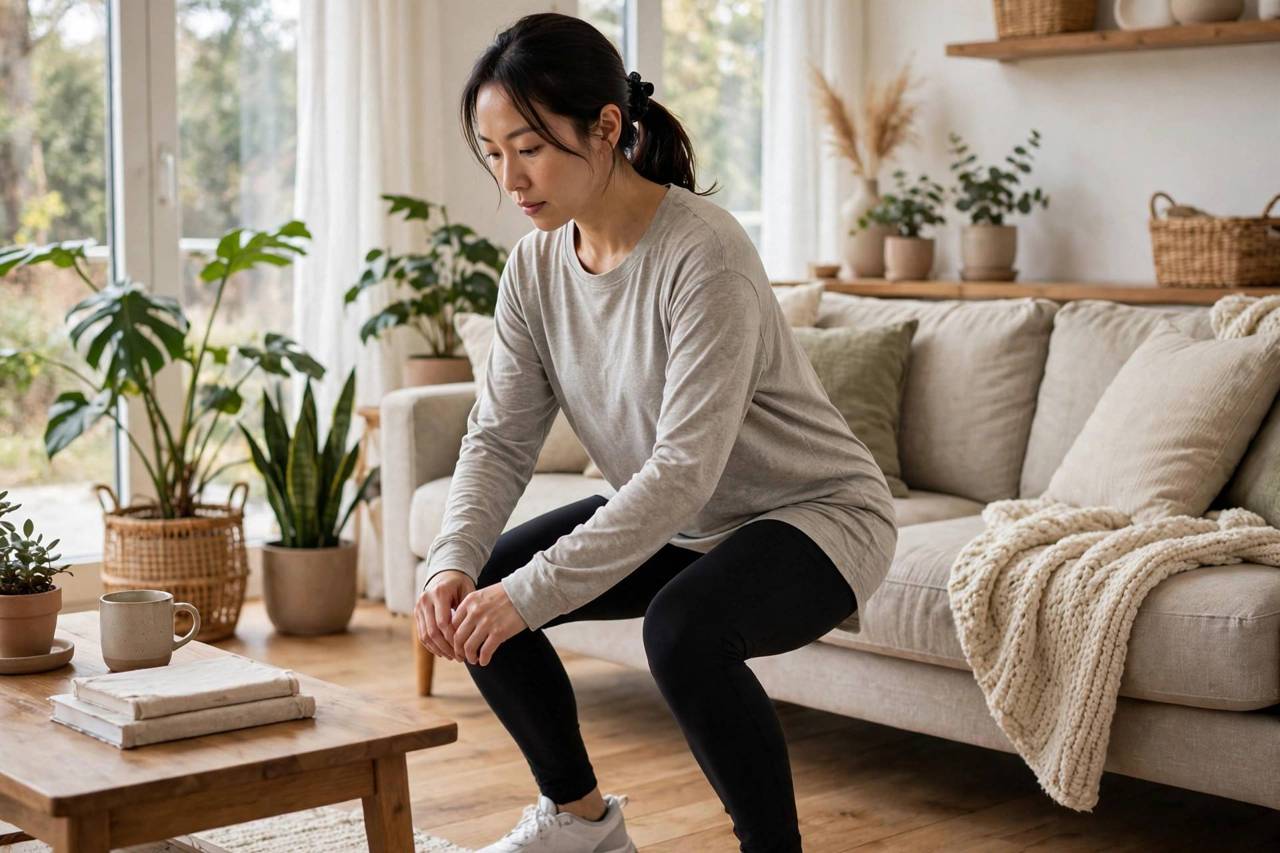
5. Squat (knee-dominant leg). Bodyweight squats → Bulgarian split squats (rear foot on a chair — brutally effective) → pistol squat progressions. Single-leg work is the secret weapon of no-gym leg training; it doubles the load per leg instantly.
6. Hinge (hip-dominant leg). Glute bridges → single-leg glute bridges → Nordic curl negatives (kneel, anchor feet under something heavy, lower slowly). Your hamstrings and glutes will never know you don’t own a deadlift bar.
For a full library of movements to draw from, check out these bodyweight exercises — it’s an excellent reference for building your exercise menu.
Progressive Overload Without Weights
Progressive overload — gradually increasing the challenge — is non-negotiable for muscle growth. Without a weight stack to add plates to, use these methods:
- Harder variations: incline push-up → push-up → decline → archer → one-arm progression. Each step is a “weight increase.”
- More reps: when you can do 3 sets of 12 clean reps, move to a harder variation rather than endless reps.
- More sets: add a set per exercise every week or two, up to 4-5 sets.
- Slower tempo: 3-4 seconds lowering each rep dramatically increases time under tension. Tempo is free intensity.
- Shorter rests: dropping rest from 90 to 60 seconds increases the challenge without changing the exercise.
- Added load: a backpack filled with books is a legitimate weight vest. Wear it for push-ups, squats, and lunges.
- Unilateral work: switching from two limbs to one roughly doubles the load. Bulgarian split squats, single-arm rows, archer push-ups.
Track everything in a notebook or app: exercise, variation, sets, reps. If you’re not progressing some variable over time, you’re maintaining, not building. The log doesn’t lie.
How to Build Muscle Without Gym: The 4-Day Home Program
Here’s a complete weekly program. Each session takes 40-50 minutes. Rest 60-90 seconds between sets.
Day 1 — Push (chest, shoulders, triceps):
- Push-ups (your current hardest variation): 4 sets to 1-2 reps from failure
- Pike push-ups: 3 sets of 8-12
- Tricep dips (chair or sturdy surface): 3 sets of 10-15
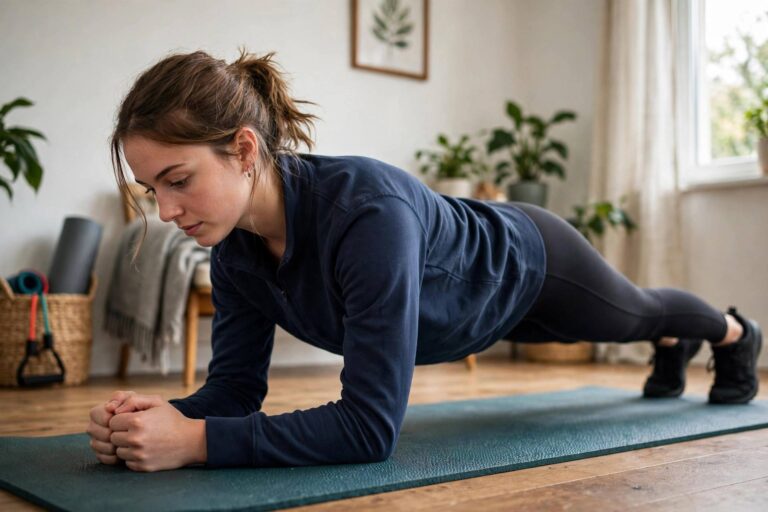
- Plank: 3 sets, hold as long as possible with good form
Day 2 — Pull (back, biceps):
- Pull-ups or negatives: 4 sets to near failure
- Bodyweight rows (table or bar): 4 sets of 10-15
- Backpack curls or towel curls: 3 sets of 12-15
- Dead hang: 3 sets, max time
Day 3 — Legs:
- Bulgarian split squats: 4 sets of 10-12 per leg
- Glute bridges or single-leg bridges: 3 sets of 15-20
- Nordic curl negatives: 3 sets of 5 (slow!)
- Calf raises (single-leg): 3 sets of 15-20 per leg
Day 4 — Full body / weak points:
- Pick your weakest movement pattern and hit it with 5 sets
- Superset push-ups + rows: 3 rounds
- Core circuit (plank, dead bugs, mountain climbers): 3 rounds
Rest or do light activity on the other three days. As you advance and want more structure around your training split, my guide on the best workout split for muscle gain will help you organize your week for maximum growth.
Nutrition: You Can’t Build Without Fuel
Training is the stimulus; nutrition is the building material. Two things matter most:
Protein: Aim for roughly 0.7-1 gram of protein per pound of bodyweight daily (that’s about 1.6-2.2g per kg). Spread it across 3-4 meals. Eggs, chicken, fish, Greek yogurt, lentils, beans, tofu — whatever fits your diet and budget. This is the single most impactful nutrition change for muscle building.
Calories: To build muscle efficiently, eat slightly above maintenance — a modest surplus of 200-300 calories daily. You can’t build a house without bricks, and you can’t build muscle in a large deficit. That said, beginners can absolutely build muscle while losing fat (body recomposition) for the first several months — one of the great beginner advantages.
Don’t overcomplicate supplements. Creatine monohydrate is the most researched, effective, and affordable supplement in existence — 3-5g daily, no loading needed. Everything else is optional. Sleep 7-9 hours; muscle is built during recovery, and skimping on sleep measurably reduces gains.
Minimal Equipment Worth Buying (Optional)
You can do this entire program with zero equipment. But if you want to invest a little, these give the biggest return:
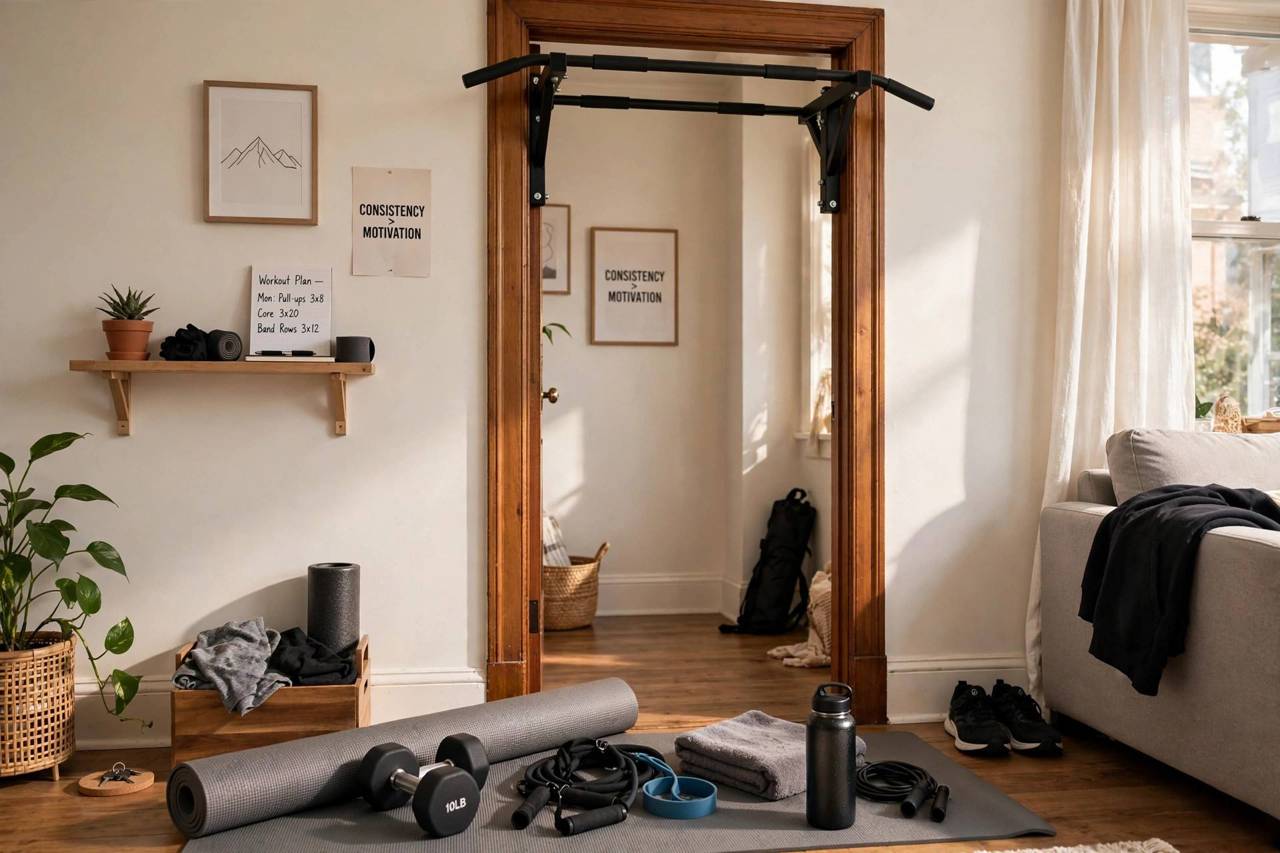
- Doorway pull-up bar — the single highest-ROI purchase. Unlocks pull-ups, chin-ups, and hanging leg raises.
- A sturdy backpack — load it with books for weighted push-ups and squats.
- Resistance bands — cheap, versatile, great for rows, pull-aparts, and assisted movements.
- Parallettes or push-up handles — deeper range of motion on push-ups, easier on wrists.
Total cost for all four: less than two months of most gym memberships. And they last for years.
Common Mistakes That Stall Home Gains
- Doing the same easy workout forever. If your routine hasn’t gotten harder in a month, your muscles have no reason to grow. Progress something every week.
- Skipping pulling movements. Push-up-only programs create imbalances and that hunched-forward look. For every push, do a pull.
- Neglecting legs. Legs are half your body. Bulgarian split squats are hard precisely because they work — embrace the burn.
- Training to failure every set. Near failure builds muscle; absolute failure every set fries your recovery. Leave 1-2 reps in the tank on most sets.
- No rest days. Muscles grow during recovery. Training the same muscles hard daily is counterproductive — respect the program’s rest days.
- Expecting overnight results. Visible muscle takes months of consistency, not weeks. Take progress photos monthly — the mirror lies day to day, but photos across months tell the truth.
What Progress Actually Looks Like
Set honest expectations: in your first 3-6 months of consistent training and eating, noticeable changes in strength and visible muscle are absolutely achievable — beginners gain fastest. Months 6-12 bring continued steady progress. After the first year, gains slow (that’s normal physiology, not failure) and patience becomes the skill.
Measure progress three ways: strength (are your numbers going up?), photos (monthly, same lighting), and how your clothes fit. The scale alone is misleading — muscle is denser than fat, so the scale may barely move while your body transforms.
If you’re just starting your fitness journey overall, pairing this program with foundational conditioning helps enormously — see how to build muscle at home for complementary approaches to round out your routine.
You now know how to build muscle without gym. The barbell doesn’t have a monopoly on muscle. What builds your body is progressive challenge, consistent effort, enough protein, and enough sleep — all available in your living room starting today. Six months from now, you’ll wish you’d started today. So start today.
FAQ
Can you really build muscle with just bodyweight exercises?
Yes. Muscle growth depends on training close to failure with progressive overload — not on the equipment used. Bodyweight exercises taken to near-failure with progressively harder variations build muscle effectively, especially for beginners and intermediates.
How long does it take to build muscle without a gym?
Beginners typically see noticeable strength gains within 4-8 weeks and visible muscle changes within 3-6 months of consistent training. Progress depends on training consistency, progressive overload, adequate protein, and sleep — the same factors as gym training.
What’s the best bodyweight exercise for building chest muscle?
Push-up progressions: start with incline or standard push-ups and progress to decline, archer, and one-arm variations as you get stronger. Dips on a sturdy chair or counter complement them well for triceps and lower chest.
How do I build leg muscle without weights?
Single-leg exercises are the key: Bulgarian split squats, pistol squat progressions, single-leg glute bridges, and Nordic curl negatives. Going unilateral effectively doubles the load per leg, and adding a loaded backpack increases it further.
Do I need to eat more to build muscle at home?
For optimal muscle growth, eat in a slight caloric surplus (200-300 calories above maintenance) with adequate protein (roughly 0.7-1g per pound of bodyweight daily). Beginners can build muscle while losing fat for the first several months, but long-term growth needs sufficient fuel.