
After years of tutoring, I can walk into a classroom in September and make a pretty good guess about who will have the best grades in June. It is not the “smartest” kids. It is not the ones who study the most hours. It is the ones with the best systems — small, boring, repeatable habits that compound over a semester.
The students who struggle tend to share a pattern too: they study in panicked bursts, they re-read instead of testing themselves, and they treat every subject the same. Good grades are not about working harder. They are about working on the right things, consistently. Here are the 15 habits I have seen separate top students from everyone else.
Table of Contents
- The Mindset Habits
- The Daily System Habits
- The Study Technique Habits
- The Exam Performance Habits
- The Sustainability Habits
- Frequently Asked Questions

The Mindset Habits
1. They Treat School Like a Skill, Not a Talent Contest
Top students believe grades respond to strategy. When they do badly, they ask “what went wrong with my process?” — not “am I just dumb?” This single belief determines whether a bad test becomes a course correction or a spiral. Adopt it deliberately: after every disappointing result, write down one process fix.
2. They Aim for Understanding First, Grades Follow
Chasing points directly leads to shallow tricks. Chasing genuine understanding — “can I explain this to someone?” — produces the deep learning that earns points as a side effect. The students obsessing over grade calculators are usually outperformed by the ones obsessing over the material.
3. They Are Not Afraid to Look Stupid Early
Top students ask the “dumb” question in week two. Struggling students stay silent, fall behind, and then it is too late to ask without embarrassment. Confusion compounds with interest — ask early while it is cheap.
The Daily System Habits
4. They Capture Everything in One Place
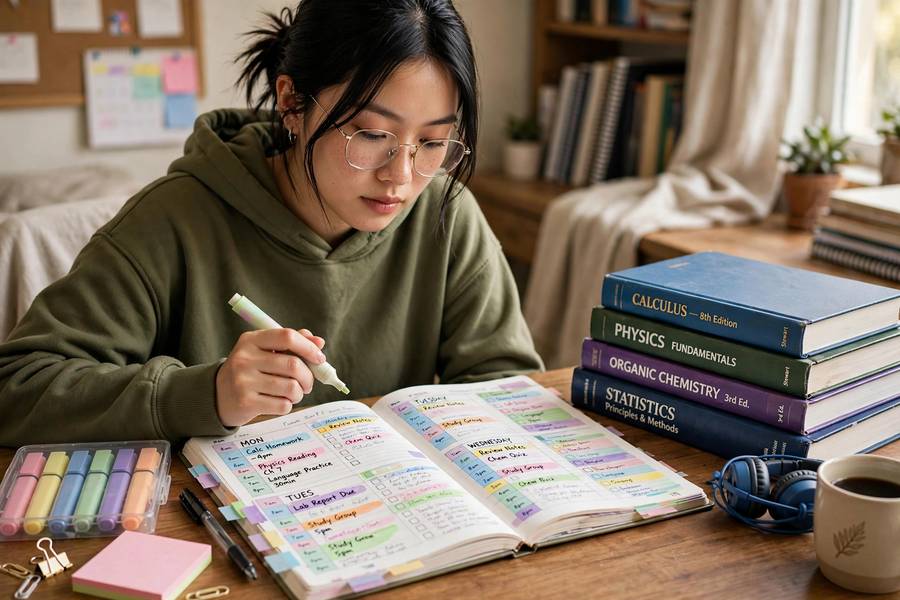
Every assignment, every deadline, every test date goes into one system — a planner app, a notebook, whatever you will actually check. Top students never rely on memory for logistics. Your brain is for thinking, not storing due dates.
5. They Do a Daily 10-Minute Review
Every evening, ten minutes: what did I learn today? What is due this week? What confused me? This tiny habit prevents the “I forgot we had a test” disasters and keeps material warm between classes. It is the highest-ROI ten minutes in studying.
6. They Start Assignments the Day They Are Given
Not finish — start. Open the document, read the prompt, sketch an outline, write the first ugly paragraph. Starting early gives your subconscious days to work on it, and it transforms deadlines from emergencies into finish lines.
7. They Protect Their Sleep
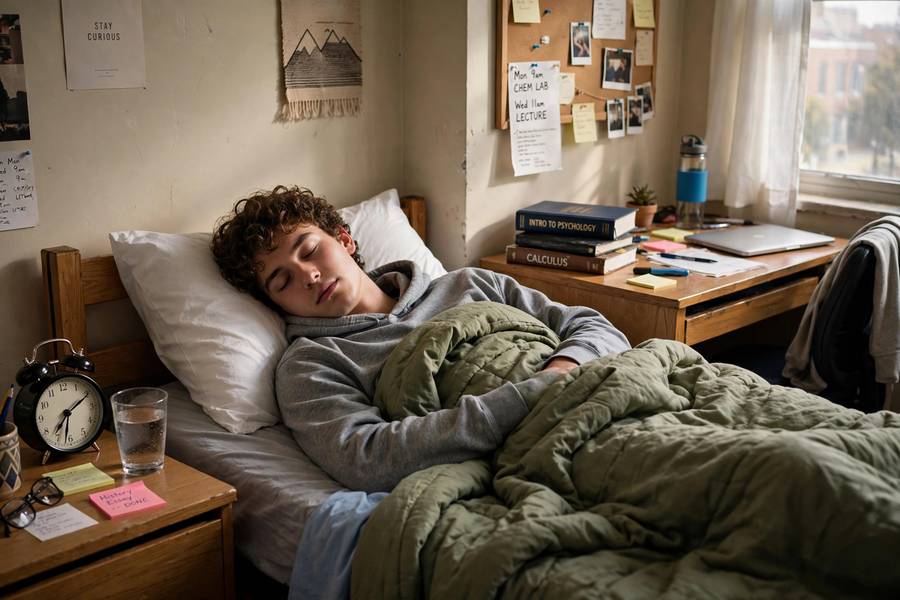
This one is non-negotiable and the most ignored. Sleep consolidates memory — pulling an all-nighter literally prevents your brain from storing what you studied. Top students treat 7–9 hours as part of the study plan, not as time stolen from it.
The Study Technique Habits
8. They Test Themselves Constantly
The single most powerful study habit: active recall. Top students close the book and retrieve — flashcards, blank-page brain dumps, practice questions. They spend their study time answering, not re-reading.
9. They Space Their Studying
Cramming produces familiarity; spacing produces memory. Top students start exam prep 1–2 weeks out, in short sessions, revisiting material at expanding intervals. The same total hours, dramatically better retention.
10. They Take Notes That Serve Review
Their notes are built for future self-testing: questions in margins, cue-column format, summaries in their own words. And they use tools that fit — a reliable notes app beats “a pile of loose paper” every time.
11. They Study the Right Things
Before a test, top students ask: what will actually be tested? They review past exams, listen for professor emphasis (“this will definitely be on the test” is not subtle), and weight their effort toward high-probability material. Studying everything equally is studying nothing strategically.

The Exam Performance Habits
12. They Have a Test-Day Protocol
Preview the whole exam first. Answer easy questions to bank points and build confidence. Budget time per section and move on when stuck (circle it, return later). Read every question twice — most “careless” errors are reading errors.
13. They Review Every Returned Test
The test is not over when you get the grade — it is over when you have extracted every lesson. Top students redo every missed question, classify the error (concept? careless? time?), and adjust. A returned test is a personalized study guide for the final.
The Sustainability Habits
14. They Take Real Breaks
Focused 25–50 minute blocks with genuine breaks (walk, snack, fresh air — not phone scrolling) beat bleary 4-hour sessions. Your brain consolidates during downtime. Top students work intensely and rest deliberately.
15. They Ask for Help Before Drowning
Office hours, tutoring centers, study groups, teachers after class — top students use all of them, early. Seeking help is not weakness; it is the most efficient study technique available. One targeted explanation can replace hours of confused solo grinding.
Put these together and you have a complete operating system for school — and my guide on how to study for final exams shows how to deploy it under pressure.
How to Study Smarter, Not Longer
Total study hours correlate weakly with grades; what you do in those hours decides everything. Replace rereading with retrieval: close the book and recite key ideas aloud. Replace highlighting with summarizing: after each section, write the main point in your own words. Use spaced repetition — review new material after one day, then three, then a week — instead of cramming the night before. Study in 25–50 minute focused blocks with real breaks; attention is a depletable resource. And always study the way you will be tested: practice problems for problem-based exams, essay outlines for essay exams. Two focused hours beat six distracted ones every single time.
These principles work for any subject — they’re the same reason my guide on how to learn a new language faster leans so heavily on active recall. And if you’re curious how different teaching philosophies approach all this, the Montessori method explained is a fascinating contrast to conventional schooling.
What Top Students Do on Weekends
Weekends separate the consistent from the crammers. Top students spend 60–90 minutes on a weekend review: previewing next week’s topics (so lectures feel like review, not first contact), clearing the week’s confusion backlog, and organizing notes. They also genuinely rest — sports, friends, hobbies. The weekend review prevents Monday panic; the real rest prevents burnout. Both are strategic.
Frequently Asked Questions
Through systems, not talent: daily review habits, active self-testing instead of re-reading, spaced study sessions, protected sleep, and treating every test as feedback. Consistency with good techniques beats occasional heroic effort.
Quality matters more than quantity. Two focused hours using active recall beat six hours of passive re-reading. Most top students study in consistent daily blocks rather than marathon sessions.
Efficient studying reduces total hours. Active recall, spaced repetition, and strategic focus on likely-tested material let you learn more per hour. But there is no zero-effort path — efficiency is not the same as avoidance.
Usually it is technique, not effort: re-reading instead of self-testing, cramming instead of spacing, or studying everything equally instead of strategically. Switch to active recall and spaced sessions first.
Yes, significantly. Sleep consolidates memory — all-nighters prevent your brain from storing what you studied. Students who protect 7–9 hours consistently outperform equally studious sleep-deprived peers.
Both have value: solo for focused retrieval practice, groups for explaining concepts (teaching is a powerful learning tool) and catching blind spots. Use groups for discussion and quizzing, not just sitting near each other.