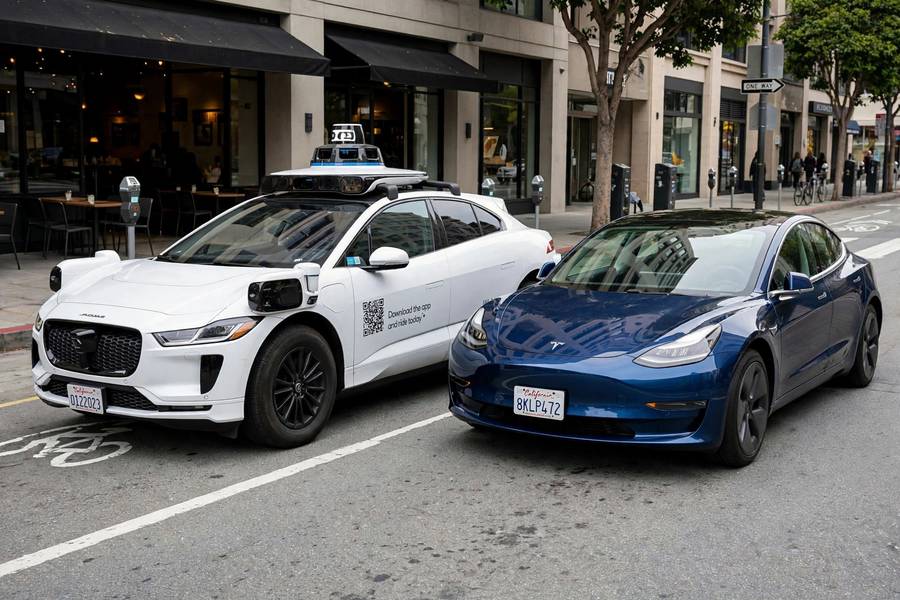
The most important rivalry in autonomous driving is not between companies — it is between philosophies. Waymo and Tesla represent opposite answers to the same question: what does it take to make a car drive itself? Waymo says: the full sensor suite, HD maps, geofenced operation, safety above all, expand slowly. Tesla says: cameras only, no maps, generalized AI, ship to everyone, iterate fast. One of them is wrong about something fundamental. Possibly both.
I have watched this rivalry for years, and what fascinates me is that it is really a debate about the nature of intelligence: is driving a measurement problem (Waymo) or a learning problem (Tesla)? This article compares the two approaches honestly — technology, safety, business model, and track record — without picking a tribe. For the underlying mechanics both rely on, see my guide to how self-driving cars work.
Table of Contents
- The Two Philosophies
- Technology: Sensors and Maps
- Technology: The AI Approach
- Deployment: Robotaxis vs Consumer Cars
- Safety Records Compared
- Business Models
- Strengths and Weaknesses
- Who Is Winning?
- What Each Gets Wrong
- Frequently Asked Questions
The Two Philosophies
Waymo’s philosophy: solve driving completely, in one place at a time. Start with a defined area, map it to centimeters, equip the car with every sensor, validate exhaustively, remove the driver, and only then expand to the next area. It is the aerospace approach: correctness first, scale second. The bet is that driving is fundamentally a robotics problem solvable with enough sensing, mapping, and engineering rigor.
Tesla’s philosophy: solve driving generally, everywhere at once. Put cameras in millions of customer cars, collect data from all of them, train one giant neural network to drive from vision alone, and push it to the whole fleet over the air. It is the software approach: scale first, iterate fast. The bet is that driving is fundamentally a learning problem solvable with enough data and a big enough model — the same bet that worked for language.
Notice the symmetry: Waymo constrains the environment (mapped zones, good weather) to make the problem tractable. Tesla constrains the sensors (cameras only) to make the solution scalable. Each thinks the other’s constraint is the fatal one. Waymo thinks camera-only perception cannot be safe enough; Tesla thinks the mapped-zone approach cannot scale fast enough. The industry has placed billions on each side.
Technology: Sensors and Maps
The hardware difference is stark:
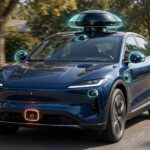
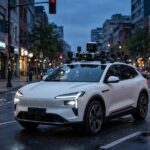
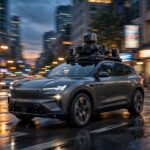
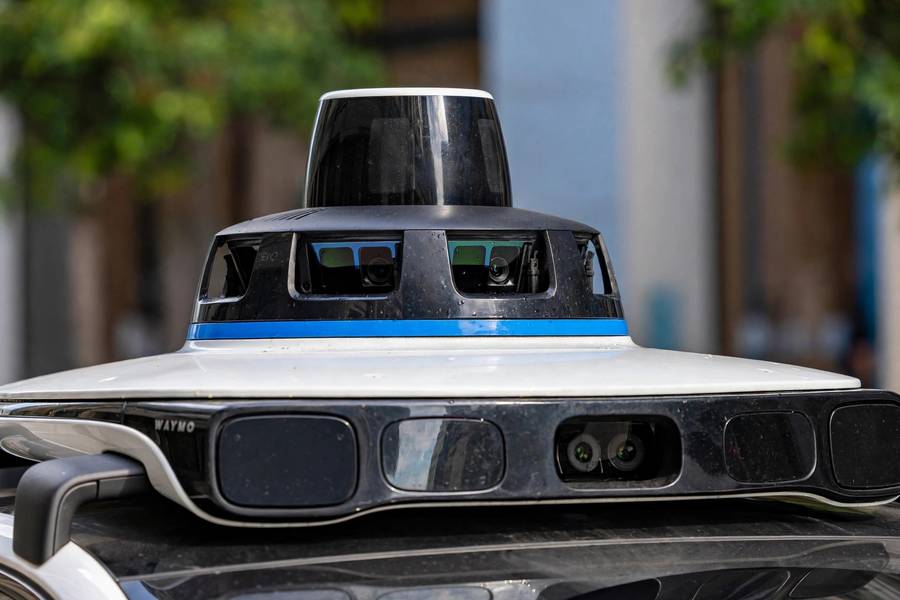
Waymo vehicles carry the full suite: LiDAR (multiple units), radar, cameras (high-resolution, all directions), and sometimes more. They operate on HD maps built and maintained by Waymo’s own mapping fleet — centimeter-accurate models of every street in the operating area. The car localizes against the map, perceives with the sensors, and drives with heavy redundancy. It is the most sensor-rich, map-dependent approach in the industry.
Tesla uses cameras only — eight of them — plus ultrasonic sensors (being phased out) and, in newer models, no radar at all. No LiDAR. No HD maps; the car navigates with standard navigation maps plus what its cameras see in real time. Tesla’s argument: humans drive with two eyes and a brain, so vision plus intelligence is sufficient in principle. LiDAR is, in Elon Musk’s memorable phrase, a crutch.
The engineering tradeoff: Waymo’s approach makes each individual driving task easier (precise geometry from LiDAR, known road layout from maps) at the cost of scalability (every new city needs mapping, every car needs expensive sensors). Tesla’s approach makes each driving task harder (infer 3D from 2D images, navigate without precise maps) at the benefit of scalability (every Tesla ever sold is a potential robotaxi with a software update).
Technology: The AI Approach
The software philosophies differ just as deeply:
Waymo uses a modular stack: separate systems for perception, prediction, planning, and control, each engineered and validated independently. This is classical robotics — understandable, testable, debuggable. If the car does something wrong, engineers can usually trace which module failed. The cost: hand-engineered modules may plateau; integrating them is complex.
Tesla has moved aggressively toward end-to-end neural networks: a single large model trained on millions of hours of human driving video, mapping camera input directly to driving output. The famous “occupancy network” builds a 3D understanding from cameras alone; the planning network decides what to do. It is the deep-learning maximalist bet: with enough data and parameters, the network learns everything — including things engineers would never think to program.
Both companies train on staggering data volumes — which is why how AI models are trained at this scale is its own engineering discipline. (The AI decision-making behind the wheel deserves separate study.)
Deployment: Robotaxis vs Consumer Cars
Waymo operates a robotaxi service: fully driverless vehicles (no one behind the wheel) in defined zones of several US cities — Phoenix, San Francisco, Los Angeles, Austin, and expanding. You hail one with an app, it arrives empty, it drives you. This is Level 4 autonomy, real and operating, completing hundreds of thousands of paid rides. The constraint: it only works where Waymo has mapped and validated.
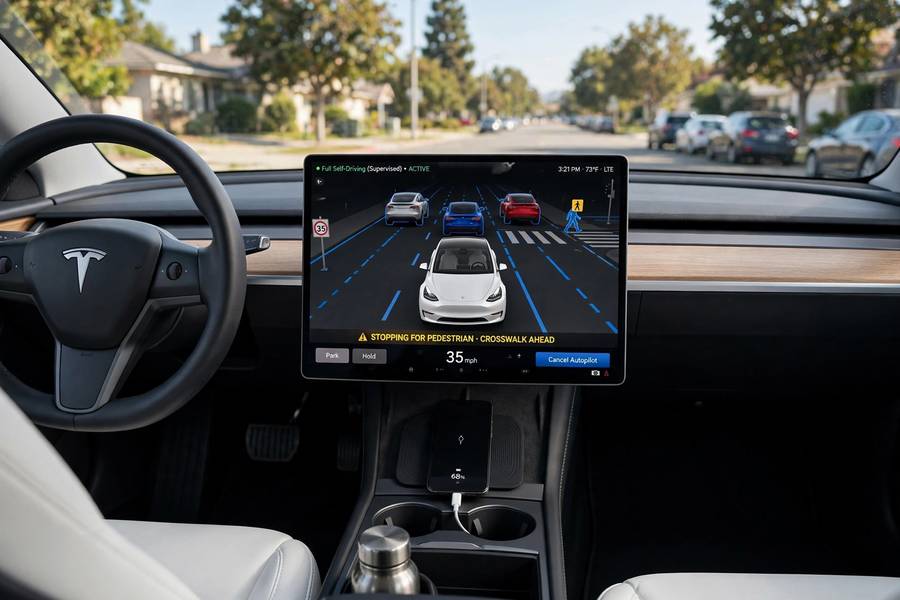
Tesla sells cars to consumers with “Full Self-Driving” (Supervised) — an advanced driver-assistance system that handles most driving tasks but requires an attentive human ready to take over. It works (with supervision) across North America, on any road, with no geofencing. This is Level 2 autonomy: impressive, widely deployed, and emphatically not driverless.
Safety Records Compared
This is where the debate gets heated, so let me be careful:
Waymo publishes detailed safety data: millions of fully driverless miles with crash rates it reports as dramatically lower than human benchmarks — fewer injury crashes, fewer airbag deployments, fewer serious incidents. Independent analysis broadly supports the direction, though comparing robotaxi miles (mapped areas, good weather, cautious driving) to overall human driving (everywhere, all conditions) is imperfect. Waymo’s record also includes incidents — the vehicles have been involved in crashes, some serious — and every one gets scrutinized precisely because the standard for machines is higher than for humans.
Tesla publishes quarterly safety reports comparing crash rates with Autopilot engaged versus without. The numbers favor Autopilot, but the comparisons are heavily confounded: Autopilot is used mostly on highways (the safest roads), by Tesla owners (a self-selected group), compared against all driving everywhere. Critics — including federal regulators — have challenged the methodology. Tesla’s systems have also been involved in high-profile fatal crashes, several involving drivers who over-trusted the system, treating Level 2 assistance as full autonomy.
My honest assessment: Waymo’s safety case is stronger and more transparent — driverless operation with published data and third-party scrutiny. Tesla’s data is real but harder to interpret, and the human-factors problem (drivers over-trusting the system) is a genuine safety issue that belongs on Tesla’s ledger, not the drivers’. When a system’s design invites misuse, the misuse is partly the design’s fault. The incident reporting frameworks emerging in the industry exist partly because of cases like these.
Business Models
Waymo is building a transportation service: own the fleet, operate the rides, capture the per-mile economics. It is capital-intensive (cars, sensors, mapping, operations) but the prize is enormous — a slice of the trillions spent on transportation. Backed by Alphabet’s balance sheet, Waymo can afford the long game. The risk: the unit economics have to work, and they have to work before the capital markets lose patience.
Tesla is selling cars and software: the vehicle is the product, Full Self-Driving is a high-margin software option (thousands of dollars upfront or a monthly subscription). Every car sold funds the data collection that improves the software that makes the next car more valuable — the flywheel. The robotaxi vision (a Tesla Network of owner-operated autonomous taxis) would convert the installed base into a fleet overnight. The risk: FSD has been “coming soon” for years, and regulators may never approve unsupervised operation of the current hardware.
Strengths and Weaknesses
Waymo’s strengths: genuine driverless operation, strong safety record, rigorous engineering culture, Alphabet’s funding, methodical expansion. Waymo’s weaknesses: slow geographic expansion (mapping is the bottleneck), high per-vehicle cost, limited operating domains, and the open question of whether the approach scales to everywhere or just to well-mapped cities.
Tesla’s strengths: massive fleet and data scale, over-the-air deployment to millions of cars, vertical integration (chips, software, vehicles), and the end-to-end AI approach that could — could — generalize in ways modular systems cannot. Tesla’s weaknesses: the safety-validation gap for unsupervised driving, the human-overtrust problem, regulatory skepticism, and a track record of overpromising timelines.
Who Is Winning?
It depends on what race you think they are running. The uncomfortable possibility: they are running different races, and both can win theirs — Waymo becomes the dominant robotaxi operator in mapped urban areas while Tesla ships the best driver-assistance to private owners. The market is big enough for both; transportation is not a winner-take-all prize.
What Each Gets Wrong
Waymo’s blind spot: the mapping bottleneck. If every new city requires months of mapping and validation, expansion is linear in a world that rewards exponential. Waymo is working on reducing map dependence, which tells you they see the problem too. The question is whether they can generalize faster than Tesla can validate.
Tesla’s blind spot: the validation gap. End-to-end neural networks are powerful and opaque; proving an opaque system safe enough for unsupervised operation is an unsolved problem — not just technically but regulatorily. “It drives well in our testing” is not a safety case that convinces aviation-style regulators. Tesla needs a validation methodology for black-box driving AI, and it does not have one yet.
My prediction, for what it is worth: the approaches converge. Waymo is reducing its dependence on HD maps; Tesla keeps adding sensing sophistication to its vision stack. In ten years, the winning system will probably look like a hybrid — rich sensing, learned end-to-end components, with enough structure to be validated. The rivalry’s real product is not a winner but the forcing function: each company’s existence makes the other better.
Frequently Asked Questions
Waymo operates fully driverless robotaxis (Level 4) in mapped urban zones using LiDAR, radar, cameras, and HD maps. Tesla sells consumer cars with camera-only supervised driver assistance (Level 2) that works anywhere but requires an attentive driver. Different technology, different deployment, different autonomy level.
Waymo’s published data shows lower crash rates than human benchmarks across millions of driverless miles, with transparent methodology. Tesla’s safety reports favor Autopilot but use confounded comparisons (mostly highway driving). Waymo’s safety case is currently stronger and more independently scrutable.
Tesla’s philosophy is that cameras plus AI are sufficient since humans drive with vision alone, and that LiDAR is an expensive crutch that cannot scale to millions of consumer cars. Waymo and most competitors disagree, arguing LiDAR’s precise 3D geometry is essential for safety. It is the industry’s defining technical bet.
Yes — in Waymo’s operating zones (including parts of Phoenix, San Francisco, Los Angeles, and Austin), you can hail a fully driverless ride with no one behind the wheel via the Waymo app. Service areas are expanding but remain limited to mapped, validated zones.
No — despite the name, it is a Level 2 driver-assistance system that requires constant driver supervision. The driver must watch the road and be ready to take over at any moment. Treating it as full autonomy has caused fatal crashes; the naming remains controversial.