Online MBA Curriculum: What You Actually Learn


Prospective students often ask me what they’ll actually learn in an online MBA, and I understand the skepticism behind the question. Brochures promise “leadership” and “strategic thinking,” which sound like the kind of vague outcomes that could mean anything. So let me answer concretely, as someone who has advised MBA students for years and watched what the curriculum actually does to people’s capabilities.
An online MBA curriculum covers the same core ground as an on-campus program: the functional disciplines of business, the analytical tools to make decisions, and the leadership skills to execute them. This guide walks through every part of a typical online MBA curriculum, what you learn in each area, how online delivery shapes the experience, and how to get the most from each course.
In this guide:
- The core curriculum: purpose and structure
- Accounting: reading the story in the numbers
- Finance: making money decisions
- Marketing: understanding customers and markets
- Operations: how work actually gets done
- Strategy: putting it all together
- Leadership and organizational behavior
- Analytics, economics, and decision tools
- Electives, concentrations, and capstones
- How online delivery changes the learning
The core curriculum: purpose and structure
Every accredited MBA, online or on-campus, is built around a core: the set of courses everyone takes regardless of specialization. The core exists for a specific reason: business problems don’t respect functional boundaries. A marketing decision has financial implications; an operations choice affects strategy. The core gives you literacy in every function so you can lead across them.
A typical core sequence runs 24-36 credits (8-12 courses) covering accounting, finance, marketing, operations, strategy, organizational behavior, economics, and business analytics. Programs for non-business undergraduates add foundation courses in statistics, microeconomics, and financial accounting basics. The core usually occupies your first year; electives and concentrations follow.
The online format doesn’t dilute this content. Accredited programs teach the same curriculum online as on campus, often with the same faculty. What changes is the delivery: recorded lectures, discussion boards, virtual team projects, and live sessions instead of physical classrooms. The learning objectives are identical. When comparing programs in the best online MBA programs landscape, curriculum quality varies more by school than by format.
Accounting: reading the story in the numbers
Most students dread accounting and most graduates call it unexpectedly valuable. Financial accounting teaches you to read the three core statements, income statement, balance sheet, cash flow statement, and understand what they’re really saying about a business’s health. You’ll learn that profit and cash are different things, that revenue recognition involves judgment, and that the numbers tell a story if you know how to read it.
Managerial accounting shifts from external reporting to internal decision-making: cost behavior, budgeting, variance analysis, and pricing decisions. This is the accounting you’ll actually use as a manager: building budgets, explaining why actuals missed forecast, deciding whether a product line earns its keep.
What you take away: the ability to look at any business’s financials and form an independent judgment, rather than relying on someone else’s interpretation. For non-finance professionals, this is often the single most empowering part of the MBA. One of my advisees, a marketing manager, told me accounting was the course that changed how she operated: “I stopped asking finance for permission and started bringing them analysis.” That’s the transformation.
Finance: making money decisions
Corporate finance teaches the logic of investment: time value of money, risk and return, valuation, capital budgeting, and how companies decide what to fund. You’ll learn to build a discounted cash flow model, evaluate a project with NPV and IRR, and understand why a dollar today differs from a dollar next year.
The deeper lesson is decision discipline. Finance gives you a structured way to compare options with different risks, timelines, and payoffs, which is the essence of executive decision-making. You’ll also study how companies raise and structure capital, what leverage does to risk, and how markets value businesses.
Students often find finance the most quantitatively demanding core course. If your math is rusty, prepare before the term: review algebra, exponents, and basic statistics. Programs sometimes offer pre-term quantitative modules; take them seriously. The students who struggle in finance are almost always struggling with the math mechanics, not the concepts.
Marketing: understanding customers and markets
MBA marketing is not about making ads. It’s about understanding customers deeply, segmenting markets intelligently, positioning offerings distinctively, and measuring what works. You’ll study consumer behavior, market research methods, pricing strategy, brand management, and increasingly, digital marketing analytics.
The analytical side surprises many students: modern marketing courses are heavily quantitative, covering customer lifetime value, acquisition costs, attribution modeling, and experimental design. The creative instincts many marketers bring get paired with measurement discipline, which is exactly the combination employers pay for.
What you take away: a framework for any customer-facing decision. Whether you’re launching a product, entering a market, or repositioning a service, you’ll have a structured approach: who are the customers, what do they value, how do we reach them, and how do we know it’s working. Even non-marketers find this valuable; every business role touches customers eventually.
Operations: how work actually gets done
Operations management covers the design and control of the processes that create value: supply chains, inventory, quality management, process improvement, and service operations. It’s the least glamorous core course and quietly one of the most useful.
You’ll learn to analyze bottlenecks, understand queuing and capacity, apply lean and Six Sigma thinking, and make trade-offs between cost, quality, speed, and flexibility. The frameworks are practical and immediately applicable: I advise students to analyze their own employer’s operations as coursework, which produces insights their managers actually use.
The deeper lesson is systems thinking: seeing how parts of an organization interact, where constraints really live, and why local optimization often hurts global performance. This perspective distinguishes managers who fix symptoms from leaders who fix systems.

Strategy: putting it all together
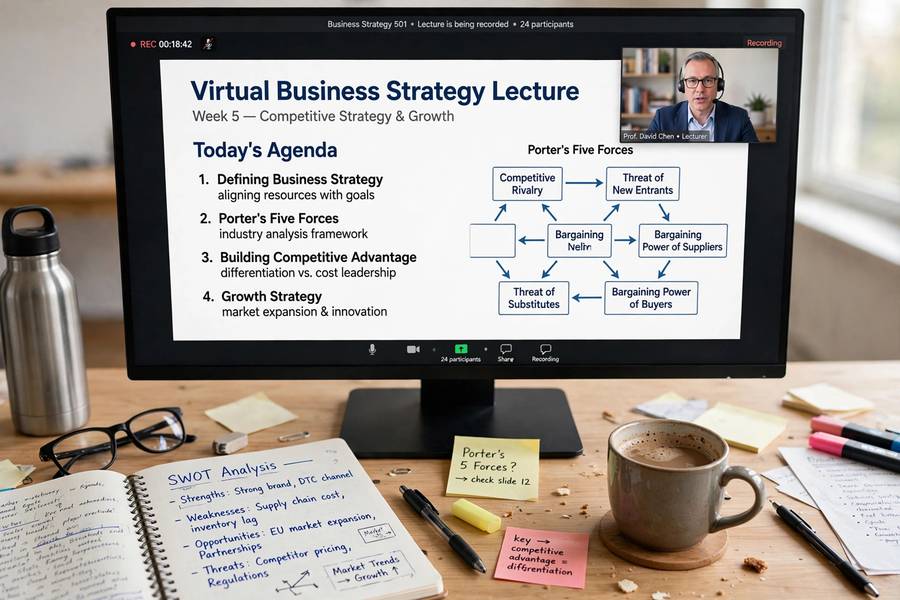
Usually taken near the end of the core, strategy is the capstone discipline: it integrates everything. You’ll study industry analysis, competitive positioning, corporate strategy (what businesses to be in), and how companies sustain advantage over time. The classic frameworks, Porter’s five forces, resource-based view, blue ocean, appear here, but the real learning is in applying them to messy, real cases.
Strategy courses run heavily on case discussions: you’ll dissect real companies’ decisions, argue positions, and defend recommendations. Online, this happens through live case discussions, written analysis, and team-based strategy simulations. The format works well virtually; some students actually prefer having time to compose thoughtful written analysis rather than thinking on their feet in a physical classroom.
What you take away: the ability to think at the enterprise level. Where accounting taught you to read the numbers and finance taught you to evaluate investments, strategy teaches you to decide what game the company should be playing. It’s the course that most directly prepares you for senior leadership conversations.
Leadership and organizational behavior
These courses study how people actually behave in organizations: motivation, team dynamics, power and influence, negotiation, organizational culture, and leading change. The content draws on psychology and sociology as much as business, which surprises students expecting pure management technique.
You’ll typically complete leadership assessments (360-degree feedback is common), practice negotiation through simulations, and analyze cases of organizational success and failure. Many students find this the most personally transformative part of the MBA: the 360 feedback alone, hearing how colleagues actually experience your leadership, changes how people operate.
Online delivery handles this better than skeptics expect. Virtual team projects across the program become a laboratory for distributed leadership, directly relevant to modern work. Discussion boards and peer feedback, done well, produce genuine reflection. The key is engagement: students who invest in these courses’ experiential components gain far more than those who treat them as soft requirements.
Strong communication underpins all of this, which is why I often point students toward resources on constructing clear arguments; the ability to make a crisp, evidence-backed case serves you in every leadership context.
Analytics, economics, and decision tools
Modern MBA curricula have expanded significantly here. Business analytics courses teach data-driven decision-making: regression, forecasting, data visualization, and increasingly, working with large datasets and analytical tools. You won’t become a data scientist, but you’ll become an intelligent consumer and commissioner of analysis, which is what most leaders need.
Managerial economics provides the framework for market decisions: supply and demand, pricing power, competitive dynamics, and decision-making under uncertainty. It gives you the economist’s lens on business problems, which complements the accountant’s and marketer’s lenses from other courses.
Statistics deserves a special mention as the hidden backbone. It appears within analytics, marketing research, operations, and finance. Students who build genuine statistical literacy, understanding variation, significance, and what data can and can’t prove, gain an advantage that compounds across every subsequent course. If you take one preparatory step before enrollment, make it statistics.
Electives, concentrations, and capstones
After the core, you customize. Most programs offer 12-18 elective credits, often organized into concentrations: finance, marketing, business analytics, entrepreneurship, healthcare management, supply chain, and others depending on the school.
Choose electives strategically, not just by interest. The best elective strategy aligns with your career goal: depth in your target function, complementarity with your background (the engineer takes finance; the accountant takes strategy), or exploration if you’re still deciding. Talk to alumni in roles you want about which electives mattered for them.
Many programs culminate in a capstone: a consulting project with a real company, a business plan, or a strategy simulation. Treat the capstone as the degree’s thesis, your chance to integrate everything and produce something portfolio-worthy. I advise students to choose capstone projects in their target industry or function; the best capstones become interview stories and sometimes job offers.
Some students also use electives to explore adjacent credentials or deepen specific skills. If you’re weighing the MBA against other graduate paths, understanding which degrees deliver the strongest career payoff helps you allocate your elective energy wisely.

How online delivery changes the learning
The curriculum is the same; the experience differs in ways worth understanding.
Pacing and discipline. Online learning rewards self-discipline more than classroom learning. Without physical attendance, your engagement depends on your systems. Successful online students time-block, participate actively in discussions, and treat virtual sessions with classroom seriousness. Understanding how e-learning works best before you start gives you a real head start.
Discussion quality. Asynchronous discussions, done well, produce deeper reflection than spontaneous classroom comments; you have time to think before writing. Done poorly, they’re perfunctory post-and-reply exercises. Contribute substantively and you’ll learn more while building a reputation among faculty and peers.
Team projects. Virtual teams are harder to coordinate but teach distributed collaboration, a genuinely valuable modern skill. Set explicit norms early: communication channels, response times, meeting cadences. The project management you practice here transfers directly to remote and hybrid work.
Networking. Requires more intentionality online. Attend live sessions, join virtual clubs, participate in residencies if offered, and proactively build relationships. The network won’t happen to you; you build it deliberately.
An online MBA curriculum teaches you to read financials, evaluate investments, understand customers, improve operations, think strategically, lead people, and decide with data. That’s a formidable toolkit, and it’s identical to what on-campus students receive. What you learn is determined by the curriculum; how much you learn is determined by your engagement. Show up fully, apply everything at work, choose electives with intent, and the degree will repay your effort many times over.
What do you learn in an online MBA curriculum? You learn the core business disciplines: accounting (reading financial statements), finance (investment decisions and valuation), marketing (customers and markets), operations (processes and supply chains), strategy (competitive positioning), leadership and organizational behavior, plus business analytics, economics, and statistics. Electives and concentrations then let you specialize in areas like finance, marketing, analytics, or healthcare management. Is an online MBA curriculum the same as on-campus? At accredited programs, yes: the curriculum, learning objectives, and often the faculty are identical. What differs is delivery (recorded lectures, discussion boards, virtual team projects instead of physical classrooms). The degree requirements and academic rigor are the same, which is why most diplomas don’t distinguish between online and on-campus study. What is the hardest course in an MBA program? Most students name corporate finance or business analytics/statistics as the most demanding, primarily due to quantitative intensity rather than conceptual difficulty. Students with rusty math skills should prepare before the term with a pre-MBA quantitative course. Accounting surprises many as unexpectedly challenging but also unexpectedly valuable. Can I specialize in an online MBA? Yes. After completing the core curriculum (usually the first year), most online MBAs offer 12-18 elective credits organized into concentrations such as finance, marketing, business analytics, entrepreneurship, healthcare management, or supply chain. Choose electives strategically to build depth in your target function or complement your existing background. How much math is in an online MBA? Expect significant quantitative work in finance, accounting, statistics, operations, and analytics courses: algebra, statistics, and financial mathematics rather than advanced calculus. You don’t need to be a mathematician, but comfort with numbers matters. If your quantitative skills are rusty, complete a pre-MBA math or statistics course before enrollment; it will make your first year dramatically smoother.