How to Learn Sign Language Basics: A Beginner’s Roadmap

Most people who want to learn sign language basics start the same way: they learn the alphabet, fingerspell their name triumphantly, and then discover they cannot actually hold a conversation — because fingerspelling is to sign language what spelling words letter-by-letter is to speaking. Useful, but not the language. Real sign language is a complete, rich visual language with its own grammar, and learning it properly is one of the most rewarding things you can do. This guide on how to learn sign language basics will get you started the right way.
This beginner’s roadmap covers the decisions and methods that matter: choosing which sign language to learn first (it matters more than you think), building your fingerspelling foundation correctly, the learn-from-video rules that keep you from developing bad habits, a realistic 10-minute daily routine, and the Deaf community etiquette that turns a learner into a welcome guest rather than an awkward tourist.
First Decision: Which Sign Language to Learn
This surprises most beginners: there is no universal sign language. American Sign Language (ASL), British Sign Language (BSL), French Sign Language (LSF), and dozens of others are distinct languages — ASL and BSL are mutually unintelligible despite both being used in English-speaking countries. (Fun historical note: ASL descends largely from French Sign Language, which is why ASL and LSF share similarities.)
Choose based on where you live and who you want to communicate with. In the United States and much of Canada, learn ASL. In the UK, BSL. Your local Deaf community is the deciding factor — learning the language of the people you will actually sign with. Do not try to learn two at once as a beginner; get conversational in one first.
Set honest expectations about scope. ‘Basics’ means: fingerspell fluently, produce and understand several hundred core signs, handle everyday conversations (introductions, food, directions, feelings, time), and understand fundamental grammar like topicalization and facial grammar. That is roughly 3-6 months of consistent daily practice — a real, achievable goal, not a weekend project.
Fingerspelling: The Foundation (Done Right)
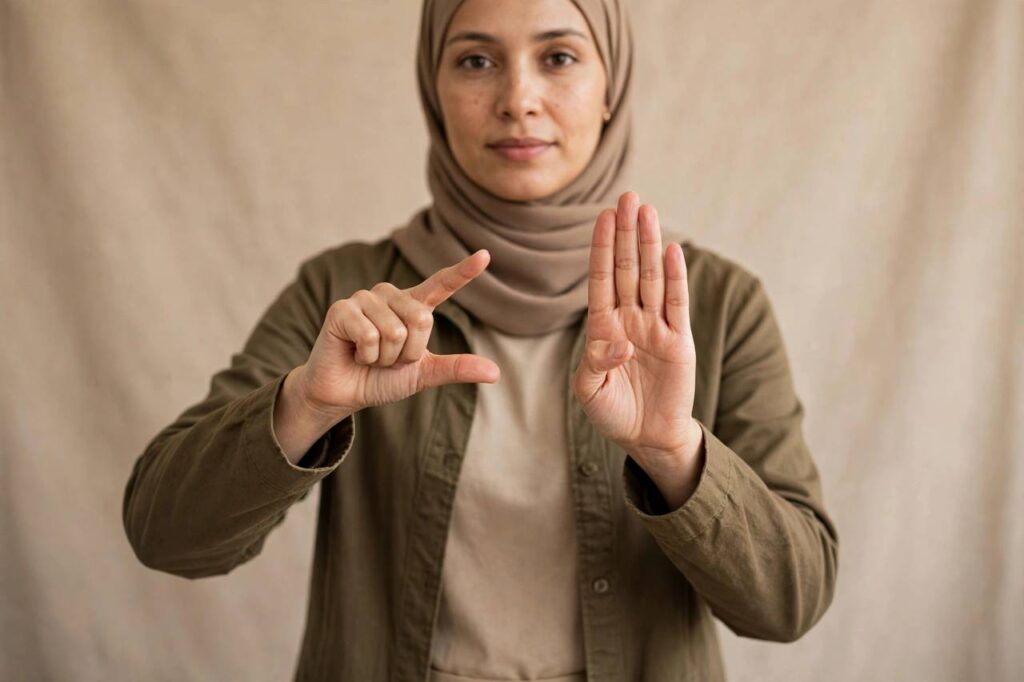
Fingerspelling — spelling words letter by letter with handshapes — is the alphabet of the manual world, and it deserves your first two weeks. Learn all 26 handshapes until each is automatic, then drill transitions: the hard part is not the shapes but flowing between them smoothly. Practice common letter pairs (th, ch, sh, ing endings) and your own name, address, and frequently spelled words until they are muscle memory.
Two technique rules that prevent permanent bad habits. One: keep your hand still and in one place — beginners wave their hand around, ‘bouncing’ each letter, which makes their fingerspelling unreadable. The hand stays anchored; only the fingers move. Two: do not look at your own hand while fingerspelling. You would not stare at your mouth while speaking — looking down breaks the visual connection with your conversation partner and slows you to a crawl.
Know fingerspelling’s real role: it is for proper nouns, technical terms, and words with no established sign — maybe 10 percent of actual signing. Learners who fingerspell everything are like tourists shouting slowly in English; it works, barely, and it is exhausting for everyone. Fingerspelling is the bridge, not the destination. Drill it, then move on to vocabulary.
Core Vocabulary: Learn Signs in Context, Not Lists
After fingerspelling, build vocabulary in thematic clusters, not alphabetical lists: greetings and introductions first, then family, food, feelings, time and days, common verbs, and question words. Thematic learning mirrors how you will actually use the language — you will need all the restaurant signs together, not ‘apple’ and ‘airplane’ because both start with A.
Learn each sign with four pieces of information: the handshape, the location, the movement, and the facial expression. These are the phonemes of sign language — change one parameter and you change the meaning. This is also why video matters enormously (next section): static diagrams cannot show movement or timing, and movement carries meaning.
Crucially, learn grammar from the start, not ‘later.’ Sign languages are not signed English — ASL, for example, uses topic-comment structure (‘STORE, I GO’ rather than ‘I am going to the store’), marks questions with eyebrow movements (raised for yes/no, furrowed for wh-questions), and uses space grammatically to track who did what to whom. Beginners who learn vocabulary with English grammar fossilize bad habits that take months to unlearn. Learn the grammar alongside the signs from day one.

The Learn-From-Video Rules
Video is your primary textbook — books and diagrams are nearly useless for a visual-spatial language. But not all video is equal, and bad sources teach bad signing. Rule one: learn from Deaf signers. Native Deaf creators and instructors model natural grammar, facial expressions, and cultural usage; hearing beginners teaching on social media often model signed English with flat affect — exactly what you must avoid.
Rule two: mirror, do not just watch. Sign along with the video in real time, then replay and sign without looking, then test yourself. Passive watching builds recognition (‘I have seen that sign’) without production ability (‘I can make that sign’) — and production is the skill. Record yourself on your phone regularly; the camera reveals handshape sloppiness and missing facial grammar that mirrors hide.
Rule three: use structured courses, not random clips. A curriculum — whether a community class, an online course from a reputable Deaf education organization, or a well-regarded video series — sequences vocabulary and grammar so each lesson builds on the last. Random social media clips teach party tricks in no order. For general language-learning principles that transfer, becoming fluent in a spoken language and learning a new language faster cover the underlying science of daily practice and immersion.
How to Learn Sign Language Basics: The 10-Minute Daily Routine
Consistency beats intensity absolutely. Ten minutes daily for three months outperforms five hours every other Sunday — motor learning consolidates between sessions, and sign production is motor learning. Here is the daily structure:
- Minutes 1-3: Fingerspelling drills. Spell the day’s words, your name, and five random words from a generator. Focus on smooth transitions and a still hand.
- Minutes 4-7: New vocabulary. Learn 5-10 new signs from your current theme — with full parameters (handshape, location, movement, facial grammar). Sign each one ten times.
- Minutes 8-10: Conversation practice. Sign a short monologue about your day, or rehearse a dialogue. Narrate your cooking, describe your plans — production, production, production.
Weekly additions: one longer session (30 minutes) reviewing the week’s vocabulary, and — as soon as you have basic conversational ability — one real conversation attempt. Language lives in interaction; solo practice builds the tools, but only conversation builds the skill. Local Deaf community events, signing meetups, or video chat with a practice partner all count.

Deaf Community Etiquette: Being a Welcome Learner
Learning sign language means entering a community with its own culture, history, and norms — and etiquette matters. First: Deaf (capital D) refers to the cultural community; deaf (lowercase) refers to the audiological condition. Learning the distinction signals respect and basic cultural literacy.
Key norms: get attention visually (a wave in the sightline, a light tap on the shoulder or table) — never grab. Maintain eye contact during signing; looking away mid-conversation is the equivalent of covering your ears. Do not chew gum or cover your mouth — the face is grammar. If you do not understand, say so honestly rather than nodding along; Deaf signers would far rather re-sign than discover you faked comprehension.
Deeper etiquette: understand that cochlear implants and ‘fixing’ deafness are sensitive topics with complex community views — listen before opining. Do not call sign language ‘beautiful’ as your main compliment; it is a language, not a performance. And approach community events as a respectful learner, not a tourist collecting experiences — contribute, volunteer, and let relationships develop naturally. The community is extraordinarily welcoming to sincere learners; sincerity is the whole admission ticket.
Finally, a note on humility: you will sign badly for a while, misunderstand constantly, and feel foolish. Every fluent signer went through this. The community expects beginners to be beginners — what it does not forgive is arrogance. Stay humble, stay curious, keep showing up.
Frequently Asked Questions
How long does it take to learn basic sign language?
With 10-30 minutes of daily practice, most learners reach basic conversational ability — everyday topics, several hundred signs, functional grammar — in 3-6 months. Fluency takes years, as with any language. Consistency is the entire game; the timeline collapses with daily practice and real conversation.
Is sign language hard to learn?
It is different, not necessarily harder. Hearing learners often find the visual-spatial grammar the biggest adjustment — using space, facial expressions, and classifiers grammatically has no spoken-language equivalent. But many find vocabulary easier than spoken languages because signs are often iconic (visually related to their meaning).
Can I learn sign language from apps?
Apps are useful supplements for vocabulary drilling, but insufficient alone — they rarely teach grammar properly, provide no conversation practice, and cannot correct your production. Use apps alongside video instruction from Deaf signers and, ideally, a class or community practice. Language needs interaction.
What is the difference between ASL and signed English?
ASL is a complete natural language with its own grammar (topic-comment structure, spatial grammar, facial grammar). Signed English systems (like SEE) encode English words in signs following English word order — useful in some educational settings, but not a natural language and not what the Deaf community uses conversationally. Learn ASL, not signed English, unless you have a specific reason.
At what age can children learn sign language?
From infancy — ‘baby sign’ is well-supported by research and reduces pre-verbal frustration. Children acquire sign languages natively on the same timeline as spoken languages. There is no ‘too early,’ and for hearing children, early exposure builds the visual-spatial skills that make later learning easier.
The Bottom Line: Choose, Drill, Sign, Belong
Learning sign language basics is a clear path: choose the language your local Deaf community uses, build fingerspelling correctly in the first two weeks, learn vocabulary in themes with real grammar from day one, study from Deaf signers on video, practice ten minutes daily with real production, and enter the community with humility and respect.
Start today: learn five handshapes, then five more tomorrow. In six months of daily practice, you will hold a real conversation — with your hands, your face, and a community waiting to welcome you.