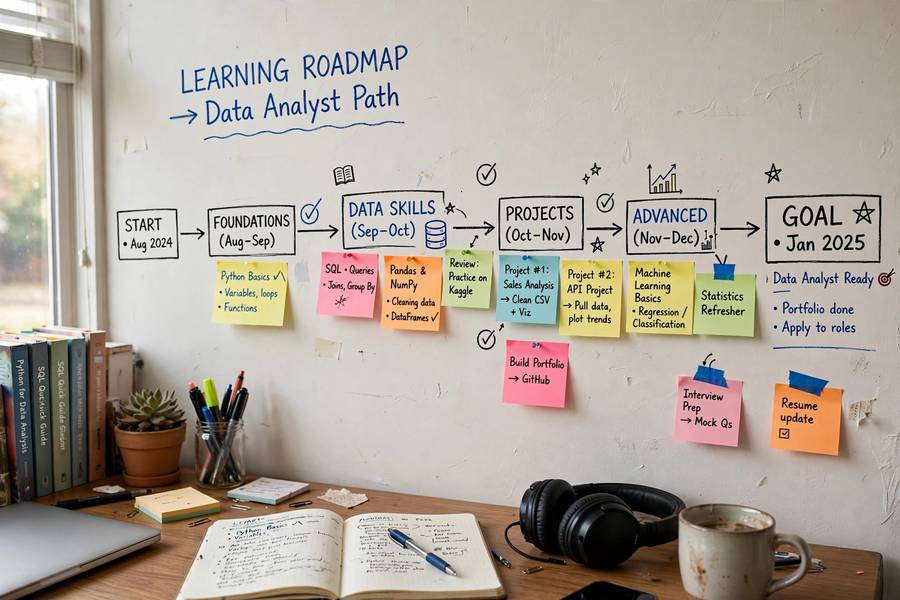
Most AI roadmaps fail beginners in one of two ways: they’re either a vague list of topics (“learn Python, then math, then ML!”) with no sequencing, or a rigid 12-month curriculum designed for full-time students. What beginners actually need is a phased plan — what to focus on each month, what “done” looks like, and permission to stop at the phase that matches their goals.
Here’s that roadmap. It’s designed for someone with a job and 5–10 hours a week. Each phase has a clear exit point, because not everyone needs to finish the whole thing. For the full philosophy behind this sequence, see my guide on how to learn artificial intelligence.
In This Guide
- How This Roadmap Works
- Month 1: Become an AI Power User
- Month 2: Learn How It Works
- Month 3: Build Your First Real Things
- Months 4–5: Go Deeper on Building
- Month 6: Specialize or Systematize
- Beyond Month 6: The Three Roads
- What to Learn in 2026 Specifically
- Frequently Asked Questions
How This Roadmap Works
Three principles:
Phases, not just topics. Each month has a theme, concrete activities, and a definition of done. You’ll always know what you’re doing and whether it’s working.
Exit ramps. After months 1, 3, and 6, you can stop — with genuinely useful skills at each point. The roadmap respects that most people don’t need the full journey.
Building beats consuming. Every phase includes making something real. If you’re only watching and reading, you’re not on the roadmap — you’re on a treadmill.
Time assumption: 5–10 focused hours per week. More is fine; less means stretching the timeline, not skipping phases.
Month 1: Become an AI Power User
Theme: Hands-on fluency with AI tools.
Do this: – Set up ChatGPT, Claude, and Gemini. Use all three daily for real work — writing, analysis, planning, learning, brainstorming. – Practice deliberate prompting: give context, specify format, provide examples, iterate on outputs. Notice what works. – Try one image generator (Midjourney, DALL-E, or Stable Diffusion) and one AI search tool (Perplexity). – Keep a simple log: what you asked, what worked, what failed, what surprised you.
Learn this: – What hallucinations look like (and how to catch them) – The practical differences between the major assistants – Basic AI vocabulary: prompt, model, training, inference, tokens
Done when: You reach for AI tools instinctively for suitable tasks, you can predict roughly what a prompt will produce, and you’ve caught at least a dozen hallucinations. You’re no longer a tourist.
Exit ramp: If your goal was “use AI well at work,” you can stop here — you’re already ahead of 90% of professionals.
Month 2: Learn How It Works
Theme: Conceptual understanding — no math required yet.
Do this: – Watch 3Blue1Brown’s neural networks series (visual, intuitive, math-light). – Read one good popular book on AI (e.g., Co-Intelligence by Ethan Mollick — practical and current). – Follow one quality AI newsletter to build ambient awareness of the field.
Learn this: – Machine learning: the core idea of learning from data – Neural networks: what layers, weights, and training mean intuitively – How AI models are trained — the data-to-capability pipeline – What large language models actually are (prediction machines, not minds) – Key limitations: bias, hallucinations, data cutoff, no real understanding
Done when: You can explain to a friend, in plain language, how a chatbot produces its answers — and why it sometimes gets things confidently wrong. If you can do that clearly, you understand more than most commentators.
Month 3: Build Your First Real Things
Theme: Making, not watching.
Do this (pick two): – Design a multi-step AI workflow you actually use weekly (research assistant, content pipeline, decision helper). – Build an automation with Make or Zapier connecting AI to your real tools. – Create something with an AI API — even a simple script that does one useful thing. – Browse AI projects for beginners for concrete ideas matched to your level.
Learn this: – How APIs work (conceptually: you send text, you get text back) – The basics of automation logic: triggers, actions, conditions – How to evaluate whether your build actually works (not just demos well)
Done when: You have two working things you use regularly, and you can explain how each one works. Screenshots and write-ups go in your portfolio — start it now.
Exit ramp: Stopping here gives you “AI builder” skills — enough for automation roles, AI-assisted freelancing, and serious hobby projects.

Months 4–5: Go Deeper on Building
Theme: From tinkering to engineering.
Do this: – Learn Python basics if you haven’t (focus on: data structures, functions, APIs, libraries — skip the computer-science theory for now). – Build a larger project: something with multiple components that takes 3–4 weeks. A chatbot over your own documents, an AI-powered analysis tool, a content system. – Learn to use one AI API deeply — understand parameters (temperature, max tokens), costs, and error handling. – Start reading documentation instead of tutorials. This is a graduation milestone.
Learn this: – Python for AI: requests, JSON, basic data handling – How embeddings and vector search work (conceptually) — the basis of RAG systems – Prompt engineering as a discipline — my guide on learning prompt engineering covers the systematic approach – Evaluation: how to test whether AI outputs are good, not just plausible
Done when: You’ve shipped a multi-week project, you read docs comfortably, and you can estimate what an AI build will cost and how long it’ll take. You’re thinking like a practitioner.
Month 6: Specialize or Systematize
Theme: Depth in one direction.
Choose your track:
Track A — Applied AI professional. Go deep on AI product thinking: evaluation frameworks, AI safety basics, vendor assessment, cost management, building reliable systems. Target roles: AI product manager, AI consultant, automation lead.
Track B — Technical builder. Start the math sequence (linear algebra → probability → calculus, in that order), learn ML fundamentals properly, work toward deep learning. Target: ML engineering (12–18 more months from here).
Track C — Domain specialist. Combine AI with your existing expertise: AI for marketing, finance, healthcare operations, education, creative work. The most underrated track — domain experts who wield AI well are extraordinarily valuable.
Do this regardless of track: – Write up your journey: three portfolio pieces with honest retrospectives – Teach something: a blog post, a talk, mentoring a beginner. Teaching reveals gaps. – Set up a sustainable learning system: monthly experiments, one newsletter, one community
Done when: You have a portfolio, a specialty direction, and a learning system that doesn’t depend on motivation alone.
Beyond Month 6: The Three Roads
The practitioner road (Tracks A & C): keep building, keep shipping, go deeper in your domain. Your edge compounds through shipped work and judgment.
The engineer road (Track B): math, ML theory, deep learning, MLOps. A 1–2 year commitment from month 6. The destination is genuine ML engineering competence.
The researcher road: the engineer road plus advanced math, statistics, and original work. A multi-year commitment, usually via graduate study or exceptional self-direction.
All three are valid. The market currently rewards practitioners fastest, engineers most reliably, and researchers most prestigiously. Choose based on your temperament, not prestige.
What to Learn in 2026 Specifically
The field’s current state shapes priorities. My roundup of AI skills to learn in 2026 covers this in depth, but the short version:
- Agents and agentic workflows — AI systems that take multi-step actions are the current frontier
- Evaluation — as AI gets deployed everywhere, judging AI output quality is a booming skill
- RAG and knowledge systems — connecting AI to real data sources
- AI safety literacy — increasingly expected in professional roles
- Multimodal AI — working across text, image, audio, and video
Don’t chase every trend. But do tilt your roadmap toward where the field is going, not where it was.
A roadmap is a starting proposal, not a prison. Adjust the pace, skip what doesn’t serve your goals, linger where curiosity pulls you. The only non-negotiable: build things, regularly, from month three onward. Everything else is negotiable. Start month one today.

Frequently Asked Questions
With 5-10 hours per week: 1-2 months to use AI well, 4-6 months to build useful things, 6-12 months to work professionally with AI. ML engineering takes 1.5-3 years. This roadmap’s six phases map to those milestones.
Start with hands-on AI tool use (month 1), then concepts like machine learning and neural networks (month 2), then building real projects (month 3+). Don’t start with math or theory — practical experience first makes everything else easier.
For using AI and no-code building: no. For building with APIs and custom applications: yes, Python becomes important around month 4-5 of serious learning. Learn it when you have a clear use for it, not before.
For applied roles (AI automation, AI-assisted marketing/operations, junior AI product roles): possibly, with a strong portfolio of real projects. For ML engineering roles: no — those need 1.5+ years. Your portfolio matters more than your timeline.
Courses teach; this roadmap makes you build. Every phase includes creating something real, with exit ramps at months 1, 3, and 6. Passive course-watching without building is the most common way beginners waste a year.