Comedy Writing Exercises That Actually Build the Muscle


Comedy writing is a muscle, and muscles need drills. I’ve collected the exercises that working comics actually use — not the cute icebreakers from improv class, but the repetitive, unglamorous drills that build joke-writing into reflex. Do these daily and your output will transform within months. I say that with the confidence of someone who’s watched it happen repeatedly.
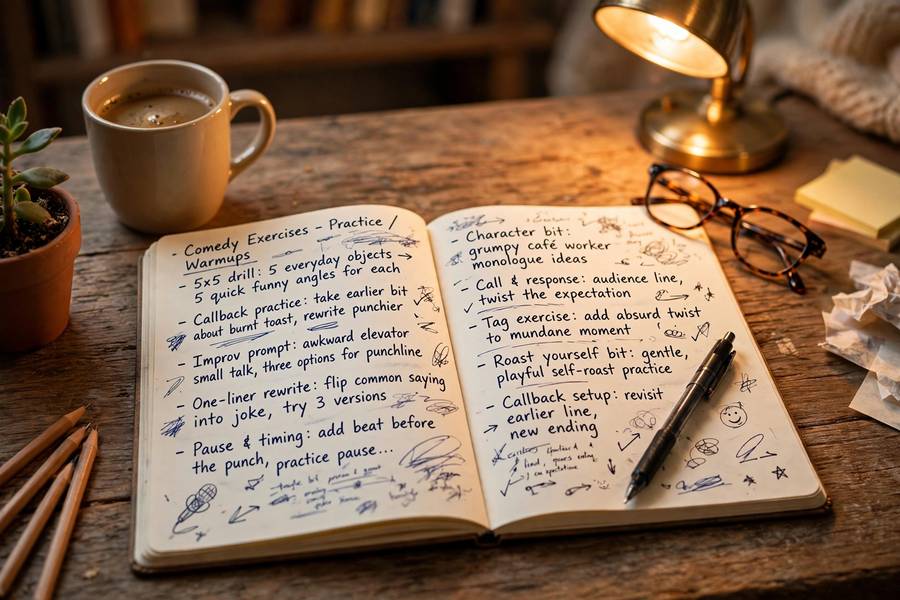
1. Freewriting: The Daily Warm-Up
How: Set a timer for 10 minutes. Pick a topic — anything: “airports,” “my neighbor,” “Monday.” Write continuously without stopping, editing, or judging. If you stall, write “I don’t know what to write” until something comes. The rule is the pen never stops. how comedians write jokes
What it trains: fluency and the bypassing of your inner critic. Most beginners self-censor the weird, specific, honest thoughts that are actually the funniest material. Freewriting teaches your brain that the page is safe, and the gold consistently appears in minutes 7–10, after the obvious stuff is exhausted. After: circle the three most interesting lines — those are premise seeds. File them in your idea bank.
2. The Top 10 List: Punchline Volume
How: Write one setup line at the top of the page — e.g., “Dating apps should come with a warning label:” — then write ten different punchlines as fast as you can. No judging while listing; speed matters more than quality.
What it trains: punchline generation under pressure, which is the single most valuable comedy skill. The pattern is always the same: the first three are obvious (everyone thinks of these), the middle four are decent, and the last three — written when you’re straining — are often the most original. After: pick the best two, and notice that they’re usually #7–#10. That’s the lesson: your best material lives past the obvious, and volume is how you reach it.
3. Premise Expansion: Finding Angles
How: Take one observation — “self-checkout machines are judging me” — and write five different angles on it: the machine’s personality, your guilt, the attendant watching, the technology’s assumptions, what it says about trust. Each angle is a potential bit.
What it trains: angle-finding, the skill that separates one-joke writers from premise developers. Beginners find one angle and stop; professionals know every premise contains five bits. This exercise makes “what else is funny about this?” automatic. After: take your best angle and run the Top 10 List on it — you’re now developing a chunk, not just a joke.
4. The Rant Page: Excavating Your Voice
How: Write one full page, uncensored, about something that genuinely bothers you. Not performative annoyance — real grievance. Swear if you swear. Be petty. Nobody will ever read this except you, so there’s no reason to be likable.
What it trains: voice. Your natural comedic voice — the attitudes, rhythms, and word choices that are distinctively yours — lives in uncensored writing. Polished writing sounds like everyone; rants sound like you. After: circle the three funniest lines. They’re almost always the most honest ones. Those lines, cleaned up slightly, are often stage-ready — because attitude is the joke, and rants are pure attitude.
5. The Rewrite Drill: Cutting as Craft
How: Take a joke you’ve written and rewrite it five times, each version shorter than the last. Version 1 is what you have; version 5 should be half the words. You’re not allowed to change the punchline’s meaning — only compress the setup.
What it trains: the professional’s core skill: deletion. Almost every weak joke is a good joke wearing too many words. This drill builds the instinct to spot throat-clearing, redundant context, and nervous over-explanation. After: perform version 5 and version 1 on different nights (if you dare) and feel the difference. The shorter version will get the bigger laugh nearly every time.
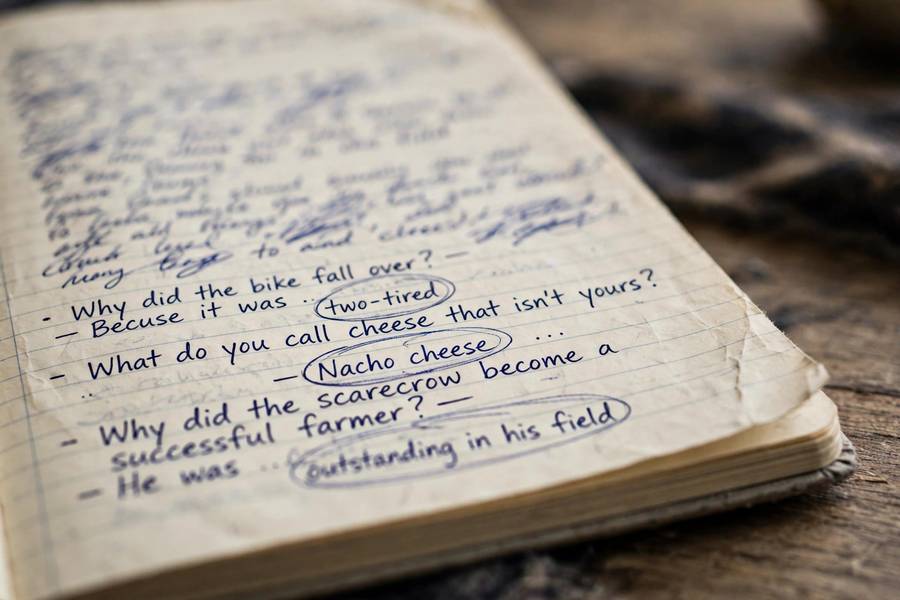
6. Tag Storm: Escalating the Laugh
How: Take a joke that already works and write ten tags — additional punchlines on the same premise. Push for escalation: each tag should raise the stakes, get more specific, or take a weirder angle than the last.
What it trains: building runs of laughter instead of single jokes. A joke with three strong tags gets four laughs for one setup’s worth of audience attention — it’s the most efficient laughter in comedy. After: order your tags weakest to strongest (save the best for last — always), and test the run on stage. You’ll feel the room build, which is addictive.
7. The Opposite Game: Breaking Patterns
How: Take a premise and write the joke, then write its exact opposite. “I’m terrible with money” → “I’m great with money (and here’s the neurotic proof).” Then write the sideways version — neither the premise nor its opposite, but the weird third option.
What it trains: breaking out of the obvious angle. The first angle you find is usually the one everyone finds; the opposite and the sideways version force originality. Many great bits are the “sideways version” of a common premise. After: compare all three and notice which feels freshest — it’s training your taste as well as your technique.
8. The Callback Hunt: Weaving the Set
How: Take two unrelated bits from your act and force a connection: write five ways bit A’s premise could reappear in bit B. The connections will feel forced at first — that’s fine; you’re training the pattern-matching muscle.
What it trains: set architecture. Callbacks — referencing earlier material later — get disproportionate laughs because the audience feels smart for remembering. Comics who naturally weave callbacks have tighter, more satisfying sets. This exercise makes the weaving deliberate until it becomes instinctive. The mechanics of why callbacks work are covered in how comedians write jokes.
9. The One-Minute Bit: Density Training
How: Take any premise and write a complete one-minute bit: setup, punchline, and at least two tags, timed to 60 seconds when spoken. Then cut it to 45 seconds without losing a laugh.
What it trains: laugh density — the laughs-per-minute rate that bookers and audiences feel instinctively. Working comics aim for a laugh every 20–30 seconds; this exercise builds the compression that makes density possible. After: perform it and count the laughs. Four-plus in a minute is professional density.
10. The Observation Log: Noticing as Practice
How: Carry a notes app and log five observations daily — overheard lines, weird behaviors, small absurdities. Not jokes, just raw material: “man at coffee shop apologized to the door he walked into.” Five a day, every day.
What it trains: the noticing muscle that feeds everything else. Comics aren’t funnier people; they’re people who notice more and write it down. After a month, you’ll have 150 raw seeds — and the habit of seeing material everywhere, which is the real prize.
Building Your Exercise Routine
Here’s a 30-minute daily routine combining the above: minutes 1–10: freewriting (warm-up). Minutes 11–20: one focused drill, rotating daily (Top 10 List Monday, premise expansion Tuesday, etc.). Minutes 21–30: review yesterday’s work with the rewrite drill.
Weekly, add one rant page and one observation-log review (mine the week’s notes for premise seeds). Monthly, take your best drill outputs to an open mic — exercises become material only on stage. The loop is: notice (log) → generate (drills) → refine (rewrite) → test (stage) → repeat. That loop, run daily, is the entire career. For the books that systematize these techniques, work through the classic comedy-writing manuals — and for the stage side, the best comedy movies rewards study with your new analytical eye. The television equivalent of these structures is the cold open, where every second must earn its laugh.

Frequently Asked Questions
Start with freewriting (10 minutes of uncensored writing on a topic), the ‘top 10 list’ (ten punchlines for one setup), and premise expansion (take one observation and find five angles). These build the core muscles: generation, punchline craft, and angle-finding.
They isolate and train specific skills — like drills in sports. Freewriting builds fluency, list-writing builds punchline volume, and rewriting drills build editing instincts. The exercises make the skills automatic so they work under stage pressure.
20–30 minutes daily is the sweet spot. Like physical training, consistency beats intensity — the benefits compound over months as the techniques become instinct.
Exercises make you more reliably funny, which is what matters professionally. ‘Talent’ is mostly pattern recognition plus volume; exercises systematically build both. Nobody is born knowing joke structure — it’s trained.
The ‘rant page’: write an uncensored page about something that genuinely bothers you, then circle the three funniest lines. Your natural voice lives in uncensored writing — the exercises just excavate it.