

People think comedy is magic — that funny people just are funny, opening their mouths and gold falls out. Having watched a lot of stand-up and read a lot about how it is made, let me ruin that illusion for you: comedy is carpentry. It is premises measured twice, punchlines cut to fit, and jokes tested in front of drunk strangers on Tuesday nights until they work.
We break down the best comedy movies step by step in a separate guide.
Here is how comedians actually write jokes — the structures, the process, and why your favorite five-minute bit probably took five months.
Table of Contents
- The Anatomy of a Joke
- Where Jokes Come From: Premises
- Building the Punchline
- Tags: Squeezing More Laughs Out
- The Writing Process: From Notebook to Stage
- Testing: The Brutal Truth Machine
- Different Styles, Different Crafts
- Writing Your First 5 Minutes
- The Business Side of Being Funny
- Frequently Asked Questions
The Anatomy of a Joke
Almost every joke has the same skeleton:
- Setup. Establishes a premise and an expectation. “I went to the DMV yesterday…” — your brain starts predicting where this goes.
- Punchline. Violates that expectation in a satisfying way. The laugh is your brain’s reward for resolving the surprise.
That gap between expectation and reality is called incongruity, and it is the engine of nearly all humor. The setup builds a pattern; the punchline breaks it. Misdirection, wordplay, exaggeration, and callback are all just different ways of building and breaking patterns.
Related: best anime series of all time.
Comedians also talk about the rule of threes: establish a pattern with two examples, break it with the third. “I need a vacation. I need a nap. I need a new personality.” Two normal, one twist. It works so reliably it is almost unfair.
Where Jokes Come From: Premises
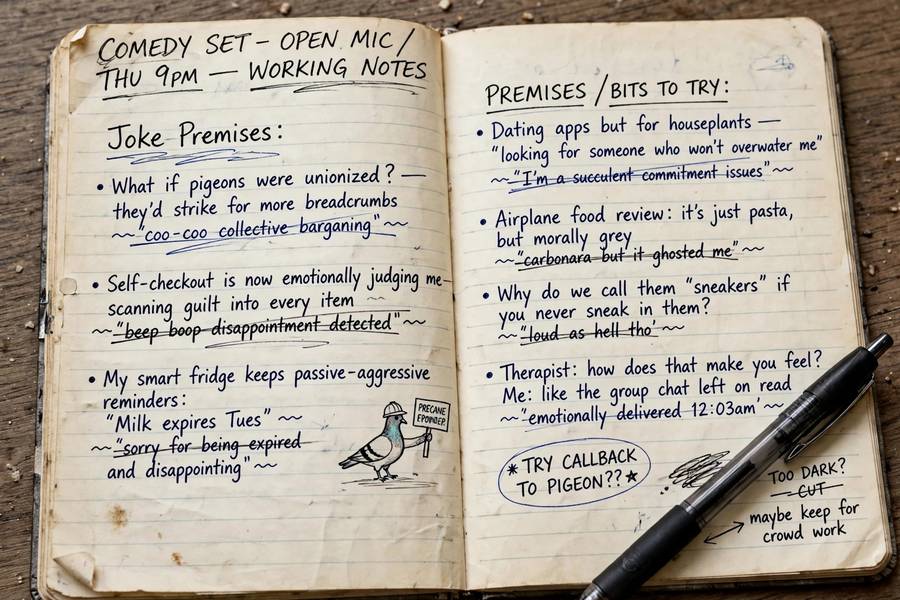
Jokes start as premises — observations, opinions, or “what if” questions. Comedians are professional noticers. The process:
- Mine your life. Relationships, jobs, family, embarrassments. The most reliable material is true and specific — generic observations get generic laughs.
- Keep a notebook (physical or phone). Every comedian carries one. Funny thoughts evaporate in minutes; the notebook is the net. Write the raw observation without judging it yet.
- Find the tension. Ask: what is weird, frustrating, or contradictory about this? The DMV is not funny; the DMV as a metaphor for mortality might be. The angle is everything.
- Heighten it. Take the observation one step further than reality. “Airports are annoying” is nothing. “Airports are the only place where taking off your shoes in public is mandatory and nobody finds it weird” is a premise.
Most premises die. Professionals generate dozens to keep one. Volume is the job.
Building the Punchline
With a premise in hand, the craft begins:
- Write the obvious punchline first — then throw it away. The first punchline your brain offers is the one every audience member’s brain also offers. The laugh lives in the second or third idea.
- Economy of words. Cut everything that is not setup or punch. “So I was at the store yesterday buying milk” becomes “I was buying milk.” Every wasted word dilutes the laugh. Great jokes are short.
- The button. End on the laugh word — never trail off with “…you know?” or explain the joke. The punchline’s last word should be the funniest word. Rearrange the sentence to make it so.
- Act-outs and voices. Physicality and character voices can carry a thin premise — but they cannot save a broken structure. Use them as seasoning, not foundation.
Tags: Squeezing More Laughs Out
A tag is an additional punchline on the same premise — milking one setup for multiple laughs. “I was buying milk. The cashier asked if I wanted a bag. Buddy, I can barely carry my life choices.” Each tag re-breaks the pattern in a new direction.
Tags are where tight five minutes become great five minutes. After the main punchline lands, ask: “What else is true about this premise?” Keep the two or three best. Kill the rest — a dying tag poisons the laughs before it.

The Writing Process: From Notebook to Stage
A realistic workflow, pieced together from countless comedian interviews:
- Capture. Premises go in the notebook constantly — no filtering.
- Write sessions. Regular dedicated time (many pros write daily) turning premises into draft bits: setup, punchline attempts, tag ideas.
- Edit on paper. Read aloud. Cut ruthlessly. If a bit cannot survive reading aloud to an empty room, it is not ready.
- Open mics. New material gets tested in low-stakes rooms. Bring a set list, record the set (audio is fine), note exactly where laughs happened — and where silence happened.
- Rewrite from the recording. The tape does not lie. The line you loved that got silence? Cut or rebuild. The throwaway ad-lib that killed? That is now the bit.
- Repeat for months. A five-minute festival set might represent a year of this cycle. The polish you see is the tip of an iceberg of dead bits.
Testing: The Brutal Truth Machine
Stage time is the only editor that matters. A joke that kills in your head can die on stage because of wording, timing, or simply because the premise does not connect. Comedians learn to read rooms like instruments: the quality of silence tells you whether to fix the wording (confused silence) or kill the bit (bored silence).
This is also why comedians bomb on purpose sometimes — testing a risky new bit in a forgiving room beats debuting it on television. Failure is data. The pros just collect it faster.
Different Styles, Different Crafts
- Observational (Seinfeld-style): “Have you ever noticed…” — premises from shared everyday experience. Deceptively hard; the observations must feel fresh.
- Storytelling: Long personal narratives with laughs woven through. Structure matters enormously — the story must earn its length.
- One-liners: Maximum density, minimum setup. Every word load-bearing. (The hardest to write well.)
- Satire/political: Premise is the news; the craft is finding the angle that reveals truth. Expires fastest — topical bits have short shelf lives.
- Absurdist/surreal: Logic abandoned deliberately. The skill is committing fully — half-absurd is just confusing.
Writing Your First 5 Minutes
If you want to try it: write 30 jokes this week using the setup-punchline structure. Test the best 10 at an open mic (they exist in most cities and welcome beginners). Record every set, note which lines got laughs, and rewrite ruthlessly — a joke is never finished, only abandoned at “funny enough.” Your first 5 minutes of solid material will take months; every comedian you admire went through the same brutal, hilarious apprenticeship.
The Business Side of Being Funny
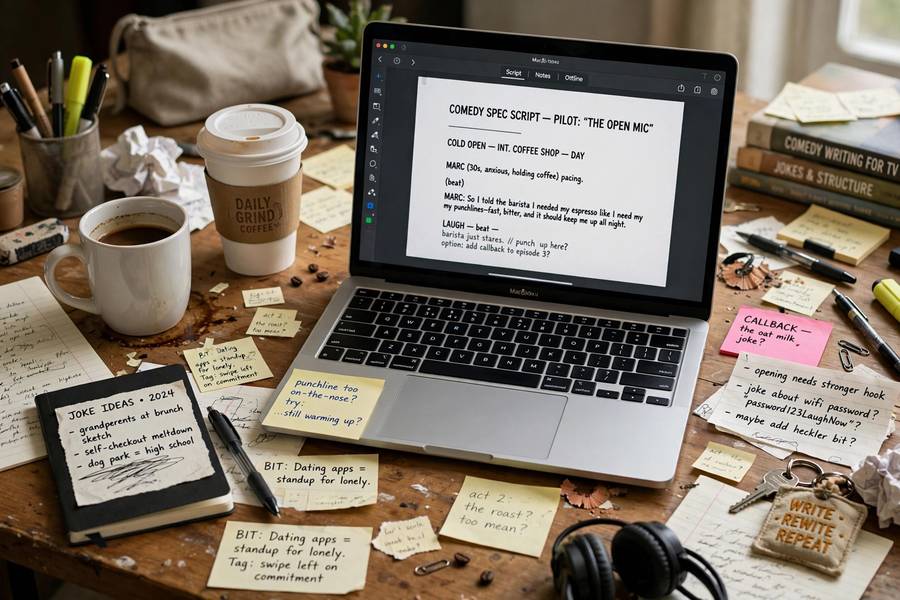
Joke-writing is also a profession beyond the stage: comedy writers staff late-night shows, sitcoms, and advertising agencies. Breaking in usually means a packet of sample jokes, spec scripts, or a strong stand-up reputation — there is no single door. Pay starts modest and scales with credits. Many comedians describe writing rooms as the purest form of the craft: ten funny people, one whiteboard, and the daily pressure to be funnier than yesterday. The stage gets the glory; the writers’ room is where most professional jokes are actually born.
Frequently Asked Questions
They capture premises (observations) in notebooks, develop setups and punchlines through dedicated writing sessions, edit ruthlessly for word economy, then test material at open mics — using recordings of audience reactions to rewrite until bits consistently land.
Setup (builds an expectation) followed by punchline (breaks it satisfyingly). The laugh comes from incongruity — the gap between what your brain predicted and what it got. Tags add extra punchlines to the same premise.
A polished five-minute set often represents months to a year of writing, testing, and rewriting. Professionals generate dozens of premises to keep one, and refine bits through repeated stage testing.
Mostly scripted and heavily rehearsed — what looks spontaneous is usually refined through dozens of performances. Crowd work is the genuinely improvised part, and even that draws on practiced techniques.
An additional punchline on the same premise after the main laugh — squeezing more comedy from one setup by finding new angles on it. Good tags separate tight sets from great ones.
The craft is learnable: premise generation, structure, word economy, and testing are all trainable skills. Natural comic instinct helps, but most working comedians attribute their ability to years of deliberate practice, not innate magic.