
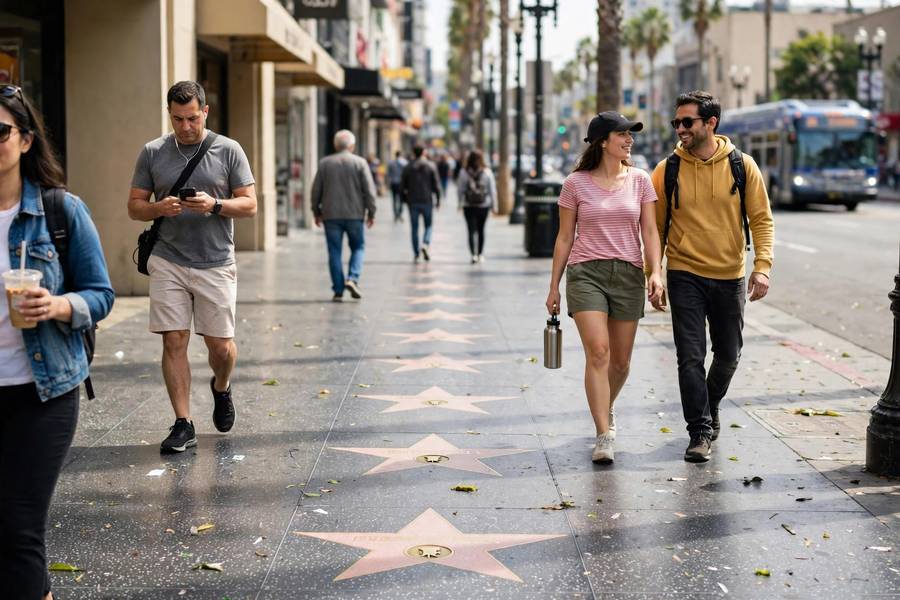
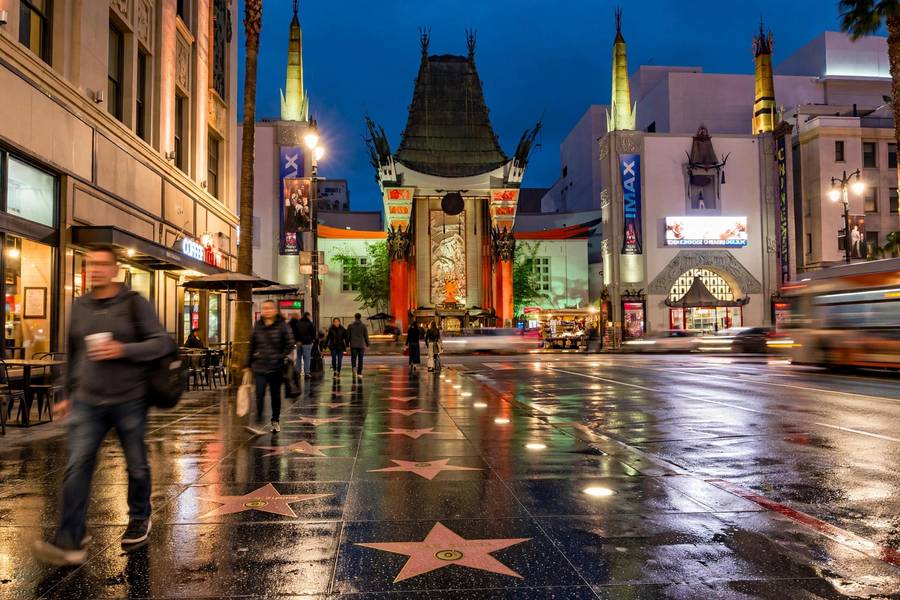
The Hollywood Walk of Fame is 15 blocks of sidewalk along Hollywood Boulevard (and Vine Street) embedded with 2,700+ brass stars honoring achievements in entertainment — film, TV, music, radio, theater, and since recently, sports entertainment.
For context on the industry behind the stars, see what Hollywood actually is.
Everyone’s seen the photos. Fewer people know how it actually works: stars aren’t purely merit awards, they cost serious money, the selection process is surprisingly bureaucratic, and some of the “facts” tourists believe are myths. As someone who covers this town, let me walk you through what’s real.
Table of Contents
- What It Actually Is
- How You Get a Star (The Real Process)
- What a Star Costs (Yes, It Costs)
- The Categories and the Symbols
- Myths Tourists Believe
- Famous Star Stories
- Visiting the Walk: What Nobody Tells Tourists
- What the Walk Means in 2026
- Frequently Asked Questions
What It Actually Is
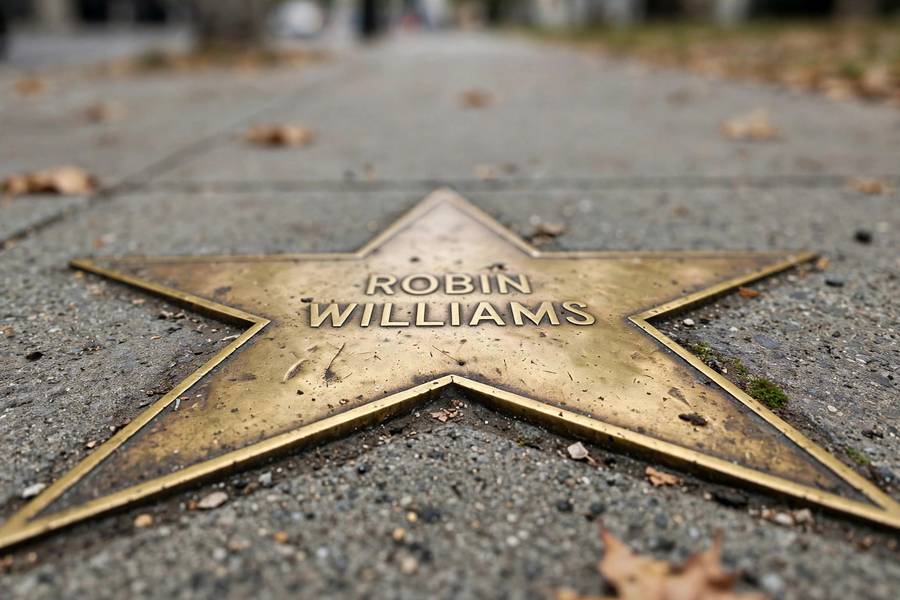
Conceived in 1953 by Hollywood Chamber of Commerce president E.M. Stuart as a way to “maintain the glory of a community whose name means glamour and excitement,” the Walk opened in 1960-61 with the first stars installed. It’s now one of the most visited landmarks in America — an estimated 10 million visitors a year walk it.
Administratively, it’s run by the Hollywood Chamber of Commerce, which owns the trademark. The stars honor contributions to entertainment across five (now six) categories. It’s a tourist attraction, a marketing tool, and a genuine industry honor — in that order of economic importance, though nobody says so at the ceremonies.
How You Get a Star (The Real Process)
Here’s the part that surprises people: you (or someone) applies.
1. Nomination. Anyone can nominate — fans, studios, publicists, the celebrities themselves. There’s an annual nomination window and a formal application with career documentation.
2. The committee. The Chamber’s Walk of Fame Selection Committee (industry veterans, historians) meets each June to choose ~25-30 new honorees from hundreds of nominations.
3. The criteria. Officially: professional achievement, longevity (minimum five years in entertainment), and — the telling one — contributions to the community and a guarantee they’ll attend the unveiling. The attendance requirement is practical: a star ceremony with no star is bad television.
4. Acceptance and scheduling. The honoree accepts, pays the fee (see below), and a ceremony date is set — usually within two years.
5. The ceremony. A 45-minute public event: speeches, the unveiling (the star is covered until the moment), photos. The Chamber livestreams them now.
What the process rewards: sustained careers, good industry relationships, and a publicist who files the paperwork. What it doesn’t measure: any objective “greatness” metric. It’s an honor, not a ranking.
What a Star Costs (Yes, It Costs)
The current fee is around $75,000 (it rises periodically). This covers:
- Creating the star (terrazzo and brass craftsmanship)
- Installation (cutting into the sidewalk, which involves the city)
- Security and crowd management for the ceremony
- Perpetual maintenance of the star
Who pays? Usually the studio, record label, network, or a sponsor — it’s a marketing expense. Sometimes fan clubs crowdfund it. The honoree occasionally pays personally, though publicists prefer it looks like an honor, not a purchase.
Is it “buying” the star? Not exactly — the committee still selects. But the fee means the system favors people with institutional backing. An equally deserving indie artist without a label’s $75k is at a structural disadvantage. The Walk is democratic in theory, sponsored in practice.
The Categories and the Symbols
Each star carries an emblem showing its category:
- Motion pictures — classic film camera
- Television — TV set
- Recording (music) — phonograph record
- Radio — microphone
- Live theatre — comedy/tragedy masks
- Sports entertainment — added recently, recognizing the category’s cultural weight
Some honorees have multiple stars in different categories (a handful have four or five). The stars’ locations also matter: the most prestigious stretches are in front of the TCL Chinese Theatre and the Dolby Theatre — placement is part of the honor’s theater.

Myths Tourists Believe
“You have to be super famous.” Not exactly — longevity and industry standing matter more than current heat. Plenty of beloved character actors have stars; plenty of viral sensations don’t (yet).
“The stars are pure merit awards.” The fee + application + attendance requirement make it part honor, part industry event. That’s fine — just don’t confuse it with the Oscars.
“You can’t buy one.” You can’t buy selection, but money is structurally involved at every step. Let’s be honest about it.
“Vandalized stars get removed.” They get repaired — sometimes repeatedly. Certain stars are vandalized regularly enough that the Chamber has the restoration down to a routine. The sidewalk is a public battleground for cultural arguments, literally underfoot.
“All the biggest names have one.” Notably, some huge figures don’t — through disinterest, scheduling, or principle. Absence isn’t always oversight; sometimes it’s a statement.
Famous Star Stories
- The most photographed: Marilyn Monroe’s star draws constant crowds — six decades after her death, the most visited star on the Walk. Fame’s half-life, measured in foot traffic.
- The ceremony that broke the internet: recent unveilings for major pop stars draw thousands of fans and millions of streams — the Chamber has learned to stage these as media events.
- The controversial ones: stars for figures with complicated legacies spark periodic debates about removal. The Chamber’s position: the Walk is a historical record, not a moral endorsement — they don’t remove stars.
- Fictional characters: yes, really — Mickey Mouse, Godzilla, the Simpsons, and others have stars. The Walk honors entertainment impact, and fictional icons qualify. Tourists love them; purists grumble.
- The stolen star: at least one star has been stolen outright (pried from the sidewalk). It was replaced. Hollywood, man.
- The double-take stars: a few names appear more than once because the honoree earned stars in multiple categories — the ultimate “wait, didn’t I just see that name?” moment for observant tourists.
Visiting the Walk: What Nobody Tells Tourists
If you go — and you should, once — a few things the guidebooks soft-pedal:
- Go early or on a weekday. Midday on a Saturday is a slow-moving river of selfie sticks. At 8am it is almost peaceful.
- You will not see all 2,700+ stars. They span 15 blocks. Pick your must-sees in advance using the Chamber’s official star map, or you will wander aimlessly.
- It is free. The sidewalk costs nothing. Anyone charging “admission” to the Walk itself is running a scam — walk past them.
- The impersonators work for tips. A photo with “Marilyn” costs a few dollars. Agree on the price before posing, not after.
- Pair it with the TCL Chinese Theatre. The handprint forecourt is right there and genuinely worth 20 minutes.
What the Walk Means in 2026
In the streaming era, the Walk’s meaning has shifted. It used to be the industry’s hall of fame. Now it’s:
A tourist economy anchor. The surrounding blocks — souvenirs, tours, impersonators — depend on foot traffic the stars generate. The Walk is infrastructure for an entire micro-economy.
A PR instrument. Star ceremonies are content: livestreamed, clipped, memed. For a mid-career artist, it’s a relevance event as much as an honor.
A contested historical record. As cultural reckonings continue, the Walk’s permanence (they don’t remove stars) makes it a physical archive of who the industry valued, when — including the uncomfortable parts. That’s arguably its most honest function.
Still genuinely moving, sometimes. Strip away the machinery, and a working actor getting a star after 30 years — surrounded by family, on the boulevard where they once took the bus to auditions — is real. The industry runs on manufactured moments; occasionally one is true.
For the publicity machinery around these moments, see how talent agents work. More industry coverage in our Celebrity section.
Frequently Asked Questions
A 15-block sidewalk landmark along Hollywood Boulevard embedded with 2,700+ brass stars honoring achievements in film, TV, music, radio, theater, and sports entertainment. Run by the Hollywood Chamber of Commerce since 1960.
Through nomination (anyone can nominate), selection by the Chamber’s committee each June, acceptance, payment of the ~$75,000 fee, and attendance at the unveiling ceremony. Criteria include 5+ years in entertainment and professional achievement.
Around $75,000, covering star creation, installation, ceremony security, and perpetual maintenance. Usually paid by the honoree’s studio, label, or sponsors as a marketing expense.
Anyone can be nominated, but selection requires 5+ years of professional achievement in entertainment, committee approval, the fee, and a commitment to attend the ceremony. It’s competitive — hundreds are nominated yearly, ~25-30 selected.
Yes — Mickey Mouse, Godzilla, The Simpsons, and others have stars. The Walk honors entertainment impact broadly, and fictional icons with major cultural footprints qualify.