Subscription Box Packaging Ideas (Unforgettable Unboxing on a Budget)

Your packaging is your storefront, your commercial, and your brand ambassador — arriving monthly at your customer’s door. In subscription boxes, packaging isn’t protection for the product. The packaging is part of the product. Customers film it, photograph it, and share it — or they don’t, and that difference is worth real money.
But here’s the tension: packaging is also pure cost. Every dollar in the box is a dollar out of margin. I’ve seen founders spend $8 per box on packaging that wowed everyone and bankrupted the unit economics, and founders who spent $0.50 and wondered why nobody shared their unboxing. Here’s how to nail the balance — memorable unboxing that protects your margins. For the full business picture, see our guide on how to start a subscription box business.
Contents
- Why Packaging Matters More for Boxes
- Decision 1 The Box Itself
- Decision 2 Interior Presentation
- Decision 3 Inserts That Work
- Decision 4 The Personal Touch
- Decision 5 Protection Without Ugliness
- Cost Control the Budget Ladder
- Sustainable Packaging That Impresses
Why Packaging Matters More for Boxes
For regular e-commerce, packaging is logistics — get the product there safely, cheaply. For subscription boxes, packaging is theater. The customer isn’t just receiving products; they’re experiencing a monthly ritual. The box on the doorstep, the opening, the reveal — that’s the product as much as what’s inside.
The unboxing economy. Customers film unboxings voluntarily — millions of views across platforms. Each filmed unboxing is free advertising reaching exactly your target audience. But nobody films a brown box with crumpled newspaper. Shareable packaging is a marketing channel with zero media cost.
Perceived value. Identical products in beautiful packaging feel worth more than in plain packaging — this is well-documented consumer psychology. A $40 box that feels like $60 retains better, gifts better, and justifies its price effortlessly. Packaging is the cheapest perceived-value lever you have.
Brand differentiation. In crowded niches, products overlap — everyone’s sourcing similar items. Packaging is where your brand becomes unmistakable. The distinctive box, the signature color, the recognizable style: these build brand equity that products alone can’t.
The retention connection. Boring packaging accelerates subscription fatigue — month four feels routine. Packaging variations (seasonal designs, new interior layouts, surprise elements) refresh the ritual and fight the “same old box” churn driver.
The investment case is clear. The discipline is spending where customers see and feel it, and economizing everywhere else.
Decision 1 The Box Itself
The outer box sets the entire tone. Your options, by investment level:
Plain box + custom stickers/labels ($0.50–1.50/box). The lean startup choice. A quality kraft or white mailer box with a well-designed branded sticker or sleeve. Looks intentional, costs little, ships well. Honestly effective — many successful boxes never graduate past this. The sticker is doing the branding work; make it excellent.
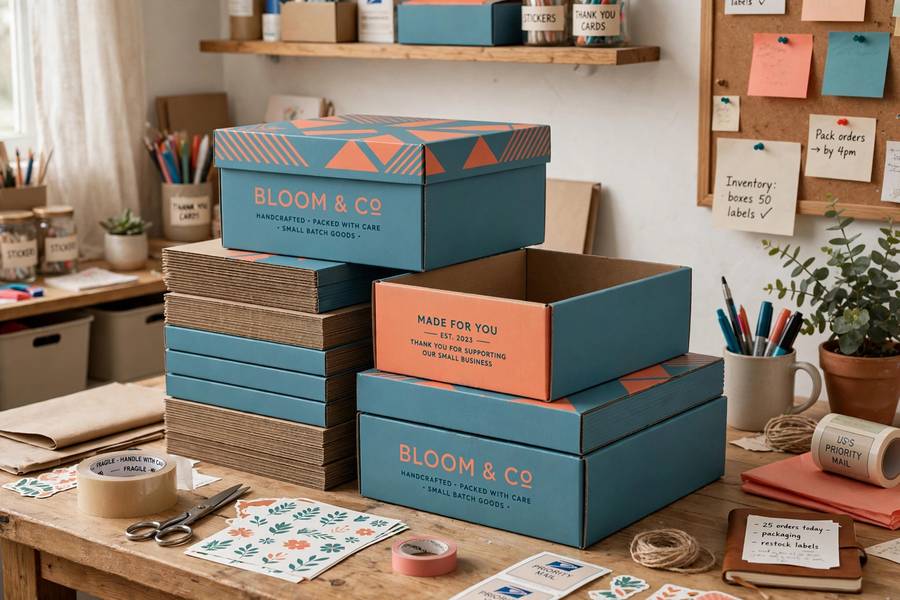
Custom printed boxes ($2–5/box at 500+ units). Full-color exterior printing with your branding, patterns, or artwork. The professional standard — instantly recognizable, highly shareable. Minimum orders (typically 500–1,000) and design costs ($300–1,000 for professional design) are the barriers. Worth it once you’re past 200 subscribers and the per-unit cost drops.
Structural custom packaging ($4–8/box). Unique box shapes, magnetic closures, drawer-style boxes, rigid gift boxes. Maximum wow factor, maximum cost. Justifiable for premium boxes ($75+/month) where packaging is part of the luxury promise. Overkill for most — the ROI rarely supports it below premium price points.
What matters most: structural quality first, beauty second. A gorgeous box that arrives crushed is worse than a plain box intact. Choose the right box strength for your shipping journey (double-wall for heavy items, appropriate burst strength), then make it beautiful within that constraint.
Sizing discipline. The box should fit contents snugly — oversized boxes waste filler, increase dimensional-weight shipping costs, and feel empty (psychologically deflating). Measure your typical contents, add minimal clearance, and size accordingly. Custom sizes cost more per box but save on shipping and filler — do the total math.
Decision 2 Interior Presentation
The reveal moment — opening the box — is the emotional peak. Design it deliberately:
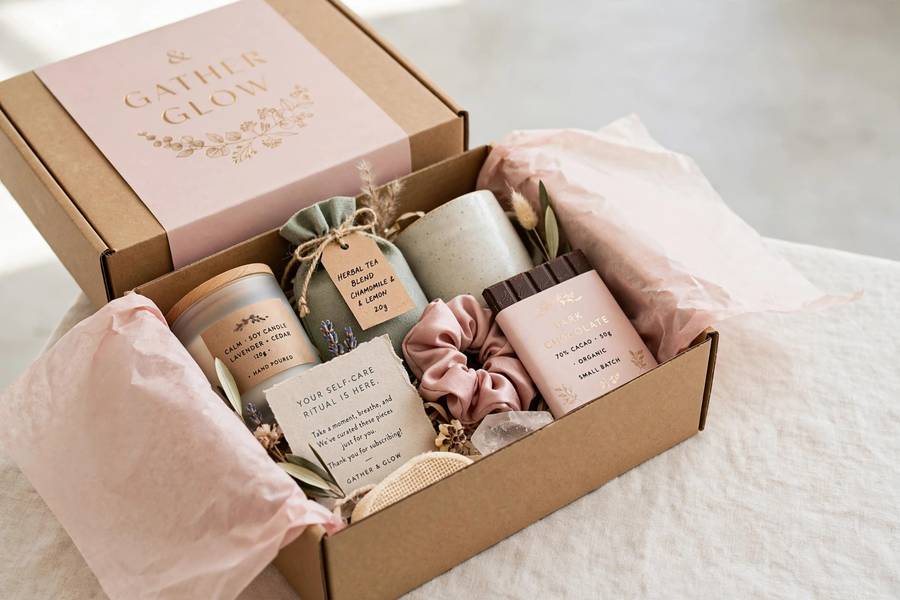
Tissue paper ($0.10–0.30/box). The single highest-ROI packaging element. Custom-printed tissue with your logo or pattern transforms a box interior for pennies. Even plain colored tissue (brand color) beats white. The crinkle, the color, the unwrapping — it’s ceremony, and ceremony is what subscriptions sell.
The top-of-box moment. What’s seen first when the tissue parts? Design this view intentionally: the hero product centered, the personal note on top, everything arranged — not dumped. Pack with the reveal in mind, every single month. A packing diagram (photo of the ideal layout) ensures consistency across packers.
Filler that fits the brand. Crinkle paper (brand colors, $0.15–0.40/box), shredded kraft, or custom excelsior — filler should complement, not just cushion. Avoid: packing peanuts (messy, cheap-feeling, environmentally hostile), newspaper (says “we don’t care”), excessive void fill (says “the box is too big”).
Layering. Tissue, then products arranged in layers, each layer a small discovery. The multi-layer reveal extends the unboxing moment — more time spent, more delight, more filming. Simple to execute: tissue between product layers, each visible as the previous is lifted.
Color story. Pick 2–3 brand colors and use them consistently: tissue, filler, stickers, inserts. Cohesive color creates the “designed” feeling that separates premium from amateur. It costs nothing extra — just discipline.
Decision 3 Inserts That Work
Inserts — the paper goods inside the box — are your cheapest communication channel. Use them strategically:
The product card/menu. Lists what’s inside with brief descriptions and the “why” behind each item’s selection. Transforms random products into curated experience. Cost: $0.10–0.25 printed. Value: enormous — it’s the difference between “stuff in a box” and “a curated box.”
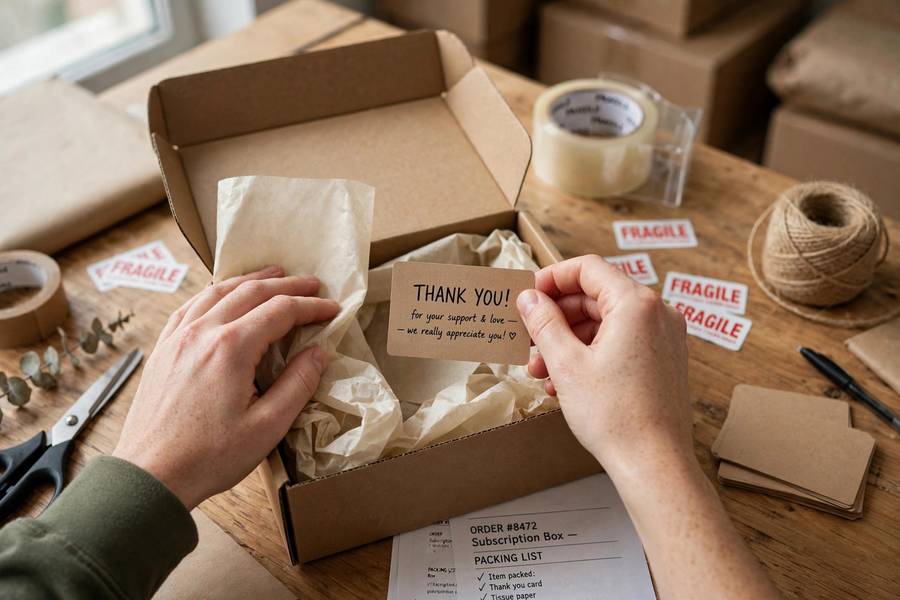
The personal note. Handwritten (or handwritten-style printed) note from the founder. “Packed this one myself — hope you love the [item]!” The personal connection in an automated world. At small scale, actually handwrite them. At larger scale, print in handwriting font on quality card stock — still effective.
The next-box teaser. “Next month: [theme] — you won’t want to miss it.” Printed on the product card or a separate insert. Fights churn by building anticipation. Your cheapest retention tool.
The referral/share card. “Love your box? Share with hashtag [#YourHashtag] for a chance to win [prize]. Refer a friend — you both get [reward].” Turns the unboxing moment (peak enthusiasm) into marketing action. Timing is everything; the card captures it.
Educational content. Usage guides, recipes, tips related to the products. Adds value beyond the items, positions you as the expert curator, and gives customers a reason to keep (not recycle) the insert.
What to skip: loose coupons for other companies (dilutes your brand), excessive promotional material (feels like junk mail), anything requiring customer effort without clear reward. Every insert must earn its place — if it doesn’t inform, delight, or convert, cut it.
Decision 4 The Personal Touch
The touches that make boxes feel human in an automated commerce world:
Handwritten elements. Even one handwritten line on the product card (“Enjoy! — Sarah”) transforms perception. Customers mention these in reviews disproportionately — tiny effort, outsized impact. Systematize it: each packer writes one line per box.
Founder visibility. A small photo and story on the insert — who curates this box and why. People subscribe to people, not companies. The founder’s face and story build the parasocial connection that retains subscribers through mediocre months.
Name personalization. “Packed especially for [Name]” — printed mail-merge on the card, or handwritten for VIPs. Addressing the customer by name triggers the cocktail-party effect — attention and warmth. Costs nothing with basic systems.
Surprise extras. An occasional unannounced bonus item — a sample, a sticker, a small treat. Unpredictable rewards create stronger loyalty than predictable ones. Not every month (then it’s expected); randomly, 3–4 times a year. The surprise is the point.
Birthday/anniversary acknowledgment. If you collect the data, a birthday-month extra or anniversary note (“1 year together!”) deepens the relationship enormously. Small effort with customer data you’re already collecting.
The principle: automation handles scale; humanity handles loyalty. As you grow, systematize the personal touches rather than abandoning them — printed handwriting fonts, mail-merge names, scheduled surprise programs. The feeling of personal attention scales even when actual handwriting doesn’t.
Decision 5 Protection Without Ugliness
Products must arrive intact — but protective packaging doesn’t have to be ugly:
Match protection to fragility. Not everything needs bubble wrap. Sturdy items need only separation; fragile items need individual wrapping. Over-protecting everything wastes money and creates an unpacking chore; under-protecting breakables creates replacements and angry emails.
Beautiful protection exists. Custom tissue wrapping for fragile items, branded bubble mailers inside the box, compartment inserts that hold items securely and look designed. Protection integrated into presentation beats protection slapped on top.
The shake test. Before finalizing any packaging design, pack a box and shake it vigorously. Then drop it from waist height. If anything breaks or shifts badly, redesign. Your carrier will be rougher than your test — build margin.
Weather considerations. Summer heat melts chocolates and cosmetics; winter cold cracks liquids. If your products are temperature-sensitive, factor seasonal packaging (insulated liners, cold packs — $1–3/box extra) into pricing. A melted box in July is a churned subscriber.
Right-sizing revisited. The number-one protection failure is oversized boxes letting contents crash around. Snug fit + appropriate filler = protection + presentation + lower shipping. It’s the rare triple win — take it.
Cost Control the Budget Ladder
Packaging budgets by stage:
Under 50 subscribers ($1–2/box total packaging): plain mailer + custom sticker + colored tissue + printed product card (home printer or local print shop). Looks intentional, costs little. Focus spending on the sticker design — it’s carrying the brand.
50–200 subscribers ($2–4/box): custom printed tissue, professional product cards (offset printed), branded filler, better box (still stock, but quality). Add the referral card and teaser insert. The unboxing starts feeling designed.
200–500 subscribers ($3–6/box): custom printed boxes become economical — take the plunge. Full insert suite, seasonal variations, upgraded filler. This is where packaging becomes a genuine competitive advantage.
500+ subscribers ($4–8/box justified): structural options open up, premium finishes (foil, embossing, matte lamination) become affordable per-unit, 3PL can handle complexity. Packaging at this scale is brand infrastructure — invest accordingly.
Across all stages: get 3+ quotes for every packaging component, negotiate at volume thresholds, and review costs quarterly. Packaging suppliers reward loyalty and volume — consolidate vendors where possible for better terms.
The golden rule: total packaging (box + interior + inserts) should stay under 10–15% of your box price. A $45 box supports $4.50–6.75 in packaging. Exceed this and you’re funding aesthetics with margin — pretty boxes that lose money are just expensive art projects.
Sustainable Packaging That Impresses
Sustainability isn’t just ethics — it’s marketing. Customers notice and share eco-packaging:
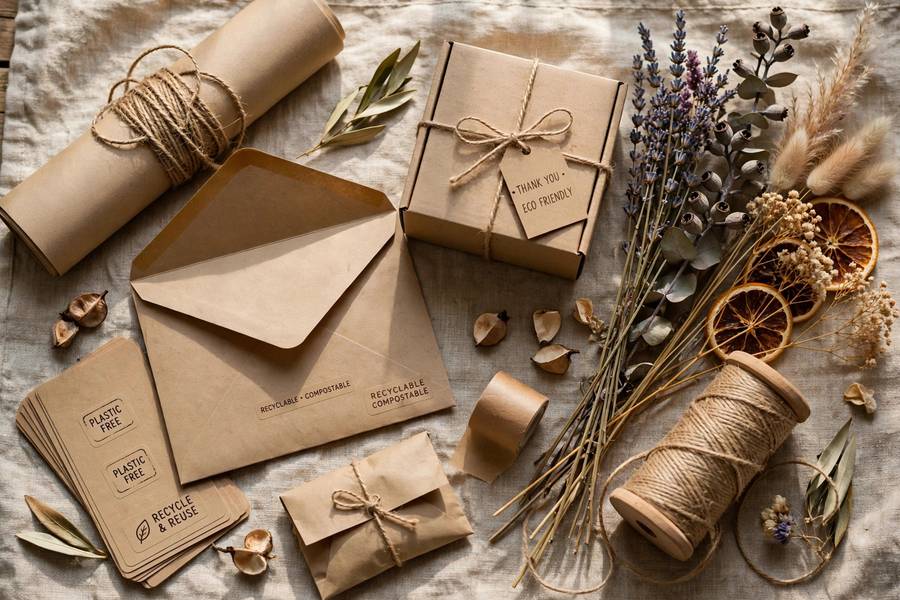
Recyclable mailers. Corrugated cardboard boxes are widely recyclable — state it on the box (“100% recyclable packaging”). Customers feel good; you pay nothing extra.
Compostable filler. Cornstarch-based packing peanuts (dissolve in water — fun unboxing moment), shredded kraft, mushroom-based cushioning. Slight premium over plastic, enormous perception value.
Soy-based inks. For custom printing — standard option at most printers now, worth mentioning on the box.
Minimal plastic. Eliminate plastic poly bags where possible; use paper alternatives. Each plastic element removed is a marketing point gained.
The reuse angle. Design boxes worth keeping — sturdy, beautiful, useful for storage. “Our boxes are designed to be reused” turns packaging into a lasting brand presence in the customer’s home.
Frequently Asked Questions
Keep total packaging (box, interior, inserts) under 10–15% of your box price — $4.50–6.75 for a $45 box. Start lean ($1–2/box: plain mailer, custom sticker, tissue) and upgrade as volume makes custom printing economical around 200+ subscribers.
The essentials: a quality box sized snugly, branded tissue paper, filler matching your brand colors, a product card explaining each item’s curation, a personal note, a next-box teaser, and a referral/share card. Every insert must inform, delight, or convert — or be cut.
Design for the reveal: hero product centered on top, tissue layers creating discovery moments, cohesive brand colors throughout, and a personal note visible at opening. Then promote a branded hashtag and run unboxing contests — customers will film packaging worth filming.
Recyclable corrugated boxes, compostable filler (cornstarch peanuts, shredded kraft), soy-based inks, minimal plastic, and reusable box designs. Sustainable options typically add 10–20% to packaging costs — easily justified by customer perception and sharing value. Be honest about what you actually do.
Yes, once past ~200 subscribers when per-unit costs drop to $2–5. Below that volume, plain boxes with excellent custom stickers achieve 80% of the branding impact at a fraction of the cost. Never sacrifice box structural quality for print beauty — a crushed pretty box is worse than a plain intact one.