Every few months someone pitches me a subscription box idea with shining eyes: “It’s like Birchbox but for left-handed gardeners!” Enthusiasm is great. But most subscription box ideas die on the same rocks: products that cost too much to source, customers who churn after two boxes, and shipping that eats the margin alive.
I’ve evaluated dozens of box concepts with founders. The winners share specific traits — repeatable curation, defensible margins after shipping, and a reason customers stay past month three. Here are 12 of the best subscription box ideas, each evaluated honestly on what makes it work and what kills it. For the full launch playbook, see our guide on how to start a subscription box business.
Contents
- What Makes a Box Idea Work
- The Scoring System
- Hobby and Passion Boxes
- Food and Drink Boxes
- Self Care and Lifestyle Boxes
- Niche and Novelty Boxes
- How to Pick Your One
- Validating Before You Invest
What Makes a Box Idea Work
Before the list, the filter every idea must pass:
Repeatable curation. Can you find 12 months of different, interesting products without repeating yourself or scraping the barrel by month four? Boxes die when curation exhausts. The best niches have deep product ecosystems — hundreds of potential items, not dozens.
Margin after shipping. The brutal math: box price minus product cost minus packaging minus shipping = your gross margin. Shipping a 3-pound box costs $8–15 domestically. If your box sells for $30 and products cost $12, you’re left with $3–10 before any other expense. Many “great ideas” fail right here. Light, compact, high-perceived-value products win.
A reason to stay. Why does month four beat month one? Discovery (new things each month), convenience (restocking essentials), community (belonging), or progression (skill-building). Boxes without a retention mechanism churn at 10–15% monthly — meaning you must replace your entire customer base yearly just to stand still.
Sourcing you can actually do. Can a small founder reliably source these products monthly at wholesale prices? Ideas requiring rare, handmade, or licensed products create sourcing nightmares. Boring, available supply chains beat exotic ones.
An audience you can reach. Is there a defined community — online groups, influencers, forums, hashtags — where these customers gather? “Everyone who likes surprises” isn’t an audience. “Home coffee brewers” is.
Run every idea below through this filter. The scores reflect my honest assessment, not hype.
The Scoring System
Each idea gets rated on three factors (1–5):
- Margin potential: can you clear 40%+ gross margin after all costs?
- Retention strength: do customers naturally stay 6+ months?
- Sourcing ease: can a small operator reliably source monthly?
Higher total = stronger idea. But fit matters more than score — your knowledge, passion, and access to a niche outweigh a point or two.
Hobby and Passion Boxes
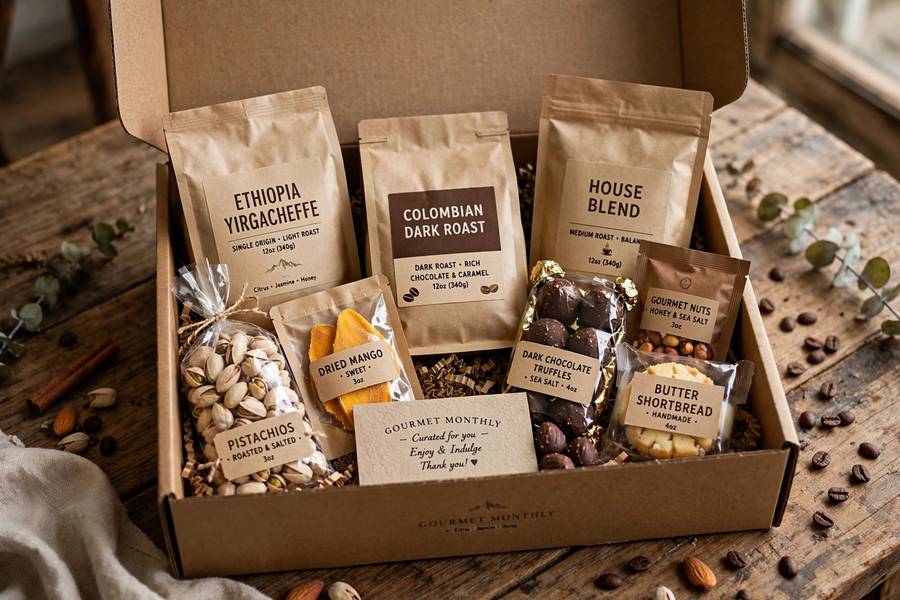
1. Coffee subscription (Score: 12/15). Margin 4, Retention 5, Sourcing 4. Coffee drinkers consume daily — the ultimate retention driver. Roasters offer wholesale readily, the product is light, and the discovery angle (single origins, roast profiles) stays fresh indefinitely. The catch: crowded market. Win with a sharp angle — decaf-only, espresso-specific, or a region focus — not generic “great coffee.”
2. Hobby craft kits (Score: 11/15). Margin 4, Retention 4, Sourcing 3. Knitting, embroidery, model-building, watercolor — hobbyists spend heavily and love curated supplies. Monthly projects create natural progression (month 3 builds on month 1). Sourcing is the challenge: you need genuinely good materials, not dollar-store filler, and kit design takes real expertise. Founder must know the craft deeply.
3. Book boxes (Score: 10/15). Margin 3, Retention 4, Sourcing 3. Readers are loyal and the community aspect (read-alongs, author notes) drives retention. But books are heavy (shipping!), margins on books are thin, and competing with libraries and Kindle is real. The winners add curation value — themed goods, annotations, exclusive editions — not just “a book monthly.”
Food and Drink Boxes
4. Snack discovery boxes (Score: 11/15). Margin 4, Retention 3, Sourcing 4. International snacks, healthy snacks, regional specialties — the discovery thrill is strong and sourcing is straightforward through distributors. Light products, good margins. Retention is the weakness: novelty fades, and month-six snacks feel less exciting than month-one. Combat with themes, limited editions, and community voting on contents.
5. Specialty tea (Score: 12/15). Margin 5, Retention 4, Sourcing 3. Tea is the margin king — incredibly light, tiny product cost, huge perceived value. Loose-leaf and specialty teas wholesale cheaply and feel premium. The audience (wellness, ritual, connoisseurs) is defined and reachable. Sourcing quality consistently takes work, but the economics forgive a lot.
6. Cooking ingredient boxes (Score: 10/15). Margin 3, Retention 4, Sourcing 3. Spice blends, sauces, small-batch condiments — consumables with natural reorder logic. Recipe cards add value cheaply. Watch weight (jars are heavy) and shelf life. The meal-kit giants own the full-meal space; win in the specialty-ingredient lane they ignore.
Self Care and Lifestyle Boxes
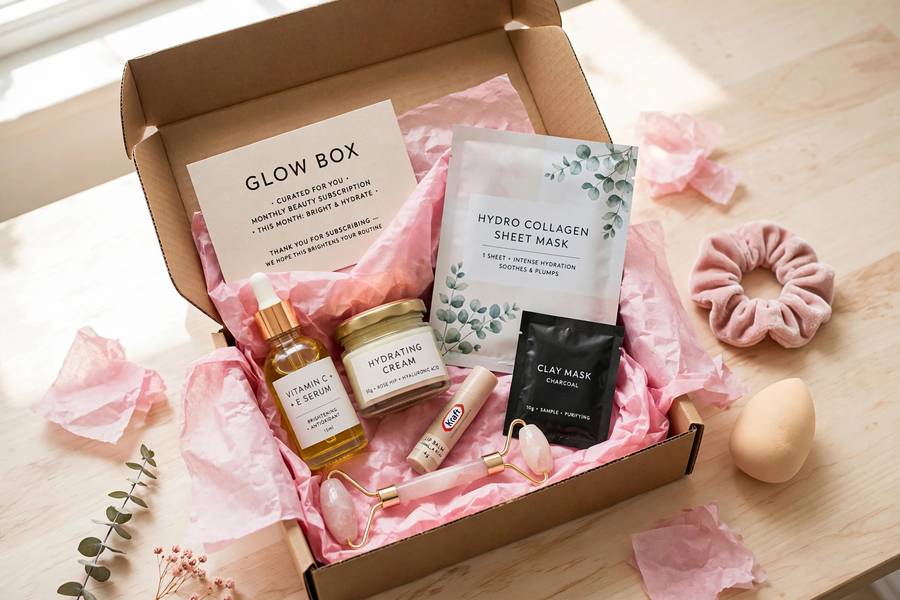
7. Self-care/wellness boxes (Score: 11/15). Margin 4, Retention 3, Sourcing 4. Bath products, candles, journals, skincare minis — the audience is massive and products source easily. But it’s the most crowded category in subscription boxes. Differentiation is everything: a specific angle (new moms, night-shift workers, men’s self-care — underserved) beats generic “treat yourself.”
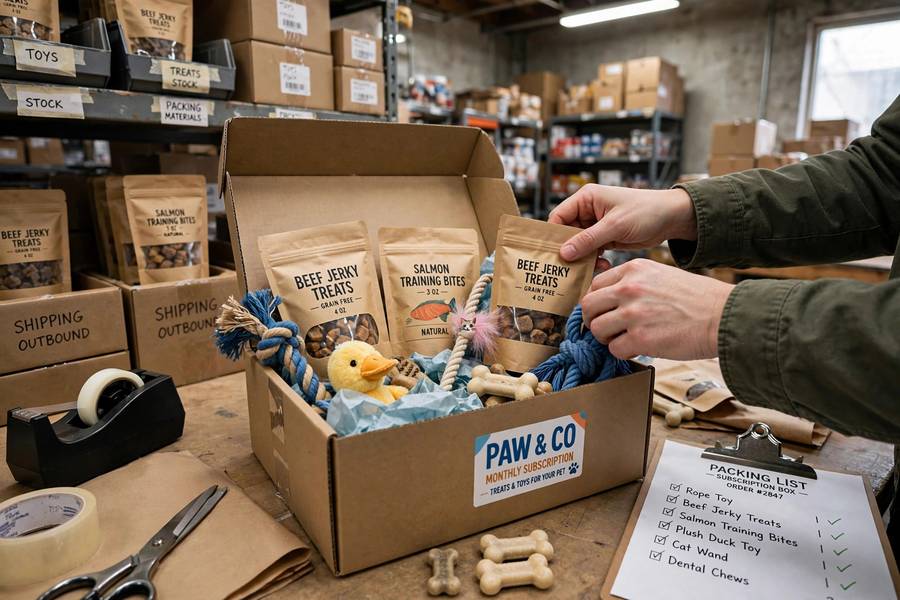
8. Pet boxes (Score: 13/15). Margin 4, Retention 5, Sourcing 4. My highest-scoring mainstream idea. Pet owners spend emotionally, pets consume treats and toys constantly (built-in retention), and the unboxing joy — watching the dog go crazy — is marketing gold that customers film and share free. Dog and cat are crowded; exotic pets, specific breeds, or senior-pet care are open lanes.
9. Men’s grooming boxes (Score: 10/15). Margin 4, Retention 3, Sourcing 4. Good margins on small products, straightforward sourcing, defined audience. Retention lags because grooming routines stabilize — once a man finds his products, discovery loses appeal. Counter with seasonal rotations and limited editions.
Niche and Novelty Boxes
10. Kids’ activity/STEM boxes (Score: 12/15). Margin 4, Retention 4, Sourcing 4. Parents pay premium for educational screen-free activities, kids’ delight drives renewals (children lobby parents — the ultimate retention mechanism), and the STEM/educational angle justifies higher prices. Age-appropriate progression keeps it fresh. Design quality matters enormously — cheap-feeling kits churn fast.
11. Plant boxes (Score: 9/15). Margin 3, Retention 3, Sourcing 2. Huge enthusiasm, terrible logistics — live plants ship badly, die in transit, and create support nightmares (“my plant arrived dead”). The survivors focus on supplies and accessories (pots, tools, seeds) rather than live plants, or go ultra-premium with guaranteed-live delivery. High passion, high operational difficulty.
12. Collector/hobbyist boxes (Score: 11/15). Margin 5, Retention 4, Sourcing 2. Trading cards, pins, miniatures, fandom merch — collectors pay premium prices and stay loyal to curation they trust. Margins on licensed or exclusive items are excellent. But sourcing is the hardest on this list: licensing, exclusivity deals, and limited-run products require industry access most founders don’t have. If you have the connections, it’s gold; if not, it’s a wall.
How to Pick Your One
Score is a starting point. Now apply the personal filters:
What do you know deeply? The craft-kit box works if you’re a crafter. The coffee box works if you’re a coffee person. Curation is a knowledge business — customers smell inauthenticity instantly. Your genuine expertise is a moat that generic competitors can’t cross.
Who can you reach on day one? The best idea with no audience access loses to a decent idea with a ready community. If you’re active in the home-broiler coffee community with 5,000 followers, the coffee box isn’t just a good idea — it’s your idea.
What can you source this month? Call three potential suppliers before committing. If you can’t get wholesale pricing and reliable availability confirmed, the idea is theoretical. Real supplier conversations kill more bad ideas than any analysis — which is exactly their value.
What’s your unfair advantage? A roaster connection, a craft skill, an audience, a design eye, a logistics background — the thing competitors can’t easily replicate. Build the box around the advantage, not the trend.
One box, one audience, one promise. The founders who struggle run three box concepts simultaneously. Pick one. The focus compounds: better curation, better sourcing terms, clearer marketing, stronger community. You can expand later from a position of strength.
Validating Before You Invest
Don’t order 500 boxes on a hunch. Validate in stages:
Stage 1: The landing page test ($0–100). Build a simple page describing the box, its price, and what’s inside month one. Drive 200–500 targeted visitors (community posts, small ad spend, your network). Measure email signups. Under 5% conversion to “notify me at launch” — rethink the idea or the pitch.
Stage 2: The pre-sale ($500–2,000 risk). Offer founding-member pricing for the first box, limited quantity (50–100). Real money changing hands is the only validation that counts. If you can’t pre-sell 50 boxes to strangers, the idea needs work — and you’ve learned it for the cost of a landing page, not a warehouse of inventory.
Stage 3: The pilot box. Fulfill the pre-sales yourself — source, pack, ship 50 boxes by hand. You’ll learn your true costs (they’re always higher than spreadsheet estimates), your time per box, and what customers actually think. Their feedback shapes box two.
Stage 4: Decide with data. After the pilot: true margin per box, hours per box, customer satisfaction, and — critically — how many pilot customers want box two. If the economics work and customers re-order, scale deliberately. If not, you’ve spent hundreds learning instead of thousands failing.
The subscription box graveyard is full of great ideas with bad economics. The filter, the scoring, the personal fit, and the staged validation — run every idea through all four, and you’ll pick a box that survives past month three. That’s when the real business starts.
Picked your idea? How to start a business covers the formation groundwork before box one ships.
Frequently Asked Questions
Pet boxes, specialty tea, and collector boxes score highest on combined margin and retention. Pet boxes lead overall — emotional spending, constant consumption, and shareable unboxing moments drive both acquisition and retention.
Filter ideas through repeatable curation, margin after shipping, a natural retention mechanism, sourcing you can actually do, and an audience you can reach. Then apply personal fit: your deep knowledge, day-one audience access, and unfair advantage matter more than the raw score.
In stages: a landing page measuring signup conversion, then a limited pre-sale of 50–100 boxes at founding-member pricing, then a hand-fulfilled pilot revealing true costs. Only scale when the pilot shows working economics and customers wanting box two.
The common killers are shipping costs destroying margins, curation exhausting after a few months, no retention mechanism (10–15% monthly churn), and sourcing problems. Most failures are economics, not concept — the idea was fine, the math wasn’t.
Yes, for well-chosen niches with disciplined economics. The generic-box era is over — winners have sharp angles, 40%+ gross margins after shipping, and real retention mechanisms. Crowded categories (beauty, generic snacks) need strong differentiation; underserved niches remain wide open.