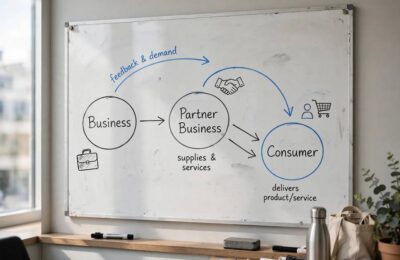
Pricing a subscription box looks simple — pick a monthly number — but it’s the highest-stakes decision in the business. Price too low and you bleed margin on every shipment while training customers to expect cheap. Price too high and acquisition stalls. And unlike one-time products, your price repeats monthly, which means pricing mistakes compound 12 times a year.
I’ve rebuilt pricing for struggling boxes and launched pricing for new ones. The pattern is consistent: founders underprice from fear, ignore shipping in the math, and leave the most profitable pricing structures (tiers, annual plans) completely unused. Here’s the complete playbook. For the startup cost side, see our breakdown of how to start a subscription box business.
Contents
- The Pricing Math First
- The Three Pricing Models
- Tiered Pricing the Revenue Multiplier
- Annual Prepay Your Cash Flow Engine
- Intro Offers That Do Not Destroy You
- Shipping to Price or Not to Price
- Raising Prices Without Spiking Churn
The Pricing Math First
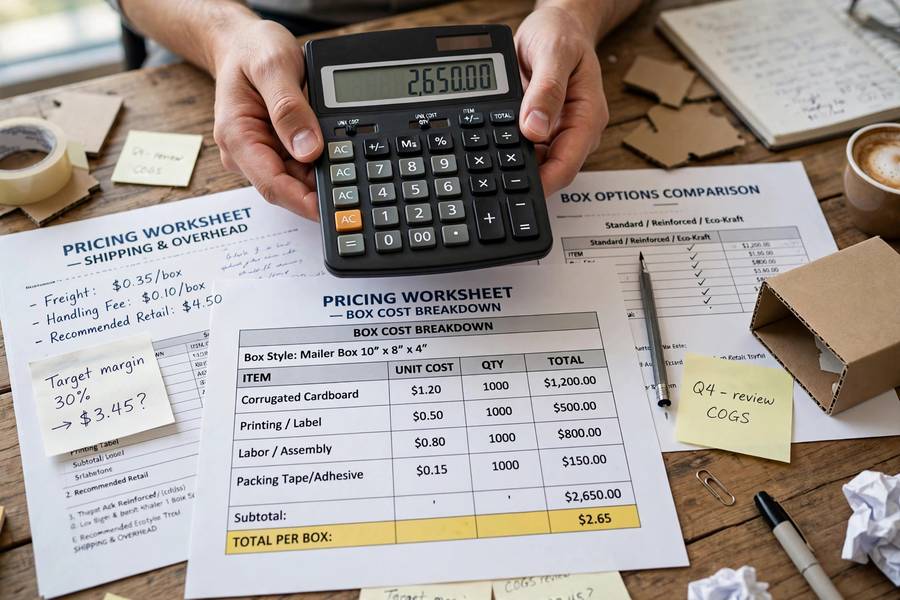
Every pricing strategy starts from the same equation. Work it before choosing any number:
Per-box cost = product + packaging + outbound shipping + payment processing + packing labor allocation
Example for a $44.99 box: – Products: $13.50 – Packaging: $2.75 – Shipping: $9.25 – Processing (2.9% + $0.30): $1.60 – Packing labor: $1.50 – Total: $28.60 – Gross margin: $16.39 (36%)
36% — workable but tight. Now the same box at $49.99: margin becomes $21.39 (43%). Five dollars of price, seven points of margin. That’s the leverage you’re working with.
Targets: 40–50% gross margin after all direct costs. Below 35%: no room for acquisition spend or surprises — you’re one bad month from losses. Above 55%: you may be leaving growth on the table (or you’ve built something genuinely premium — verify with price testing).
The costs founders forget: packing labor (your time has value), shipping supply costs beyond postage (labels, tape, printer ink), customer service time per subscriber, and churn replacement acquisition. Fully-loaded margin is always lower than spreadsheet margin. Build 5 points of cushion into your target.
Price from margin, not from competitors. “Competitors charge $35” is information, not instruction. If your costs demand $45 for healthy margins, the answer isn’t to price at $35 and hope — it’s to build a box worth $45, or cut costs to make $35 work. Pricing to competitors’ numbers with your cost structure is how boxes die slowly.
The Three Pricing Models
1. Single-tier flat rate. One box, one price, every month. Simplest to operate, easiest to market, cleanest messaging. Best for: new boxes validating the concept, niches where one configuration serves everyone, founders who want operational simplicity. Limitation: you capture one price point — leaving money from customers who’d pay more and excluding those who’d pay less.
2. Tiered plans. Two to three box sizes or value levels at different prices. Best for: most established boxes — it’s the highest-revenue model for the majority. The middle tier becomes the popular choice; the premium tier captures enthusiasts; the basic tier catches the price-sensitive. (Detailed below.)
3. Build-your-own / customizable. Subscribers choose products or categories within a price band. Best for: niches with strong preference variation (snacks with dietary needs, beauty with skin types). Highest perceived value, highest operational complexity — customization multiplies packing complexity and inventory management. Only attempt with systems ready.
My default recommendation: launch single-tier to validate, add tiers at 100–200 subscribers when you understand your customers’ willingness to pay. Customization comes last, if ever — it’s operationally expensive and most boxes don’t need it.
Tiered Pricing the Revenue Multiplier
Tiering is the single highest-ROI pricing change most boxes can make. Here’s how to structure it:
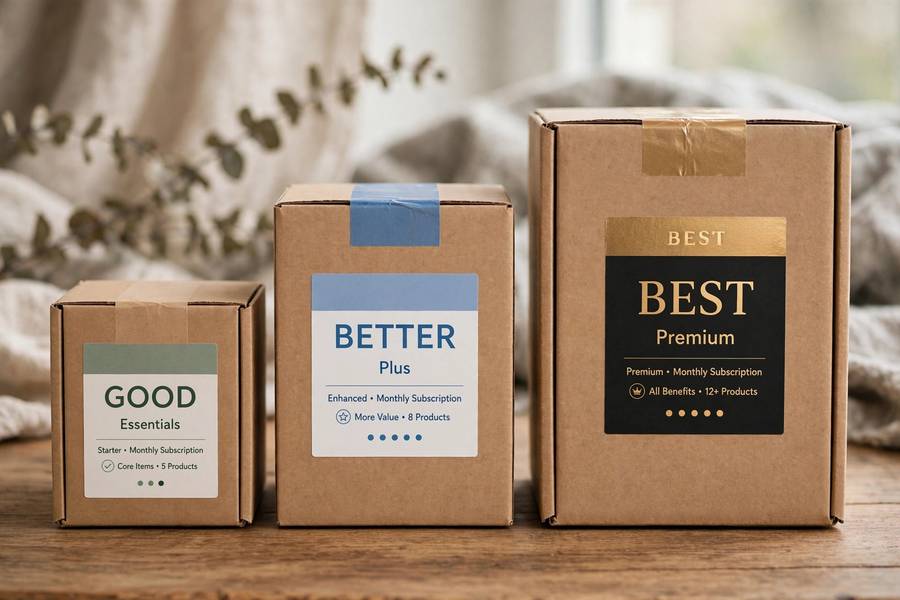
The classic three: Mini ($24.99), Classic ($44.99), Deluxe ($69.99). Three tiers, clear value steps, the middle positioned as the obvious choice.
Value steps must be real. Each tier needs genuinely more value — more products, premium items, exclusive access. Customers detect “same box, different price” instantly. The deluxe tier should include at least one item unavailable in lower tiers — exclusivity justifies the jump.
Price gaps matter. Tiers too close together ($39/$44/$49) create decision paralysis without revenue differentiation. Tiers too far apart ($25/$45/$95) make the top feel unreachable. Aim for 60–80% steps: $25 → $45 → $75. Each step feels like a meaningful upgrade worth considering.
Name them well. “Basic/Standard/Premium” is forgettable. Names tied to your brand and audience (“Explorer/Voyager/Pioneer,” “Essential/Indulgent/Opulent”) reinforce identity and make the premium tier feel aspirational rather than expensive.
The decoy dynamic. Price the top tier to make the middle look smart. Most customers avoid the cheapest (fear of missing out) and the most expensive (fear of overspending) — they land in the middle. A well-priced premium tier exists partly to sell the middle tier. This isn’t manipulation; it’s presenting genuine options in a way humans process easily.
Expected results: typical tier distribution is 15% basic / 60% middle / 25% premium. Average revenue per subscriber rises 20–35% versus single-tier at the middle price. That’s pure margin expansion from presentation alone.
Operational reality check: tiers multiply SKUs, inventory complexity, and packing variations. Two tiers is manageable for most; three is the practical maximum until you have fulfillment systems (or a 3PL) handling complexity. Don’t tier beyond your operational capacity.
Annual Prepay Your Cash Flow Engine
The most underused pricing strategy in subscription boxes: annual plans.
The offer: 12 months for the price of 10 (roughly 17% discount), or 2 months free. The subscriber commits yearly; you collect upfront.
Why it’s transformative: – Cash flow: a year’s revenue collected today funds inventory, marketing, and growth without debt. For a box at $45/month, each annual subscriber brings $450 immediately versus $45 monthly. – Churn elimination: annual subscribers can’t churn monthly — your most volatile metric stabilizes. Even if 20% don’t renew at year-end, you’ve had 12 months of guaranteed revenue. – Commitment psychology: prepaid subscribers engage more (sunk cost fallacy working for you), complain less, and become better community members. – Valuation: businesses with annual recurring revenue command higher multiples than monthly — if you ever sell, annual plans directly increase enterprise value.
How to position it: present monthly as the default, annual as the smart upgrade — “Save $90 with annual” beside the monthly option. Don’t hide monthly (it converts the cautious), but make annual visually compelling.
The discount math: giving 2 months free (17% off) costs less than it appears. Your per-box margin stays identical — you’re discounting, not cost-increasing. And the cash-flow and churn benefits far outweigh the discount. Even at 10–15% of subscribers on annual, the impact is material.
Offer it at signup and at renewal. New subscribers: present both options. Existing monthly subscribers approaching month 3–4 (past the early churn window, engaged enough to commit): targeted annual upgrade offer. Time it when satisfaction is highest.
Intro Offers That Do Not Destroy You
Acquisition offers work — but badly designed ones attract discount-seekers who churn at the first full-price billing:
First-box discount (not ongoing). “50% off your first box” — the discount applies once, then full price. This lowers trial risk without establishing a discounted price anchor. Far superior to “20% off for 3 months,” which trains customers to expect $36, not $45.
Free bonus item (better than discounting). Instead of cutting price, add value: “First box includes a bonus $15 item free.” Perceived value stays high, price integrity intact, and the bonus item showcases your curation.
Founding-member pricing (use sparingly). A locked-in lower rate for the first 100 subscribers. Powerful for launch momentum, dangerous long-term — you’re permanently discounting your earliest, often most loyal customers. If used, cap the number strictly and consider a time limit (“founding rate for 12 months”).
What to avoid: perpetual discounts, deep ongoing discounts (anything over 20% ongoing destroys margin), and discount codes scattered across coupon sites (attracts the wrong customers and trains price sensitivity). Every discount should have an expiration and a strategic purpose.
The trial-box question: some boxes offer a one-time trial box at a slight premium (“try one box for $49, no subscription”). This converts the commitment-phobic and often outperforms discounts — the customer pays full price to sample, then subscribes at full price. No discount anchor established.
Shipping to Price or Not to Price
Three approaches, each with trade-offs:
Free shipping (built into price). The price includes shipping — “$49/month, shipping included.” Highest conversion (customers hate surprise shipping fees), simplest messaging. Requires pricing high enough to absorb shipping — which usually means a higher sticker price. Best for: premium boxes where the total price still feels fair.
Shipping added at checkout. “$39/month + shipping.” Lower sticker price, but checkout friction — abandoned carts spike when shipping appears late. Best for: price-sensitive categories where the base price must stay low to compete. Mitigate by showing shipping early, not as a surprise.
Flat-rate shipping. “$39/month + $5 flat shipping” (you subsidize the rest). A middle path — transparent, predictable, psychologically palatable. The $5 feels nominal even when actual shipping is $10. Best for: most boxes, honestly — it balances conversion and margin.
My recommendation: build shipping into the price (“free shipping”) for boxes over $40 — the premium audience expects it and conversion lifts outweigh the sticker shock. Use flat-rate for boxes under $40 where every dollar of sticker price affects competitiveness. Never surprise with shipping at checkout — it’s the top abandonment trigger in subscription commerce.
International shipping: price it separately, always. International rates ($25–60+) can’t be absorbed into domestic pricing. Offer it as an option with real-time or flat-rate international fees — and be aware that customs, duties, and delivery times create support overhead. Many successful boxes stay domestic-only until 500+ subscribers.
Raising Prices Without Spiking Churn
You’ll need to raise prices eventually — costs rise, value improves. Here’s how without a churn spike:
Raise for new subscribers first. Immediate, no announcement needed. New customers never knew the old price. Watch conversion rates for 30 days — if they hold, the market accepts the new price.
Grandfather existing subscribers (temporarily). Give current subscribers 60–90 days at the old rate, then move them up with notice. “As a thank you for being with us, your current rate is locked until [date].” This honors loyalty while still achieving the increase.
Announce with value, not apology. “Starting [date], subscriptions will be $49/month (from $45). Here’s what your box includes now that it didn’t before: [specific improvements].” Confident, brief, value-forward. Never apologize for charging sustainably — apologize for nothing.
Improve something visible. Time a small upgrade with the increase — an extra item, better packaging, a new feature. The story becomes “more value” rather than “higher price.” The improvement cost is minor; the perception shift is major.
Expect 3–5% churn from the increase. Normal, acceptable, and priced in. The 95% who stay at the higher price generate more revenue than the 5% who left at the old price. Do the math beforehand so you don’t panic at the first cancellations.
How much, how often: 5–10% every 12–18 months is sustainable and expected. Larger jumps (15%+) need stronger value justification. Never go 3+ years without an increase — the eventual correction becomes shocking instead of routine.
Pricing only holds inside a clear positioning story — our marketing plan guide shows how to build it.
Frequently Asked Questions
Start from your fully-loaded per-box cost (product, packaging, shipping, processing, labor), target 40–50% gross margin, and price from that math — not from competitors. Then tier (good/better/best), offer annual prepay, and build shipping into the price or use flat-rate.
Target 40–50% gross margin per box after all direct costs. Below 35% leaves no room for acquisition costs or surprises; above 55% may mean you’re underinvesting in growth. Remember margin must also cover churn-replacement acquisition costs.
Yes, once past ~100 subscribers. Three tiers (e.g., $25/$45/$75) typically lift average revenue per subscriber 20–35% versus single-tier. Keep value steps real, price gaps at 60–80%, and don’t exceed your operational capacity — three tiers max without fulfillment systems.
Raise for new subscribers first, grandfather existing ones for 60–90 days, announce with added value (not apology), pair with a visible improvement, and expect 3–5% churn as normal. Raise 5–10% every 12–18 months rather than letting prices stagnate for years.
For boxes over $40, yes — build shipping into the price. Conversion lifts outweigh sticker shock at premium prices. For boxes under $40, flat-rate shipping ($5) balances competitiveness and margin. Never surprise customers with shipping fees at checkout.