How to Market a Subscription Box (From Pre-Launch to 1,000 Subscribers)

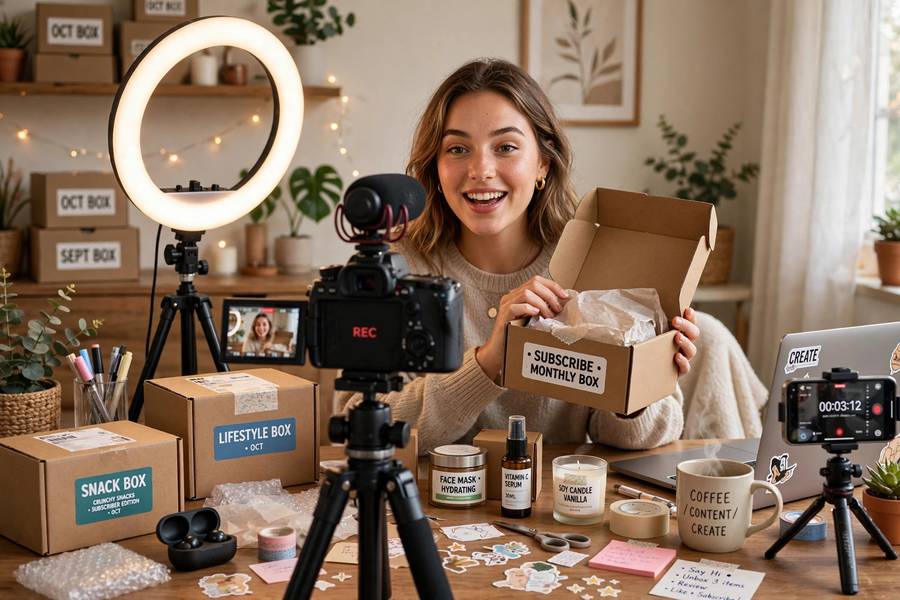
Marketing a subscription box is different from marketing most products. You’re not selling a thing — you’re selling a recurring experience, a monthly surprise, a belonging. The purchase decision is emotional and visual in a way that spec sheets can’t touch. And your best marketing asset isn’t an ad — it’s your subscribers filming themselves opening your box.
I’ve helped boxes go from zero to their first thousand subscribers. The playbook has distinct phases — pre-launch, launch, growth, and retention marketing — and skipping phases is why most box marketing fails. Here’s the full sequence. For the business foundation underneath, see our guide on how to start a subscription box business.
Contents
- Why Box Marketing Is Different
- Phase 1 Pre Launch Building the List
- Phase 2 Launch the First 100
- Phase 3 Growth Channels That Scale
- The Unboxing Content Engine
- Paid Acquisition the Math
- Retention Marketing the Compounding Layer
Why Box Marketing Is Different
Three things make subscription box marketing unique:
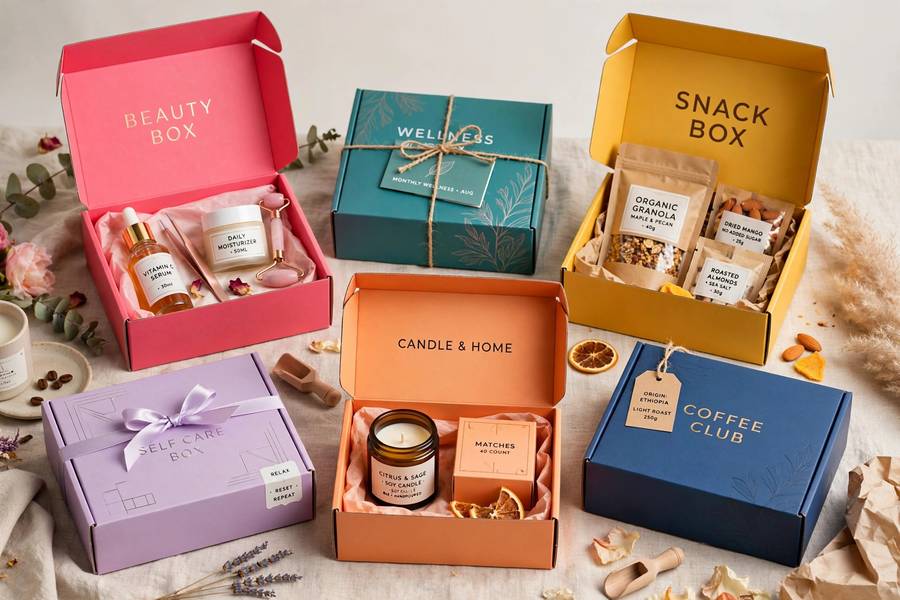
You’re selling transformation, not products. Nobody subscribes for “5–7 items monthly.” They subscribe for the feeling: discovery, self-care, expertise, belonging. Your marketing must sell the experience — the anticipation, the unboxing, the community — with products as evidence, not the headline.
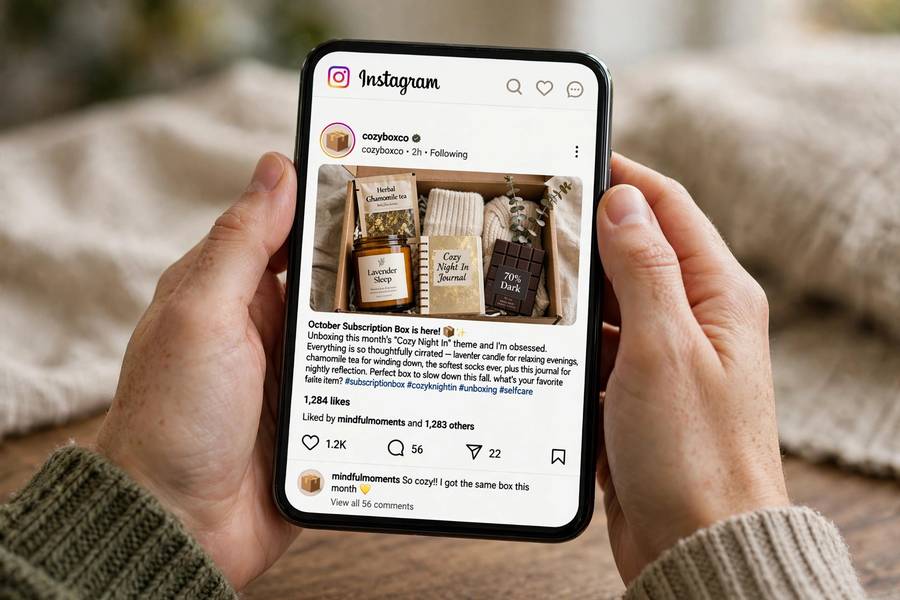
Visual proof dominates. Subscription boxes are inherently photogenic — that’s a structural advantage most businesses would kill for. Unboxing videos, flat-lay photos, “what I got” posts: this content markets itself because it’s genuinely enjoyable to consume. Your job is to make the box worth filming, then make filming easy.
Recurring revenue changes the math. A $45/month subscriber staying 8 months is worth $360 in revenue. That means you can afford $30–60 to acquire a subscriber and still profit handsomely — acquisition budgets that would be insane for one-time products make perfect sense here. But it also means churn is an existential metric in a way one-time businesses never face.
The community is the moat. Boxes with active communities (Facebook groups, Discord, hashtags) retain dramatically better than boxes that just ship products. Community marketing isn’t a nice extra — it’s a retention strategy disguised as marketing.
Phase 1 Pre Launch Building the List
Start marketing 6–12 weeks before your first box ships. The goal: an email list of 500–2,000 interested prospects before launch day.
The coming-soon page. One page: what the box is, what’s in box one (tease, don’t fully reveal — mystery drives signups), the price, and an email capture with a compelling reason (“Get 20% off your first box + early access”). Every other pre-launch activity drives traffic here.
The founding-member offer. “First 100 subscribers lock in founding-member pricing forever” (or for 12 months — be careful with forever). Scarcity + status + discount: the combination converts browsers to committed. Cap it genuinely — false scarcity destroys trust.
Content before product. Start creating content in your niche 2–3 months pre-launch: the Instagram account showing curation process, TikToks of sample products, blog posts about the niche. You’re building an audience that converts to subscribers on day one — not starting from zero at launch.
Community seeding. Join the communities where your customers live (subreddits, Facebook groups, forums, Discord servers). Contribute genuinely for weeks before mentioning your box. When launch comes, you’re a known member sharing news, not a stranger spamming.
The referral pre-launch. “Refer 3 friends, get your first box free.” Pre-launch referral mechanics can 3–5x your list — people share upcoming launches more readily than existing products (novelty + no purchase required). Build the sharing into the signup confirmation.
Target: 500+ emails minimum before launch. With a 5–10% conversion rate, that’s 25–100 day-one subscribers — enough for a real launch, social proof, and momentum. Below 200 emails, consider extending pre-launch rather than launching to crickets.
Phase 2 Launch the First 100
The first 100 subscribers are the hardest and most important. They provide revenue, feedback, testimonials, and the social proof everything else builds on.
Launch to your list first. Email sequence over 7–10 days: announcement, behind-the-scenes, founding-member reminder, last-call. Your warm list converts 5–15% — this is where pre-launch work pays off.
Personal outreach. Message everyone you know personally — not mass spam, but genuine notes to people in the niche. “Hey, I launched the [niche] box we’ve talked about — would love your honest feedback on the concept.” Personal asks convert at rates advertising can’t touch.
Founder story PR. Local press, niche blogs, podcasts in your space — “local entrepreneur launches [interesting] subscription box” is a story journalists actually want. Pitch 20–30 outlets personally. One good feature can drive 50+ subscribers.
Launch partnerships. Complementary brands, influencers, community leaders — anyone with an audience overlap. Offer their audience an exclusive deal; offer them affiliate commission or cross-promotion. Launch week partnerships concentrate attention.
Document everything. Film the packing, the first shipments, your reactions — launch content is inherently compelling and becomes evergreen marketing material. “Our first 100 boxes shipped!” posts generate the social proof that sells boxes 101–500.
The first-100 mindset: these subscribers get white-glove treatment — personal thank-you notes, direct access to you, input on future boxes. They’ll become evangelists or critics; the experience you deliver determines which. Over-invest here without apology.
Phase 3 Growth Channels That Scale
Past 100, you need repeatable acquisition. Ranked by typical effectiveness for subscription boxes:
1. Instagram/TikTok organic. Your highest-leverage free channel. Unboxing content, curation process, “what’s in the box” reveals, founder personality — post daily if possible. The algorithm rewards the exact content boxes naturally produce. One viral unboxing can add hundreds of subscribers overnight.
2. Influencer partnerships. Micro-influencers (5K–50K followers) in your niche outperform celebrities for boxes — higher trust, lower cost, better audience fit. Structure: free box + affiliate commission per subscriber (not flat fees — align incentives). Track with unique codes.
3. Facebook/Instagram ads. The workhorse paid channel for subscription boxes — visual product, targetable interests, proven creative formats (unboxing videos as ads perform exceptionally). Start at $20–30/day, scale what works. Creative matters more than targeting: authentic unboxing beats polished brand ads consistently.
4. Google Ads (branded + niche terms). Lower volume than social but higher intent — someone searching “[niche] subscription box” is ready to buy. Bid on your brand terms (competitors will otherwise) and niche category terms.
5. Podcast sponsorships. Niche podcasts with engaged audiences convert remarkably well for subscription boxes — the host-read endorsement carries deep trust. Start with smaller shows ($200–500/episode), measure with unique codes, scale what works.
6. Affiliate program. 10–20% commission per subscriber (first month or recurring for 3 months). Bloggers, YouTubers, and niche sites promote you for performance-based pay — zero upfront cost, pure variable expense. Manage actively: recruit affiliates, provide creative, track performance.
7. Pinterest. Evergreen visual search — “gift ideas for [niche],” unboxing pins, box photography. Slow to build, compounds indefinitely. Particularly strong for gift-oriented boxes (holiday spikes are enormous).
Channel discipline: add one channel at a time, prove economics (CAC vs LTV), then add the next. Three working channels beat seven hopeful ones.
The Unboxing Content Engine
Your subscribers are a volunteer marketing team — activate them:
Design for filming. The unboxing experience must be camera-worthy: beautiful box exterior, tissue paper, items arranged for reveal, a personal note on top. Every design decision should pass the test: “would someone film this?” If yes, they’ll market for you free.
The hashtag system. One branded hashtag, promoted everywhere — in the box (printed card), in emails, on social. Feature the best customer unboxings on your channels (with permission). Being featured motivates more filming; more filming produces more content. The loop feeds itself.
Unboxing incentives. Monthly “best unboxing video” contest with a prize (free box, gift card). Small cost, enormous content generation. Even the non-winners’ videos market you — every entry is an advertisement you didn’t pay to produce.
Seed the format. Your own unboxing videos establish the template — what to show, how to film, what to say. Customers imitate what they see. Professional-ish founder unboxings (authentic, not overproduced) set the standard.
Repurpose everything. Customer unboxing videos become: ad creative (with permission — highest-converting ad format for boxes), website social proof, email content, social posts. One customer video can work across five channels. Build the repurposing habit.
Paid Acquisition the Math
Paid ads work for boxes — but only with disciplined unit economics:
Know your allowable CAC. Formula: (monthly gross margin per subscriber × average subscriber lifetime in months × target profit margin). Example: $18 margin × 7 months average lifetime = $126 lifetime gross profit. At 50% target margin, allowable CAC = $63. You can spend up to $63 acquiring a subscriber profitably.
Start small, scale winners. $20–30/day per channel, one creative angle at a time. Kill anything above allowable CAC after 2 weeks of data. Scale winners gradually (20–30% budget increases, not 10x jumps — algorithm stability matters).
Creative is everything. For subscription boxes, creative hierarchy: (1) authentic unboxing videos, (2) customer testimonial compilations, (3) “what’s inside” reveals, (4) founder story. Polished brand ads consistently underperform authentic content. Your phone films better ads than an agency for this category.
Landing page match. Ad shows unboxing → landing page shows unboxing, not a generic homepage. Message match between ad and page is the highest-leverage conversion factor. One focused landing page per major campaign.
Retargeting. Your cheapest paid acquisition: retarget site visitors who didn’t subscribe (they’re warm — 3–5x conversion vs cold). Set up retargeting from day one; it’s the first paid channel to enable and the last to turn off.
The scaling trap: profitable at $50/day, unprofitable at $500/day. Acquisition costs rise with scale as you exhaust the best audiences. Watch CAC weekly as you scale budgets — the moment it exceeds allowable, pull back. Profitable small beats unprofitable big.
Retention Marketing the Compounding Layer
Acquisition gets all the attention; retention drives the economics. Market to existing subscribers deliberately:
The anticipation build. Tease next month’s box mid-cycle: “Next month’s theme is…” with a partial reveal. Anticipation reduces churn — subscribers stay to see what’s coming. The teaser email gets your highest open rates; use it.
The community. A private Facebook group or Discord for subscribers: spoilers, discussions, polls on future boxes, member spotlights. Community members churn at roughly half the rate of non-members. It’s also free market research and a content source.
Win-back sequences. Cancelled subscribers aren’t gone — they’re paused. Automated sequence: immediate “sorry to see you go” + feedback ask, 30-day “here’s what you missed,” 90-day “we’ve improved X” + comeback offer. Well-run win-backs recover 10–20% of churned subscribers.
Surprise and delight. Occasional unexpected extras — a bonus item, a handwritten note, early access to something. Unpredictable rewards create stronger loyalty than predictable ones (variable reinforcement beats fixed schedules). Budget a small monthly “delight” fund.
Referral program. Subscribers referring friends: give both sides a reward (free box, discount, credit). Referred subscribers have higher retention and lower CAC than any paid channel. Make sharing one-tap easy with referral links.
Box marketing runs on content — what content marketing maps the full playbook.

Frequently Asked Questions
Build an email list 6–12 weeks pre-launch with a coming-soon page, founding-member offer, niche content, community participation, and referral mechanics. Target 500+ emails before launch — at 5–10% conversion, that’s 25–100 day-one subscribers.
Instagram and TikTok organic lead for free acquisition — unboxing content is inherently viral-friendly. For paid, Facebook/Instagram ads with authentic unboxing creative work best. Micro-influencers on commission (not flat fees) deliver strong ROI. Add channels one at a time, proving economics each.
Calculate allowable CAC: monthly gross margin × average subscriber lifetime in months × your target profit margin. With $18 margin and 7-month average lifetime, you can spend up to ~$63 per subscriber at 50% target margin. Never scale spend past this number.
Build anticipation with mid-cycle teasers, run a subscriber community (halves churn rates), send win-back sequences to cancelled subscribers, add surprise-and-delight extras, and run a referral program. Retention marketing compounds — it’s the highest-ROI work in the business.
Yes — they’re the highest-converting content format for boxes, both organic and as ad creative. Design packaging to be camera-worthy, promote a branded hashtag, run unboxing contests, and repurpose customer videos across ads, website, and email. Your subscribers are a volunteer marketing team.