The quietest luxury cars share a superpower: they make the outside world disappear. I’ve measured cabin noise in dozens of cars over the years (a phone decibel meter and a highway on-ramp teach you a lot), and the difference between a genuinely quiet car and a merely quiet-ish one is the difference between arriving refreshed and arriving drained.
Here’s how silence is engineered, which cars do it best, and how to judge quietness yourself.
Contents
- Why Quietness Is the Ultimate Luxury
- How Manufacturers Engineer Silence
- The 5 Sources of Cabin Noise
- 1 Rolls-Royce Phantom
- 2 Rolls-Royce Ghost and Spectre
- 3 Mercedes-Benz S-Class
- 4 BMW i7
- 5 Bentley Flying Spur
- 6 Lexus LS 500h
- 7 Audi A8 L
- 8 Lucid Air
- How to Test Quietness on a Test Drive
- What Ruins a Quiet Car
Why Quietness Is the Ultimate Luxury
Noise is stress. Constant low-level noise — tire roar, wind whistle, engine drone — forces your nervous system to work overtime filtering it out. You don’t consciously notice it, but your body does: elevated heart rate, faster fatigue, worse mood. It’s why you arrive from a 4-hour drive in a noisy car feeling beaten, and from the same drive in a quiet car feeling fine.
This is also why quietness is the hardest luxury attribute to fake. You can photograph leather, but you can’t photograph silence. It requires hundreds of pounds of insulation, obsessive aerodynamic work, and powertrain refinement — all expensive, all invisible, all felt.
Decibels are logarithmic: a 10 dB reduction sounds roughly half as loud. The gap between a 72 dB economy car and a 58 dB Phantom at highway speed isn’t “a bit quieter” — it’s a different world.
How Manufacturers Engineer Silence
The quietest cars layer multiple technologies:
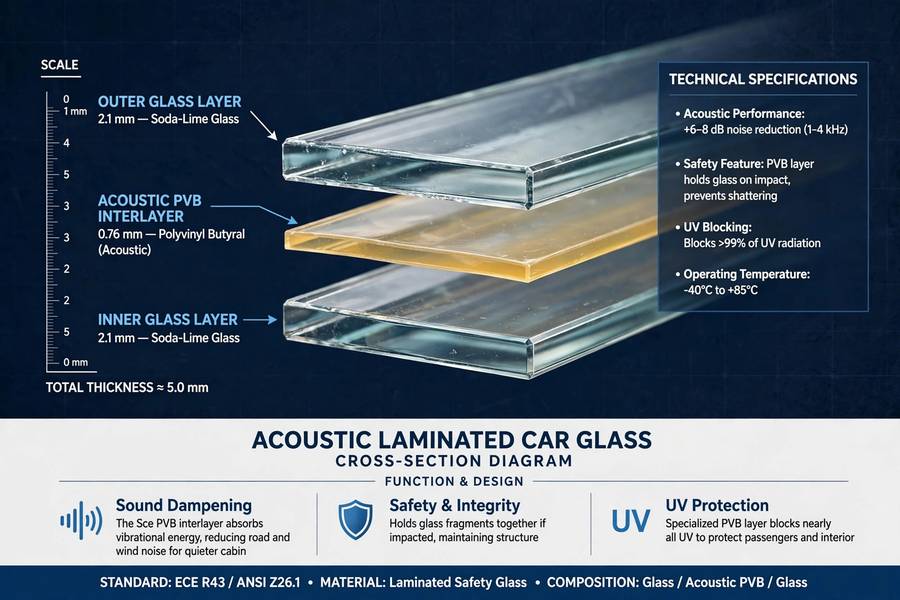
- Acoustic laminated glass — two glass layers with a sound-dampening interlayer. Blocks high-frequency wind noise dramatically. The best cars use it on all windows, not just the windshield.
- Mass insulation — dense damping mats in the floor, doors, firewall, wheel wells, and headliner. The Phantom carries 130+ kg of it. Weight is the enemy of efficiency but the friend of silence.
- Active noise cancellation — cabin microphones detect low-frequency drone; speakers emit inverse waves to cancel it. Excellent for engine and tire boom.
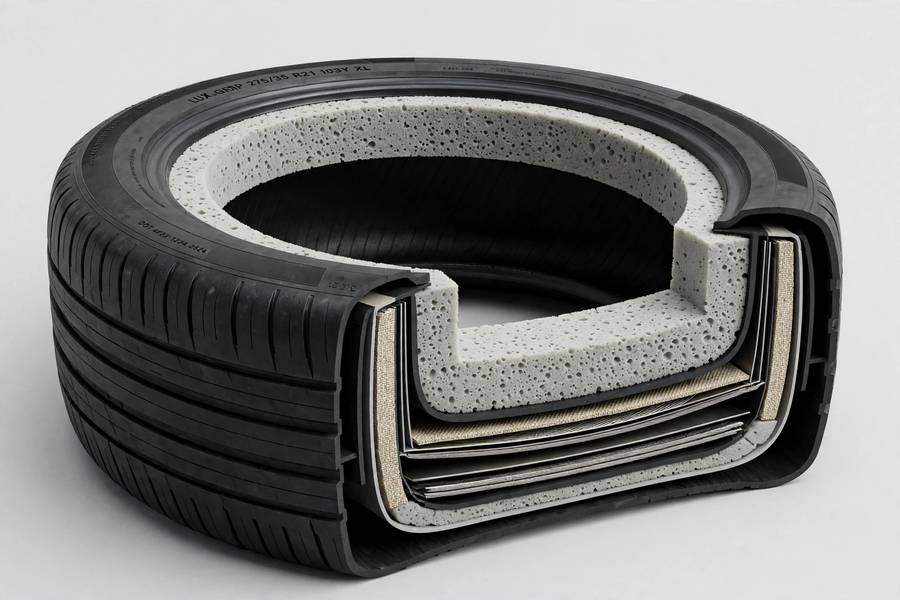
- Foam-filled tires — an acoustic foam ring inside the tire absorbs the cavity resonance that causes tire roar. Increasingly common on luxury EVs.
- Aerodynamic sealing — flush door handles, sealed panel gaps, underbody panels, acoustic windshield wipers. Wind noise is the dominant highway noise source, and it’s fought millimeter by millimeter.
- Powertrain isolation — hydraulic mounts, decoupled subframes, and (best of all) electric motors with no combustion vibration at all.
- Double door seals — luxury cars often have dual or triple door seals; you feel the difference in the thunk when they close.
No single technology does it — it’s the stacking of all of them that creates true silence.
The 5 Sources of Cabin Noise
Understanding the sources helps you judge what you’re hearing:
- Tire/road noise — dominant at most speeds. Depends on tire design, road surface, and insulation. The hardest to eliminate completely.
- Wind noise — dominant at highway speed. Aerodynamics and sealing.
- Engine noise — dominant under acceleration. Isolation and inherent smoothness.
- Mechanical noise — suspension thumps, brake squeal, HVAC fan. Build quality.
- Structural resonance — low-frequency boom from the body itself. Stiffness and damping.
A truly quiet car suppresses all five. Most “quiet” cars suppress three and hope you don’t notice the rest.
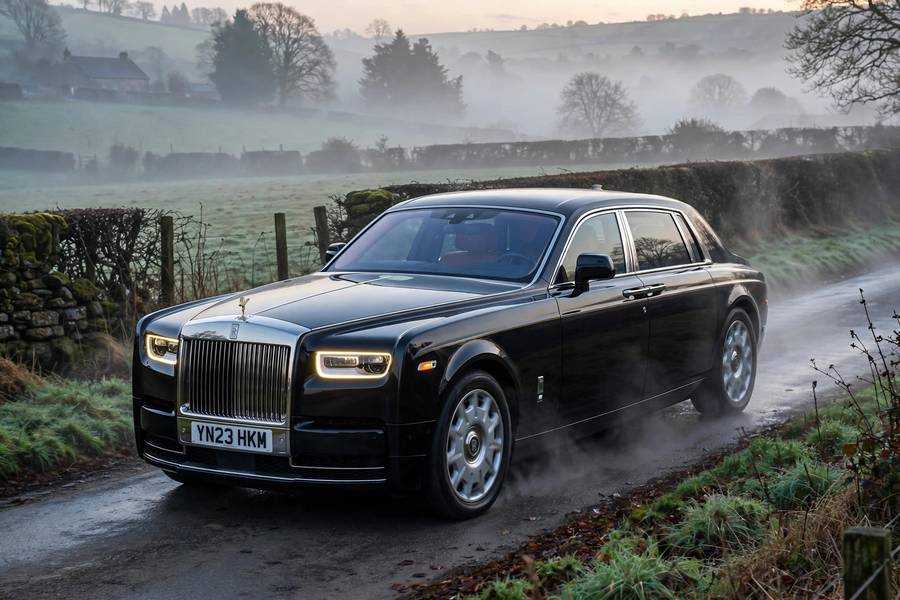
1 Rolls-Royce Phantom
~57–59 dB at 70 mph
The benchmark, and it’s not close. The Phantom’s silence program is the most comprehensive in the industry: 130+ kg of sound insulation, double-glazed windows all around, foam-filled tires, the quietest tires specially developed with Continental, aerodynamic optimization of every surface, and a V12 so smooth and isolated you check it’s running.
What it’s like: at highway speed, you hear… almost nothing. Tire noise is a distant whisper. Wind is absent. The V12 is inaudible. Conversations happen at living-room volume. It’s genuinely surreal the first time — your brain keeps waiting for noise that never comes.
No other combustion car touches it. Nothing with an engine, period.
2 Rolls-Royce Ghost and Spectre
~59–61 dB at 70 mph
The Ghost is the Phantom’s slightly smaller sibling — 95% of the isolation in a more drivable package. The Spectre (electric) might actually be quieter in some conditions: no engine means no combustion noise at all, just tire and wind — both suppressed to Rolls standards.
The Spectre is philosophically interesting: electric power might be the ultimate Rolls-Royce powertrain. Silence was always the brand’s goal; electricity just delivers it more completely than any V12.
3 Mercedes-Benz S-Class
~60–62 dB at 70 mph
The S-Class is the quietest car under $200,000, and the gap to the Phantom is smaller than the price gap suggests. Acoustic glass all around, extensive insulation, active noise cancellation, and superb aerodynamics (0.22 Cd — one of the slipperiest sedans ever) combine for a cabin that’s genuinely serene.
The EQS (electric S-Class equivalent) is even quieter — EVs eliminate engine noise entirely, and Mercedes’ insulation handles the rest. If silence-per-dollar is the metric, a used EQS might be the best value in quiet motoring.
4 BMW i7
~60–62 dB at 70 mph
The i7 benefits enormously from electric power — no engine, no transmission, just tire and wind noise, both well-suppressed. BMW’s acoustic glass, insulation package, and aerodynamics are excellent, and the result is a cabin that rivals the S-Class for serenity.
It’s slightly less isolated than the S-Class at highway speed (a touch more tire noise on coarse surfaces), but the difference is small. For an EV, it’s superb — electric luxury done right.
5 Bentley Flying Spur
~61–63 dB at 70 mph
The Flying Spur is very quiet — but deliberately less isolated than the Phantom. Bentley tunes in a whisper of engine character (especially the W12 models) because their buyers want to feel something. It’s a philosophical choice, not an engineering failure.
The hybrid models are quieter in EV mode. But if absolute silence is the goal, the Phantom and S-Class both beat it. If you want quiet with a hint of soul, the Bentley’s tuning is perfect.
6 Lexus LS 500h
~61–63 dB at 70 mph
Lexus built its reputation on quietness, and the LS 500h upholds it. The hybrid system runs in near-silent EV mode at low speeds, the cabin insulation is excellent, and the active noise cancellation handles the rest. It’s the quietest Japanese luxury car by a clear margin.
It doesn’t reach Phantom/S-Class levels of highway isolation — slightly more tire noise on coarse asphalt — but the powertrain refinement is superb, and the overall serenity is outstanding for the price.
7 Audi A8 L
~62–64 dB at 70 mph
The A8 has always been among the quietest in its class — Audi’s acoustic engineering is superb, with double-glazed windows standard and excellent aerodynamics. It’s a touch behind the S-Class in ultimate isolation but ahead of most competitors.
The cabin’s serenity is one of the A8’s strongest arguments in a segment where it’s otherwise coasting on reputation. If quiet is your priority and you prefer Audi’s restrained design, it’s a strong choice — especially used, where depreciation has been generous.
8 Lucid Air
~60–62 dB at 70 mph
The Lucid Air deserves its spot: EV silence, excellent aerodynamics (0.21 Cd — the slipperiest production car), acoustic glass, and a stiff, well-damped structure. On smooth highways, it’s among the quietest cars I’ve experienced — the lack of engine noise combined with good insulation is remarkable.
The caveat: on coarse road surfaces, tire noise is slightly more prominent than in the S-Class — Lucid’s insulation isn’t quite at Mercedes’ level yet. But the fundamental EV quietness gives it a high floor. As the company matures, expect it to challenge the top three.
How to Test Quietness on a Test Drive
Don’t trust the brochure. Do this:
- Bring a decibel meter app. Not lab-accurate, but consistent enough for comparisons. Measure at 70 mph on the same road in each car.
- The radio-off test. Everything off — radio, fan on low — highway speed. Just listen for 60 seconds. Note what you hear: tire roar? Wind whistle? Engine drone?
- The conversation test. Talk at normal volume with a passenger. If you raise your voice, it’s not quiet enough.
- Vary the road surface. Concrete highways are much louder than fresh asphalt. Test both — the best cars stay quiet on concrete.
- Check at different speeds. Some cars are quiet at 60 but get loud at 80 (aerodynamics). Test your actual cruising speed.
- Rear seat test. Sit in the back — it’s often quieter (further from the engine) or louder (closer to the rear tires) than the front. Know which.
What Ruins a Quiet Car
Even the quietest car can be sabotaged:
- Wrong tires. Sport tires on a luxury car destroy quietness. Touring tires with acoustic foam are transformative — the single biggest quietness upgrade for any car.
- Worn tires. As tread wears, noise increases dramatically. Cupped or feathered tires roar.
- Wrong pressure. Underinflation increases tire noise and changes the contact patch.
- Roof racks and accessories. A roof box can add 5+ dB of wind noise — devastating to a quiet cabin.
- Worn door seals. Aging seals let wind whistle in. Replacing them is cheap and effective.
- Open windows/sunroof. Obviously — but even a cracked window destroys the acoustic envelope.
I once had a customer complain their S-Class had “gotten loud.” The cause: worn performance tires the previous owner had fitted. New touring tires, and the silence returned. The car was fine; the rubber wasn’t.
Silence is the deepest luxury because it’s the most honest — it can’t be photographed, only felt. If you prioritize it, the ranking is clear: Phantom for the ultimate, S-Class for the rational, i7 or EQS for electric. And whatever you buy, put the right tires on it — they’re the foundation everything else is built on.
For the broader luxury context, see most luxurious cars and what makes a car luxurious for the full philosophy. The mechanicals behind the silence — including drivetrain noise characteristics — are covered in AWD vs 4WD explained.
Frequently Asked Questions
The Rolls-Royce Phantom — approximately 57–59 dB at 70 mph, thanks to 130+ kg of insulation, acoustic glass, foam-filled tires, and obsessive aerodynamics. The Ghost and electric Spectre are close behind.
Yes, inherently — no engine noise or vibration. But tire and wind noise remain, so a well-insulated gas car (S-Class) can beat a poorly-insulated EV. The quietest EVs (i7, EQS, Lucid Air) combine electric silence with proper insulation.
In decibels (dB) at cruising speed, typically 70 mph. Decibels are logarithmic — 10 dB less sounds roughly half as loud. True luxury sedans measure 57–63 dB; economy cars are typically 68–72 dB.
Enormously — tires are the dominant noise source at most speeds. Touring tires with acoustic foam are dramatically quieter than sport tires. Worn, cupped, or underinflated tires get progressively louder. Tires are the single biggest quietness variable you control.
A used Mercedes EQS or S-Class — 60–62 dB serenity at a fraction of new price. The Genesis G90 is the best new-car value in quietness. Whatever you buy, fitting proper touring tires maximizes the quietness you paid for.