What is thrust angle in wheel alignment? It’s the angle everyone ignores and the one that explains the most mysterious handling complaints. I’ve had customers come in after two front-end alignments elsewhere, still complaining the car “drives crooked” — and thrust angle was the answer both times.
Let me explain it the way I wish someone had explained it to me early in my career: no jargon walls, just what it is, why it matters, and what fixes it.
Contents
- Thrust Angle in One Paragraph
- The Shopping Cart Analogy
- What Causes Thrust Angle Problems
- Dog-Tracking: The Classic Symptom
- Why Front-Only Alignments Cannot Fix It
- How Shops Measure Thrust Angle
- How Thrust Angle Gets Corrected
- Thrust Angle vs Toe: What Is the Difference
- Can Thrust Angle Damage Tires
- What to Ask Your Alignment Shop
Thrust Angle in One Paragraph
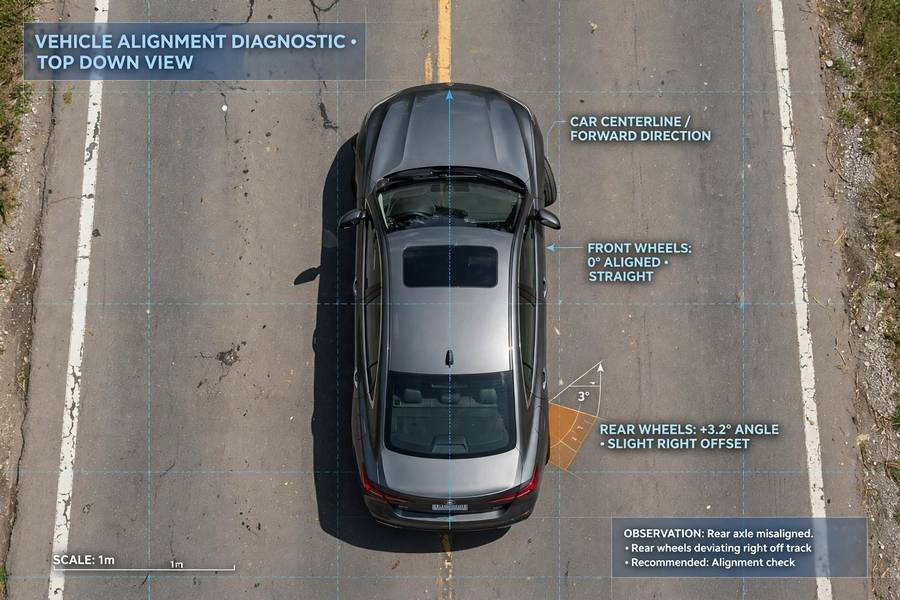
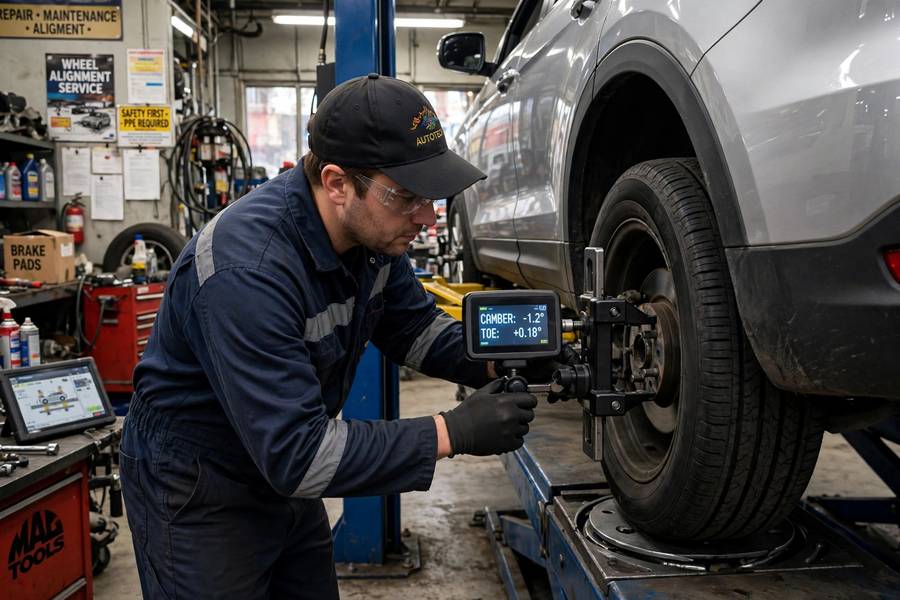
Thrust angle is the direction your rear axle is actually pushing the car, compared to the car’s true straight-ahead line. In a perfect world, the rear wheels push dead straight forward, in line with the chassis — thrust angle of zero. When rear toe is uneven side to side (one rear wheel toed-in more than the other, for example), the rear axle pushes slightly diagonally. That diagonal push is the thrust angle, and the front wheels have to steer slightly off-center to compensate — which is why your steering wheel sits crooked even though the car goes “straight.”
The Shopping Cart Analogy
Everyone’s pushed a shopping cart with a bad wheel. You know the feeling: the cart wants to go one way, and you have to hold the handle crooked to keep it moving straight down the aisle.
Your car with a thrust angle problem is that shopping cart. The rear axle is the bad wheel — pushing diagonally. The steering wheel is the handle — held off-center to compensate. The car goes where you want, but everything’s fighting slightly, and the tires pay the price.
The analogy breaks down in one way: on the cart, you feel the fight immediately. In a car, power steering masks it. You adapt to the crooked wheel within days and stop noticing — but the tires never adapt. They just wear unevenly, silently, until you notice the tread’s gone on one side.
What Causes Thrust Angle Problems
Thrust angle error comes from uneven rear toe — the two rear wheels not pointing the same direction relative to the car’s centerline. The causes:
- Rear impacts — even a moderate bump to one rear wheel (pothole, curb, parking-lot tap) can shift that wheel’s toe without affecting the other side. One-sided change = thrust angle.
- Worn rear bushings — control arm and trailing arm bushings wear unevenly. The left side wears differently from the right (road crown, driving habits, luck), and the geometry goes asymmetric.
- Bent rear suspension components — a bent trailing arm, lateral link, or toe link on one side changes that wheel’s angle independently.
- Previous bad alignment — a tech who set rear toe unevenly, or who aligned the front without establishing the rear reference properly.
- Subframe shift — a collision or hard impact that moves the rear subframe slightly rotates the entire rear geometry.
- Sagging springs (one side) — a weak spring on one rear corner changes that wheel’s camber and toe under load.
Notice the pattern: anything that affects one rear wheel differently from the other creates thrust angle. Symmetric changes (both sides equally) don’t — they change toe, but not thrust angle.
Dog-Tracking: The Classic Symptom
The signature symptom of thrust angle problems has the best name in automotive diagnostics: dog-tracking. Watch a dog run sometime — its body angles sideways while it moves forward. A car with bad thrust angle does the same thing: the body sits slightly rotated relative to the direction of travel.
How it feels from the driver’s seat: – Crooked steering wheel going straight — the #1 indicator – The car feels like it’s “crabbing” slightly, especially noticeable when following another car (you see more of one side of the car ahead than you should) – Vague rear-end feel — the back of the car seems to wander independently, particularly in crosswinds or on grooved pavement – Uneven tire wear that’s hard to explain from front readings alone
The frustrating part: a standard test drive might not reveal it clearly. It shows up best on a straight, flat road at highway speed, watching the steering wheel position and feeling for that subtle sideways sensation.
Why Front-Only Alignments Cannot Fix It
This is the key insight, and it’s why I always push 4-wheel alignments.
A front-only (2-wheel) alignment adjusts the front wheels relative to each other and to an assumed centerline. But if the rear is pushing diagonally, the assumed centerline is wrong. The tech aligns the front perfectly — to the wrong reference. The car still dog-tracks. The wheel’s still crooked. The customer comes back angry, and the shop says “the alignment is in spec” — which is technically true and practically useless.
Only a 4-wheel alignment measures the rear, calculates the actual thrust angle, and aligns the front to the true centerline. The front wheels end up steering slightly to compensate for the rear’s push — which sounds wrong but is exactly right. The steering wheel centers, the car tracks true, and tire wear normalizes.
This is also why “the alignment is in spec but the car still pulls” is almost always a rear/thrust angle issue. The front specs were measured against the wrong reference.
How Shops Measure Thrust Angle
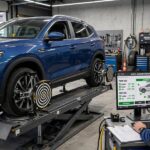
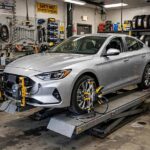
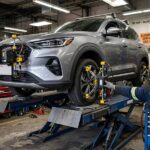
On a modern alignment rack, thrust angle measurement is automatic. The system:
- Mounts sensors on all four wheels
- Measures each wheel’s toe angle individually
- Calculates the rear axle’s thrust line from the two rear toe readings
- Compares the thrust line to the vehicle’s geometric centerline
- Displays thrust angle — typically in degrees, with spec usually under 0.25 degrees (some manufacturers allow up to 0.5)
The whole thing takes seconds once the sensors are mounted. There’s no extra charge for it — it’s part of any 4-wheel alignment. Which is another reason the 4-wheel service is worth it: you’re already paying for the measurement; you might as well get the correction.
Older equipment (string alignments, basic laser systems) can measure thrust angle too, but it takes more setup. If your shop does 4-wheel alignments on modern equipment, thrust angle is in the printout — ask to see it.
How Thrust Angle Gets Corrected
Thrust angle itself isn’t directly adjusted — it’s corrected by fixing the underlying rear toe imbalance:
- Equalize rear toe. The tech adjusts the rear toe links/bolts so both rear wheels have matching toe relative to the centerline. When rear toe is symmetric, thrust angle goes to zero. This is the fix in most cases.
- Replace worn parts. If bushings or links are worn, adjustment won’t hold. Replace the worn components first, then align. Adjusting around worn parts is temporary at best.
- Straighten or replace bent parts. A bent trailing arm or toe link has to be replaced — you can’t adjust out a bend reliably.
- Reposition a shifted subframe. If the subframe moved, the tech loosens it, shifts it back to position (using factory alignment pins or measurements), and retorques. Then aligns.
- Align the front to the corrected thrust line. After the rear is fixed, the front is aligned to the true centerline. If the rear can’t be perfectly zeroed (some cars have limited rear adjustment), the front is aligned to compensate for the remaining thrust angle — the steering wheel centers and the car tracks straight even with a small residual angle.
In stubborn cases where the rear has no factory adjustment (some cars), aftermarket adjustable toe links or camber kits solve it. A good alignment shop stocks or can order these.
Thrust Angle vs Toe: What Is the Difference
People mix these up, so let me be precise:
- Toe is the angle of an individual wheel (or axle pair) relative to straight-ahead — whether the wheels point slightly inward or outward.
- Thrust angle is the direction of the rear axle’s push relative to the car’s centerline — determined by the difference in toe between the left and right rear wheels.
You can have perfect total rear toe (both wheels toed-in equally, summing to spec) but still have thrust angle error — if one wheel is toed-in 0.2 degrees and the other is toed-out 0.2 degrees, total toe looks fine but the axle pushes diagonally. This is exactly why total-toe-only measurements miss it, and why individual wheel readings matter.
Think of it this way: toe is about each wheel; thrust angle is about what the pair does together.
Can Thrust Angle Damage Tires
Yes — through two mechanisms:
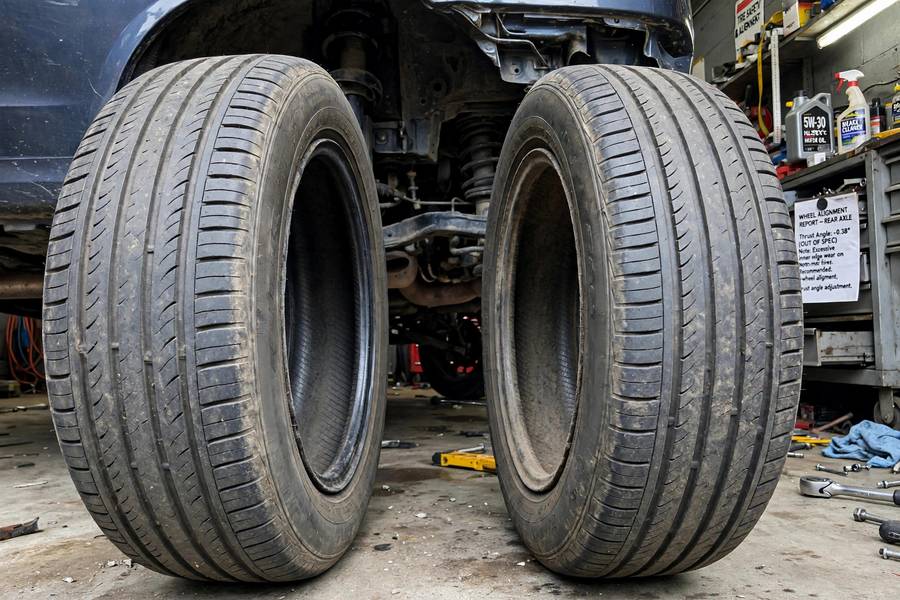
- The rear tires themselves wear unevenly because they’re rolling at an angle to the direction of travel — constant slight scrubbing.
- The front tires wear unevenly because they’re held at a constant slight steering angle to compensate — they’re always turning a tiny bit, even going “straight.”
The wear is gradual and easy to miss because it’s symmetric-ish and doesn’t produce the dramatic one-sided baldness of bad camber. It just shortens tire life across all four, quietly. I’ve seen cars lose 20–30% of potential tire life to uncorrected thrust angle that nobody noticed because “the alignment was in spec” — front spec, that is.
What to Ask Your Alignment Shop
To make sure thrust angle gets proper attention:
- “Is this a 4-wheel alignment?” — If no, thrust angle isn’t being measured. Find another shop for modern cars.
- “Can I see the thrust angle reading?” — On the before-and-after printout. Before should show the problem; after should show it near zero.
- “Are the rear readings in spec?” — Don’t accept “we only did the front” on a car with adjustable rear suspension.
- “What if the rear won’t come into spec?” — The answer should involve inspecting for worn/bent parts, not shrugging.
- “Is the steering wheel centered?” — Verify on the test drive after. A centered wheel is the real-world proof the thrust angle is handled.
A shop that talks confidently about thrust angle is a shop that understands alignment. A shop that looks confused when you mention it? That’s useful information too.
Thrust angle is one of those things that’s invisible until someone explains it — then you can’t unsee it. If your steering wheel has been sitting crooked and nobody can explain why, now you know what to ask about. For the full picture of how all the angles work together, read what wheel alignment actually is. And since I mentioned 4-wheel alignment several times — if you’re weighing the options, my AWD vs 4WD explained guide covers drivetrains, though for the alignment-type decision itself, the rule is simple: modern car, four wheels, every time. If uneven wear is what started this whole investigation, how to change a tire is worth knowing too.
Frequently Asked Questions
Thrust angle is the difference between the direction your rear axle pushes the car and the car’s true straight-ahead line. It’s caused by uneven rear toe side to side, and it makes the car dog-track with a crooked steering wheel.
Uneven rear toe from one-sided impacts, worn rear bushings, bent suspension components, shifted subframes, or previous bad alignments. Anything affecting one rear wheel differently from the other creates thrust angle error.
Yes — by equalizing rear toe so both rear wheels match, replacing any worn or bent parts first, and then aligning the front to the corrected centerline. It’s a standard part of any 4-wheel alignment.
Dog-tracking is when a car drives slightly sideways — the body angled relative to the direction of travel, like a running dog. It’s the classic visible symptom of thrust angle problems, accompanied by a crooked steering wheel.
No. A 2-wheel alignment doesn’t measure the rear axle, so it can’t detect or correct thrust angle. Only a 4-wheel alignment measures rear toe, calculates thrust angle, and aligns the front to the true centerline.