

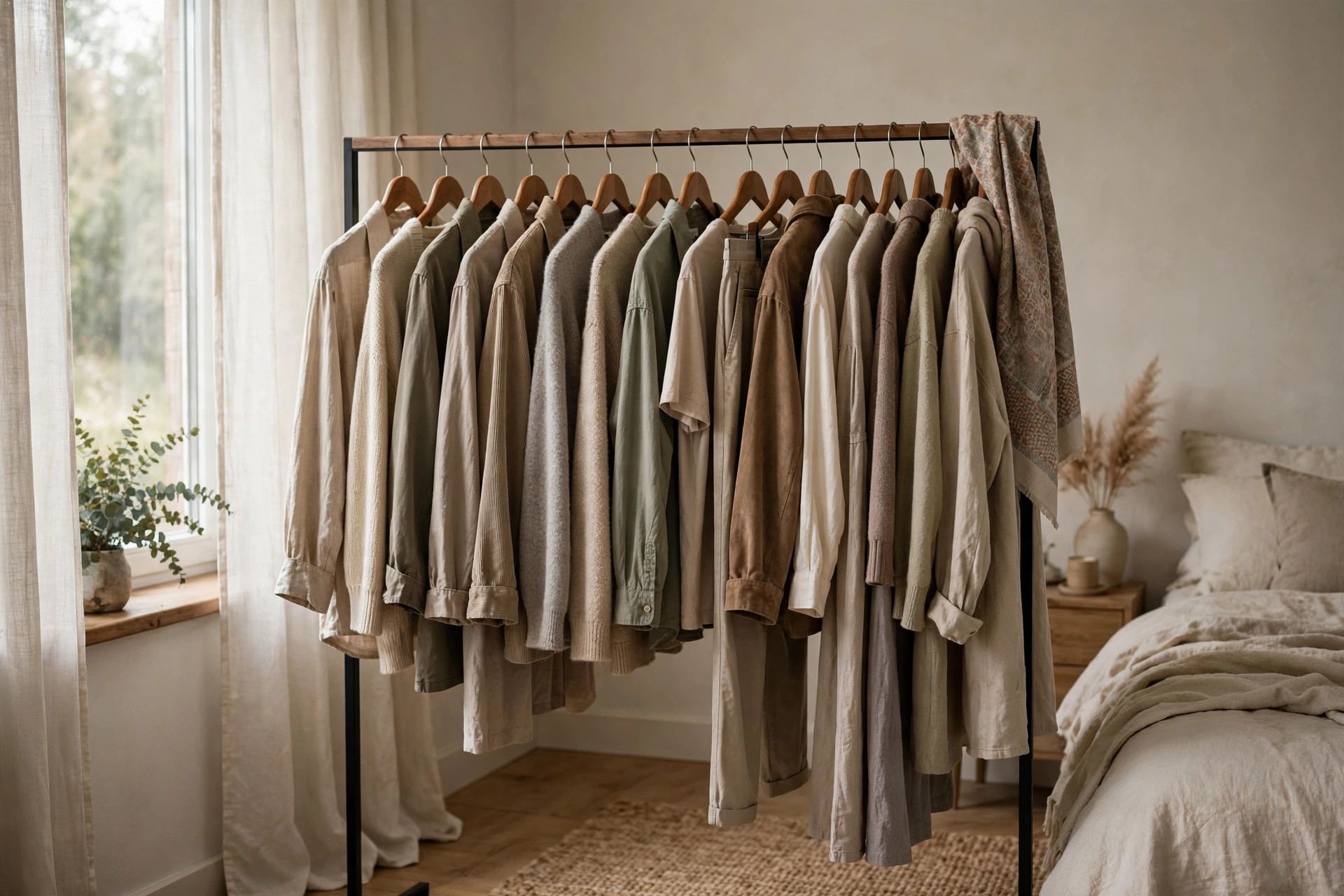
I used to stand in front of a full closet every morning and wear the same seven things on rotation. Not because the other sixty items were bad — I just couldn’t see them, couldn’t decide, and didn’t have the mental energy at 7 a.m. to style an outfit from chaos. So I did what the internet told me: I tried a strict capsule wardrobe. Thirty-three items, all neutrals, three months. I quit in week three, standing in my grey-and-beige uniform, missing my rust-colored sweater like an old friend.
Here’s what I learned: the idea behind a capsule wardrobe is genuinely good. The dogma around it is not. So this is a capsule wardrobe guide for real life — how to build a small, mix-and-match wardrobe with your colors, your budget, and your personality still intact. No beige prison. Promise.

What a Capsule Wardrobe Actually Is (And the Instagram Version It Isn’t)
Strip away the Pinterest boards and the definition is simple: a capsule wardrobe is a small collection of clothes that all work with each other, so getting dressed takes no effort.
That’s it. Fewer pieces, chosen on purpose, in colors and cuts that mix and match. The Instagram version adds rules that were never the point: exactly thirty-three items, only neutrals, replace everything on the first of the month. Ignore them.
What a capsule wardrobe is not: a personality transplant. It won’t make you love beige if you love jewel tones. And it’s not about owning as little as humanly possible — it’s about owning exactly what you actually wear, and letting the rest go. You can’t build a capsule out of a closet you haven’t sorted yet, so declutter first — small steps, in order.
Why I Quit My First Capsule
Let me tell you about week three of my strict attempt, because I think you’ll recognize yourself in it. I’d dutifully packed away everything that wasn’t in my chosen thirty-three. My rail was beautiful. Grey, black, white, denim. Very calm. Very me, apparently not at all.
The problem: I’d removed everything that made getting dressed fun. My rust sweater — the one that makes my whole face look better — didn’t “go with everything,” so it was exiled to a box. By week three I was bored of my own clothes, which is a strange feeling when you technically own plenty of them.
So I quit, and then slowly built my own version — with a real color palette, a few statement pieces, and enough flexibility for weddings, muddy weekends, and loud-scarf days. It worked. I’ve been some version of it ever since.
The lesson: the capsule that works is the one designed around your actual life, not someone else’s template. Take the principle — fewer, better, mixable — and leave the rules.
The Only Principle That Matters
If you take one thing from this guide, take this: every piece should work with most of the other pieces. That’s the whole game.
In a normal closet, you own forty tops and only five that go with your favorite jeans. In a capsule, you own twelve tops and all twelve go with your favorite jeans. You own less, but you have more outfits — because everything connects. Fewer, better, mixable.
This is why the palette matters more than the number. When your colors harmonize, any top works with any bottom, and you can get dressed half-asleep. (I have tested this extensively. It works.)
Step 1: Find Your Real Palette
Forget “neutrals only.” The question is: what are YOUR neutrals?
Look at the clothes you reach for most. What colors keep showing up? For me it’s navy, cream, olive, and denim — with rust and a deep teal as my accent colors. My “neutrals” include olive, which no style guide would bless, but it’s the color I wear three times a week, so it’s neutral in my life.
Here’s a gentle exercise: pull out your ten most-worn pieces and lay them on the bed. You’ll see the pattern immediately. Two or three base colors will dominate — those are your neutrals. Then notice the accent that appears once or twice — the color that makes you happy. That’s your statement color, and it belongs in the capsule. The rust sweater is back in mine, and it earns its place every week.
One practical note: when nearly everything shares an undertone (warm or cool), mixing is effortless. You don’t need a color theory degree — just notice whether your favorite pieces lean warm (creams, rusts, olives) or cool (true whites, navy, charcoal) and let that lead.
Step 2: Count What You Actually Wear
Before you choose a single item, do a two-week audit. It’s the least glamorous and most useful part of this whole process.
For two weeks, notice what you actually wear — not what you think you wear. I kept a running note on my phone. Some people turn all their hangers backward and flip them as they wear things. Either way, you’re gathering data.
What you’ll find: you wear maybe twenty to thirty pieces regularly, and the rest is decoration. That number — your real number — is the honest size of your capsule. For most people it’s somewhere between twenty-five and forty pieces, not counting underwear, workout gear, or occasion wear. Don’t force a smaller number than your life needs. The point is clarity, not a record.
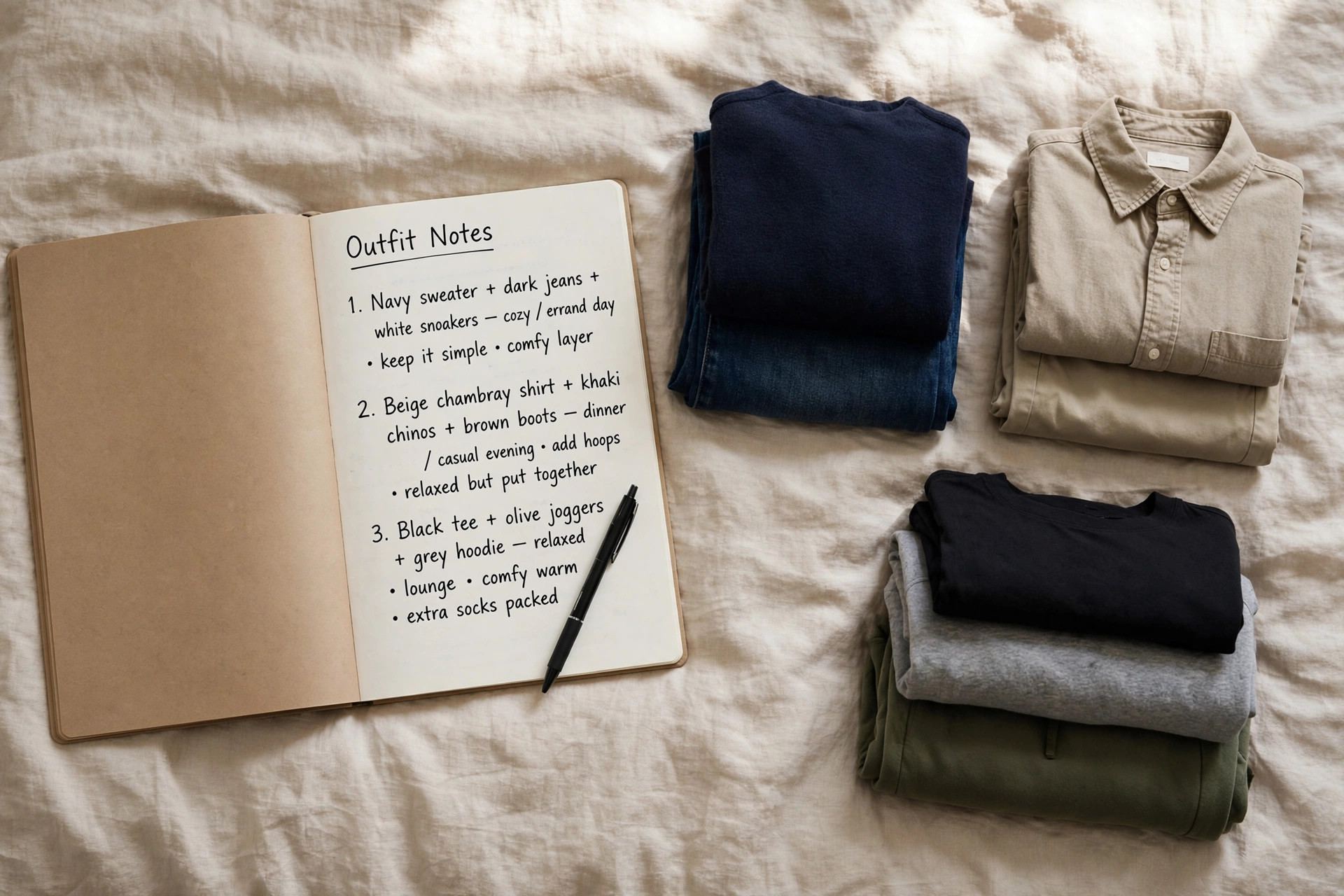
Step 3: Build the Four Groups
Think of your capsule in four groups. When each group is balanced, everything mixes:
Base pieces. The workhorses: jeans, trousers, simple skirts, plain tees, the everyday knits. These are your neutrals doing the heavy lifting. Aim for quality over quantity here — the pieces you wear three times a week should be the best-made things you own.
Layers. Cardigans, blazers, jackets, the open shirt you throw over everything. Layers are what make the same base pieces look different day to day. A navy sweater with a denim jacket is a different outfit than the same sweater with a blazer. This group multiplies your wardrobe without multiplying your closet.
Statement pieces. The rust sweater. The patterned scarf. The boots people remember. These are the pieces with personality — the ones that make the capsule feel like yours instead of a uniform. A capsule without a single thing you love is a capsule you’ll abandon by week three. (Ask me how I know.)
Shoes and accessories. Keep it honest: the shoes you actually wear, in colors that go with your palette. Three to five pairs cover most lives. Accessories are the cheapest way to make base pieces feel new.
A note on numbers: don’t buy your way into a capsule. Start with what you own. You’ll find gaps — everyone does — and you fill them slowly, one considered purchase at a time. A capsule built by shopping spree is just a smaller version of the same old habit.
Seasonal Swaps Without the Drama
Here’s the part that makes capsules work year-round: you don’t own one capsule, you own a rotating one. When the seasons change, the off-season clothes go into storage boxes — not the donation pile, storage — and the right-season pieces come out.
Two practical tips. First, store clean: wash or air everything before it goes into the box, or you’ll open it in spring to a surprise. Second, keep a tiny list on the box of what’s inside. Future you, standing in front of a sparse autumn rail, will want to know that the good wool coat is in Box 2 and not gone forever.
The swap itself is also your audit moment: anything in the box that no longer excites you when you open it is telling you it’s donation time. Listen to it.
Side benefit nobody mentions: packing for a trip from a capsule closet is absurdly easy. Everything goes with everything, so a carry-on practically packs itself.
Doing It on a Real Budget
The internet will happily sell you a $3,000 “capsule wardrobe starter kit.” Please don’t. The best capsule I ever built cost almost nothing, because it was built from what I already owned plus a few thrift-store finds.
My honest budget playbook: start with what you own — the audit already found your favorites. Thrift the gaps (bring a “test top” from your palette to the fitting room). Buy the true workhorses new and well-made — the jeans you wear three times a week are worth it. And fill one gap at a time; one considered piece a month beats one frantic spree.
The Parts I Don’t Do
In the spirit of honesty, here are the standard capsule rules I break, and why it still works:
I don’t count items. The number was never the point. Some seasons my capsule is twenty-eight pieces; some it’s thirty-eight. What matters is that everything earns its place and mixes well.
I don’t do strict seasons. I live somewhere with long shoulder seasons, so my “autumn” box and “winter” box overlap heavily. I swap gradually instead of all at once. The boxes are a tool, not a ceremony.
I allow one wild card. Every season I keep one thing that breaks every rule — currently a vintage floral jacket that goes with nothing and delights me completely. The wild card is the pressure valve. It keeps the whole system joyful instead of joyless.

Frequently Asked Questions
A capsule wardrobe is a small, intentional collection of clothes where every piece works with most of the others — so getting dressed is effortless. It’s typically 25–40 versatile pieces in a coordinated color palette, rotated seasonally. The point isn’t owning as little as possible; it’s owning exactly what you actually wear.
Most people land between 25 and 40 pieces, not counting underwear, workout gear, or occasion wear. The honest way to find your number is a two-week audit of what you actually wear — your real number beats any prescribed one. Don’t force a smaller count than your life needs.
Start with what you own — your two-week audit reveals your real favorites, and they’re already paid for. Thrift the gaps, buy workhorse pieces (like jeans you wear constantly) new and well-made, and fill one gap at a time instead of shopping in a spree. The best capsules are built slowly, not bought.
No — that’s one of the most persistent myths. Your capsule should use YOUR palette: the colors you actually reach for. Pull out your ten most-worn pieces and you’ll see your real base colors immediately. Accent and statement pieces with personality (like a favorite rust sweater) belong in the capsule — a wardrobe without anything you love is one you’ll abandon.
Do a seasonal swap two to four times a year: store off-season clothes in boxes (clean, with a list of contents on the lid) and bring out what’s right for the weather. Long shoulder seasons can overlap gradually rather than swapping all at once. The swap is also your audit moment — anything in the box that no longer excites you is telling you it’s donation time.
If mornings feel like fourteen decisions before breakfast, yes. A well-built capsule cuts decision fatigue dramatically — everything mixes, so getting dressed takes minutes. The key is building your own version around your colors, budget, and life, not following someone else’s strict rules. A joyful capsule lasts; a punishing one doesn’t.
The Wardrobe That Gets Out of Your Way
Here’s the quiet truth: the goal was never the wardrobe. It’s the morning where you get dressed in three minutes, feel like yourself, and spend the saved energy on something that matters.
Start with the two-week audit, and build around what you love — in your colors, at your pace, through the same slow-living lens I bring to everything. And keep one wild card. The floral jacket stays.
If this resonates, there’s more of my lifestyle writing where it came from. Fewer clothes, better mornings — and a little more room for the life you’re living.