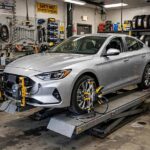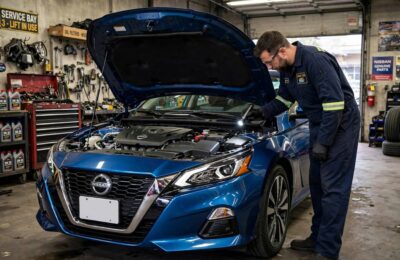
How long does a wheel alignment take? If you’re asking because you’re planning your day around a shop visit — fair question, and I get it daily. The short answer: a straightforward alignment takes 30 to 60 minutes of actual work. The long answer: your total time at the shop depends on several things, and knowing them means you won’t be the person angrily checking their watch at minute 45.
Let me break down where the time actually goes, what makes it longer, and how to make your visit as fast as possible.
Contents
- The Straight Answer: 30 to 60 Minutes
- What Happens During Those Minutes
- Two-Wheel vs Four-Wheel: Does It Change the Time
- What Slows an Alignment Down
- Seized and Rusted Adjustment Points
- When the Alignment Reveals Bigger Problems
- The Wait Before the Work Starts
- Dealership vs Independent Shop vs Tire Chain
- How to Make Your Visit Faster
- Can You Wait or Should You Drop Off
The Straight Answer: 30 to 60 Minutes
For a typical car with no complications, here’s the realistic breakdown:
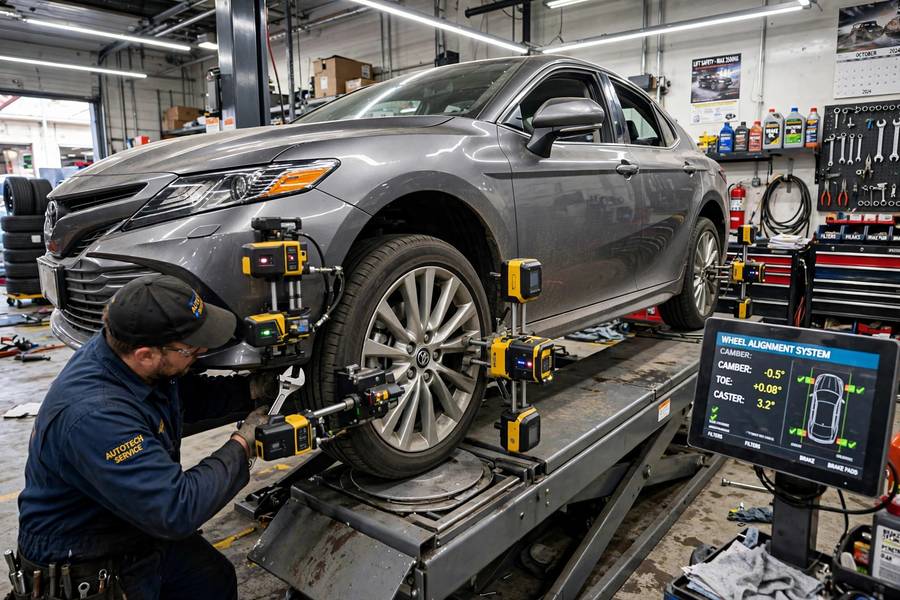
- Setup (10–15 minutes): Drive onto the rack, mount the alignment heads/sensors on all four wheels, compensate for runout (spinning each wheel to account for rim imperfections), and take the initial readings.
- Adjustment (15–30 minutes): The tech loosens adjustment points and dials toe, camber, and caster into spec, re-measuring after each change.
- Verification and printout (5–10 minutes): Final readings, test of steering center, printout of before-and-after numbers.
That’s it. On a cooperative car, a good tech can be done in 30 minutes. Most take 45. An hour is normal if the tech is thorough or the car fights a little.
What the clock doesn’t include: the wait before your car gets on the rack, which is where most of the “it took two hours” stories come from.
What Happens During Those Minutes
People imagine the tech just “straightening the wheels.” The actual process is more precise:
- Inspection first. A good tech checks tire pressure, tire condition, and suspension play before touching anything. Aligning a car with a loose ball joint is pointless — the numbers won’t hold.
- Rack setup. The car goes on a level alignment rack (not a regular lift — the rack keeps the wheels loaded as they sit on the ground, which matters for accurate geometry).
- Sensor mounting. Modern shops use 3D imaging or laser heads clamped to each wheel. Older shops use string and mirrors — slower but still accurate in good hands.
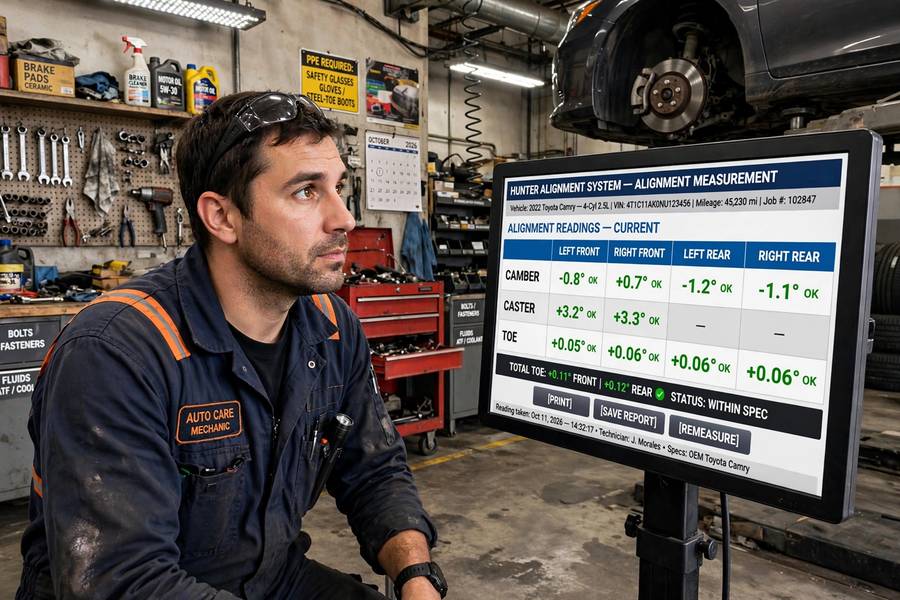
- Initial measurement. The system reads camber, caster, and toe on all four wheels and compares to manufacturer specs.
- Adjustment. Toe is adjusted via tie rod ends (front) and various rear links. Camber and caster may use eccentric bolts, shims, or slotted strut mounts depending on the car. Some cars have limited factory adjustment — more on that below.
- Re-measure and verify. Every adjustment changes the others slightly, so it’s iterative: adjust, measure, adjust again until everything’s in the green.
- Steering wheel centering. The wheel is locked straight during the process; the tech verifies it’s centered when driving straight.
- Printout. Before-and-after numbers. Always ask for this.
Two-Wheel vs Four-Wheel: Does It Change the Time
A two-wheel (front-only) alignment is slightly faster — maybe 20–40 minutes — because the tech only measures and adjusts the front axle. But here’s my honest take: on any modern car, get the four-wheel alignment.
Why? Rear alignment affects the front. If the rear toe is off, the car “dog-tracks” (rear wheels don’t follow the front), and no amount of front adjustment fixes the handling. The rear also sets the thrust angle — the direction the rear axle pushes the car — which the front must be aligned to. A front-only alignment on a car with rear issues is half a job.
The price difference is small ($50–100 for two-wheel vs $75–150 for four-wheel), and the time difference is maybe 10–15 minutes. Get all four.
What Slows an Alignment Down
Several things turn a 40-minute job into a two-hour one:
- Rusted adjustment hardware. Tie rod lock nuts and eccentric bolts seize with age and road salt. The tech may need heat, penetrating oil, and patience.
- Aftermarket or modified suspension. Lowered cars, lift kits, and aftermarket control arms change geometry beyond factory specs. The tech has to work to custom numbers, which takes longer.
- Limited factory adjustment. Some cars (many Hondas and Toyotas, for example) have minimal factory camber adjustment. Getting camber into spec may require aftermarket camber bolts or shims — which means parts, which means more time.
- Uneven tire wear or mismatched tires. Badly worn tires give inconsistent readings. Some shops will recommend replacing first.
- Previous bad work. If someone aligned it wrong before, or installed parts incorrectly, the tech has to undo that first.
None of these are the tech being slow. They’re the car being difficult.
Seized and Rusted Adjustment Points
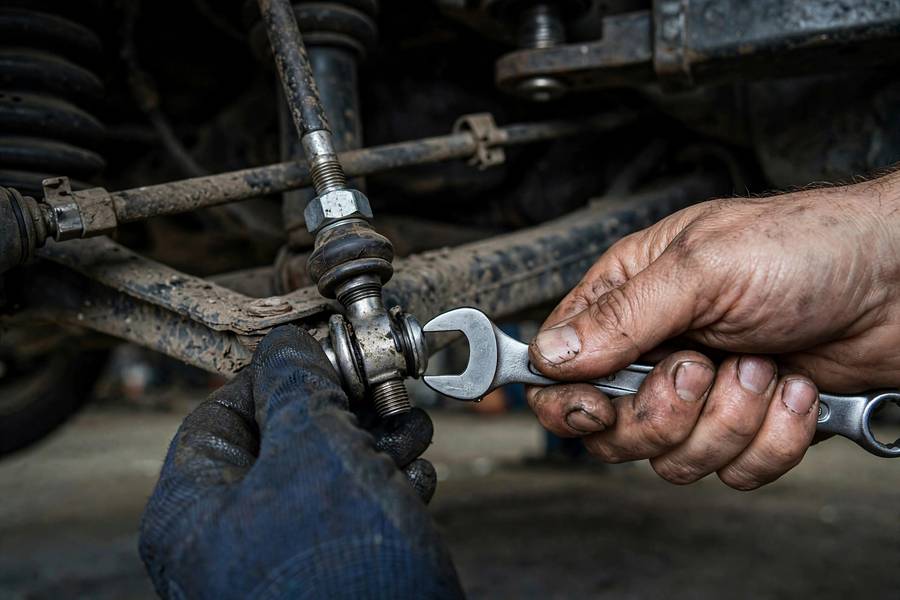
This deserves its own section because it’s the most common time-killer, especially in rust-belt regions. Tie rod ends, jam nuts, and camber bolts live in the worst possible environment — low on the car, constantly sprayed with water, salt, and grit.
When a jam nut is seized, the tech can’t just muscle it — too much force snaps the tie rod, turning a $100 alignment into a $400 repair. So they soak it in penetrating oil, apply heat carefully, work it back and forth. Each seized point can add 15–30 minutes.
If you live where roads get salted, this is your life. The prevention: get alignments done regularly (every year or two) rather than waiting five years — adjustment points that get moved stay movable. A car aligned regularly almost never seizes up.
When the Alignment Reveals Bigger Problems
Sometimes the rack tells a story the driver didn’t expect: the numbers won’t come into spec, or they drift as soon as the car rolls. That means something’s bent or worn:
- Bent control arm or tie rod — from an impact the driver forgot about or never noticed
- Worn ball joint or bushing — play that lets geometry shift
- Shifted subframe — from a collision
- Sagging springs — ride height too low for spec geometry
In these cases, the alignment stops being a 45-minute service and becomes a troubleshooting job. The tech should show you the readings, explain what’s preventing spec, and quote the repair. This is where the before-and-after printout earns its keep — it’s proof of what’s actually wrong, not just a sales pitch.
A good shop calls you before doing additional work. A shop that just starts replacing parts without asking? Different shop next time.
The Wait Before the Work Starts
Here’s the real time sink most people don’t account for: queue time. Your 45-minute alignment might involve:
- 15–30 minutes checking in, especially at a busy tire chain on a Saturday
- 30–90 minutes waiting for a rack to free up if you walked in without an appointment
- The actual 30–60 minutes of work
So “how long does a wheel alignment take” has two answers: 30–60 minutes of work, and 1–3 hours of your day if you don’t plan. The fix is simple: make an appointment, and ask when you book how long the total visit usually runs.
Dealership vs Independent Shop vs Tire Chain
Timing varies by shop type:
- Tire chains (Firestone, Discount Tire, etc.): Often fastest for straightforward alignments — they do dozens daily, and many offer lifetime alignment packages. But they’re high-volume, so appointment timing matters more.
- Independent shops: Usually 45–75 minutes of careful work. The tech often has more experience with difficult cases (seized hardware, modified cars). My preference for anything complicated.
- Dealerships: Thorough, factory-spec focused, but often slower — 1–2 hours total isn’t unusual, and they cost more. Worth it for cars with complex electronic steering or driver-assist systems that need calibration after alignment (more common on newer cars — see below).
A note on newer cars: Many 2020+ vehicles have lane-keep assist, adaptive cruise, and other ADAS features that rely on cameras and sensors. Some manufacturers require ADAS recalibration after alignment changes. That can add 30–60 minutes and significant cost. Ask upfront if your car needs it.
How to Make Your Visit Faster
From someone who’s worked both sides of the counter:
- Make an appointment. Walk-ins wait. Always.
- Go on a weekday morning. Tuesday–Thursday, early, is the sweet spot. Saturday is the worst.
- Empty heavy junk from the car. Alignment is done at normal ride height — 200 lbs of tools in the trunk changes the numbers. Some shops will ask you to remove it anyway.
- Check tire pressure beforehand. Wrong pressure skews readings; the tech will set it right, but it saves a step.
- Mention symptoms clearly. “Pulls right, wheel is crooked since the pothole last week” gets the tech oriented faster than “just check it.”
- Ask about lifetime packages if you plan to keep the car — one purchase, free rechecks.
Can You Wait or Should You Drop Off
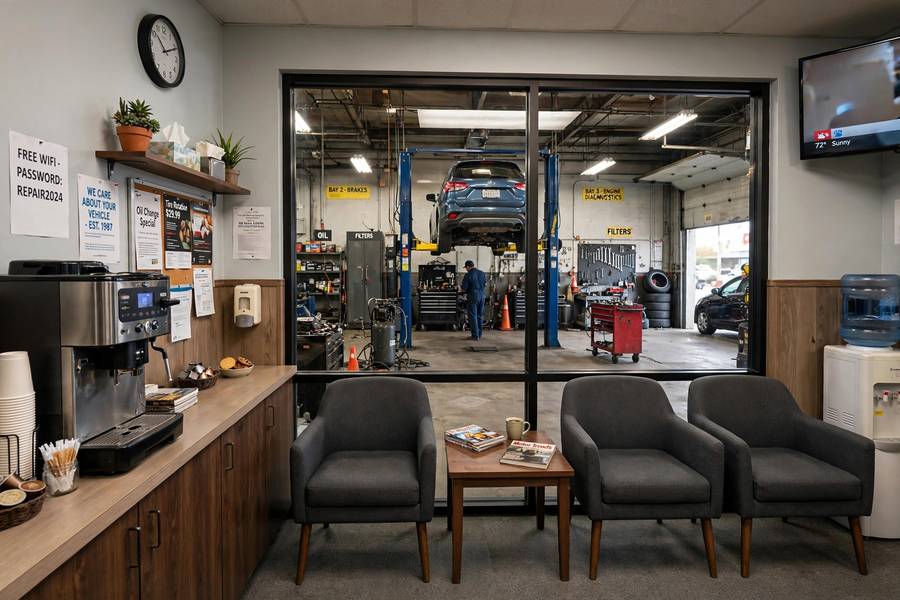
For a simple alignment with an appointment: wait. Bring something to do for an hour. Most shops have Wi-Fi and coffee, and you’ll want to talk to the tech about the printout anyway.
Drop it off if: – You suspect bigger problems (the car may need parts ordered) – It’s a complicated vehicle (modified, ADAS calibration needed) – The shop is slammed and quotes a long wait
Either way, always get the before-and-after printout — emailed, printed, photographed, whatever. It’s your receipt for the work and your baseline for next time.
Bottom line: the work itself is quick — under an hour for most cars. Your total time depends on planning. Book ahead, go midweek, and you’ll be in and out. And if you’re wondering whether the underlying angles are even the problem, start with what wheel alignment actually is — and since uneven wear is the usual reason people book alignments in the first place, knowing how to change a tire is the skill that keeps a worn tire from ruining your week.
Frequently Asked Questions
The actual work takes 30–60 minutes for a standard four-wheel alignment. Total shop visit time is usually 1–2 hours including check-in and queue time — less with an appointment on a weekday.
Yes — most alignments are quick enough to wait for. Bring something to occupy an hour. Drop the car off instead if you suspect worn parts or your car needs ADAS recalibration, which adds significant time.
Usually queue time, not work time. Seized adjustment hardware, aftermarket suspension, or discovered worn parts can also extend the actual work well beyond an hour.
Only slightly — about 10–15 minutes more. The price difference is small too. Get the four-wheel alignment; rear angles affect front handling, and a front-only job on a car with rear issues is incomplete.
Not strictly, but walk-ins often wait 30–90 minutes for a free rack. An appointment — ideally Tuesday through Thursday morning — gets you in and out in about an hour total.