If you’ve ever wondered what causes wheel misalignment, I can answer from the shop floor: it’s almost always one of seven things, and five of them I see every single week. Alignment doesn’t drift for no reason — something specific knocks it out. Understanding what those somethings are saves you money, because half of them are preventable.
Let me walk you through each cause the way I’d explain it to a customer leaning on my service counter — what happens, why it knocks the geometry out, and what you can actually do about it.
Contents
- 1 Potholes, the Number One Killer
- 2 Curb Strikes
- 3 Worn Tie Rod Ends
- 4 Worn Ball Joints and Control Arm Bushings
- 5 Sagging Springs and Worn Struts
- 6 Heavy Loads and Towing
- 7 Accidents and Hard Impacts
- Why Alignment Goes Out Even Without Impacts
- How to Prevent Misalignment
- What to Do After Any of These Happen
1 Potholes, the Number One Killer
Potholes are, by a wide margin, the most common cause of wheel misalignment I see. One deep pothole at speed can do what years of normal driving can’t: instantly knock toe or camber out of spec.
Here’s why. Your suspension is designed to absorb vertical impacts within a range. A shallow dip? Fine — the spring and damper handle it. A deep, sharp-edged pothole at 40 mph? The wheel drops in and slams the far edge, sending a shock load through the tire, rim, strut, control arm, and tie rod all at once. Something in that chain moves — a tie rod bends slightly, a bushing deforms, a strut mount shifts — and now your geometry is off.
The frustrating part: the damage is often invisible. The car looks fine. But the steering wheel sits a few degrees crooked, or the car pulls slightly. That slight change is now scrubbing rubber off your tires every mile.
Prevention: Slow down for potholes you can’t avoid (impact force rises with the square of speed — halving speed quarters the force), and grip the wheel firmly when you hit one. After a hard hit, watch for pulling, vibration, or a crooked wheel — and check your tires for bulges, which indicate internal damage that can cause a blowout later.
2 Curb Strikes
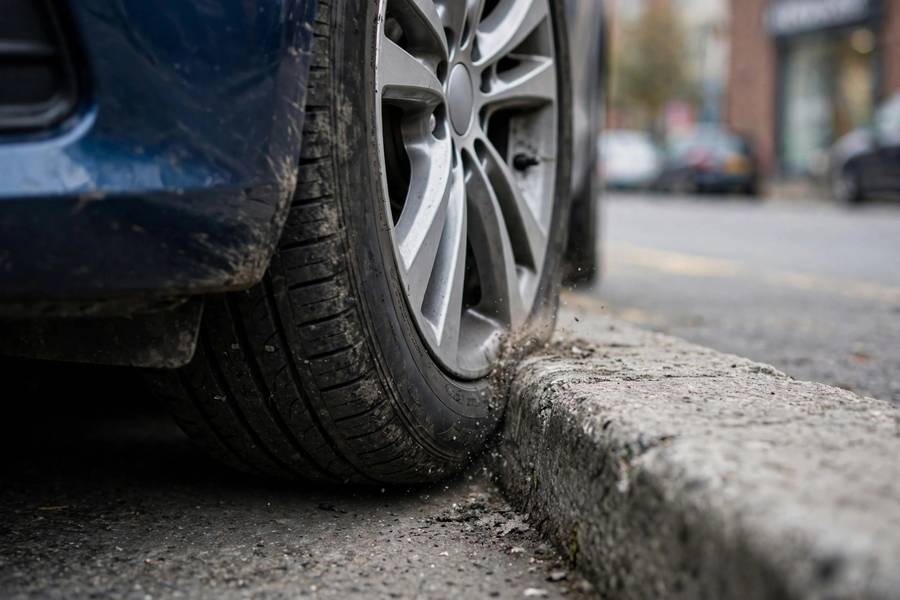
Curb strikes are potholes’ close cousin. Sliding into a curb — in ice, rain, or just a misjudged turn — hits the wheel laterally instead of vertically, and lateral forces are what alignment angles are least able to absorb.
The typical curb-strike customer comes in with the steering wheel off-center and one front tire wearing on the edge. What happened: the tie rod (which sets toe angle) took the lateral hit and bent slightly, or the steering knuckle shifted. Sometimes the rim itself is bent too, which compounds the problem — a bent rim plus bad alignment will eat a tire fast.
Winter is curb-strike season. Ice + curbs = my busiest months for alignment work. If you slid into a curb hard enough to feel it, don’t wait for symptoms — get the alignment checked. The longer you drive on it, the more tire you sacrifice.
3 Worn Tie Rod Ends
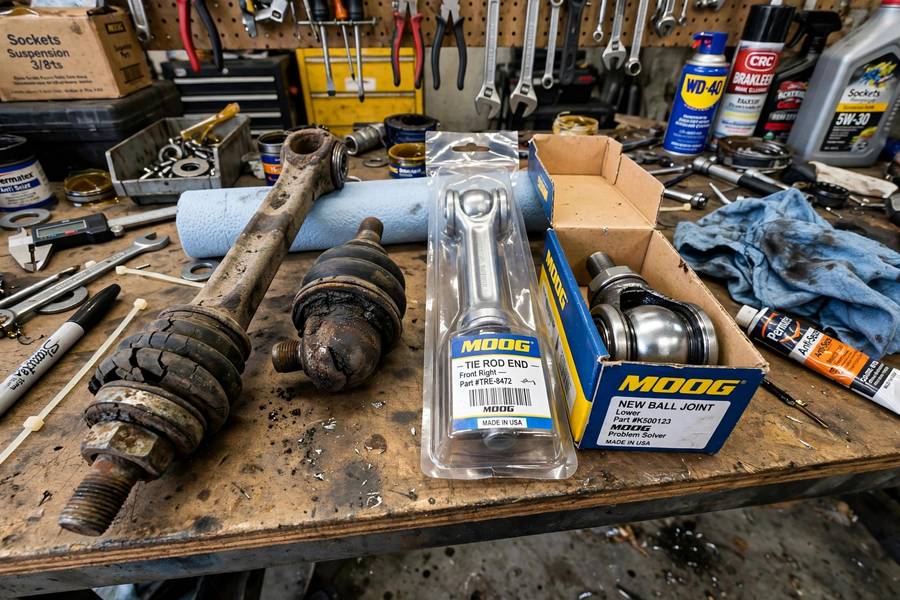
Not every cause is dramatic. Tie rod ends are ball-and-socket joints that connect your steering rack to the wheels, and they wear out — it’s just what they do. Every steering input, every bump, cycles that little joint. Over 80,000–120,000 miles, they develop play.
Play in a tie rod end means the wheel can shift slightly independent of the steering input. That shift changes toe angle dynamically — the alignment is effectively different when you’re driving versus when the car is sitting still. This is why a car with worn tie rods can pass a casual visual check but show bad numbers on the alignment rack.
The telltale signs: a clunking noise when turning at low speed, vague or “loose” steering feel, and toe wear on the front tires (feathered edges). When I replace tie rod ends, I always align afterward — new parts change geometry, and skipping the alignment wastes the money you just spent on parts.
4 Worn Ball Joints and Control Arm Bushings
Ball joints and bushings are the pivot points of your suspension. Ball joints let the wheel move up and down and steer; control arm bushings cushion the arm’s connection to the chassis. Both wear with mileage, and both affect camber and caster angles when they do.
Worn bushings are sneaky. The rubber cracks and compresses over time, letting the control arm shift position slightly under load. Your alignment might measure fine sitting still on the rack, but change dynamically as you drive — braking shifts the arm one way, acceleration another. The symptom is often uneven wear that “doesn’t make sense” from a static measurement, plus a vague wandering feeling.
I’ve seen cars where the alignment printout looked acceptable at rest, but the bushings were so shot that the geometry changed inches under braking. The fix isn’t an alignment — it’s new bushings (or control arms), then an alignment.
5 Sagging Springs and Worn Struts
This one surprises people. Your springs hold the car at its designed ride height, and alignment angles are engineered for that specific height. When springs sag with age (or struts lose their damping and let the car sit lower), the geometry changes — particularly camber.
A car sitting an inch lower than designed will typically gain negative camber (top of the tire tilting inward), which wears the inner edge of the tires. This is why older cars with high mileage often develop inner-edge tire wear even without any impacts — the springs have simply settled.
The fix: replace the worn springs/struts to restore ride height, then align. Aligning a car with sagging springs is putting a bandage on the wrong problem — the numbers will drift again because the geometry is still wrong at the underlying level.
6 Heavy Loads and Towing
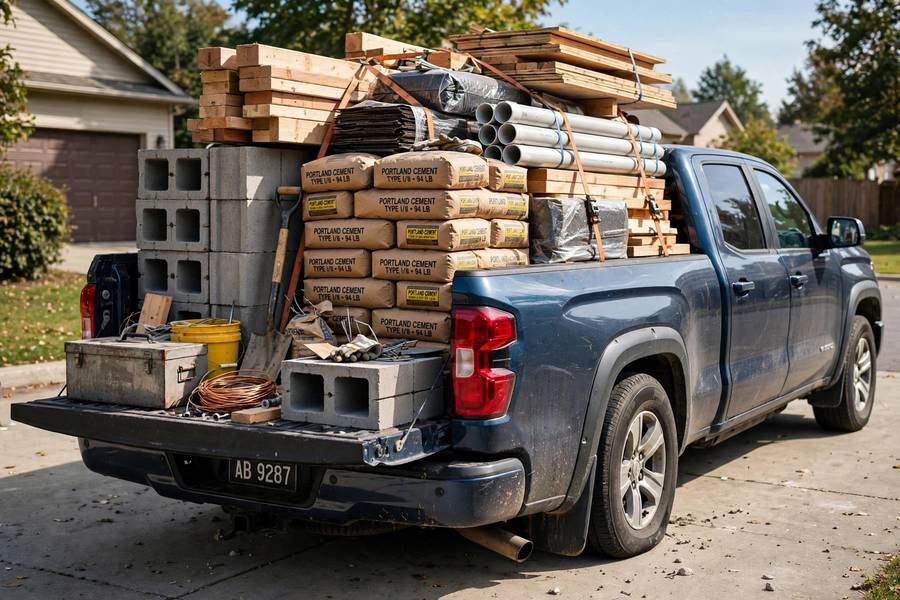
Loading your car to the roof or towing at max capacity compresses the rear suspension, changing the rear alignment angles (especially toe and camber on the rear axle). Occasional heavy loads? The suspension rebounds and geometry returns. Chronic overloading? Springs fatigue, bushings compress permanently, and the alignment shifts for good.
Trucks and SUVs that tow regularly are the classic case. I see work trucks with rear toe knocked out from years of overloaded beds. The tell: rear tires wearing unevenly despite the front looking fine.
This is also why I tell people: if you tow often, get the alignment checked with your typical load in mind, and consider air helper springs or load-leveling if you’re consistently near capacity. Protecting ride height protects alignment.
7 Accidents and Hard Impacts
Even low-speed collisions can cause wheel misalignment. A 10-mph fender bender that barely marks the bumper can bend a control arm, shift a subframe, or damage a strut tower — all of which change alignment geometry. Higher-speed impacts can shift the entire subframe, which throws off all four wheels at once.
Here’s what most people miss: after bodywork is done and the car looks perfect, the alignment underneath may still be off. Cosmetic repair and mechanical repair are different jobs. Any car that’s been in a collision — even a minor one — should get a four-wheel alignment check as part of the repair process. A good body shop does this automatically; a cheap one doesn’t.
Subframe shift is the serious version. The subframe holds the suspension mounting points, and if it moves even a few millimeters in a hit, every angle on that axle changes. Realigning requires loosening the subframe, shifting it back, and retightening — a bigger job than a standard alignment, but the only real fix.
Why Alignment Goes Out Even Without Impacts
Sometimes there’s no dramatic event. The car just gradually starts pulling, or the tires start wearing funny. The usual suspects:
- Normal bushing and joint wear — rubber ages, metal wears, geometry shifts. This is just mileage.
- Rough roads — you don’t need one big pothole. Thousands of small impacts on rough roads add up, especially on cars with 100,000+ miles.
- Settling after suspension work — new struts, springs, or control arms can settle slightly in the first few hundred miles. Some shops recommend a re-check after suspension work for exactly this reason.
- Temperature cycles — extreme heat and cold accelerate rubber bushing degradation.
This is why I recommend an alignment check annually or every 12,000–15,000 miles even if everything feels fine. Catching gradual drift early costs $75–$150. Catching it after it’s eaten a set of tires costs $75–$150 plus $600–$1,000 in rubber.
How to Prevent Misalignment
You can’t prevent all of it, but you can cut the frequency significantly:
- Slow down for potholes and rough roads. Speed is the multiplier on every impact.
- Don’t curb your wheels. Sounds obvious. Happens constantly.
- Rotate tires every 5,000–7,500 miles and inspect for uneven wear — early detection of alignment drift.
- Fix worn suspension parts promptly. A $200 tie rod end now prevents $800 in tires later.
- Don’t chronically overload. Respect the payload rating.
- Annual alignment check. Cheap insurance, especially on rough-road regions.
- After any suspension work, align. Non-negotiable — new parts mean new geometry.
What to Do After Any of These Happen
The pattern is simple: impact or symptom → inspect → align. After a hard pothole or curb hit, do a quick check yourself — look at the tire for bulges or cuts, drive slowly and feel for pulling or vibration, check whether the steering wheel sits straight. Anything off? Get to a shop.
At the shop, ask for the before-and-after printout. The “before” numbers tell you what moved and how far; the “after” numbers prove it’s back in spec. If a tech says the alignment “wouldn’t come into spec,” that’s code for a bent or worn part — ask them to show you which one and why.
One last thing: if your car pulls or the wheel is crooked, don’t just live with it. I wrote a full breakdown of what happens when you keep driving on it — see what wheel alignment actually is for the fundamentals, learn how to change a tire so uneven wear never strands you, and check AWD vs 4WD explained if you’re wondering whether your drivetrain affects how misalignment feels. It does — AWD systems mask pulling longer, which means the tire damage goes further before you notice.
Frequently Asked Questions
Potholes are the most common cause, followed by curb strikes, worn tie rod ends, worn ball joints and bushings, sagging springs, heavy loads, and accidents. Roughly half of cases trace to a single impact event.
Yes — gradually. Rubber bushings age, ball joints develop play, and springs sag with mileage. Rough roads accelerate this. That’s why annual alignment checks catch drift before it destroys tires.
Not always — light brushes usually don’t. But a hard lateral hit can bend a tie rod or shift the knuckle. If the steering wheel is off-center afterward or the car pulls, get it checked.
Worn shocks and struts let the car sit lower than designed, which changes camber angles — typically causing inner-edge tire wear. Fix the suspension first, then align; aligning on sagging springs won’t hold.
Always. Any suspension work — struts, control arms, tie rods, ball joints — changes geometry. Skipping the alignment after new parts wastes the money you spent on the parts through uneven tire wear.