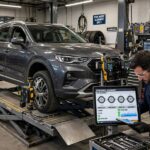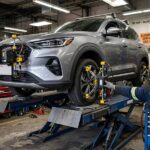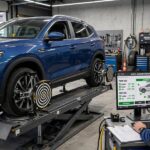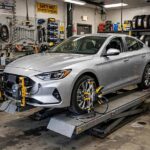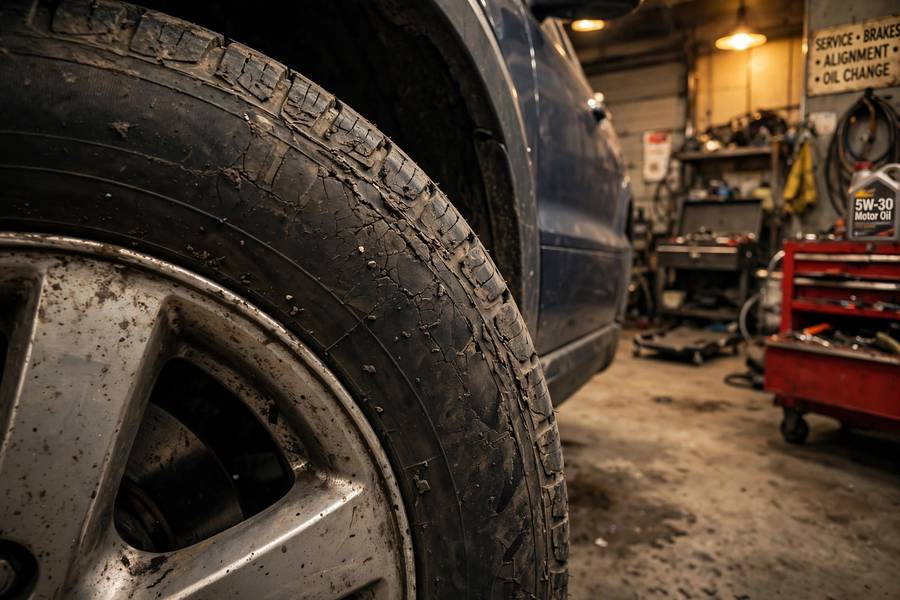
Can you drive with bad wheel alignment? Technically, yes — your car won’t just stop running. But I’ve been turning wrenches for a decade, and I can tell you from the bay: driving on a bad alignment is like walking with one shoe on and one shoe off. You’ll get there, but you’re destroying your tires with every mile and paying for it at the pump too.
Let me give you the honest answer I’d give a friend who just asked me this in my shop — no scare tactics, just what actually happens, when it’s genuinely dangerous, and how to decide whether to drive to the shop or tow it.
Contents
- The Short Answer
- What Bad Alignment Does to Your Tires
- What It Does to Your Fuel Economy
- How It Affects Handling and Safety
- The Warning Signs You Should Not Ignore
- When Bad Alignment Becomes Actually Dangerous
- Can You Drive to the Shop or Should You Tow It
- What Causes Alignment to Go Bad Suddenly
- How Much Does Fixing It Cost
- How Long Can You Realistically Wait
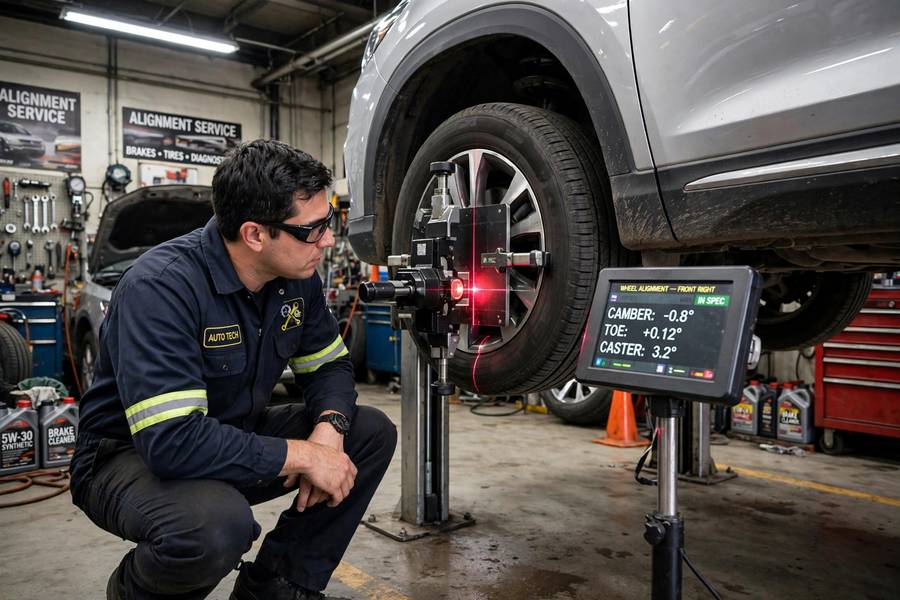
The Short Answer
Yes, you can drive with bad wheel alignment for a short time. Most cars with a mild alignment issue will track slightly off-center and wear tires unevenly over weeks or months — not fail catastrophically today.
But “can” and “should” are different questions. The real costs sneak up on you:
- Tire damage — the #1 consequence. A bad alignment can chew through a set of tires in months instead of years.
- Fuel waste — misaligned wheels drag sideways instead of rolling straight, burning extra fuel constantly.
- Handling degradation — pulling, wandering, vibration. Annoying at low speed, genuinely sketchy at highway speed.
- Stress on suspension parts — ball joints, tie rods, and bushings work harder than designed.
So the honest mechanic’s answer: drive it to the alignment rack this week, not next month. The repair costs less than one prematurely destroyed tire.
What Bad Alignment Does to Your Tires
This is where the real money goes. Alignment is measured in three angles — camber, caster, and toe — and when any of them is out of spec, the tire doesn’t sit flat on the road.
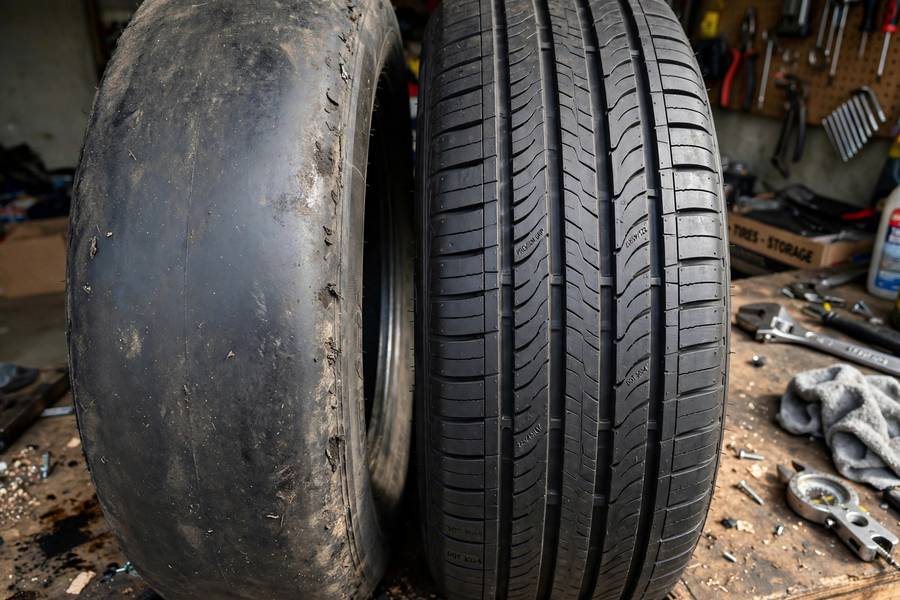
Toe problems are the worst offenders. Toe is whether your wheels point slightly inward (toe-in) or outward (toe-out) when viewed from above. Even a fraction of a degree out, and the tires scrub sideways as they roll — literally dragging rubber off the tread every rotation. I’ve seen cars with bad toe settings destroy front tires in under 10,000 miles. A toe issue will show up as feathered tread edges (run your hand across the tread; it feels smooth one way, rough the other) or one-sided wear.
Camber problems tilt the tire, wearing either the inner or outer edge. Bad camber is common after hitting curbs or potholes. You’ll see one shoulder of the tire going bald while the rest looks fine.
Here’s the part people miss: uneven wear is permanent. An alignment fixes the angles going forward, but it doesn’t un-wear the tire. If you’ve driven 5,000 miles on a bad alignment, those tires carry that damage to the end of their life — which is now much shorter.
What It Does to Your Fuel Economy
Misaligned wheels don’t roll straight — they scrub. That scrubbing is friction, and friction costs fuel. The numbers vary, but a significantly misaligned car can lose 5–10% of its fuel economy. On a car getting 30 mpg, that’s 1.5–3 mpg gone, every tank, forever, until it’s fixed.
Do the math on your own driving: if you drive 12,000 miles a year and fuel economy drops 2 mpg from 30 to 28, that’s roughly 30 extra gallons — $100+ a year at typical prices. An alignment costs less than that in most markets. It pays for itself just in fuel, before you count tire savings.
How It Affects Handling and Safety
Mild misalignment mostly feels annoying: the car pulls to one side on straight roads, the steering wheel sits crooked when you’re going straight, or the car feels “twitchy” and needs constant correction.
Severe misalignment is a safety issue:
- Pulling at highway speed forces you to fight the steering constantly. In an emergency maneuver, that fighting costs reaction time and precision.
- Wandering — the car feels like it can’t decide where to go — is exhausting on long drives and dangerous in crosswinds.
- Vibration through the steering wheel (often combined with balance issues) reduces your feel for the road.
None of this means the car is undrivable tomorrow. It means your margin of safety shrinks, and emergencies are exactly when you need that margin.
The Warning Signs You Should Not Ignore
Your car tells you about alignment problems before they get expensive. Listen for these:
- Pulling — the car drifts left or right on a straight, flat road when you loosen your grip on the wheel.
- Crooked steering wheel — driving straight but the wheel is off-center. This one is almost always alignment.
- Uneven tire wear — check all four tires monthly. Wear on one edge, feathering, or bald spots on one tire only.
- Vibration — especially at highway speeds (also get balance checked; they often go together).
- Loose or wandering steering — the car feels less planted than it used to.
- Squealing tires on normal turns at normal speeds.
One or two of these = get an alignment check soon. Several of these together = get it done this week.
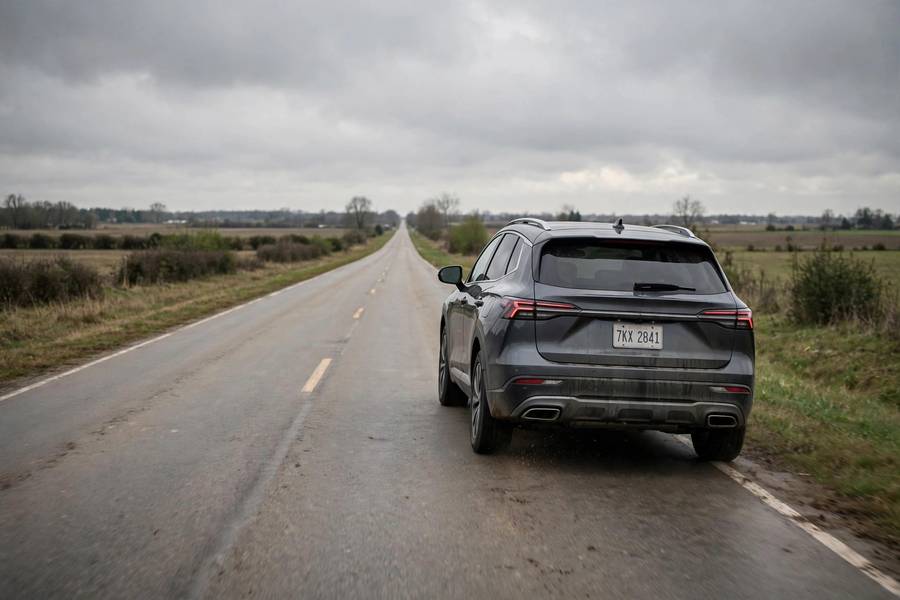
When Bad Alignment Becomes Actually Dangerous
I’m not here to scare you, but there are situations where you should stop driving and sort it out immediately:
- After a hard impact — you smashed a curb at speed, hit a deep pothole, or had any collision. The alignment isn’t the only concern; you may have bent a control arm, cracked a rim, or damaged a tie rod. Any of those can fail. Get it inspected before driving further.
- Extreme pulling — if the car yanks hard enough that you need two hands to keep it straight, don’t highway-drive it.
- Visible suspension damage — anything bent, cracked, or leaking underneath is a stop-driving issue.
- Tire down to cords — if uneven wear has exposed the steel belts or cords, that tire can blow out. Replace it before driving.
Normal bad alignment from gradual wear? Annoying and expensive, not an emergency. Bad alignment after an impact? Different story — that’s an inspection, not a shrug.
Can You Drive to the Shop or Should You Tow It
For the vast majority of bad-alignment cases, driving to the shop is fine. The shop doing your alignment expects you to drive there — that’s the whole business model.
Drive yourself if: – The car tracks reasonably straight with mild pulling – Tires have legal tread remaining (no cords showing) – No noises, no clunks, no visible damage underneath – Steering feels connected, just slightly off
Tow it (or at least get it inspected where it sits) if: – The car pulls violently or the steering feels disconnected – You just had a significant impact and something looks or sounds wrong – A tire is worn to cords or bulging – There’s any fluid leaking from suspension or steering components
When in doubt, call the shop and describe the symptoms. A good shop will tell you honestly whether to drive it in or have it towed — and if they push a tow for a mild pull, find a different shop.
What Causes Alignment to Go Bad Suddenly
Alignment doesn’t usually fail overnight — but it can shift fast after:
- Pothole hits — the #1 sudden cause. One deep pothole at speed can knock toe or camber out in an instant.
- Curb strikes — sliding into a curb in rain or ice, or misjudging a parking turn.
- Worn suspension parts — tie rod ends, ball joints, and control arm bushings wear gradually, then reach a tipping point where the alignment goes off all at once.
- Accidents — even low-speed bumps can bend things underneath.
- New suspension work — struts, control arms, tie rods: any of these being replaced changes geometry, which is why a good shop aligns the car after suspension work. If yours didn’t, that’s your answer.
Gradual causes exist too — normal wear, heavy loads, rough roads — but sudden-onset alignment issues almost always trace back to an impact or a worn part that finally gave up.
How Much Does Fixing It Cost
Realistic numbers from the shop world:
- Two-wheel (front) alignment: $50–$100
- Four-wheel alignment: $75–$150
- At a dealership: often $120–$200
If the alignment won’t hold or can’t be brought into spec, something’s worn or bent — tie rod ends ($150–$400 replaced), ball joints, or control arms ($200–$600+). A good alignment tech will show you the before-and-after printout and tell you if a part is preventing proper adjustment. Always ask for the printout — it’s your proof the work was done and your early warning if something’s borderline.
One more thing: some shops sell “lifetime alignment” packages for $150–$250. If you drive rough roads or keep cars long-term, they’re genuinely worth it — I’ve seen customers get aligned three or four times on one package.
How Long Can You Realistically Wait
Here’s my honest timeline:
- A few days to a week — totally fine for a mild pull with decent tires. Schedule the appointment.
- A few weeks — acceptable if symptoms are mild and you’re not doing highway miles, but you’re actively wearing tires the whole time.
- A month or more — you’re now spending more on tires and fuel than the alignment would have cost. Penny wise, pound foolish.
- After an impact — don’t wait. Inspect now.
The alignment itself takes about an hour (I’ll cover that in detail separately). It’s one of the cheapest, fastest services a shop offers — which is exactly why waiting on it makes no sense. The repair is cheap; the damage from waiting is not.
If you take one thing from this: bad alignment is a slow, expensive problem, not a sudden dangerous one — unless something bent or broke. Get it checked, get the printout, and stop donating your tires to the pavement. For the full picture of how the angles work and what each one does, start with what wheel alignment actually is, and if you’re about to buy new rubber, make sure you know how to change a tire too — because nothing stings like paying for tires twice. And if your pulling gets worse in bad weather, the drivetrain matters as well — see AWD vs 4WD explained for how your drive system affects traction.
Frequently Asked Questions
Yes, for a short time — most bad alignment causes gradual tire wear and pulling rather than sudden failure. But every mile costs you in tire damage and fuel, so get it fixed within a week or two.
Uneven tire wear (costing you a full set of tires early), 5-10% worse fuel economy, degraded handling, and extra stress on suspension components like tie rods and ball joints.
Mild misalignment is mostly an expense, not an emergency. It becomes dangerous after hard impacts (possible bent parts), with violent pulling, or when uneven wear exposes tire cords — any of which warrant immediate inspection.
Yes. Uneven wear from misalignment is permanent — fixing the alignment stops further damage but doesn’t restore already-worn tread. That’s why delaying the fix costs more than the alignment itself.
If you notice pulling, a crooked steering wheel, or vibration after a hard pothole hit, get it checked — potholes are the most common sudden cause of misalignment, and impacts can also bend suspension parts.