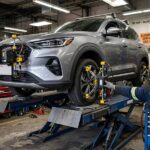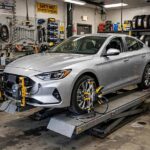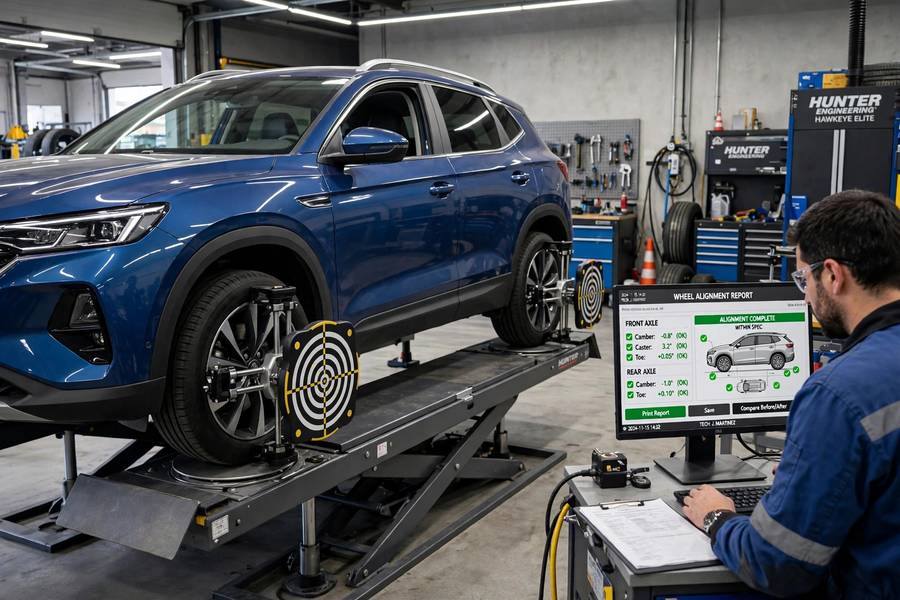
“How much for an alignment?” is a question with a genuinely useful answer — unlike most car repair pricing, alignment costs are pretty standardized. I’ve worked at independents, dealers, and tire chains, and the price structure is consistent enough that I can give you real numbers and tell you exactly what moves them up or down.
Here’s the short version: expect $75–200 at most shops, more at dealers, with a few specific situations that push it higher. Here’s what you’re actually paying for, when the upsells are legitimate, and how to avoid paying twice.
Contents
- Typical Price Ranges
- Two Wheel vs Four Wheel Alignment
- Where You Go Matters: Shop vs. Dealer vs. Chain
- What Drives the Price Up
- The Lifetime Alignment Deal: Worth It?
- Free Alignment Checks
- When You Actually Need One
- How Not to Pay Twice
Typical Price Ranges
Typical U.S. ranges as of 2026. These are what I see across the industry — your city’s labor rates will nudge them, but the structure holds:
| Service | Independent shop | Dealership |
|---|---|---|
| Front-end (2-wheel) alignment | $75–125 | $120–180 |
| Four-wheel alignment | $120–200 | $180–300+ |
| Alignment check only | $0–50 | $50–100 |
| Lifetime alignment package | $180–250 (chains) | Rarely offered |
Most modern cars need a four-wheel alignment — the rear angles matter and are usually adjustable. The front-end-only alignment is increasingly a legacy service for older vehicles with non-adjustable rear suspensions. Always confirm which service you’re being quoted; a 2-wheel price on a car that needs 4-wheel isn’t comparable to the proper quote.
These are ranges, not quotes — get a real number for your specific car. But if someone quotes you $400 for a standard alignment on a Camry with no explanation, you now know enough to ask questions.
Two Wheel vs Four Wheel Alignment
Two-wheel (front-end) alignment measures and adjusts only the front wheels. On older cars with solid rear axles or non-adjustable rear suspension, this was the whole job — the rear was fixed by design. It’s quicker (30–45 minutes) and cheaper.
Four-wheel alignment measures all four wheels and adjusts front and rear. The critical addition is the thrust angle — whether the rear wheels point straight ahead relative to the car’s centerline. A front-only alignment on a car with a thrust angle problem is money wasted.
For any car built in roughly the last 25 years, four-wheel is the correct service. The $30–75 premium buys you the rear measurement, and the rear is often where the real problem lives — especially after curb hits, which love to knock rear toe out.
Where You Go Matters: Shop vs. Dealer vs. Chain
Independent shops ($120–200 for 4-wheel) are usually the sweet spot. The techs do alignments daily, the equipment is modern, and the price is fair. The good ones show you the before-and-after printout without being asked and explain what was out. Find one you trust and keep going back — alignment is a relationship service, like a barber.
Tire chains ($90–180, often with lifetime packages) do enormous alignment volume. The quality varies by location more than by brand — a great tech at a chain is as good as anyone, and a rushed one is as bad. Chains are where the lifetime alignment deals live, which can be excellent value (more below). They’re also the most likely to find “additional work” — more on upsells shortly.
Dealerships ($180–300+) charge the most. Worth it for luxury/performance cars with complex suspensions, vehicles needing ADAS recalibration after alignment changes, and warranty situations. For a mainstream car, the dealer alignment and the independent alignment are the same service with different invoices.
What actually matters more than the shop type: the equipment and the tech. A modern imaging alignment rack in the hands of someone who cares beats a premium shop with outdated gear and a rushed tech. Ask how old their rack is and whether you’ll get a printout. The answers tell you everything.
What Drives the Price Up
Standard alignment, standard car, standard price. These are the things that move the needle:
Luxury and performance cars. More adjustable angles, tighter specs, sometimes weighted alignment procedures (ballast in the seats to simulate load). Expect the high end of every range, sometimes beyond.
ADAS recalibration. Many modern cars have lane-keeping and adaptive cruise cameras calibrated to the car’s geometry. Changing alignment angles can require recalibration — a separate procedure adding $150–400. Not every alignment needs it; ask whether it’s required for your specific car.
Seized or rusted adjustment hardware. In rust-belt states, tie rod jam nuts and eccentric bolts can be frozen solid. Freeing or replacing them adds labor and parts — honest extra work, but it should be disclosed before they start, not discovered on your invoice.
Camber/caster correction kits. Some cars lack factory adjustment for camber or caster; the fix is aftermarket eccentric bolts or adjustable arms ($50–200 in parts plus labor). Sometimes necessary, sometimes premature — ask to see the before numbers and what caused the angle to go out. “It’s just out” isn’t a cause.
The Lifetime Alignment Deal: Worth It?
The lifetime alignment — pay $180–250 once, get free alignments for as long as you own the car — is one of the most debated deals in the business. Here’s my honest breakdown:
Worth it if: you keep cars 5+ years, drive rough roads, or go through tires quickly. Two paid alignments already exceed the $180–250 package price.
Not worth it if: you trade cars every 2–3 years or drive mostly smooth highways.
The fine print: it’s lifetime of YOUR ownership, not the car’s — it doesn’t transfer when you sell, and it covers one specific vehicle. “Free alignments” means the alignment labor; parts found during visits cost extra.
My verdict: for long-term owners in pothole territory, it’s the best deal in car maintenance. For everyone else, pay per visit.
Free Alignment Checks
Many shops — especially tire chains — offer free alignment checks: they put the car on the rack, measure everything, and show you the numbers at no charge. This is genuinely useful and usually honest. The rack time is cheap for them, and it’s a great lead generator for actual alignments.
How to use it well: get the check, look at the printout, and ask which angles are out and by how much. A toe reading 0.01 degrees past the limit is technically “out” and practically irrelevant; deep in the red is eating your tires. A good tech tells you the difference without being asked.
One caution: a free check sometimes comes with a same-day pressure pitch. Alignment is rarely an emergency unless the car is undrivable — take the printout home if you need to think.
When You Actually Need One
Not on a schedule — on symptoms and events:
- New tires. The single best time. Fresh rubber deserves correct geometry, and you’re already at the shop.
- After any significant impact. Potholes, curb hits, accidents — even minor ones. If you felt it in the steering wheel, get it checked.
- Uneven tire wear. Feathering, one-sided wear, cupping — the tires are telling you the geometry is off.
- Pulling or wandering. Car drifts on flat roads, steering wheel off-center, constant corrections.
- Suspension work. Any time tie rods, ball joints, struts, or control arms are replaced, the alignment must be redone. Any shop doing suspension work should mention it; if they don’t, ask.
- Steering feels wrong. Vague, darty, won’t return to center — caster or toe issues.
What doesn’t require one: routine mileage intervals. Unlike oil changes, alignments aren’t maintenance-by-calendar. “It’s been a year” alone isn’t a reason — but “it’s been a year and the car pulls slightly” is. And if you’re evaluating a used car’s condition, tire wear patterns are one of the most honest clues available — part of knowing how to buy a used car with your eyes open is reading what the tires say about the car’s past.
How Not to Pay Twice
The most expensive alignment is the one you pay for twice. Here’s how that happens and how to avoid it:
Aligning over worn parts. Worn tie rods, ball joints, or bushings won’t hold an alignment — the numbers drift as soon as you drive away. Always inspect the suspension first. Ask: “did you check the suspension components first?” If the answer is vague, go elsewhere.
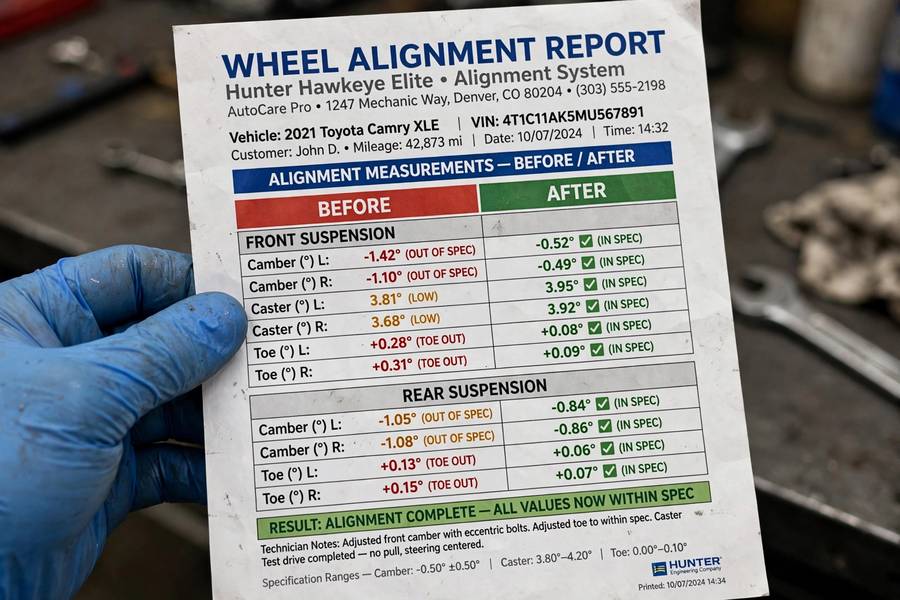
Skipping the printout. No printout, no proof. The before-and-after sheet shows what was out and what’s in spec now. Keep it with your records.
Ignoring the tires. An alignment can’t fix worn tires, and worn tires can mask alignment results. If your tires are already destroyed by bad geometry, align first, then replace — or do both together. And keep them rotated and inflated afterward; even perfect alignment can’t save neglected tires.
An alignment is one of the fairest-priced services in the industry — standardized, quick, and verifiable with a printout. Know the ranges, match the service to your car, get the sheet, and you’ll never overpay. And since tires are the other half of the equation, knowing how to change a tire covers you for the roadside side of tire care. For the full explanation of what those angles on the printout mean, start with what wheel alignment is — and then you’ll read that printout like a pro.
Frequently Asked Questions
A four-wheel alignment typically costs $120–200 at an independent shop or $180–300+ at a dealership. Front-end (2-wheel) alignments run $75–125. Most modern cars need the four-wheel service. Prices vary by region, vehicle type, and whether ADAS recalibration is required.
They can be — at $180–250, the package pays for itself after two regular alignments. It’s worth it if you keep cars 5+ years, drive rough roads, or go through tires quickly. It’s not transferable when you sell the car, and additional parts or repairs found during visits cost extra.
There’s no fixed schedule — get one when you install new tires, after pothole or curb impacts, when you notice pulling, wandering, or uneven tire wear, and after any suspension work. Routine calendar-based alignments aren’t necessary unless symptoms or events warrant it.
Common reasons: worn suspension parts that won’t hold the settings, a tire problem (separated belt or uneven wear) rather than a geometry problem, or the rear thrust angle wasn’t corrected (front-only alignment on a car needing four-wheel). Ask for the printout and have the tech cross-rotate front tires as a diagnostic.
Almost all modern cars need a four-wheel alignment — it measures the rear wheels and corrects thrust angle, which a front-only alignment misses. Two-wheel alignments suit older vehicles with non-adjustable rear suspensions. The 4-wheel service costs $30–75 more and is the correct choice for most cars.