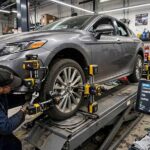
Every alignment printout lists three angles — camber, caster, toe — and most customers look at the numbers the way I look at tax forms: with quiet dread and zero comprehension. Then the tech says “your toe was out” and everyone nods like that means something.
It does mean something, and it’s not complicated. These three angles are just three ways of describing how your wheels sit and point. I explain them to customers with hand gestures and a coffee cup — here’s the coffee-cup version, written down.
Contents
- The Three Angles in One Paragraph
- Camber: The Lean
- Caster: The Shopping Cart Trick
- Toe: Pigeon Toed or Duck Footed
- How the Three Work Together
- What Each Misadjustment Feels Like
- Can You Adjust Them Yourself?
The Three Angles in One Paragraph
Stand in front of your car and look at a front wheel. Camber is whether the top of the wheel leans inward or outward. Now look at the car from the side: caster is the tilt of the steering axis — the imaginary line the wheel pivots around when you turn. Now look down from above: toe is whether the fronts of the tires point slightly toward each other or away from each other. Three viewpoints, three angles, and together they describe exactly how each wheel meets the road.
An alignment measures all three (plus a few secondary angles) against the factory specification and adjusts them back into range. For the full picture of the service itself, see what wheel alignment is. This article is about understanding the angles on the printout.
Camber: The Lean
Camber is the inward or outward tilt of the wheel when viewed from the front. Lean the top of the wheel toward the car and that’s negative camber; lean it away and that’s positive camber. Zero camber means the wheel sits perfectly vertical.
Here’s why it matters: when a car corners, body roll pushes the outside wheels outward, trying to lift their inner edges off the pavement. A little negative camber pre-compensates — as the car leans, the outside tire flattens onto the road, maximizing grip. That’s why performance cars run visible negative camber; those tilted-looking wheels at a track day are deliberate.
But camber is a trade-off. Too much negative camber wears the inner edges of your tires prematurely — the classic “my tires are bald on the inside” complaint. Too much positive camber wears the outer edges and makes handling vague. For street cars, the factory spec is usually near zero with a whisper of negative — the engineers splitting the difference between tire life and cornering stability.
What knocks camber out: worn ball joints and control arm bushings (the most common cause I see), bent struts or control arms from pothole and curb hits, and sagging springs. Note that on many economy cars, rear camber isn’t adjustable from the factory — if it’s out, something is worn or bent, and the fix is parts, not adjustment. When a shop tells you “we need a camber kit,” they mean aftermarket bolts or arms that add adjustability the factory didn’t include.
Caster: The Shopping Cart Trick
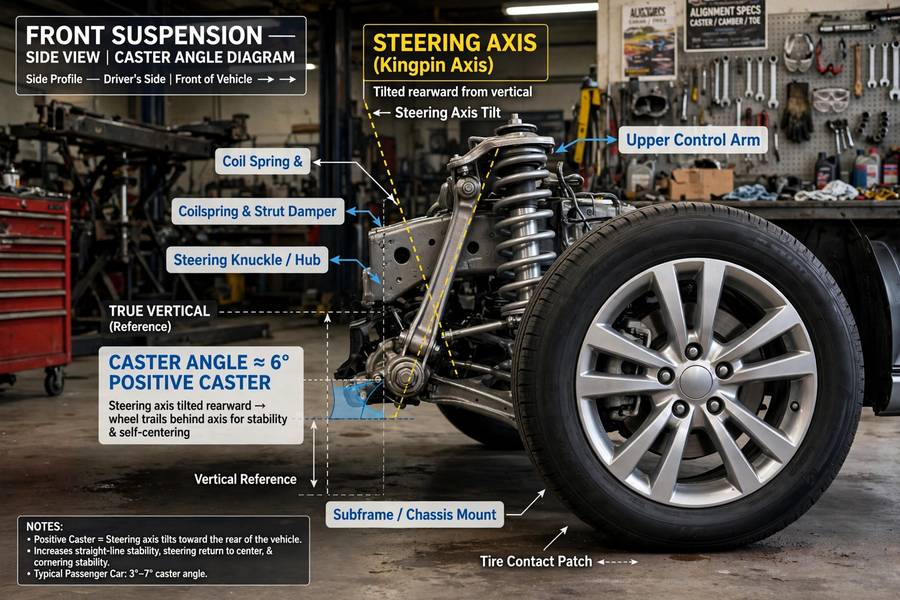
Caster is the forward or backward tilt of the steering axis when viewed from the side. Positive caster means the axis tilts backward at the top (the bottom pivot point sits ahead of the top); negative caster tilts it forward.
The shopping cart is the perfect demonstration. A cart’s front wheels trail behind their pivot — that’s extreme positive caster — and it’s why they track straight and stable when you push the cart, but also why they flutter and shimmy when something’s off. Your car’s front wheels work on the same principle, just far more subtle: positive caster makes the wheels want to roll straight ahead and gives the steering its self-centering feel — that satisfying return-to-center when you let go of the wheel coming out of a turn.
Caster’s effects on driving feel are significant: more positive caster gives heavier, more stable steering with strong self-centering and relaxed highway tracking — which is why modern cars run generous amounts. Less positive caster means lighter, darty steering that wanders and needs constant correction.
Here’s the practical bit: caster rarely causes tire wear directly, which is why it’s the forgotten angle. But it’s often why a car “just doesn’t feel right” after an alignment that only corrected toe. A bent strut or control arm from a curb hit changes caster, and the symptom is vague wandering or a steering wheel that doesn’t quite return on its own.
Toe: Pigeon Toed or Duck Footed
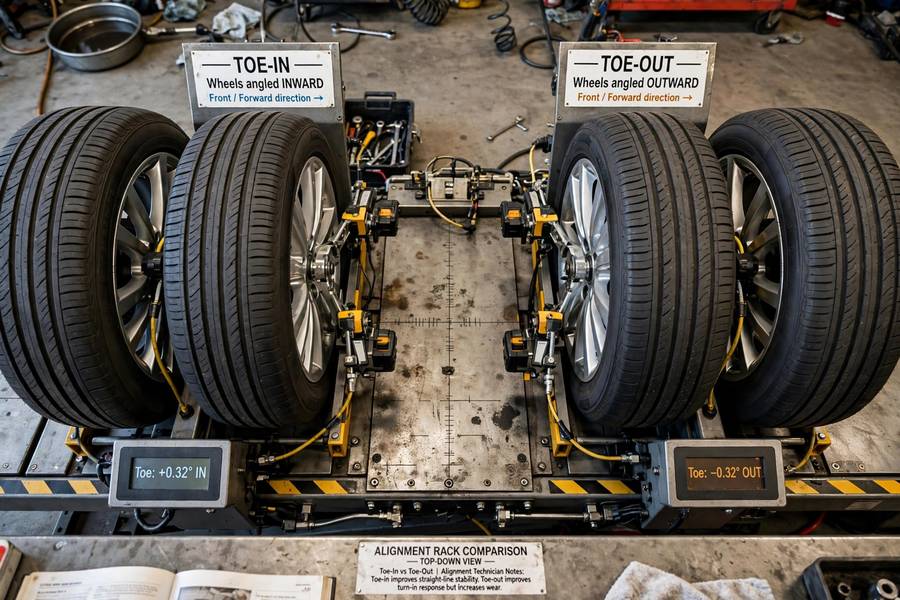
Toe is whether the fronts of the tires point toward each other (toe-in, pigeon-toed) or away from each other (toe-out, duck-footed) when viewed from above. It’s measured in fractions of a degree or fractions of an inch, and it’s the angle that goes out of spec most often — and eats tires fastest.
Toe is the tire-killer of the three angles. Here’s why: imagine walking pigeon-toed — every step, your feet scrub sideways against the ground. That’s exactly what toed-in or toed-out tires do: they drag sideways as they roll. Even small toe errors scrub rubber constantly. A toe misalignment of just a fraction of a degree can wear tires visibly in a few thousand miles, and it creates a distinctive feather-edged wear pattern — run your hand across the tread and the edges feel sharp in one direction, smooth in the other, like a saw blade.
The factory specs a tiny amount of toe-in on most cars for stability — it keeps the car tracking straight and compensates for the slight outward pull of driving forces. Performance setups sometimes run a touch of toe-out up front for sharper turn-in response, at the cost of straight-line stability and tire life. It’s all trade-offs, all the way down.
What knocks toe out: it’s the most vulnerable angle because it’s adjusted at the tie rods — the most exposed steering components. Potholes, curb kisses, worn tie rod ends, worn steering rack bushings. I’ve seen toe knocked out by a single enthusiastic encounter with a parking block. The good news: of the three angles, toe is the easiest to adjust — it’s the primary adjustment on every alignment, done by threading the tie rods in or out.
How the Three Work Together
Here’s what the printout doesn’t tell you: the angles interact. Camber and toe conspire on tire wear — a little excess of each multiplies wear far beyond what either would cause alone. Caster influences how camber behaves in corners. The engineers designed these interactions deliberately; it’s a tuned system, not three random numbers.
And all three sit on top of the suspension’s health. Worn ball joints, tie rods, bushings, struts, and springs make every angle a moving target — which is why a good alignment starts with a suspension inspection, not the rack. Aligning a car with worn parts is like getting a haircut in a windstorm: technically possible, practically pointless.
One more interaction worth knowing: ride height affects all three angles. Lowered cars (or cars with sagging springs) change camber and toe geometrically — which is why they need alignments and often camber correction kits.
What Each Misadjustment Feels Like
Translate the printout into driving feel:
- Excess negative camber: inner tire edges wearing; car feels planted in corners but darty on grooved highways (tramlining — following every groove in the road).
- Excess positive camber: outer edges wearing; vague, rolly handling.
- Low/uneven caster: wandering, weak steering return, constant small corrections on the highway. Often one-sided — pulls or drifts.
- Too much toe-in: tires feather-edged; car feels stable but reluctant to turn in; rapid wear.
- Too much toe-out: darty, nervous steering; the car feels like it wants to change lanes on its own; rapid wear.
- Toe out of spec side-to-side: the steering wheel sits crooked going straight — the classic “my wheel is off-center” complaint. This one is almost always toe.
If you’re experiencing any of these, the fix starts with an alignment check — most shops will put it on the rack and show you the numbers for a modest fee, sometimes free. Get the printout. Now you can read it.
Can You Adjust Them Yourself?
The honest answer: toe, roughly, yes — camber and caster, effectively no.
Toe can be approximated at home with the string method: strings run along both sides of the car at hub height, measuring rim to string front and rear. It’ll get you close enough to drive to the shop without destroying tires — the traditional roadside fix after replacing a tie rod. But “close enough to drive” isn’t “in spec.”
Camber and caster need the rack: precise measurement under load, and finicky adjustments without live readings.
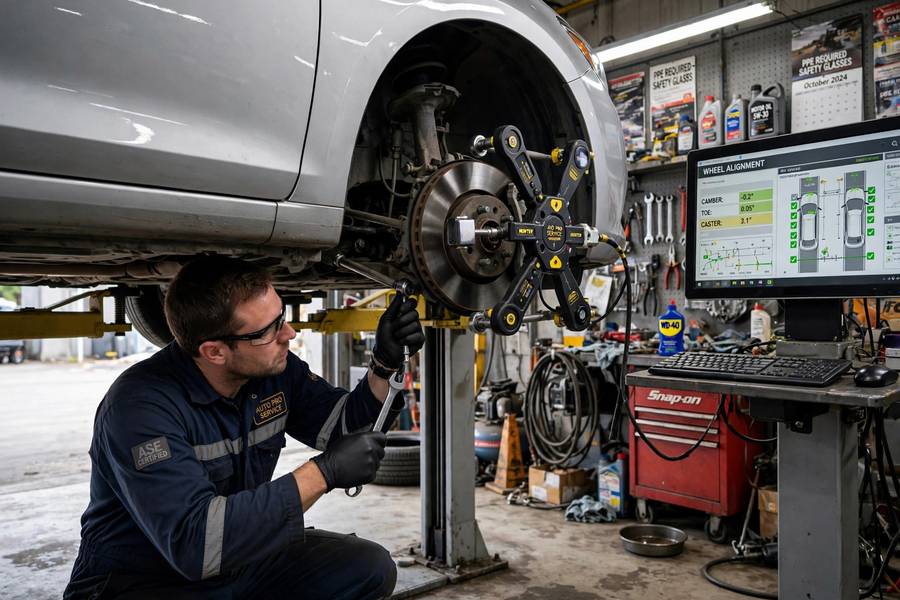
My take: the DIY string alignment is a legitimate emergency skill — if you replace a tie rod end on a Sunday, string it close and drive gently to the shop Monday. But a proper alignment on a modern rack costs $75–200 and gives you a printout proving every angle. For the precision involved and the tire life at stake, it’s one of the best values in car maintenance.
And while you’re thinking about how your car meets the road, remember the tires themselves are half the equation: proper inflation, regular rotation, and knowing how to change a tire when the inevitable happens. If you’re curious how power gets to those carefully-angled wheels, what all-wheel drive is is worth the read.
Three angles, three viewpoints, one system. Now the printout makes sense.
Frequently Asked Questions
Camber is the inward/outward tilt of the wheel viewed from the front; caster is the forward/backward tilt of the steering axis viewed from the side; toe is whether the fronts of the tires point toward or away from each other viewed from above. Together they’re the three main wheel alignment angles.
Toe causes the fastest tire wear — even tiny toe errors scrub rubber constantly and create feather-edged wear. Excessive camber wears the inner or outer edges. Caster rarely wears tires directly but affects handling feel and straight-line stability.
Negative camber (top of the wheel tilted inward) improves cornering grip because body roll flattens the outside tire onto the road in turns. Too much of it wears the inner tire edges prematurely and can cause tramlining on grooved roads. Factory specs use just a whisper of negative camber for street cars.
Toe can be roughly set at home with the string method — good enough to drive to a shop after a repair, but not true spec. Camber and caster need a professional alignment rack for accurate measurement and adjustment. A proper alignment costs $75–200 and includes a before-and-after printout.
A crooked steering wheel when driving straight is almost always a toe problem — the impact knocked the tie rod adjustment out, often unevenly side-to-side. An alignment corrects it by resetting toe to spec and centering the wheel. Have the suspension inspected too, since impacts can bend or wear components.