“My car shakes on the highway — I need an alignment.” I hear this weekly, and half the time the customer is wrong — they need a balance, not an alignment. The two services sound similar, they’re sold in the same shops, and most drivers use the words interchangeably. But they fix completely different problems, and paying for the wrong one means the shake (or the pull, or the tire wear) is still there when you drive out.
I’ve been doing both services for years, and the distinction is simple once someone explains it right. Here it is: alignment adjusts the angles of the wheels; balancing adjusts the weight distribution of the tire-and-wheel assembly. One is about geometry, the other is about physics. Let me break down what each does, how to tell which one you need, and what they cost.
Contents
- The Difference in One Sentence
- What Wheel Alignment Actually Does
- What Wheel Balancing Actually Does
- Symptoms: How to Tell Which One You Need
- Can You Need Both at the Same Time?
- What Each Service Typically Costs
- My Advice: Diagnose Before You Buy
The Difference in One Sentence
Wheel alignment adjusts the angles at which your tires contact the road — camber, caster, and toe — so all four tires point the right direction and sit flat. Wheel balancing corrects uneven weight distribution in the tire-and-wheel assembly by adding small weights, so it spins smoothly without vibration.
Think of it this way: alignment is about where the wheels point; balancing is about how the wheels spin. A wheel can be perfectly balanced but badly aligned (it’ll spin smoothly while chewing up your tires), or perfectly aligned but badly balanced (it’ll point straight while shaking your fillings loose at 70 mph). Different problems, different fixes.
If you’re fuzzy on the alignment side, start with what wheel alignment is — the full explanation of those angles and why they drift. Then come back here for the comparison.
What Wheel Alignment Actually Does
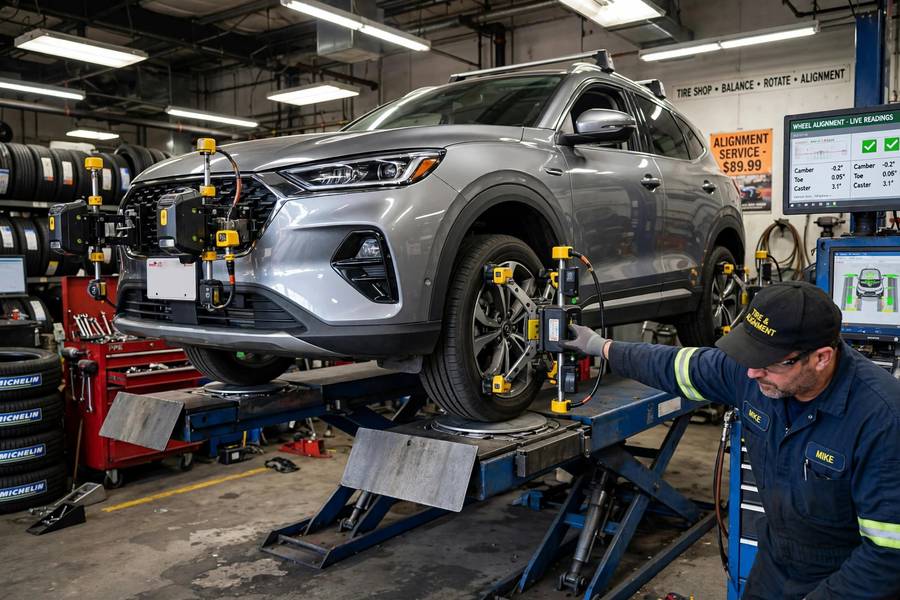
Your wheels aren’t just bolted on straight — they’re set at precise angles engineered for your car. Camber (the inward or outward tilt), caster (the steering-axis angle), and toe (whether the fronts of the tires point slightly in or out) all affect handling, stability, and tire wear. Over time, potholes, curb hits, worn suspension parts, and even normal settling knock these angles out of spec.
An alignment puts the car on a rack, mounts laser or camera targets to each wheel, and measures every angle against the factory specification. The technician then adjusts the suspension — tie rods for toe, and on many cars camber and caster via adjustable bolts or shims — until everything is back in spec. It’s a geometry correction, done with the wheels stationary.
Alignment is about direction and contact: making the tires point correctly and sit flat on the road so the car tracks straight and the tires wear evenly. Nothing spins during an alignment. Nothing gets weighed.
What Wheel Balancing Actually Does
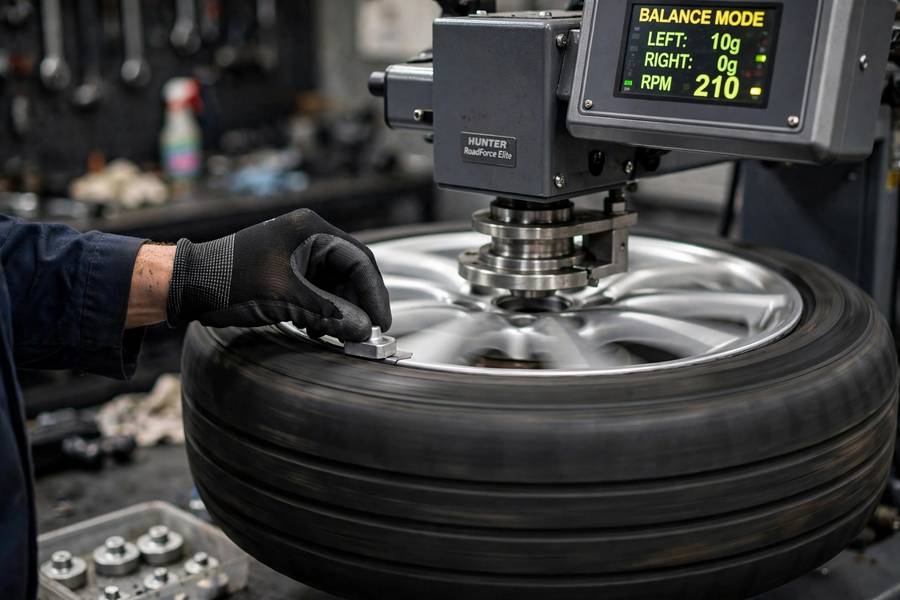
No tire-and-wheel assembly is perfectly uniform. There are always slight variations — a heavier spot in the tire, the valve stem, minor manufacturing differences. At low speeds you never notice. At highway speeds, that heavy spot becomes a centrifugal hammer, yanking the wheel up and down or side to side thousands of times per minute.
Balancing fixes this on a spin balancer: the wheel goes on the machine, spins up, and sensors detect exactly where the heavy spots are and how much counterweight is needed. The tech clips or sticks small lead (or zinc/steel) weights to the rim at precise positions until the assembly spins true.
Balancing is about rotation: making the spinning mass uniform so there’s no vibration. The wheel’s angles don’t change at all. A balance takes 15–20 minutes per wheel and is one of the simplest services in the shop.
Here’s the detail most people don’t know: wheels need rebalancing periodically because balance changes. Tires wear unevenly, weights fall off (you’ll sometimes see the clean outline on the rim where one used to be), and tire rotations change the dynamics. That’s why I recommend balancing with every tire rotation — it’s cheap and it keeps highway manners crisp.

Symptoms: How to Tell Which One You Need
This is the practical part — the symptoms are distinct once you know what to feel for.
| Symptom | Likely culprit |
|---|---|
| Vibration in the steering wheel at 50–70 mph, smooth below and above | Balance (front wheels) |
| Vibration in the seat or floor at highway speed | Balance (rear wheels) |
| Car pulls to one side on a flat, straight road | Alignment |
| Steering wheel off-center when driving straight | Alignment |
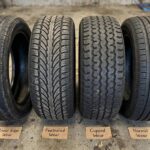
| Uneven tire wear (one edge worn, feathering, cupping) | Alignment (or worn suspension) |
| Vibration that appears right after new tires | Balance (they weren’t balanced properly) |
| Car wanders, feels loose or darty | Alignment |
| Vibration after hitting a pothole + new pull | Both — the impact knocked alignment out and possibly damaged the tire/wheel |
The classic tell: vibration that comes and goes with speed is balance. It’ll be smooth at 40, shaky at 60, maybe smooth again at 80 — because the vibration frequency matches the wheel’s rotation at certain speeds. A constant pull or uneven wear is alignment — it doesn’t care about speed, it’s always there.
One caution: uneven tire wear can also come from worn suspension parts (ball joints, tie rods, struts), under-inflation, or never rotating tires. If your tires are wearing strangely, have the shop check the suspension before paying for an alignment — aligning a car with worn parts is like tailoring a suit on a moving person. The numbers won’t hold.
Can You Need Both at the Same Time?
Absolutely, and it’s common. The two services address different things, so there’s no conflict in doing both — and certain situations genuinely call for it:
New tires. Always balance new tires (non-negotiable — every new tire needs balancing). And it’s the smart time to check alignment too, since you’re already at the shop and fresh rubber deserves correct geometry. Many shops offer a package price.
After a big pothole or curb hit. Impacts can knock alignment angles out AND damage a wheel or tire enough to throw off balance. If you hit something hard enough to feel it in your spine, get both checked.
Buying a used car. Uneven tire wear on a used car tells you the alignment’s been off — and who knows when the wheels were last balanced. When you’re learning how to buy a used car with your eyes open, tire condition is one of the best clues to how the car was maintained. Weird wear patterns are a negotiation point.
Vibration plus pulling. If the car both shakes at speed and drifts sideways, you’ve got both problems. Fix both.
What you don’t need: a balance sold as an alignment fix, or vice versa. If your symptom is a pure highway vibration and the shop sells you an alignment without mentioning balance, they’re either guessing or padding. The symptom table above is your defense — match your symptom to the service before you authorize anything.
What Each Service Typically Costs
Typical U.S. ranges as of 2026 — these are what I see across the industry, not quotes:
Wheel balancing: $15–30 per wheel, or $60–120 for all four. Often bundled free with tire purchase or discounted with rotation. It’s quick, it’s cheap, and shops do it all day.
Wheel alignment: $75–150 for a standard two-wheel (front-end) alignment; $120–200 for a four-wheel alignment at an independent shop. Dealers run higher — $150–300+. Luxury cars, vehicles with adjustable air suspension, or cars needing aftermarket adjustment kits (for camber/caster correction) cost more.
The “lifetime alignment” deal: many chains offer lifetime alignments for $180–250 — pay once, get alignments free for as long as you own the car. Worth it if you keep cars long-term, drive rough roads, or go through tires quickly. Not worth it if you trade cars every three years.
Watch for the alignment upsell stack: “you need a camber kit” ($100–200 in parts plus labor) is sometimes legitimate — some cars genuinely lack factory camber adjustment — and sometimes it’s margin. Ask to see the before measurements on the printout. A good shop shows you the numbers; a shady one just tells you it’s “way out.”
My Advice: Diagnose Before You Buy
Here’s my shop-floor advice, refined over years of watching people pay for the wrong service:
- Match your symptom to the table above before you walk in. Vibration at speed = balance. Pulling or uneven wear = alignment.
- Ask for the specific service by name. “I need my wheels balanced” gets you a balance. “My car shakes” gets you whatever the service writer feels like selling.
- Get the printout. Any alignment should come with before-and-after measurements. Keep it — it’s your proof and your baseline for next time.
- Check the simple stuff first. Tire pressure, lug nut torque (yes, how to change a tire properly matters — unevenly torqued lugs can cause vibration), and a visual check for tire damage or missing balance weights. I’ve “diagnosed” vibrations that were just 15 PSI low in one tire.
- Don’t ignore either problem. Bad balance beats up suspension components and makes driving miserable. Bad alignment eats tires — a $150 alignment saves a $600 set of tires. Both are maintenance, not luxuries.
Alignment is geometry. Balancing is physics. Now you know which is which — and more importantly, which one your car actually needs.

Frequently Asked Questions
Wheel alignment adjusts the angles of the wheels (camber, caster, toe) so tires point correctly and wear evenly. Wheel balancing corrects uneven weight in the tire-and-wheel assembly with small weights so it spins without vibration. Alignment is geometry; balancing is rotational physics.
Vibration at highway speeds (50–70 mph) that comes and goes with speed points to balancing. A car pulling to one side, an off-center steering wheel, or uneven tire wear points to alignment. It’s possible to need both, especially after hitting a pothole or when installing new tires.
No. Balancing only corrects weight distribution for smooth spinning — it cannot change wheel angles. If your car pulls to one side or your tires wear unevenly, no amount of balancing will fix it. Each service corrects a different problem.
Wheel balancing typically costs $15–30 per wheel ($60–120 for all four). Wheel alignment runs $75–150 for front-end or $120–200 for four-wheel at independent shops, more at dealers. Lifetime alignment packages ($180–250) can pay off if you keep the car long-term.
New tires always need balancing — it’s part of proper installation. An alignment check at the same time is smart preventive care, since fresh rubber deserves correct geometry and you’re already at the shop. Many shops offer package pricing for both.