Ask a diesel truck owner why they love their truck and you’ll hear some version of: “It just pulls.” Ask a petrol sports car owner the same question and you’ll hear: “It just revs.” Those two answers contain the entire diesel-versus-petrol torque story. They make their power in fundamentally different ways, and understanding the difference explains everything from towing ratings to why diesels dominate trucks and petrol dominates sports cars.
I’ve worked on both for years, and I own a soft spot for each. This isn’t a “which is better” article — it’s a “why they’re different” article, because once you understand the why, the right choice for your situation becomes obvious.
Contents
- The Core Difference: How Each Engine Burns Fuel
- Why Diesels Make More Low-End Torque
- Why Petrol Engines Rev Higher (and What That Buys You)
- Torque Curves Compared: What They Look Like
- The Turbo Equalizer: How Modern Engines Blurred the Lines
- Real-World: Towing, Daily Driving, and Fuel Economy
- Which One Suits You
The Core Difference: How Each Engine Burns Fuel
Everything starts with combustion. If you’re fuzzy on the basics, my piece on torque and how it works in cars sets the foundation.
Petrol engines use spark plugs to ignite a premixed charge of fuel and air. The mixture burns fast — a controlled explosion that pushes the piston down quickly. Petrol is volatile and burns rapidly, which lets the engine spin fast: 6,000–7,500 RPM redlines are normal, and performance engines go higher.
Diesel engines use compression ignition — no spark plugs. The piston squeezes air so hard (compression ratios of 15:1 to 22:1, versus 10:1 to 13:1 for petrol) that it gets hot enough to ignite fuel injected directly into the cylinder. Diesel fuel burns slower and more progressively than petrol — more of a sustained push than a sharp bang.
That combustion difference shapes everything downstream. The slow, sustained push of diesel combustion happens over more of the piston’s downward stroke, which means more turning force at the crankshaft — which is torque, almost by definition. The fast bang of petrol combustion delivers its energy quickly, which favors high RPM operation — which is horsepower.
Why Diesels Make More Low-End Torque
Four mechanical reasons stack up in diesel’s favor:
- Higher compression ratio. Squeezing the charge harder extracts more energy per combustion event. More energy per power stroke = more twisting force per revolution = more torque. This is the single biggest factor.
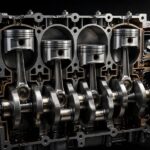
- Longer stroke. Diesel engines typically have a longer piston stroke relative to bore diameter (undersquare design). Longer stroke means the connecting rod pushes on the crankshaft through a longer lever arm — literally. Longer arm = more torque. The trade-off is that long-stroke engines can’t rev as high (piston speeds get extreme), which is why diesels redline around 4,000–4,500 RPM.
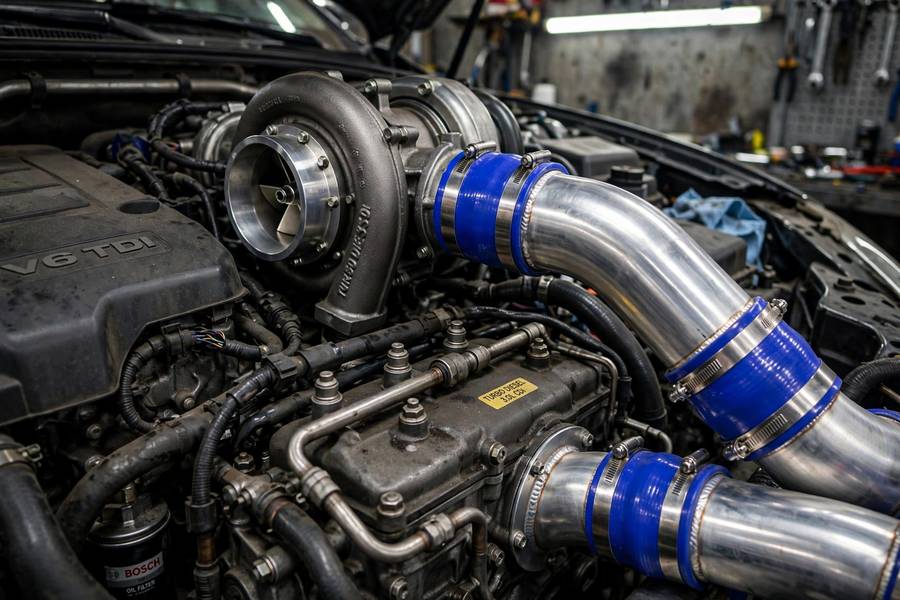
- Turbocharging (near-universal on modern diesels). Forcing extra air into the cylinders lets the engine burn more fuel per stroke. Modern diesel turbos are sized for low-RPM response, so peak torque often arrives by 1,500–1,800 RPM and stays flat for a wide band.
- Heavier, stronger internals. Diesel components are built to withstand enormous cylinder pressures — thicker blocks, stronger cranks, beefier rods. This robustness is also why diesels famously last: the engine is overbuilt by necessity, and overbuilt engines live long lives.
The net result: a 2.0-liter diesel might make 280 lb-ft at 1,750 RPM where a 2.0-liter naturally aspirated petrol makes 150 lb-ft at 4,000 RPM. That’s not a small difference — it’s nearly double the pulling force, available at half the engine speed.
Why Petrol Engines Rev Higher (and What That Buys You)
Petrol’s advantages are the mirror image:
- Higher redlines. Lighter internals, shorter strokes, and faster-burning fuel let petrol engines spin to 7,000+ RPM. Since horsepower = torque × RPM ÷ 5,252, high revs let a petrol engine make big horsepower numbers even with modest torque.
- Broader usable rev range. A petrol engine might pull usefully from 2,000 to 7,000 RPM — a 5,000-RPM-wide band. A diesel’s useful range might be 1,500 to 4,000 RPM. That wider band gives the driver (or the gearbox) more flexibility.
- Refinement. Petrol engines are inherently smoother and quieter — less compression, lighter reciprocating mass, faster combustion. Modern diesels are vastly better than the clattery old ones, but petrol still wins on refinement.
- Weight. Petrol engines are lighter for equivalent power, which helps handling and efficiency in smaller cars.
This is why sports cars are petrol (or electric): performance driving lives at high RPM, where petrol’s rev range and responsiveness shine. A diesel sports car would run out of revs before the fun started.
Torque Curves Compared: What They Look Like
Picture the two curves side by side:
Diesel curve: rises steeply from idle, hits a big flat plateau of torque by ~1,750 RPM, holds it to ~3,000 RPM, then falls off as the engine approaches its low redline. It looks like a tabletop — massive early, then done. The area under the curve (total work available) at low RPM is enormous.
Petrol curve (naturally aspirated): rises gradually, peaks around 4,000–5,000 RPM, then holds or gently declines to redline. It looks like a hill — you have to climb it to find the power. Turbo petrols split the difference: early rise like a diesel, flatter mid-range, higher redline.
What this means in the seat: the diesel shoves you back the instant you touch the throttle and keeps shoving without needing to rev. The petrol needs revs to wake up but rewards you with a wider, more exciting powerband. Neither is “better” — they’re different tools. A tabletop is great for pulling stumps; a hill is great for running up.
The Turbo Equalizer: How Modern Engines Blurred the Lines
Here’s where it gets interesting: turbocharging has narrowed the gap dramatically.
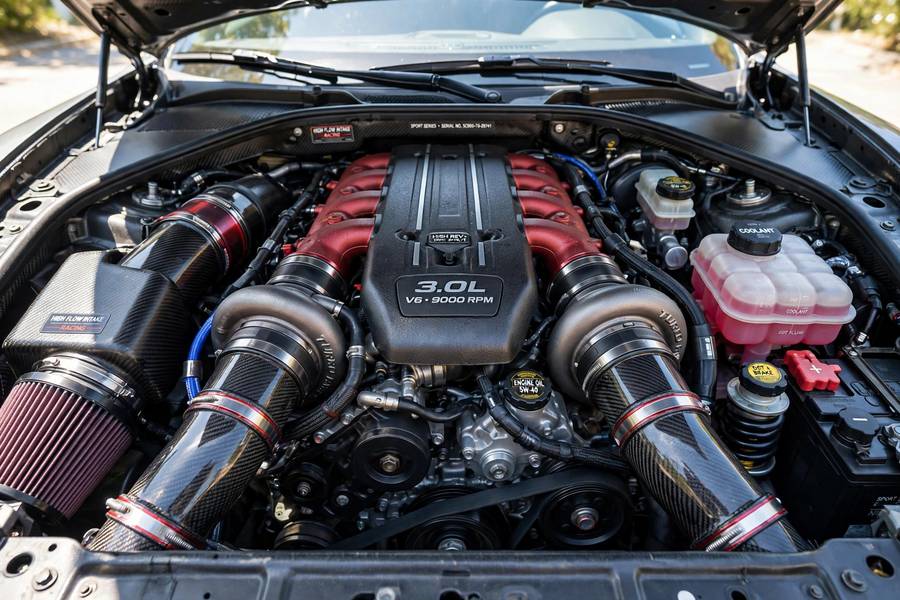
Modern turbo petrol engines now produce diesel-like low-end torque. A 2.0T petrol making 280 lb-ft at 1,600 RPM would have been unthinkable twenty years ago — that’s diesel territory, from a petrol engine that still revs to 6,500. Direct injection, variable valve timing, and twin-scroll turbos made this possible. The modern turbo petrol is genuinely the best of both worlds for most drivers: low-end pull and high-RPM range.
Meanwhile, modern diesels got cleaner, quieter, and more powerful — but also more complex. Diesel particulate filters (DPFs), AdBlue/DEF systems, and high-pressure common-rail injection added cost and maintenance. A modern diesel is a sophisticated machine, not the simple tractor engine of legend. When you’re buying a used car with a diesel, the emissions system’s condition matters as much as the engine’s.
The honest 2026 assessment: for passenger cars, turbo petrol has largely won — it delivers 90% of the diesel’s torque advantage with fewer complications. Diesel’s remaining stronghold is heavy towing and high-mileage commercial use, where its efficiency under load and durability still justify the complexity.
Real-World: Towing, Daily Driving, and Fuel Economy
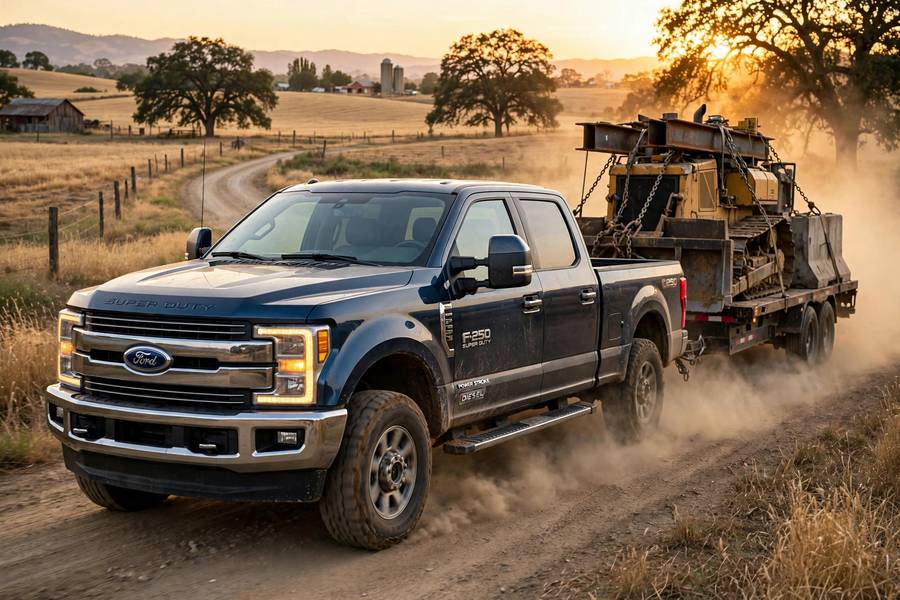
Towing: Diesel wins, and it’s not close. Towing is sustained high-load work at moderate RPM — exactly where diesel torque lives. A diesel truck towing 10,000 lbs sits at 2,000 RPM, relaxed, sipping fuel. The equivalent petrol truck towing the same load is at 3,500+ RPM, working hard, drinking fuel. This is why every serious tow rig is diesel (or now, increasingly, electric).
Daily driving: Modern turbo petrol wins for most people. The low-end torque gap has closed, petrol is more refined, and you avoid diesel’s emissions-system maintenance. Unless you’re towing regularly or driving huge highway miles, petrol (or hybrid) is the easier ownership experience.
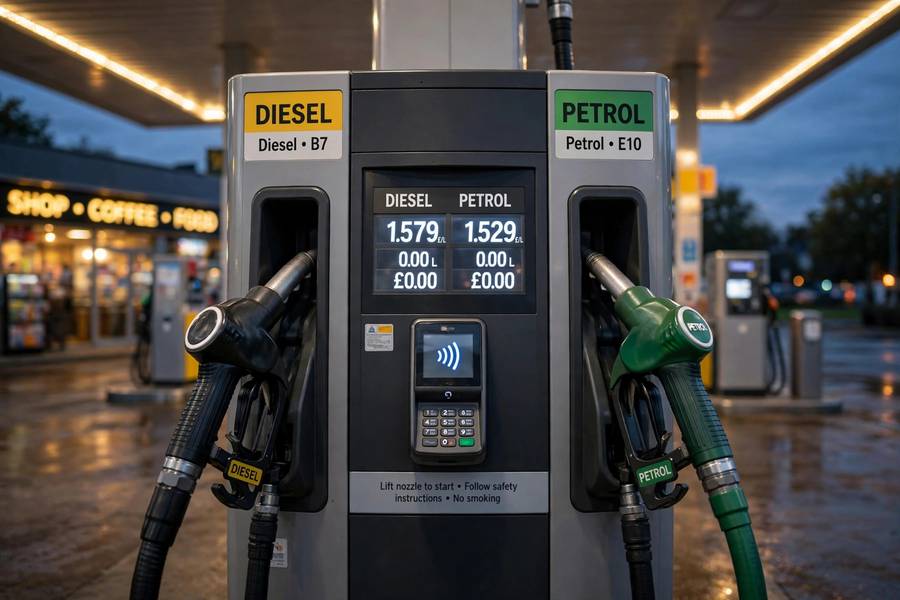
Fuel economy: Diesel fuel contains about 10–15% more energy per gallon than petrol, and diesel engines are thermally more efficient (higher compression = more energy extracted). So diesels typically get 20–30% better fuel economy in equivalent vehicles. But diesel fuel often costs more per gallon, and diesel maintenance (how often to change engine oil intervals are similar, but diesel services cost more) eats into the savings. Do the math for your mileage before assuming diesel saves money.
Longevity: Diesels last longer on average — 300,000+ miles isn’t unusual for a well-maintained diesel, where 200,000 is a good run for petrol. But “well-maintained” is doing heavy lifting in that sentence, and modern emissions equipment has introduced failure points the old mechanical diesels never had.
Which One Suits You
My shop-floor summary:
- Tow heavy or drive huge miles: diesel. Nothing else pulls like it, and the fuel economy under load pays off.
- Daily driver, mixed use: modern turbo petrol. The torque gap is small now, refinement is better, ownership is simpler.
- Fun car: petrol (or electric). Revs are joy, and diesels don’t do joy above 4,000 RPM.
- Keeping it simple and cheap: naturally aspirated petrol. Fewer systems, fewer surprises.
The torque difference is real and rooted in physics — compression ignition, long strokes, and high cylinder pressures will always favor low-end pulling force. But the practical gap is the smallest it’s ever been, and for most drivers in 2026, the choice comes down to use case, not ideology.
Frequently Asked Questions
Diesels use higher compression ratios, longer piston strokes (a longer lever arm on the crankshaft), and slower-burning fuel that pushes the piston over more of its stroke. Combined with turbocharging, this produces much more low-end twisting force than an equivalent petrol engine.
Yes — most diesels redline around 4,000–4,500 RPM versus 6,500–7,500 for petrol. The long stroke and heavy internals needed for high compression can’t safely sustain high piston speeds, and diesel fuel burns too slowly for high-RPM operation.
Diesel, by a wide margin. Towing is sustained high-load work at moderate RPM — exactly where diesel torque peaks. A diesel tows heavy loads at low, relaxed RPM with better fuel economy under load than an equivalent petrol engine.
Largely, yes for passenger cars. Modern turbo petrol engines produce diesel-like low-end torque (e.g., 280 lb-ft at 1,600 RPM) while keeping petrol’s high redline. Diesel’s remaining advantages are heavy towing, sustained-load efficiency, and longevity.
On average, yes — 300,000+ miles is common for well-maintained diesels because their components are overbuilt for high cylinder pressures. However, modern diesel emissions systems (DPF, AdBlue) added complexity and potential failure points the old mechanical diesels didn’t have.