Every fall, customers ask me about storing batteries for winter — classic cars, boats, motorcycles, the summer convertible. And every spring, a good number of those batteries come back dead, because “storing” meant “abandoning on the garage floor for five months.” A stored battery isn’t a paused battery — it’s a slowly dying one unless you manage it. The chemistry doesn’t care that you’re not driving. Here’s how to store a battery for months and have it actually work when you return. For normal lifespan expectations, see how long car batteries last.
Table of Contents
- Why Stored Batteries Die
- Step 1: Start With a Full Charge
- Step 2: Clean and Inspect Before Storage
- Step 3: Choose the Right Location
- Step 4: The Maintainer (Your Best Investment)
- Storing the Battery in the Vehicle vs Removed
- How Long Can a Battery Sit Without Attention?
- Bringing a Stored Battery Back Into Service
- Frequently Asked Questions
Why Stored Batteries Die
Two killers work on stored batteries: self-discharge and sulfation. Self-discharge is the battery’s internal chemistry slowly consuming its own charge — conventional flooded batteries lose roughly 5-15 percent of charge per month at room temperature (faster when hot, slower when cold). A fully charged battery in October is at 50-70 percent by March with zero attention. That’s just sitting there.
Sulfation is the permanent damage. When a battery sits partially discharged, lead sulfate crystals form on the plates — and unlike the soft sulfate of normal cycling, these crystals harden over time into a form that won’t dissolve on recharge. The longer and deeper the discharge, the worse the sulfation. A battery left at 50 percent for five months doesn’t just need charging in spring — it’s lost capacity permanently. This is the mechanism behind most “stored battery” deaths: not the discharge, but the sulfation the discharge allowed.
The cruel math: a battery stored at full charge with periodic maintenance lasts years in storage. The same battery stored discharged and ignored can be ruined in a single season. Storage isn’t about the battery waiting — it’s about you preventing the chemistry from eating itself.
Step 1: Start With a Full Charge
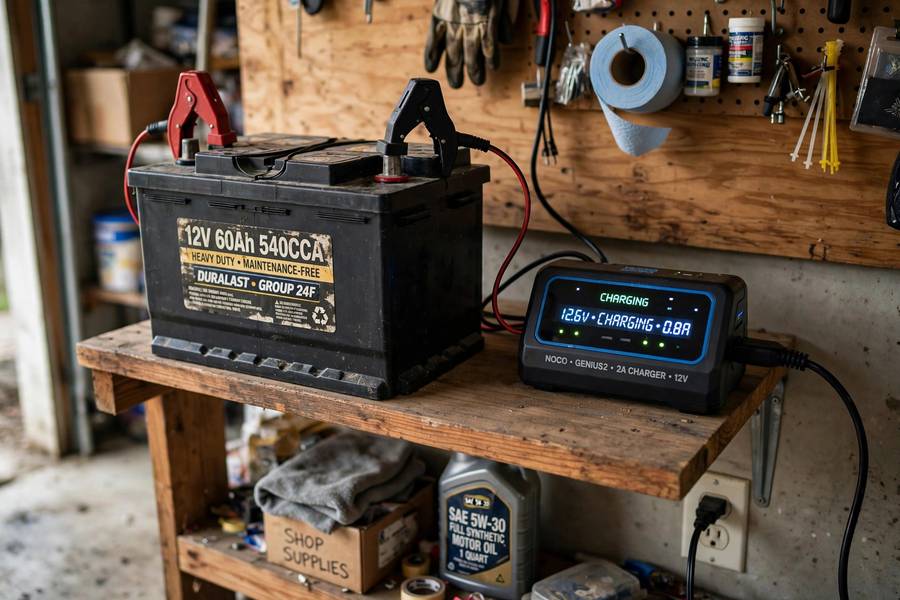
Never store a discharged or partially charged battery. Before storage, charge the battery fully — with a charger, not just a drive (though a good 45-minute highway drive works in a pinch). Verify with a voltmeter if you have one: 12.6V+ after resting an hour off the charger. A battery that won’t reach full charge isn’t a storage candidate — it’s a replacement candidate. Storing a weak battery just schedules its funeral.
Why full charge matters so much: sulfation rate depends on discharge depth. A battery at 100 percent sulfates minimally; at 80 percent, slowly; at 50 percent, aggressively. Starting storage at full charge buys maximum time before sulfation becomes significant. It’s the single highest-leverage step in this whole guide.
For batteries already in a vehicle being stored (winter car storage): drive the car 30-45 minutes before parking it for the season, or put it on the charger the day you park it. Don’t park it after the short drive home from work and call it stored — that battery went into hibernation half-fed.
Step 2: Clean and Inspect Before Storage
A battery going into storage should be clean. Wash the case with baking soda and water (neutralizes acid residue), rinse, dry thoroughly. Clean the terminals to shiny metal with a wire brush — corrosion in storage continues its slow work, and you’ll return to worse than you left. Apply dielectric grease or petroleum jelly to the terminals after cleaning.
Inspect honestly: any swelling, cracks, or heavy corrosion that returns quickly after cleaning means the battery is already compromised — storing it is postponing replacement, not preserving function. Check electrolyte on serviceable batteries and top with distilled water to the proper level (never overfill — charging expands the electrolyte). A battery with exposed plates going into storage is a battery that won’t come out.
Document the date and voltage: write the storage date and resting voltage on masking tape on the battery. When you return in spring, you’ll know exactly how long it sat and what it started at. It takes ten seconds and it turns guesswork into data.
Step 3: Choose the Right Location
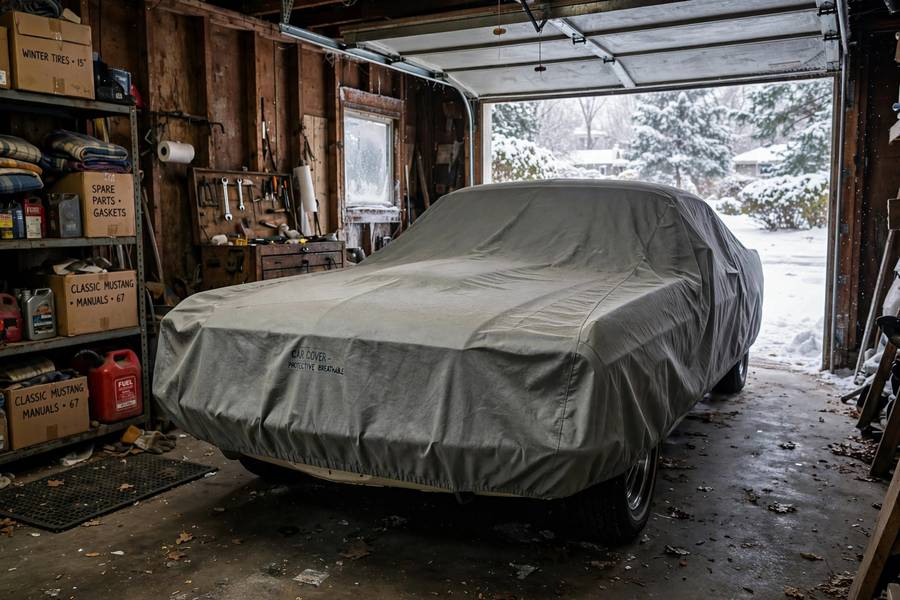
Cool, dry, and stable — that’s the target. A cool basement or insulated garage (40-60°F ideal) beats a hot attic or sun-baked shed. Cool temperatures slow self-discharge dramatically: a battery at 40°F self-discharges roughly half as fast as one at 80°F. Cold doesn’t damage a charged battery (only a discharged one’s electrolyte can freeze), so don’t fear cool storage — embrace it.
The surface: concrete is fine (the old myth about concrete draining batteries is just that — a myth from the era of porous rubber cases; modern polypropylene cases don’t care). But put it on wood or a shelf anyway — easier to keep clean, and it keeps the battery out of any floor moisture. Keep it upright, terminals covered or protected, away from anything metal that could bridge them.
What to avoid: freezing locations if the battery isn’t fully charged (discharged electrolyte freezes around -20°F to +20°F depending on charge state; fully charged electrolyte freezes around -70°F — another reason for the full charge). Damp locations (corrosion accelerator). Anywhere with temperature swings (condensation forms, corrosion follows). And anywhere inaccessible — if you can’t easily check it monthly, you won’t.
Step 4: The Maintainer (Your Best Investment)
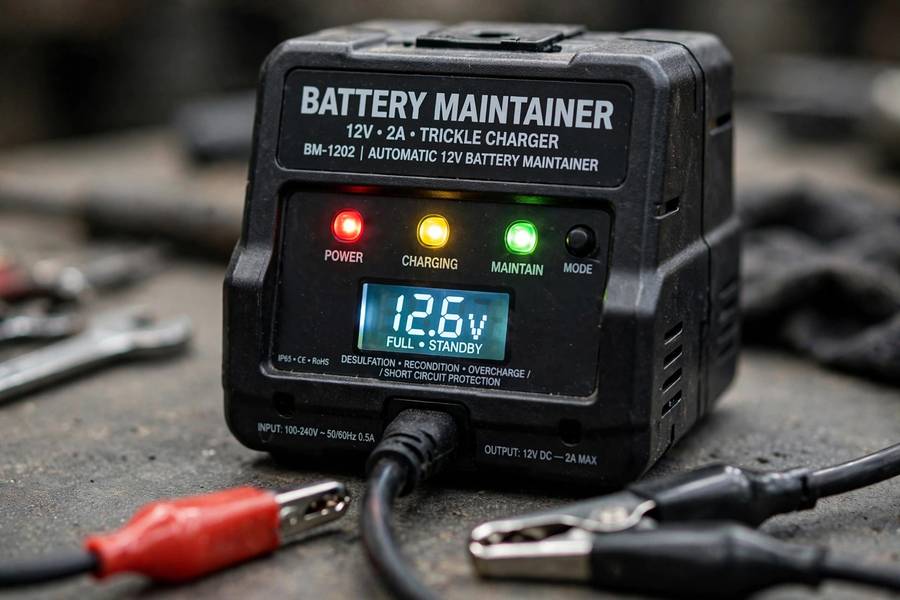
A battery maintainer (trickle charger, $35-$60) is the definitive answer to long-term storage. It monitors voltage and delivers tiny maintenance charges as needed, holding the battery at full charge indefinitely without overcharging. Connect it, plug it in, forget about it until spring. This single device eliminates both killers — no discharge, no sulfation.
What to buy: a smart maintainer (not a dumb trickle charger — dumb ones can overcharge over months). 1-2 amps is plenty for maintenance. Get one with AGM compatibility if your battery is AGM. Name-brand maintainers (Battery Tender, NOCO, CTEK) are all solid; the $40 tier is the sweet spot. Avoid the $15 no-name units — I’ve seen them fail in ways that cooked batteries.
Connection: most maintainers come with both alligator clamps and ring terminals. For seasonal storage, the ring terminals are better — bolt them to the battery posts once, route the quick-disconnect plug somewhere accessible, and connecting/disconnecting takes two seconds all winter. If the battery stays in the vehicle, connect the maintainer the same way (positive to positive, negative to chassis ground or negative terminal).
No maintainer? The manual alternative: charge the battery fully every 4-6 weeks during storage. It works — it’s what everyone did before maintainers existed — but it requires discipline, and discipline is what storage defeats. The maintainer costs less than one replacement battery. Buy the maintainer.
Storing the Battery in the Vehicle vs Removed
In the vehicle: simpler, and with a maintainer connected it’s perfectly fine. Disconnect the negative terminal if you’re not using a maintainer — this eliminates parasitic drain from the car’s modules (25-50mA normal draw will kill a battery in 4-8 weeks). Note: disconnecting may reset radio presets, clock, and some learned parameters — annoying but harmless. Some vehicles (BMW, Mercedes) prefer you don’t leave them disconnected for months — check the manual.
Removed: better for harsh environments (unheated garage in extreme cold, or hot shed in summer) since you control the location. Also better if the vehicle is stored somewhere without power for a maintainer. The procedure: disconnect negative first, then positive, remove hold-down, lift out (they’re heavy — 30-50 lbs), clean, charge, store as above.
My default recommendation: battery in the vehicle, negative terminal disconnected OR maintainer connected (maintainer preferred). Removal only when the storage location is bad or there’s no power. The less handling, the fewer chances to drop a 40-pound acid box on your foot.
One caution for modern cars: some vehicles don’t like sitting with a dead or disconnected battery for months — modules can lose adaptations, and a few need specific wake-up procedures. A maintainer avoids all of this by keeping the battery (and thus the car’s memory) alive. Yet another point for the $40 device.
How Long Can a Battery Sit Without Attention?
With a maintainer: indefinitely — years, genuinely. The maintainer holds full charge, sulfation never starts, the battery ages only by calendar. I’ve seen batteries on maintainers last 8+ years, double their normal life.
Without a maintainer, disconnected, fully charged, cool location: 3-4 months before voltage drops into the sulfation danger zone (below ~12.4V). Check monthly with a voltmeter if you have one; recharge when it hits 12.4V. In warm locations, halve those times — heat accelerates self-discharge.
Without a maintainer, connected in the vehicle: 4-8 weeks before parasitic drain plus self-discharge kills it. This is the “parked it for winter, dead by January” scenario. Don’t do this. Either disconnect or maintain.
The point of no return: a battery left below 12.0V for months has likely sulfated beyond recovery. A smart charger with a recondition/desulfation mode might recover some capacity — worth one attempt on a quality battery — but set expectations low. Prevention (maintainer, monthly charging) beats resurrection every time.
Bringing a Stored Battery Back Into Service
Spring awakening procedure: disconnect the maintainer, check resting voltage (12.6V+ expected — if it’s significantly lower despite the maintainer, the maintainer or battery has an issue). Inspect: terminals clean? Case intact? Any swelling or leaks developed over winter? (Rare with a maintainer, but check.) If the battery was stored disconnected without maintenance charging, give it a full charge before installation — don’t just drop it in and crank.
Reinstall (if removed): clean the tray, set the battery in, secure the hold-down, connect positive first then negative, tug-test. Start the car and verify charging voltage (13.7-14.7V). Then — and this is the step people skip — get a load test at the parts store. It’s free, it takes five minutes, and it tells you whether the battery actually survived storage or just looks alive. A battery that passes a load test after storage is good for the season. One that doesn’t… well, better to learn it in the parts store parking lot than on the road.
First drive: 30+ minutes to ensure full charge and let the car’s systems relearn (idle may be rough for a few minutes after a long disconnect — normal). Check for warning lights; most clear themselves after a drive cycle or two. And if the stored battery won’t crank at all despite your best efforts, don’t force it — a proper jump start gets you to the parts store for a load test without straining the starter on a dead battery.

Frequently Asked Questions
Fully charge it, clean terminals and case, store in a cool dry place (40-60°F ideal), and connect a smart battery maintainer ($35-$60) — it holds full charge indefinitely and prevents sulfation. Without a maintainer, disconnect the negative terminal and recharge every 4-6 weeks.
If you’re not using a maintainer, yes — disconnect the negative terminal to eliminate parasitic drain (25-50mA), which kills a battery in 4-8 weeks. With a maintainer connected, leave everything hooked up. Note that disconnecting resets radio presets and clock on most cars.
With a modern smart maintainer, yes — they’re designed for indefinite connection and won’t overcharge. Don’t leave an old manual trickle charger on indefinitely; unregulated chargers can overcharge over months. The $40 smart maintainer is the right tool for storage.
On a maintainer: years. Disconnected, fully charged, in cool storage: 3-4 months before needing a recharge (check monthly, recharge at 12.4V). Connected in a parked car: only 4-8 weeks before parasitic drain kills it. Below 12.0V for months usually means permanent sulfation damage.
Yes — the “concrete drains batteries” myth dates to porous rubber battery cases from decades ago. Modern polypropylene cases are unaffected by concrete. Store upright on any clean, dry surface; wood shelving is convenient but concrete is perfectly fine.