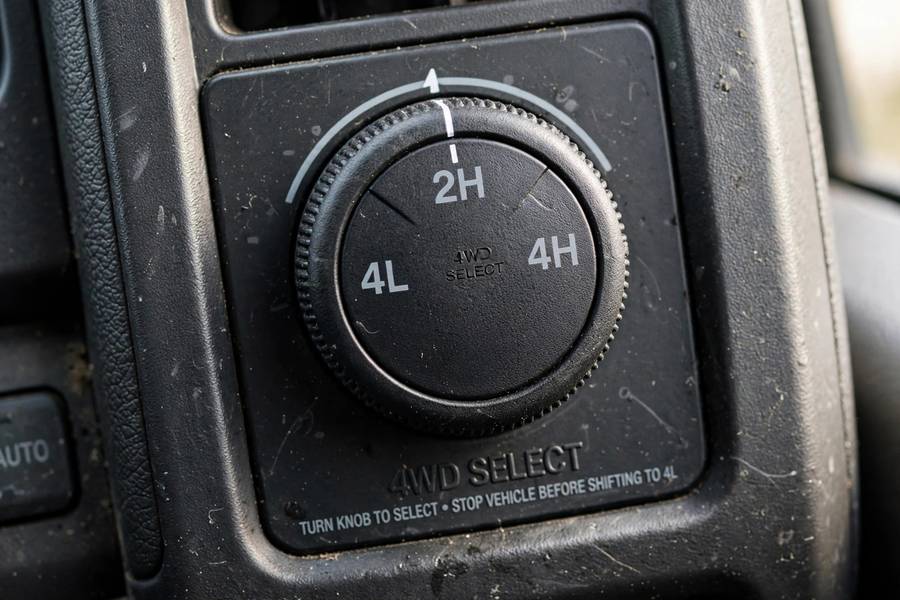
That little dial or lever with 4H and 4L on it might be the most misunderstood control in your truck. I’ve watched owners use 4WD Low on the highway (terrifying), use 4WD High for rock crawling (useless), and — my personal favorite — drive for months without knowing Low existed. The two modes do completely different jobs, and using the wrong one ranges from ineffective to expensive. Here’s exactly what each does, when each is correct, and how to shift between them without hurting anything. The wider drivetrain context is in my AWD vs 4WD guide.
Table of Contents
- What 4WD High Actually Does
- What 4WD Low Actually Does
- The Gear Math: Why Low Range Multiplies Torque
- When to Use 4WD High
- When to Use 4WD Low
- When to Use Neither
- How to Shift Between Them Correctly
- Mistakes That Break Transfer Cases
- Frequently Asked Questions
What 4WD High Actually Does
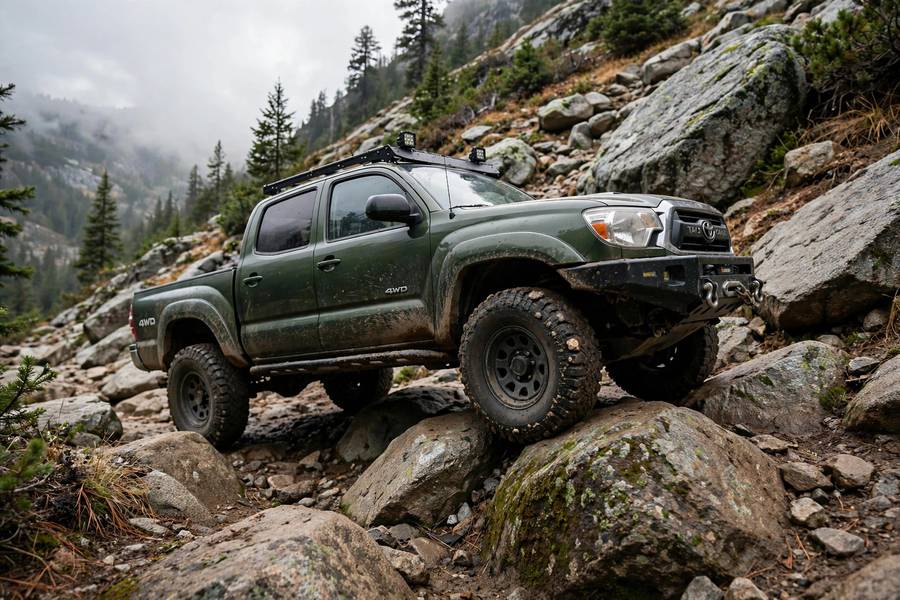
4WD High is the 1:1 mode. Power flows from the transmission through the transfer case with no gear reduction — what goes in comes out at the same speed — and the transfer case locks the front and rear driveshafts together for a fixed 50/50 torque split. Both axles turn at identical speeds. That’s it. No multiplication, no magic, just all four wheels pulling together at normal road speeds.
Think of 4H as “4WD for going places.” It’s the mode for snowy roads, muddy trails, sandy tracks, and gravel — any situation where you want maximum traction at normal driving speeds. You can shift into 4H on the fly (typically up to 45-55 mph depending on the truck) because there’s no gear meshing drama: the transfer case just engages the front output shaft and locks it to the rear.
The limitation of 4H is that it’s still geared like a road vehicle. First gear in 4H gives you the same crawl speed as first gear in 2WD — fine for momentum-based driving, useless for inching over a boulder. When the obstacle requires slow, the answer isn’t 4H with more throttle. It’s 4L.
What 4WD Low Actually Does
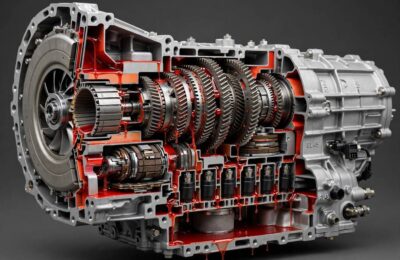
4WD Low routes power through a reduction gear set inside the transfer case before it reaches the driveshafts. Typical reduction ratios run from about 2.5:1 to 4:1 — meaning the driveshafts turn once for every 2.5 to 4 turns of the transmission output. The axles stay locked together 50/50, same as 4H. The only change is the gearing.
The effect is dramatic: your truck now crawls at walking pace with the engine barely above idle, yet each wheel receives two-and-a-half to four times the torque it would get in 4H at the same engine speed. Top speed in 4L is roughly 25 to 30 mph — the engine simply runs out of revs. This is not a driving mode. It’s a working mode.
Think of 4L as “4WD for working through things.” Rock crawling, deep mud, steep grades up or down, pulling a stuck vehicle, maneuvering a heavy trailer into a tight spot — anywhere you need maximum control at minimum speed. The reduction gearing also gives you ferocious engine braking on descents: in 4L first gear, you can walk down grades that would have you riding the brakes (and fading them) in 4H.
The Gear Math: Why Low Range Multiplies Torque
Gears trade speed for torque, always. Here’s a concrete example with typical numbers. Say your truck’s first gear ratio is 4:1, the axle ratio is 3.73:1, and the transfer case low range is 2.7:1. Total torque multiplication in 4L first gear: 4 × 3.73 × 2.7 = roughly 40:1. The engine’s torque — say 400 lb-ft — becomes about 16,000 lb-ft at the axles (before drivetrain losses). In 4H first gear, the same math without the transfer case reduction gives about 15:1, or 6,000 lb-ft.
That’s why 4L feels like a different vehicle. You’re commanding nearly triple the twisting force at the wheels while moving at a third of the speed. It’s also why 4L on a high-traction surface is so destructive: that multiplied torque has to go somewhere, and if the tires can’t slip, it goes into the U-joints, axle shafts, and transfer case gears. The system’s strength and its danger are the same number.
When to Use 4WD High
Use 4H whenever the surface is consistently slippery and you’re driving at normal speeds. Snow-covered roads: 4H. Muddy trails and two-tracks: 4H. Sandy tracks and beach driving: 4H (with aired-down tires). Gravel and loose dirt roads: 4H. Light off-roading where momentum is your friend: 4H.
Engage 4H before you need it, not after you’re stuck — shifting on the fly works, but engaging mid-crisis while wheels are spinning wildly is harder on the hardware. And disengage when conditions improve: the moment you’re back on consistently grippy pavement, shift back to 2H. The drivers who damage transfer cases aren’t the ones who use 4H — they’re the ones who forget to stop using it.
One nuance: 4H on partially cleared winter roads with dry patches is a judgment call. Brief dry patches between snowy sections are generally fine — the tires slip microscopically and release small amounts of bind. But if the road is mostly dry with occasional snow, you’re better in 2WD (or 4WD Auto if equipped) than in locked 4H.
When to Use 4WD Low
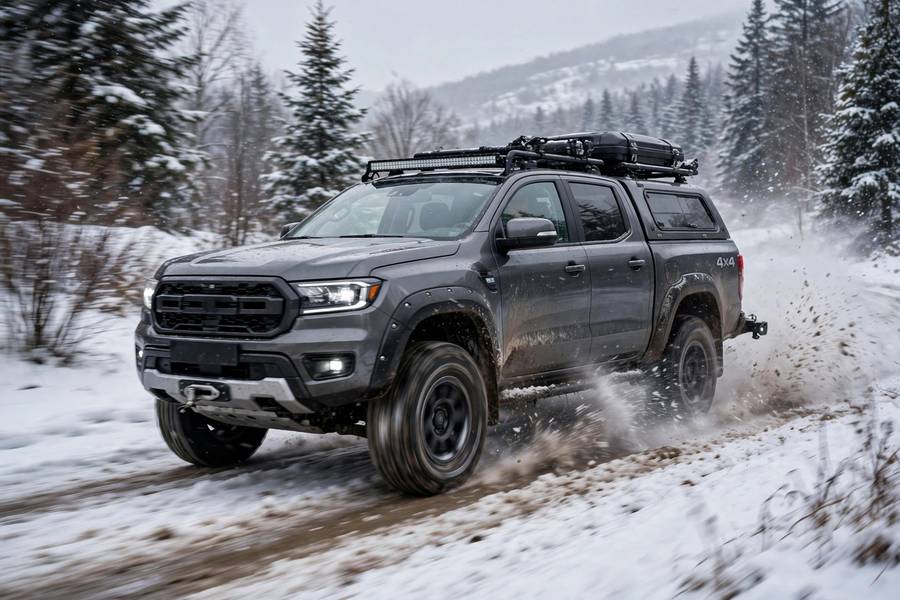
Use 4L when speed must be low and torque must be high. Rock crawling: 4L, first or second gear, idle doing most of the work. Steep ascents where wheelspin would be disastrous: 4L. Steep descents where you want engine braking to control speed: 4L, first gear, feet off both pedals. Deep mud and soft sand at crawling pace: 4L. Pulling another vehicle out: 4L. Backing a heavy trailer up a grade or into a tight spot: 4L — the gearing gives you precise low-speed control that saves clutches and tempers.
The pattern: 4L is for obstacles, not journeys. You engage it for the rock garden, the steep grade, the stuck truck — then shift back to 4H (or 2H) when the obstacle is behind you. Nobody “drives” in 4L. You work in 4L, then you drive again.
A special case worth knowing: some situations want 4L’s gearing without maximum traction — like maneuvering a trailer on dry pavement. Don’t do it. Locked 4L on pavement binds just like locked 4H, only with multiplied torque making the damage worse. If you need low-speed precision on pavement, that’s what your transmission’s low gears are for.
AWD vehicles handle low-traction situations with no low range at all — what all-wheel drive is shows the other approach to the same problem.
When to Use Neither
2H — plain two-wheel drive — is the correct mode more often than 4WD owners admit. Dry pavement: 2H, always. Wet pavement: 2H (your tires and stability control handle rain; locked 4WD adds nothing on wet asphalt and can bind). Highway driving in any conditions short of actual snow cover: 2H. Towing on dry highways: 2H — the trailer’s weight is on the rear axle anyway, and locked 4WD on dry interstate is pure drivetrain wear for zero benefit.
There’s a macho tendency to run 4H “just in case,” and it’s pure cost with no benefit. In 2H, your front drivetrain is disconnected and idle — less wear, less drag, better fuel economy (typically 1-2 mpg better than locked 4WD). The front axle components will thank you with a longer life. Save the 4WD for surfaces that actually need it; that’s what it’s for.
How to Shift Between Them Correctly
Shifting into 4H: most modern trucks allow shift-on-the-fly — just turn the dial or move the lever while driving straight at moderate speed (under 45-55 mph; check your manual). Straight matters: shifting mid-turn with wheels at different speeds makes engagement harsher. You’ll feel or hear a clunk as the front axle engages. That’s normal.
Shifting into 4L: stop the truck completely. Shift the transmission to neutral. Foot firmly on the brake. Then select 4L. The transfer case needs the driveline unloaded to mesh the reduction gears — trying to force it while moving or in gear is how shift forks get bent. You’ll hear a more substantial clunk; again, normal. Some trucks want you rolling at 1-3 mph in neutral rather than fully stopped — your owner’s manual specifies which, and it’s worth reading once.
Shifting out of 4L: same procedure in reverse — stopped, neutral, brake, select 4H or 2H. If the transfer case resists coming out of 4L (bound gears), drive straight slowly for a few feet or reverse straight briefly to unload it, then try again. Never force the lever. The shift fork inside is a $30 part that requires a $1,500 teardown to replace.
Mistakes That Break Transfer Cases
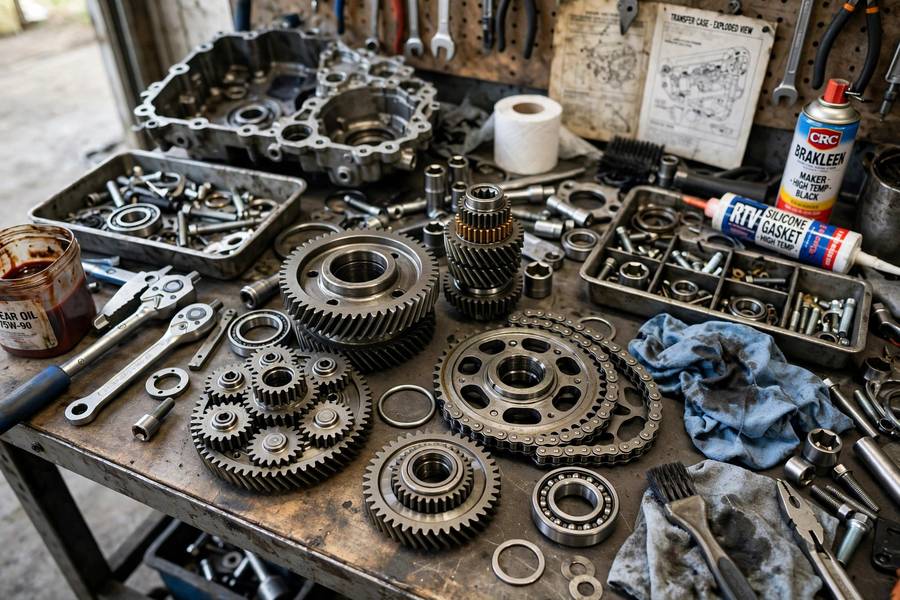
The hall of fame, from my repair bay: engaging 4L at speed — the reduction gears try to mesh at incompatible speeds and something surrenders, usually teeth. Running 4L on pavement — multiplied torque plus binding equals broken internals. Forcing a stuck shifter — bent shift fork, as above. Towing a part-time 4WD truck with the transfer case in neutral and the transmission in park but the front hubs locked — flat-towing mistakes have destroyed more transfer cases than all off-roading combined; follow the manual’s recreational towing procedure exactly.
And the quiet killer: never using 4L at all. The shift motor, actuator, and seals sit idle for years, then seize. When you finally need low range in an emergency, it won’t engage. Exercise 4L for a few minutes every couple of months on a loose surface — gravel driveway, grass field, dirt lot. It costs nothing and it’s the difference between a system that works and a dashboard light that just blinks at you.
Frequently Asked Questions
4WD High is a direct 1:1 locked mode for slippery surfaces at normal speeds. 4WD Low adds a gear reduction (typically 2.5:1 to 4:1) that multiplies torque 2.5-4x while limiting speed to about 25-30 mph — used for crawling, steep grades, and extreme traction situations.
Use 4WD Low for rock crawling, steep ascents and descents, deep mud, pulling a stuck vehicle, and maneuvering heavy trailers at low speed. Engage it stopped, in neutral, with your foot on the brake — and shift back out once the obstacle is behind you.
No. 4WD Low tops out around 25-30 mph because the reduction gearing runs the engine out of revs. Driving faster over-revs the engine and stresses the transfer case. 4WD Low is a working mode for obstacles, not a driving mode for distance.
No — stop completely, shift the transmission to neutral, keep your foot on the brake, then select 4WD Low. The reduction gears need an unloaded driveline to mesh. (Some trucks specify rolling at 1-3 mph in neutral — check your owner’s manual.) Forcing the shift while moving can break the shift fork or gear teeth.
4WD Low is perfectly safe on slippery, low-traction surfaces — it’s what the system was built for. It becomes destructive on dry pavement, where the multiplied torque plus the locked axles create extreme binding forces. Use 4L for obstacles on loose surfaces, then shift back out.