Google has survived every “Google killer” for 25 years — vertical search, social search, voice search, each heralded as the end, each absorbed or outlasted. AI search feels different, though. It’s the first challenger that attacks the core interaction (type keywords, get links) rather than the edges. The question isn’t just “which is better” but whether the fundamental model of search is changing — and what Google’s response reveals about the answer.
This guide compares them honestly: where each wins, Google’s counter-moves, and what the endgame looks like. For the mechanics, see what AI search is and how a search engine works.
Table of Contents
- Why This Challenger Is Different
- Where AI Search Beats Google
- Where Google Still Wins
- Google’s Response: Adapt or Die
- The Business Model Problem
- The Data Moat Question
- User Behavior: What’s Actually Changing
- Scenarios: How This Plays Out
- What Most Comparisons Miss: The Publisher Economy
- A Practical Decision Framework: Which Tool, Which Question
- Frequently Asked Questions
Why This Challenger Is Different
Previous Google challengers attacked features; AI search attacks the paradigm:
Vertical search (Yelp, Amazon) took specific categories — Google remained the starting point.
Social search (TikTok, Reddit) took discovery for some demographics — Google remained the utility.
Voice search changed the interface — Google adapted (Assistant) and continued.
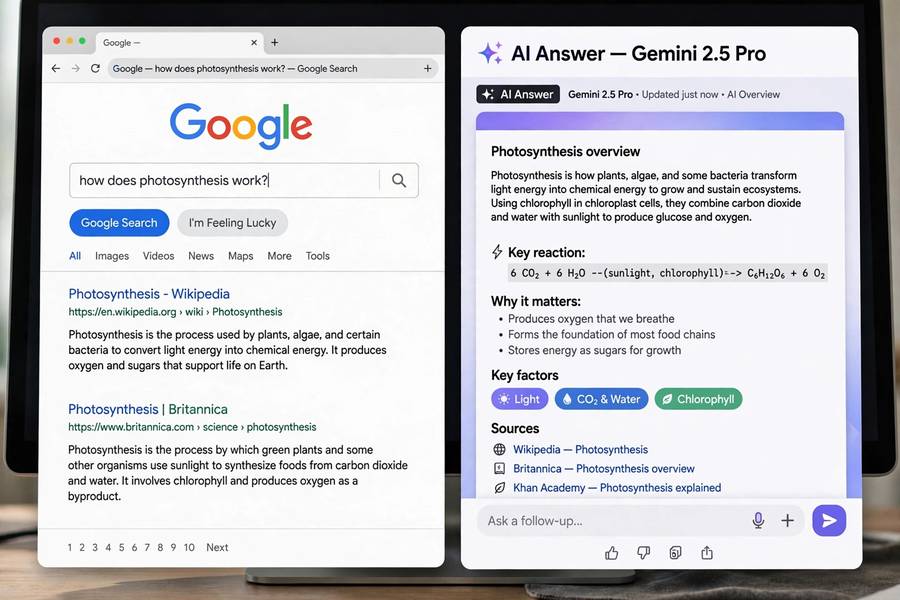
AI search changes the deal itself: instead of “we’ll find documents, you do the work,” it’s “we’ll do the work, here’s the answer.” That’s not a feature — it’s a redefinition of what search IS. If users prefer answers to link lists, Google’s core interaction is obsolete regardless of how good the links are.
That’s why this feels existential in a way previous challenges didn’t. It’s also why Google’s response matters more than the challengers’ products — the king’s adaptation determines the kingdom’s future.
Where AI Search Beats Google
Complex questions. Multi-part, nuanced, comparative — AI search synthesizes; Google makes you synthesize. The gap widens with question complexity.
Conversational refinement. Follow-ups with context (“what about cheaper options?”) — natural in AI search, restart-from-scratch in Google.
Explanations. “Explain like I’m five” — pedagogy is AI’s home turf. Google gives you pages to learn from; AI search teaches directly.
Zero-click satisfaction. The answer, not the hunt. For the large fraction of queries wanting quick answers, this is strictly better UX.
Natural language. Ask like a human, not a keyword robot. The interaction feels like the future — because it is.
The generational signal: younger users, less attached to the link-list ritual, adopt AI search faster. Habits formed now persist — this is the long-term threat, measured in decades.
Where Google Still Wins
Index breadth and depth. Decades of crawling — the most comprehensive web index ever built. Obscure topics, deep pages, the long tail: Google finds what others miss.
Real-time. Breaking news, live events, minutes-old content — Google’s crawling infrastructure is unmatched. AI search retrieval often lags.
Local and vertical. Maps, shopping, flights — Google’s integrated verticals are deeply entrenched and genuinely useful. AI search doesn’t compete here (yet).
Verification transparency. Links you can check, sources you can evaluate. For high-stakes accuracy, this matters enormously.
Habit and default. Billions of users, default placement everywhere, muscle memory. The most underrated moat in tech — behavior change is slow and hard.
The ecosystem. Gmail, Android, Chrome — search embedded in a life, not just a website. Challengers compete with a product; Google competes with an environment.
Google’s Response: Adapt or Die
Google isn’t standing still — its response has been swift and revealing:
AI Overviews. Generated answers atop traditional results — the hybrid: AI synthesis WITH the link list below. Arguably the best of both worlds, and a direct answer to the challenger.
Conversational modes. Deeper AI interaction within search — follow-ups, refinement, the conversational patterns AI search pioneered.
The Gemini integration. Google’s AI models powering search features — leveraging their AI capabilities (which are formidable) within the search product.
What the response reveals: Google believes the answer is “both” — AI synthesis plus traditional results. It’s a strong position: why choose when you can have the AI brief AND verify with links? If executed well, it’s the hardest configuration for pure AI search to beat.
The execution risk: incumbents often fumble paradigm shifts (see: every tech transition ever). Google’s AI capabilities are real, but organizational antibodies — the ad business, the link ecosystem relationships — complicate bold moves.
The Business Model Problem
The elephant in the room: search makes money from clicks (ads on results pages). AI search reduces clicks (answers instead of links). This is the innovator’s dilemma in pure form:
For challengers: how do answer engines make money? Subscriptions (limits scale), ads in answers (unproven, potentially trust-destroying), enterprise (the likely answer). The business model is genuinely unsolved — which is why many AI search products are venture-subsidized experiments.
For Google: AI answers cannibalize the ad inventory. Every query answered without clicks is revenue forgone. Google must navigate giving users what they want (answers) while preserving what pays (clicks). The tension is structural.
Whoever solves the business model of AI search at scale wins the long game. Technology without economics is a demo; economics without technology is stagnation. Watch the money, not just the models.

The Data Moat Question
A crucial and under-discussed dimension: data.
Google’s data advantages: decades of click behavior (what users actually wanted), query logs at planetary scale, the freshest index, integration data across products. This data trains better retrieval and ranking — a compounding advantage.
Challengers’ data position: starting from less, but AI search needs different data (synthesis quality feedback, answer satisfaction) where the playing field is more level.
The feedback loop: more users → more interaction data → better product → more users. Google’s loop is decades deep. Challengers must bootstrap theirs — possible (ChatGPT did it for chat), but hard.
The open question: does the AI search paradigm need Google’s specific data advantages, or does it route around them? If synthesis quality depends more on model capability than click data, the moat is shallower than it looks. If retrieval quality still rules, the moat holds.
User Behavior: What’s Actually Changing
What the data (and observation) suggests:
Query complexity is bifurcating. Simple queries still go to traditional search (fast, familiar). Complex questions increasingly go to AI. The middle is contested.
Younger users lead. The demographic gradient is real — AI-native expectations forming among users who never built link-list habits.
Verification behavior persists. Even AI search enthusiasts verify important claims traditionally — the transparency need doesn’t disappear.
Multimodal shift. Voice, image, video search growing — playing to different strengths than text link lists.
The “jobs” framing: users don’t want “search” or “AI search” — they want answers, learning, decisions, entertainment. The job determines the tool. Both paradigms will serve different jobs for a long time.
Scenarios: How This Plays Out
Scenario 1: Absorption (most likely). Google successfully integrates AI search, challengers get acquired or niche-ified. Search evolves; the king remains. Historical precedent favors this — Google absorbed every previous shift.
Scenario 2: Displacement. A challenger cracks the business model and user experience decisively; Google’s ad-business antibodies prevent adequate response. Search leadership changes hands. Rare historically, but AI’s paradigm depth makes it plausible.
Scenario 3: Fragmentation. No single winner — different tools for different jobs, users multi-home. Search unbundles into specialized answer engines, traditional verification, vertical tools. The “Google” concept dissolves into an ecosystem.
My read: Scenario 1 with elements of 3. Google’s adaptation is real and well-resourced; total displacement is hard against habit, defaults, and ecosystem. But the search experience of 2030 will look meaningfully different from 2020 — more AI synthesis, more conversation, less link-listing. The king adapts; the kingdom transforms.
What Most Comparisons Miss: The Publisher Economy
Every “AI search vs Google” debate has an invisible third party: publishers. Google’s original deal was simple — we index your content, we send you traffic, everyone eats. AI search breaks the deal: answers without clicks starve publishers of the traffic their business runs on.
Follow that to its conclusion and it gets uncomfortable. If publishers can’t monetize, quality content dries up. If quality content dries up, the retrieval layer every AI search product depends on degrades. The answer engine becomes a parasite that killed its host — brilliant synthesis of an increasingly thin web.
Google faces a version of this too: AI Overviews reduce clicks, which strains the same publisher relationships. But Google at least has decades of mutual dependence and an ad ecosystem publishers participate in. Pure answer engines mostly offer citations — a trickle of traffic against the flood they divert.
Whoever wins search has to solve the publisher problem — licensing, revenue sharing, something — or the victory is temporary. The content economy is the under-discussed variable that determines whether dethroning Google is even sustainable. Watch the money publishers get, not just the answers users get.
A Practical Decision Framework: Which Tool, Which Question
Enough theory — here’s how I actually route questions:
- Quick factual answer, low stakes → AI search. Speed wins.
- Complex explanation or comparison → AI search first, then verify the load-bearing claims traditionally.
- High-stakes decisions (money, health, legal) → traditional search and primary sources; AI only for orientation.
- Breaking news or very recent events → Google. The index lead is real.
- Learning something deeply → traditional. Read the sources yourself; the process is the point.
- Shopping, local, flights → Google’s verticals. No contest yet.
The meta-rule: the higher the stakes and the more the answer matters, the further you shift from AI synthesis toward traditional verification. Default to AI for speed; keep Google open in the next tab for truth. The sophisticated searcher in 2026 isn’t loyal to either — they’re fluent in both.

Frequently Asked Questions
Unlikely to fully replace — more likely Google absorbs AI search (it’s already doing so with AI Overviews) while the experience transforms. The paradigm (answers vs links) is genuinely shifting, but Google’s index, habits, defaults, and ecosystem are formidable moats. Expect evolution, not dethronement.
Better for complex questions, explanations, and quick answers — the synthesis advantage is real. Worse for verification, obscure topics, real-time info, and high-stakes accuracy where you must check sources. They’re different tools; the sophisticated approach uses both per task.
With AI Overviews (generated answers atop traditional results), conversational search modes, and Gemini integration. The strategy is “both” — AI synthesis plus the link list for verification. The execution risk is organizational: the ad business complicates bold moves toward fewer clicks.
Search makes money from clicks; AI search reduces clicks by answering directly. Challengers haven’t solved monetization at scale (subscriptions? ads in answers? enterprise?). Google faces the innovator’s dilemma: giving users answers cannibalizes ad inventory. Whoever solves the economics wins long-term.
Don’t switch — add. Use AI search for complex questions and quick answers, Google (or traditional search generally) for verification, obscure topics, and high-stakes accuracy. The tools are complements. Try AI search for a week on your real questions and let experience guide the mix.