
Machine learning courses are where AI education gets serious — and where beginners most often pick wrong. The gap between a great ML course and a mediocre one isn’t production quality or instructor charisma. It’s whether you emerge able to build and evaluate models yourself, or just able to recite what a random forest is at dinner parties. I’ve reviewed enough of these to know the difference is visible in the syllabus before you pay a cent.
This guide is about selection: the prerequisites you actually need, the course archetypes, how to match one to your level, and the traps specific to ML education. For the wider course landscape, see the best AI courses online.
Table of Contents
- What “Machine Learning Course” Means in 2026
- Prerequisites: What You Genuinely Need First
- The Three Course Archetypes
- Matching a Course to Your Level
- What Great ML Courses Have in Common
- ML-Specific Red Flags
- The Math Question, Answered Honestly
- After the Course: What Comes Next
- The Mistakes I See ML Learners Make
- Frequently Asked Questions
What “Machine Learning Course” Means in 2026
The term covers three different things now, and confusing them is the top selection error:
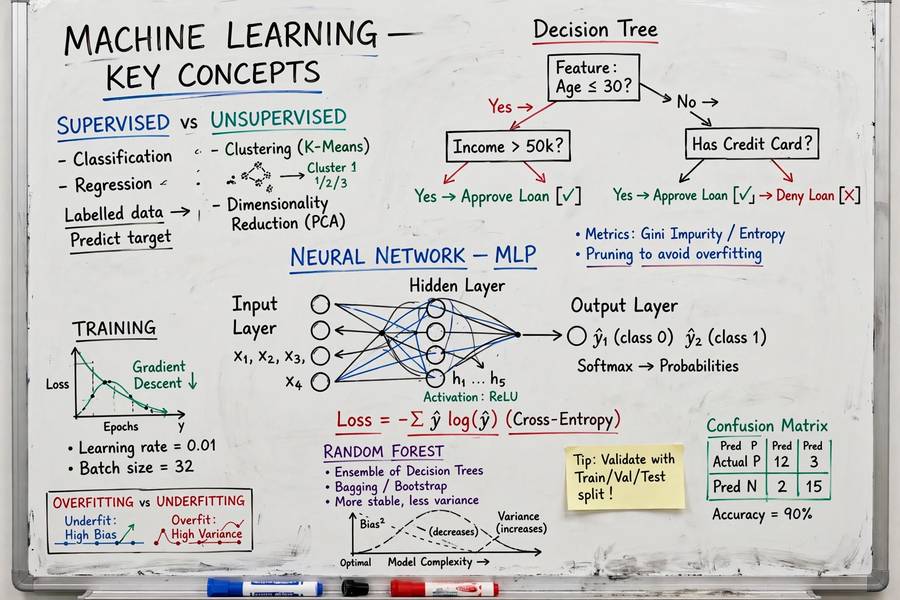
Classical ML — regression, classification, clustering, trees, SVMs, the scikit-learn universe. The foundation. Still what most “machine learning” jobs actually use day-to-day, and still the right starting point.
Deep learning — neural networks, CNNs, transformers, the PyTorch/TensorFlow world. Often sold as “machine learning courses” but really a second course. Powerful, math-heavier, and premature as a first step for most.
Applied ML / MLOps — taking models to production: deployment, monitoring, pipelines. A third course, really — valuable, but not where you start.
When a course says “machine learning,” check which of these it teaches. A beginner wanting foundations who enrolls in a deep-learning-first course will drown in week three. The honest courses state their scope plainly; the marketing-driven ones blur it.
Prerequisites: What You Genuinely Need First
The real prerequisites, no sugarcoating:
Python: yes, actually. Not “we’ll teach you Python in week one” — that’s a lie that wastes your time and the instructor’s. You need to be comfortable writing basic Python: loops, functions, data structures, maybe pandas. If you’re not there, spend a month on Python first. Every hour invested here saves three later.
Math: some, not all. You need intuitive comfort with: basic statistics (mean, variance, distributions), linear algebra concepts (vectors, matrices — intuition over computation), and calculus concepts (what a derivative means — not computing them by hand). You do NOT need to be a mathematician. The best courses teach math as needed, with intuition first.
Curiosity about data. The underrated prerequisite. ML is applied statistics on data — if working with datasets bores you, the field will bore you. Try a small data project first; your reaction is diagnostic.
Anyone telling you “no prerequisites needed” for a real ML course is selling enrollment. The prerequisites aren’t gatekeeping — they’re the difference between learning and suffering.
The Three Course Archetypes
University-style (theory-first). Lecture-heavy, math-grounded, rigorous. Think famous Stanford-style courses. Produce the deepest understanding; demand the most background. Best for: people who want foundations that last decades, career changers with strong math.
Project-based (build-first). Learn by building models for real datasets from day one, theory filled in as needed. Faster to practical capability; sometimes thinner on why things work. Best for: developers who learn by doing, people targeting applied roles quickly.
Specialization sequences. Multi-course series from platforms — structured paths with credentials. The middle ground: more guided than self-study, more practical than pure theory. Quality varies enormously by provider; the good ones are excellent, the bad ones are expensive YouTube playlists.
None is universally best. Theory-first builds the deepest foundation but has the highest dropout rate. Build-first gets you productive fastest but can leave conceptual gaps that bite later. Know yourself: do you quit when bored (choose build-first) or when confused (choose theory-first with support)?
Matching a Course to Your Level
True beginner (knows Python, no ML): classical ML course, project-based or specialization. Goal: train, evaluate, and tune models on real datasets. Timeline: 2–4 months.
Intermediate (built some models): deep learning course or applied specialization. Goal: neural networks, transformers, modern architectures. Timeline: 3–6 months.
Advanced (comfortable with deep learning): specialized topics — NLP, vision, reinforcement learning, MLOps — or research-oriented material. Goal: depth in a lane.
The most common error is skipping a level. Someone who built one tutorial model enrolls in an advanced transformers course and hits a wall. Each level’s intuition compounds — respect the sequence. And if you’re unsure whether to start with classical ML or jump to deep learning, my comparison of machine learning vs deep learning settles it.

What Great ML Courses Have in Common
Real datasets, messy ones. Toy datasets (iris flowers, Titanic) teach mechanics; messy real datasets teach judgment. Great courses graduate you to the mess.
Evaluation rigor. The difference between amateurs and practitioners is evaluation: train/test splits, cross-validation, the right metrics for the problem, knowing when your model is lying to you. Courses that drill this produce competent people.
Failure included. The best courses show what goes wrong — overfitting, leakage, bad features — not just the happy path. Debugging models is most of the real job.
Math with intuition. Formulas accompanied by “here’s what this means geometrically” beat formula dumps. The intuition is what you retain; the formulas you can look up.
A capstone. A substantial end-to-end project — your data, your model, your evaluation. This becomes portfolio piece number one, which matters more than any certificate.
ML-Specific Red Flags
“No math required.” For a real ML course, this means “we skipped the parts that make you competent.” Intuition-first math is fine; math-free is a warning.
Only toy datasets. If the whole course runs on iris and MNIST, you’ll graduate unprepared for real data’s chaos.
No model evaluation depth. A course that trains models without rigorous validation teaches you to build things that don’t work reliably. This is the most dangerous gap.
Framework-only. “Learn scikit-learn” without concepts produces tool operators, not practitioners. Tools change; concepts persist.
Outdated content. Pre-2020 courses miss the transformer era’s practical impact. The fundamentals are timeless, but the applied context should be current.
Certificate as the selling point. Certificates from good courses have some signal value; certificates as the primary pitch usually indicate thin content underneath.
The Math Question, Answered Honestly
“How much math do I need?” — the eternal question. The honest answer has layers:
To start: high-school math plus basic statistics intuition. That’s genuinely enough for a good beginner course that teaches math as needed.
To get good: comfort with linear algebra and calculus concepts (not computation — understanding). This develops during the course if it’s taught well.
To go deep (research, novel architectures): real mathematical maturity. But that’s a later decision, not a prerequisite.
The trap is treating math as a gate to clear before starting. It’s not — it’s a companion you develop alongside. Start the course; let the math come as needed. The people who wait until they “know enough math” usually never start. Understanding how AI models are trained at an intuitive level is the right initial target — the equations can wait.
After the Course: What Comes Next
A course is a beginning, not an end. The post-course plan:
- Portfolio projects (2–3, end-to-end, on data you care about). This is what gets interviews, not certificates.
- Kaggle or equivalent. Structured practice with real problems and community solutions to study.
- Specialize. Pick a lane — NLP, vision, tabular, MLOps — and go deep.
- Read papers (gradually). Start with distillations and blog explanations; work up to originals.
- Build in public. Write about what you learn. Teaching cements knowledge and signals competence simultaneously.
The course gives you the map. The territory is learned by walking it — projects, failures, debugging sessions at midnight. Everyone competent went through that phase; there’s no shortcut around it, only through it.
The Mistakes I See ML Learners Make
After years of watching people learn machine learning, the failure modes are depressingly consistent:
Tutorial hell. Completing course after course, each ending with a guided notebook, never building anything alone. You feel productive; you’ve learned to follow instructions. The cure is ugly: close the tutorial, open a blank notebook, pick a dataset you care about, and struggle. That’s where the learning actually happens.
Skipping evaluation. Beginners obsess over algorithms and ignore validation — then wonder why their “95% accurate” model fails on new data. The unsexy parts (train/test splits, cross-validation, choosing the right metric) are what separate practitioners from hobbyists. If your course glosses over them, supplement it yourself.
Math avoidance or math worship. Two opposite traps: skipping all math (you’ll never debug anything) or studying math for a year before touching ML (you’ll never start). The middle path — learning math as the course demands it, intuition first — is the only one that works.
Dataset monogamy. Training exclusively on clean tutorial datasets, then being shocked by real data’s mess. Graduate to messy data as fast as you can — Kaggle competitions are the standard prescription for a reason.
No public record. Learning in private, building nothing visible. Two public projects beat ten private notebooks for both learning depth and career value. The accountability of an audience improves the work.
Frequently Asked Questions
A classical ML course (not deep-learning-first) that matches your learning style — project-based if you learn by doing, theory-first if you want deep foundations. Ensure you know basic Python first; “no prerequisites” claims for real ML courses are misleading.
You need math intuition (statistics, linear algebra and calculus concepts), not computational fluency. Good courses teach math as needed. Don’t wait until you “know enough math” — start and let it develop alongside. Deep comfort comes with practice, not prerequisites.
Classical ML first. It’s the foundation most real jobs use daily, it teaches evaluation rigor and judgment, and deep learning makes far more sense once you understand the basics. Jumping straight to deep learning skips the conceptual base.
With basic Python and a few hours weekly: 2–4 months for classical ML foundations, 3–6 more for deep learning, 12–24 months total to job-ready with portfolio projects. Certificates alone don’t get jobs — projects do.
Mildly — they signal completion and structure, but employers hire for demonstrated capability. A portfolio of 2–3 end-to-end projects outweighs any certificate. Treat certificates as a bonus, not the goal.