
In 1950, Alan Turing proposed a deceptively simple test for machine intelligence: if a human chatting with an unseen partner can’t tell whether it’s a person or a machine, the machine can be said to think. Seventy-five years later, we’re still arguing about his test — partly because machines keep getting better at passing it, and partly because nobody agrees on what passing it proves.
The Turing test’s history is really the history of AI’s ambitions and anxieties. Every era has reinterpreted it, tried to pass it, tried to break it, or tried to replace it. Let me trace that story. For the broader timeline it belongs to, see my history of artificial intelligence.
In This Guide
- 1950: The Imitation Game Is Proposed
- How the Test Actually Works
- 1960s: ELIZA Fools People by Accident
- 1991: The Loebner Prize Begins
- 2014: Eugene Goostman “Passes” (Sort Of)
- The Critics: Searle’s Chinese Room
- The ChatGPT Era: Does Passing Still Matter?
- What Comes After the Turing Test
- Frequently Asked Questions
1950: The Imitation Game Is Proposed
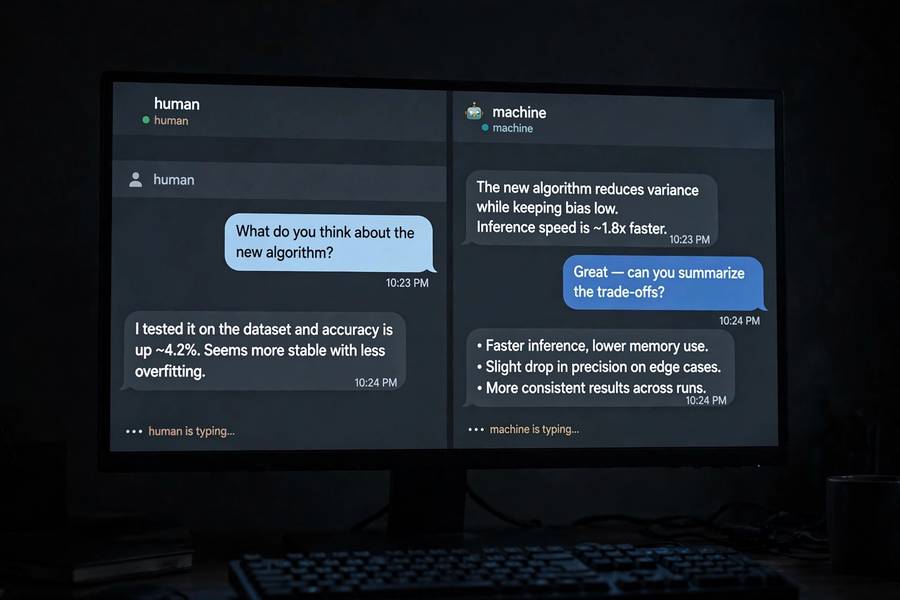
Turing’s paper “Computing Machinery and Intelligence” opened with a provocation: instead of debating “can machines think?” — a question he considered too vague — he proposed replacing it with a concrete game.
The setup: a human judge converses via text (teletype, in Turing’s day) with two hidden participants — one human, one machine. If the judge can’t reliably tell which is which, the machine passes. Turing predicted that by the year 2000, machines would fool judges 30% of the time after five minutes of questioning.
What made the proposal brilliant was its pragmatism. Turing sidestepped philosophy of mind entirely: don’t argue about consciousness, just test the behavior. It’s an operational definition — intelligence is as intelligence does. That move shaped AI research for decades.
It’s worth noting what Turing did not claim: he never said passing the test equals thinking, feeling, or being conscious. He said it would be a reasonable point to start taking machine intelligence seriously. The distinction got lost almost immediately.
How the Test Actually Works
The classic formulation has three roles:
- The interrogator — a human judge asking questions via text
- Participant A — a human, trying to convince the judge they’re human
- Participant B — the machine, trying to convince the judge it’s human
The machine’s goal isn’t to be helpful or correct — it’s to imitate. This is a crucial and often misunderstood point. A machine that answers math questions perfectly would fail, because humans make arithmetic errors. The best Turing test strategies involve deliberate mistakes, hesitations, and personality quirks.
Turing’s original version was actually a gendered parlor game (a man pretending to be a woman), adapted for the human-vs-machine question. The details have been simplified over time, but the core idea — indistinguishability through conversation — remains.
1960s: ELIZA Fools People by Accident
In 1966, Joseph Weizenbaum at MIT built ELIZA — a simple program that mimicked a Rogerian psychotherapist by reflecting the user’s statements back as questions. (“I feel sad.” → “Why do you feel sad?”) It used pattern matching and canned transformations. There was no understanding whatsoever.
And yet: people confided in ELIZA. Weizenbaum’s secretary reportedly asked him to leave the room so she could have privacy with the program. Users attributed deep understanding to what was essentially a parlor trick.
Weizenbaum was horrified — he’d built ELIZA partly to demonstrate the superficiality of such interactions, and instead watched people form emotional attachments. He became one of AI’s most prominent critics, arguing in his 1976 book that some tasks should never be delegated to machines regardless of capability.
ELIZA’s lesson, still unlearned: humans are eager to see minds where none exist. Any test that relies on human judgment inherits human gullibility. This is the Turing test’s original sin, and every “passing” claim since has had to wrestle with it.
1991: The Loebner Prize Begins
In 1991, Hugh Loebner launched an annual competition offering $100,000 and a gold medal to the first program to pass a full Turing test. The annual contests that followed became a strange theater: chatbots competing, judges deliberating, and year after year, programs that were clearly not intelligent winning prizes for being the least unconvincing.
The Loebner Prize’s history is mostly a catalog of tricks: bots that played confused teenagers, bots that changed the subject, bots that pretended to be non-native speakers (so grammatical errors seemed human). The winning strategies were about exploiting judge psychology, not demonstrating intelligence.
Serious AI researchers largely dismissed the prize — Marvin Minsky called it a “publicity stunt” that set the field back. But it kept the Turing test in public conversation for two decades, and it demonstrated something real: fooling a casual judge for five minutes is far easier than being intelligent.

2014: Eugene Goostman “Passes” (Sort Of)
In June 2014, headlines worldwide declared the Turing test passed: a chatbot named Eugene Goostman, impersonating a 13-year-old Ukrainian boy, had convinced 33% of judges at a Royal Society event — meeting Turing’s 30% threshold.
The celebration was premature, and the criticisms were devastating:
- The persona was a cheat. A 13-year-old non-native speaker is expected to make mistakes, know little, and dodge hard questions. Every limitation of the program became a feature of the character.
- Five minutes is nothing. Sustained conversation exposes shallowness; five-minute chats reward surface fluency.
- 33% of non-expert judges under artificial conditions isn’t the bar Turing imagined.
Eugene didn’t prove machines could think. It proved that with a cleverly chosen persona and short conversations, you could game the metric. The field’s reaction was mostly embarrassment — another ELIZA lesson, unlearned again.
The Critics: Searle’s Chinese Room
The most famous philosophical attack came in 1980: John Searle’s Chinese Room thought experiment. Imagine a person in a room who doesn’t understand Chinese, following rule books to manipulate Chinese symbols — producing perfect Chinese responses without comprehension. Searle argued this is all computers do: symbol manipulation without understanding.
The Chinese Room doesn’t refute the Turing test’s practical value, but it challenges what passing means. If a system can pass without understanding anything, then passing doesn’t establish thinking — just convincing symbol-shuffling.
Responses have filled volumes: maybe the whole room understands (the systems reply), maybe understanding comes in degrees, maybe Searle begs the question. I won’t resolve 45 years of philosophy here. But the debate matters because it exposes the test’s core ambiguity: are we testing intelligence, or the appearance of intelligence? Turing’s pragmatism says the distinction may not matter. Searle insists it does.
The ChatGPT Era: Does Passing Still Matter?
Modern large language models — the systems I describe in what a large language model is — have changed the conversation entirely. In controlled studies, current models fool human judges at rates well above Turing’s 30% threshold, often exceeding humans’ ability to identify actual humans.
So the test is passed — and almost nobody thinks that settles anything. Why?
Because we’ve learned that conversational indistinguishability is easier than intelligence and different from it. A model can be fluent but unreliable, articulate but ungrounded, persuasive but wrong. The Turing test measures one narrow thing — can you sound human in a chat? — and modern AI has lapped that benchmark while remaining obviously non-human in countless other ways.
The irony is rich: Turing proposed the test to avoid philosophical arguments about thinking. Seventy-five years later, passing it has generated more philosophy than ever. The test succeeded as a provocation and failed as a finish line — which may be exactly what Turing, a man who loved productive paradoxes, would have wanted.
What Comes After the Turing Test
The field is moving toward harder, more meaningful evaluations:
- Capability benchmarks — tests of reasoning, math, coding, and knowledge (MMLU, ARC, SWE-bench) that measure what systems can do, not how human they sound
- Agentic evaluations — can the system complete multi-step real-world tasks?
- Adversarial testing — deliberately trying to expose failures, hallucinations, and reasoning errors
- The “reverse” Turing test — in a world of fluent AI, the harder problem is detecting humans (CAPTCHAs, bot detection)
My view: the Turing test’s greatest legacy isn’t as a benchmark — it’s as a question. “How would we know?” is still the right thing to ask about machine minds. We just need better answers than a five-minute chat.
The Turing test survived 75 years because it asks the question everyone cares about in the simplest possible form. It will probably survive another 75 — not as a test anyone takes seriously, but as the argument we can’t stop having.

Frequently Asked Questions
Proposed by Alan Turing in 1950, it’s a test where a human judge chats via text with a hidden human and a hidden machine. If the judge can’t reliably tell which is the machine, the machine is said to pass — demonstrating human-like conversational ability.
The chatbot Eugene Goostman was claimed to pass in 2014 (33% of judges fooled), though critics called it gaming the test. Modern large language models routinely fool human judges at high rates in studies — but experts debate whether that counts as truly “passing.”
Philosopher John Searle’s 1980 thought experiment: a person manipulating Chinese symbols by rule book produces perfect Chinese without understanding it. Searle argued this shows computers manipulate symbols without genuine understanding — challenging what passing the Turing test actually proves.
Critics argue it tests imitation rather than intelligence, is vulnerable to trickery (clever personas, short conversations), relies on fallible human judges, and that modern AI can pass it while lacking genuine understanding, reliability, or grounding.
Yes — in his 1950 paper, Turing predicted that by 2000, machines with sufficient storage would fool judges 30% of the time in five-minute tests. The prediction was roughly on target for narrow versions of the test, though achieved through different means than he imagined.