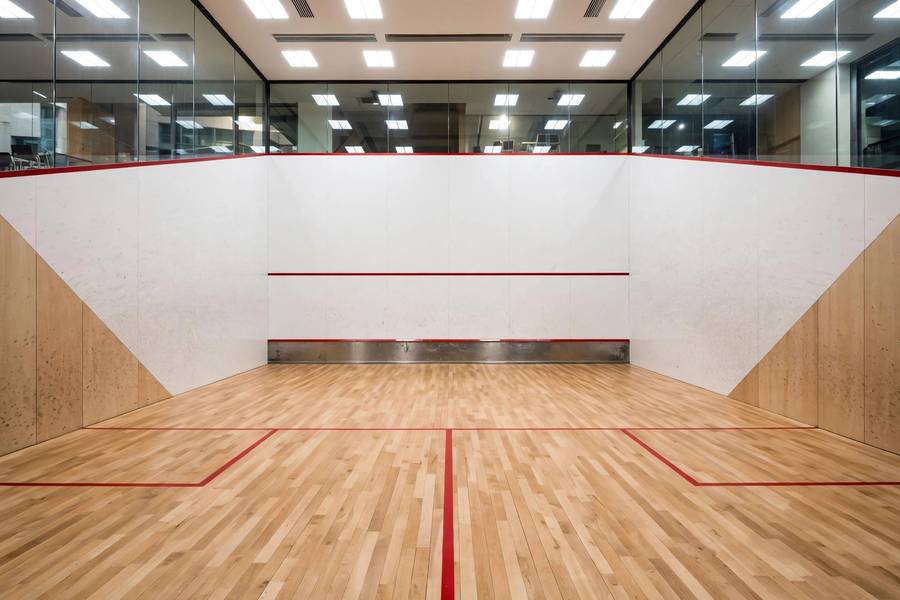
I’ve lost count of the times I’ve argued about this in club locker rooms. Someone swears their local court is “regulation,” someone else says it feels smaller, and twenty minutes later we’re pulling out a tape measure. So here are the numbers, settled once and for all — the official squash court dimensions, what every line means, and how singles and doubles courts differ.
Table of Contents
- How Big Is a Squash Court? The Headline Numbers
- Singles Court Dimensions: Every Spec
- Court Lines and Markings: What Each One Does
- Doubles Squash Court Dimensions
- Squash Court vs Racquetball Court: Side by Side
- Why These Numbers Matter in a Real Rally
- Verifying or Building a Squash Court: Quick Checklist
- Squash Court Dimensions FAQ
How Big Is a Squash Court? The Headline Numbers
A standard international singles squash court is 32 feet long and 21 feet wide — that’s 9.75 meters by 6.40 meters for the metric crowd. The minimum clear ceiling height above the playing surface is 18.5 feet (5.64 meters).
Let me put that in perspective. A tennis singles court is 78 feet long. A squash court is less than half of that, enclosed on all four sides, and you’re sprinting every inch of it. The compact size isn’t a design compromise — it’s the entire point of the sport. Everything about squash’s pace, the relentless pressure, the fact that elite players can cover the court in two steps — it all starts with these dimensions.
Every measurement is taken from the inside finished surfaces of the walls and floor, measured about 4 inches (10 cm) above the floor. That’s the official convention, straight from the world squash specifications.
Singles Court Dimensions: Every Spec
Here’s the complete breakdown. I’ll give both imperial and metric because squash is gloriously international, and you’ll find both on drawings depending on where you are.
Floor and walls:
- Length: 32 ft (9.75 m), with a tolerance of just ±10 mm
- Width: 21 ft (6.40 m), also ±10 mm — that’s less than half an inch of leeway
- Diagonal: 38.3 ft (11.665 m) — this is the builder’s truth serum; if the diagonal is off, the court isn’t square
- Front wall out line: 15 ft (4.57 m) above the floor
- Back wall out line: 7 ft (2.13 m) above the floor
- Minimum clear ceiling height: 18.5 ft (5.64 m)
The side walls slope down from the front wall height to the back wall height, following the out lines. That’s the classic squash court profile you see in every photo — towering front wall, sloping sides, low back wall.
Court Lines and Markings: What Each One Does
This is where casual players usually get lost, and honestly it’s the part that matters most if you’re learning the game. Every line on a squash court has a job.
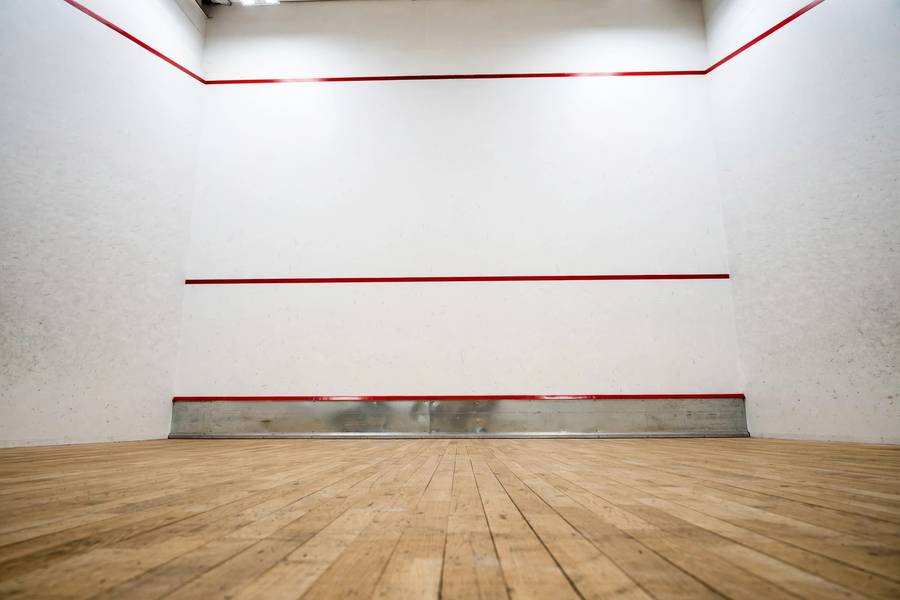
The tin. The lowest marking on the front wall — a metal strip, roughly 19 inches (480 mm) high in standard play, lowered to about 17 inches (430 mm) in professional events. Any shot that hits the tin is out. When the pros drop it to 17 inches, the game gets noticeably more attacking. Two inches doesn’t sound like much until you watch a pro nicks hunting that lower target.
The service line. Sits at 5.84 ft (1.78 m) on the front wall. On the serve, the ball has to hit the front wall above this line. It’s the line that keeps serves honest.
The out lines. Run along the top of the front wall (15 ft), slope down the side walls, and cap the back wall at 7 ft. Anything above them is out — and yes, this includes the ceiling, which is always out in squash, unlike racquetball.
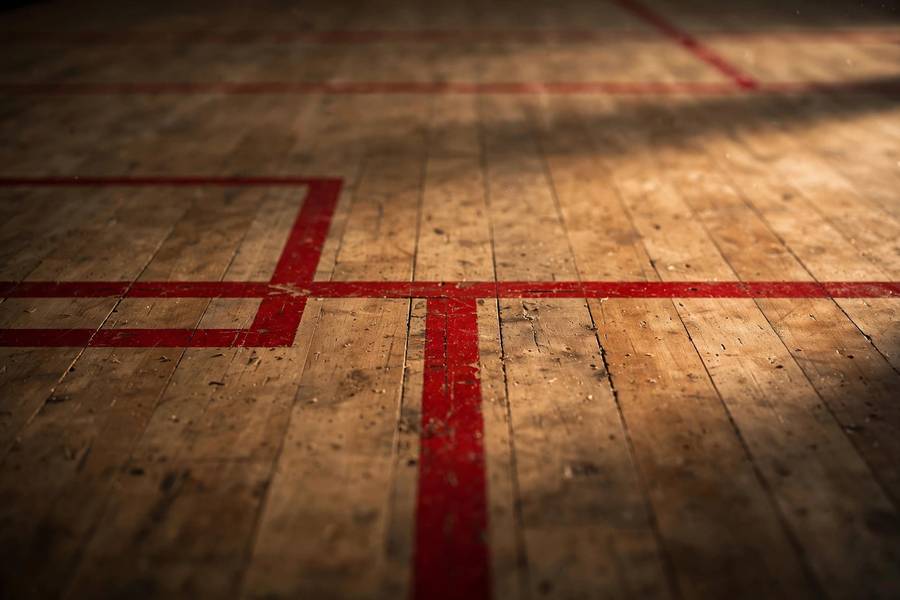
The floor markings. The floor has a short line 13.97 ft (4.26 m) from the back wall, a half-court line running from the short line to the back wall (splitting the back court into left and right), and two service boxes — 5.25 ft × 5.25 ft (1.60 m × 1.60 m) squares on either side of the half-court line. Where the short line meets the half-court line, you get the “T” — the center mark every player is taught to return to after every shot.
All lines are about 2 inches (50 mm) wide, in a color that contrasts with the floor — usually red.
I’ve said it a hundred times to juniors: learn the lines and you learn the geometry of the sport. The whole game is played in the angles between these marks.
Doubles Squash Court Dimensions
Doubles squash is a different animal — faster ball, four bodies in the box — so the court gets significantly bigger. A doubles court measures 45 feet long by 25 feet wide (13.72 m × 7.62 m). That’s 13 extra feet of length and 4 extra feet of width compared to singles.
The rest of the specs scale up too:
- Front wall height: 20 ft (6.09 m) — five feet taller than singles
- Back wall height: 7 ft (2.13 m) — same as singles
- Tin: 17 inches (430 mm)
- Service boxes: same 5.25 ft squares
- Minimum ceiling height: 24 ft (7.32 m)
The North American hardball doubles game — played with a harder, faster ball — is the version most associated with these big courts. If you’ve only played singles, walking onto a doubles court for the first time feels like stepping into a different sport entirely. The strategy changes completely: there’s so much more space that retrieving becomes an art form of its own.
If you’re new to the sport altogether, start with the basic squash rules for beginners before worrying about doubles dimensions — the rules differ slightly between the formats, and it helps to know which game you’re measuring for.
Squash Court vs Racquetball Court: Side by Side
This comparison comes up constantly, so here’s the clean answer. A racquetball court is 40 ft long × 20 ft wide × 20 ft high. Compare that to squash at 32 ft × 21 ft with an 18.5 ft ceiling.
| Squash (singles) | Racquetball | |
|---|---|---|
| Length | 32 ft (9.75 m) | 40 ft (12.2 m) |
| Width | 21 ft (6.40 m) | 20 ft (6.10 m) |
| Height | 18.5 ft (5.64 m) | 20 ft (6.10 m) |
| Ceiling | Out of play | In play |
So squash is a foot wider but a full 8 feet shorter, and the philosophies differ: in racquetball the ceiling is in play; in squash the ceiling is out. That single rule change, combined with the dimensions, produces two completely different games. Fun fact for the bar-stool debaters: despite being smaller, a squash court will exhaust you faster.
For racket-sports fans who like comparing rulebooks, the pickleball rules are another interesting study in how court geometry shapes a sport — and if you want to see how another precision sport handles its scoring, check out how tennis scoring works.
Why These Numbers Matter in a Real Rally
Okay, stats guy moment. The numbers aren’t arbitrary — they produce specific gameplay effects, and once you see them, you can’t unsee them.
The T is the mathematical center of the court for a reason. At 13.97 ft from the back wall on a 32 ft court, the T sits just behind the midpoint. That’s not luck — it’s the position that minimizes your maximum distance to any possible return. Pros fight for the T like it’s prime real estate because, geometrically, it is.
The 21-foot width is exactly wide enough that a well-struck crosscourt nick dies before your opponent can reach it, but narrow enough that you can cover both front corners from the T in two explosive steps. Widen the court by even two feet and the whole game changes — defensive retrieval gets easier, attacking gets harder.
The 15-foot front wall creates the lob. Without that height, the defensive lob — one of squash’s most beautiful shots — wouldn’t exist. The wall is tall enough to give a dying ball arc, short enough that a high boast comes back down into play. Every dimension is a compromise tuned over a century of play.
The tin at 19 inches is the game’s cruelty knob. Turn it down to 17 inches for the pros and you reward attacking precision. Keep it at 19 for club play and rallies last longer. If you ever wondered why club squash and pro squash feel like different sports, part of the answer is those two inches of tin.
Verifying or Building a Squash Court: Quick Checklist
If you’re checking an existing court or planning a build, run through this before anyone picks up a racket:
- Measure from finished surfaces, 4 inches above the floor — not from the structural walls.
- Check the diagonal (11.665 m / 38.3 ft). If length × width is right but the diagonal is off, the court isn’t square and the bounces will be wrong.
- Verify wall heights at the out lines: 4.57 m front, 2.13 m back, and that the side walls slope cleanly between them.
- Confirm the tin height: 480 mm standard, 430 mm for pro-spec. This is the single most common error in builds.
- Check line widths — 50 mm, in a contrasting color, on all floor markings and wall lines.
- Confirm clear ceiling height of at least 5.64 m with nothing projecting into it (no lights, vents, or beams below the minimum).
- Walk the floor. It should be dead level — any slope and the ball behaves differently at each end. This is the check most people skip, and it’s the one players feel immediately.
Get these seven right and you have a court that plays true anywhere in the world — which is the whole magic of standardized dimensions.
Squash Court Dimensions FAQ
A standard international singles squash court is 32 feet (9.75 meters) long and 21 feet (6.40 meters) wide. Doubles courts are larger: 45 feet long by 25 feet wide (13.72 × 7.62 meters).
The minimum clear ceiling height above a singles court is 18.5 feet (5.64 meters). The front wall out line is 15 feet (4.57 m) high and the back wall out line is 7 feet (2.13 m) high. Doubles courts need a 24-foot (7.32 m) ceiling.
The tin is a metal strip at the bottom of the front wall — any shot that hits it is out. It is 480 mm (about 19 inches) high in standard play and 430 mm (about 17 inches) in professional events, where the lower tin makes attacking easier.
A doubles squash court measures 45 feet long × 25 feet wide (13.72 × 7.62 m), with a 20-foot (6.09 m) front wall, a 7-foot (2.13 m) back wall, and a minimum 24-foot (7.32 m) ceiling. The larger size accommodates four players and the faster hardball doubles game.
Yes, mostly. A racquetball court is 40 × 20 feet — 8 feet longer than a squash court, but 1 foot narrower. Squash is also played with the ceiling out, while racquetball’s ceiling is in play.
Each service box is 5.25 feet × 5.25 feet (1.60 × 1.60 meters), located on either side of the half-court line in the back court. Servers must have at least one foot inside the box when serving.