
If you’re mapping out your AI education, you’ll hit this fork early: should you learn classical machine learning first, or jump straight to deep learning — the neural-network stuff behind ChatGPT and Midjourney? The internet is split, the advice is contradictory, and both camps sound confident. Let me settle it clearly: learn classical machine learning first. Not because deep learning isn’t important, but because ML-first makes you better at deep learning later, faster overall, and employable sooner.
I’ll explain exactly why, what “classical ML” actually covers, the rare exceptions to the rule, and the point at which you should pivot to deep learning. For the full learning sequence this fits into, see my guide on how to learn artificial intelligence.
In This Guide
- The Short Answer (and Why It’s Not Close)
- What “Classical Machine Learning” Actually Means
- What “Deep Learning” Actually Means
- 5 Reasons ML-First Wins
- The Exceptions: When to Start With Deep Learning
- When to Make the Jump
- A Practical Learning Sequence
- The Projects That Prove You Learned It
- Frequently Asked Questions

The Short Answer (and Why It’s Not Close)
Learn classical machine learning first, then deep learning. This isn’t nostalgia — it’s pedagogy. Classical ML teaches you the concepts that deep learning assumes you already know: training versus testing, overfitting, evaluation metrics, feature engineering, bias-variance tradeoff. Jump straight to deep learning and you’ll be running powerful machinery you don’t understand, which means you can’t debug it, can’t evaluate it properly, and can’t tell when it’s the wrong tool.
The analogy I use: classical ML is learning music theory before playing jazz. You can start with jazz, and some prodigies do — but for most people, theory first makes the jazz better and faster to learn.
What “Classical Machine Learning” Actually Means
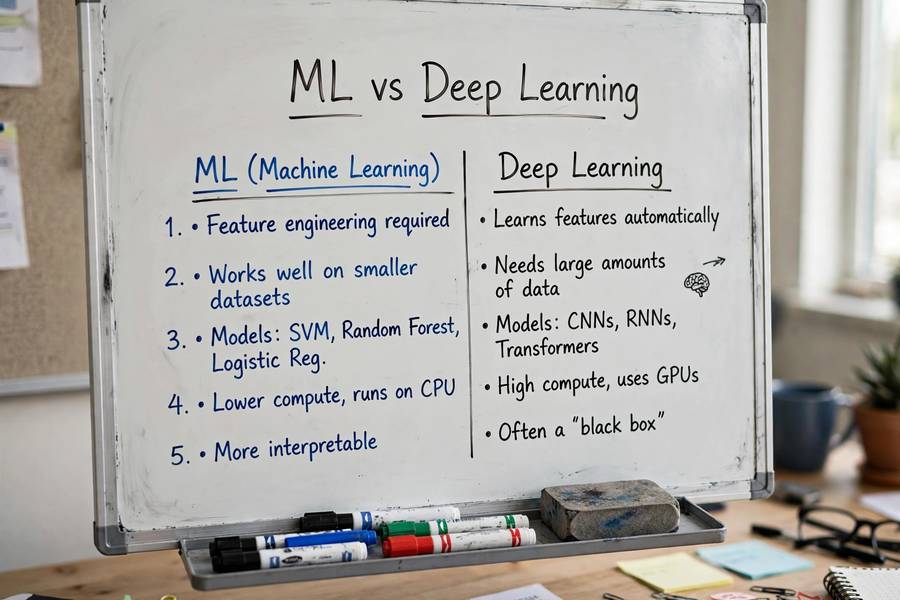
“Classical” sounds outdated; it isn’t. It means ML without deep neural networks: the algorithms that dominated the field before ~2012 and still solve most business problems today.
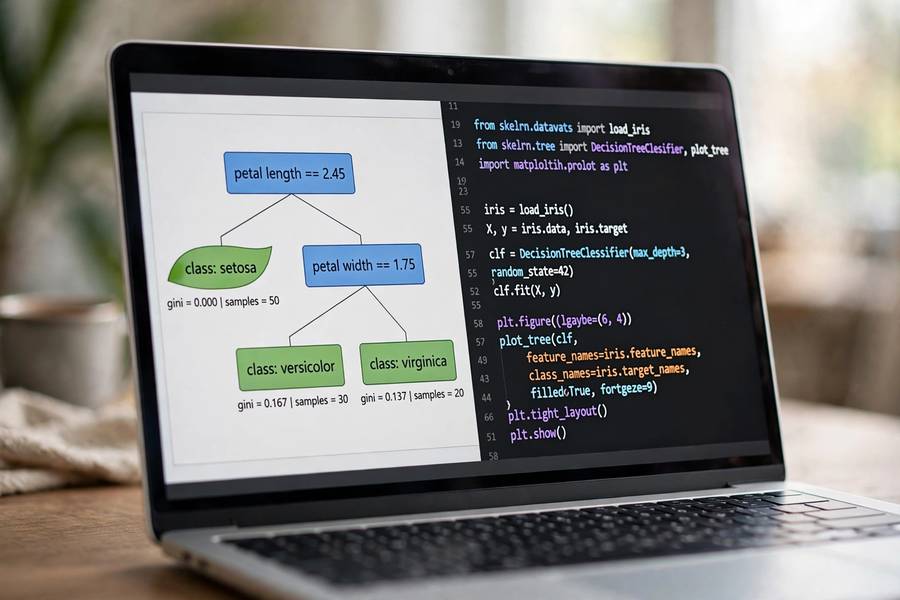
The core algorithms: linear and logistic regression, decision trees and random forests, gradient boosting (XGBoost, LightGBM), support vector machines, k-means clustering, and naive Bayes. These aren’t museum pieces — gradient boosting still wins most tabular-data competitions, and random forests remain a top choice for structured business data.
The core concepts: supervised vs. unsupervised learning, train/validation/test splits, cross-validation, overfitting and regularization, precision/recall/F1, ROC curves, feature engineering and selection. These concepts are identical in deep learning. Learn them on simple models where you can see what’s happening, and they transfer completely.
The practical reality: most companies’ ML problems are tabular data problems — predicting churn, scoring leads, forecasting demand. Classical ML solves these faster, cheaper, and more interpretably than deep learning. Learning classical ML first makes you useful immediately.
What “Deep Learning” Actually Means
Deep learning is machine learning with deep neural networks — models with many layers that learn hierarchical representations. It’s the technology behind LLMs, image generation, speech recognition, and game-playing AI.
What makes it different: scale and automation. Deep learning automates feature engineering (the network learns its own features from raw data) and scales with data and compute in ways classical methods don’t. Given enough data and GPUs, it achieves results classical ML can’t touch — on certain problems: images, text, audio, and other unstructured data.
What makes it harder: everything is bigger and more opaque. Training takes hours or days instead of seconds. Debugging means reasoning about millions of parameters you can’t inspect directly. The infrastructure (GPUs, frameworks like PyTorch) adds real complexity. And the theory — backpropagation, attention mechanisms, optimization dynamics — assumes the classical concepts as background.
5 Reasons ML-First Wins
1. Concepts transfer; tools don’t. Overfitting means the same thing whether your model is a decision tree or a 70-billion-parameter transformer. Learn it where it’s visible (small models, fast training), and you recognize it everywhere. Learn deep learning first and you’re trying to grasp fundamentals through the fog of massive complexity.
2. Faster feedback loops. A random forest trains in seconds on a laptop. A deep network trains in hours on a GPU. When you’re learning, iteration speed is everything — you need to try things, see results, and adjust hundreds of times. Classical ML gives you that; deep learning makes you wait.
3. Employable sooner. The job market has far more roles needing classical ML (data science, analytics, business ML) than deep learning research. ML-first gets you earning and building experience while you continue toward deep learning.
4. You learn when NOT to use deep learning. This is underrated and crucial. Deep learning is overkill for most problems — slower, more expensive, harder to interpret. Practitioners who only know deep learning reach for it reflexively. ML-first practitioners choose the right tool, which is what senior people actually do.
5. Deep learning becomes easier. When you finally study neural networks, you’ll recognize everything: gradient descent is optimization (you know this), overfitting is overfitting (you’ve fought it), evaluation metrics are the same. You’re learning one new thing (neural architectures) instead of everything at once.
The Exceptions: When to Start With Deep Learning
Honesty requires the counter-cases. Skip straight to deep learning if:
You’re specifically targeting LLM/vision work and already code well. If you’re an experienced programmer who wants to build with transformers now, starting with a practical deep learning course (like fast.ai) is defensible. You’ll backfill classical concepts as needed.
You’re following a structured program that integrates both. Some excellent courses teach ML concepts through neural networks carefully. The “ML-first” advice is about concept ordering, not a law — a well-designed integrated course works too.
You only care about using AI, not building models. If your goal is applied AI (APIs, agents, products), you can skip most of both and focus on the applied stack. See my overview of AI tools explained for that path.
For everyone else — especially self-learners without a curriculum designer — ML-first is the safer, faster route.
When to Make the Jump
You’ll know you’re ready for deep learning when:
- You can explain overfitting, cross-validation, and precision/recall without notes
- You’ve built and evaluated several classical models on real datasets
- You’ve encountered a problem where classical ML clearly wasn’t enough (unstructured data: images, text, audio)
- Terms like “gradient descent” and “loss function” feel familiar, not frightening
That last point matters: deep learning’s core training loop is the same optimization you learned in classical ML, just scaled up. If the classical version is comfortable, the deep version is an extension, not a new world.
A Practical Learning Sequence
Phase 1 (2–3 months): Classical ML. Python basics → scikit-learn → the core algorithms → evaluation → a few real projects on tabular data. Géron’s “Hands-On Machine Learning” covers this perfectly.
Phase 2 (1–2 months): The bridge. Learn PyTorch basics. Implement a simple neural network from scratch on a toy problem. Understand backpropagation conceptually — it’s just the chain rule applied systematically, and how AI models are trained walks through the intuition.
Phase 3 (3+ months): Deep learning proper. CNNs for images, transformers for text, the architectures behind modern AI. Now the field’s excitement is accessible — and you’ll understand it ten times better than someone who started here.
Total: 6–8 months from zero to genuinely understanding deep learning, versus flailing for a year starting directly. The “shortcut” of skipping classical ML is the longest path of all.
Machine learning first, deep learning second. It’s not the flashy advice, but it’s the advice that produces practitioners who understand what they’re doing instead of operators who can only run code they don’t comprehend. Build the foundation, then build the tower — it’ll stand taller and go up faster than you expect.
The Projects That Prove You Learned It
Knowledge without projects evaporates. Each stage of the ML-first path should produce something you can point at — and each project tests a different kind of understanding.
Classical ML stage projects. Predict something boring and real: house prices from a public dataset, customer churn, spam classification. The point is not the dataset; it’s the workflow. A good stage-one project includes data cleaning (the unglamorous 80% of the work), a baseline model, feature engineering that demonstrably improves it, and an honest evaluation — confusion matrices, learning curves, a written error analysis. If you can explain why your model fails on certain inputs, you understand ML. Most beginners skip the error analysis. Don’t.
The bridge project. Take a problem you already solved with classical ML and attack it with a small neural network — on tabular data, where gradient boosting usually wins. This teaches the most valuable lesson in the field: deep learning is not universally better. Watching a neural net lose to XGBoost on structured data cures the “deep learning for everything” instinct faster than any lecture. Then try text or images, where the neural net wins decisively, and you’ll understand the architecture-task match at a gut level.
Deep learning stage projects. Fine-tune a pre-trained model on a small domain dataset — sentiment on product reviews, image classification on a niche category. Then, and this matters: evaluate it properly, including failure cases. The difference between someone who “knows deep learning” and someone who can use it is almost entirely in evaluation discipline. Training is easy now; knowing what you built is the actual skill.
Two warnings. First, don’t build projects that are really just API calls to someone else’s model and claim you learned deep learning — you learned prompt engineering, which is fine, but it’s not this. Second, document as you go. A GitHub repository with a README explaining the approach, the results, and the mistakes is worth ten half-finished notebooks. Employers and collaborators judge process, not just accuracy scores.
Frequently Asked Questions
Yes. Classical machine learning teaches the fundamental concepts (overfitting, evaluation, train/test splits) that deep learning assumes you know. Learning ML first gives you faster feedback loops, makes you employable sooner, and makes deep learning significantly easier when you get there.
Deep learning is a subset of machine learning that uses deep neural networks with many layers. Classical ML uses simpler algorithms (decision trees, regression, SVMs) that train fast and work well on structured data; deep learning excels at unstructured data (images, text, audio) but needs more data, compute, and expertise.
Absolutely. Classical ML (especially gradient boosting and random forests) still solves most business ML problems — tabular data like churn prediction, fraud detection, and forecasting — faster, cheaper, and more interpretably than deep learning. Most industry ML jobs rely heavily on classical methods.
Plan 2-3 months for solid classical ML foundations (Python, scikit-learn, core algorithms, evaluation), then 1-2 months bridging into neural networks with PyTorch. Rushing this foundation to reach deep learning faster usually backfires.
It’s possible if you’re an experienced programmer targeting LLM/vision work specifically, or following a well-designed integrated course. But for most self-learners, skipping classical ML means struggling with concepts (overfitting, evaluation) that would have been easy to learn on simpler models first.