
“How long does it take to learn AI?” is the question I hear most, and the honest answer is the one nobody wants: it depends entirely on what “learn AI” means to you. Someone who wants to use AI tools effectively can get there in weeks. Someone who wants to build a career as a machine learning engineer is looking at a year or more of serious work. Both are legitimate goals, and confusing them is where most timeline anxiety comes from.
Let me give you realistic numbers for each destination, the factors that speed you up or slow you down, and a week-by-week sketch of what the journey actually looks like. If you haven’t mapped your overall path yet, start with my guide on how to learn artificial intelligence — this timeline slots right into it.
Table of Contents
- The Honest Short Answer
- Timeline by Goal: 4 Destinations
- What Actually Determines Your Speed
- A Realistic 12-Week Starter Plan
- The 6-Month and 12-Month Pictures
- Signs You’re Going Too Fast (or Too Slow)
- How to Learn Faster Without Burning Out
- Frequently Asked Questions

The Honest Short Answer
Here’s the range, no sugarcoating:
- 2–4 weeks to become a confident AI user — prompting well, picking the right tool for the job, judging output quality.
- 3–6 months to become a competent AI builder — calling APIs, chaining tools, fine-tuning models, shipping small applications.
- 9–18 months to become a hirable ML practitioner — solid Python, real ML fundamentals, a portfolio of projects, interview-ready.
- 2+ years to reach research-level depth — reading papers fluently, designing architectures, contributing novel work.
Notice these aren’t stages of one ladder you must climb in order — they’re different destinations. Most people asking this question want destination one or two, which is genuinely months, not years. The multi-year timelines belong to a career specialization, not to “learning AI” as a skill.
Timeline by Goal: 4 Destinations
Destination 1: Confident AI user (2–4 weeks). Learn how the major tools work, what each is good at, how to write effective prompts, and how to verify outputs. An hour a day for three weeks gets you past 90% of casual users. The skill here is judgment, not technical depth — knowing when to trust the AI and when to check its work.
Destination 2: AI builder (3–6 months). Add basic Python, API fundamentals, and one framework for chaining AI capabilities into applications. You’ll build things like custom chatbots, document Q&A systems, and automated workflows. This is the sweet spot for most professionals adding AI to an existing career.
Destination 3: ML practitioner (9–18 months). Real machine learning: data handling, model training and evaluation, the math intuition behind it all, and a portfolio proving you can do it. This is the path to job titles with “machine learning” in them, and it requires consistent, deliberate effort.
Destination 4: Research depth (2+ years). The long road — advanced math, paper reading as a habit, original experiments. Only pursue this if the research itself excites you, not as a means to an end.
What Actually Determines Your Speed
Prior programming experience is the biggest accelerator. If you already write Python comfortably, subtract 2–3 months from the builder timeline — you’re just adding AI concepts to existing fluency. If you’ve never coded, add that time for Python basics first. It’s not optional for destinations 2 and beyond.
Daily consistency beats weekend marathons. An hour every day compounds dramatically faster than seven hours on Sunday. AI concepts connect to each other; daily contact keeps those connections warm. The people who finish in the optimistic end of every range above share one trait: they showed up daily.
Project-based learning is roughly twice as fast as tutorial-only learning. Watching courses feels productive but builds fragile knowledge. Building something — even something small and broken — forces you to confront what you don’t actually understand. Every timeline above assumes you’re building from week two onward.
Your definition of “done” matters enormously. “Learn AI” is not a finish line, it’s a direction. People who stall usually haven’t defined what done looks like for them. Pick a concrete outcome — “ship a chatbot,” “automate my weekly report,” “pass an ML interview” — and the timeline sharpens immediately.
A Realistic 12-Week Starter Plan
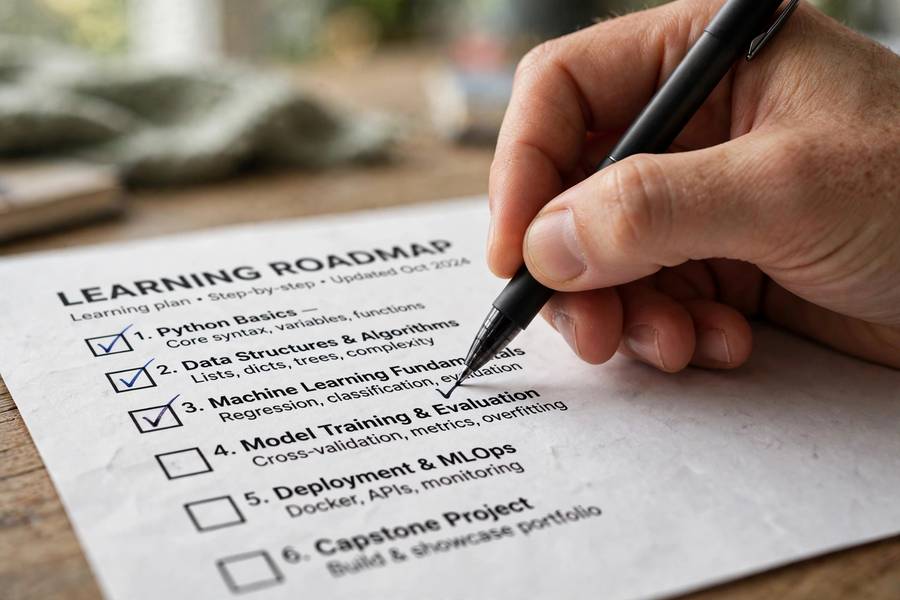
Here’s what the builder path looks like in practice, assuming an hour a day and no prior Python:
Weeks 1–2: AI literacy. Use the major tools daily. Learn what LLMs, image models, and embeddings do. Practice prompting deliberately. Read my overview of AI tools explained to map the landscape. Goal: you can pick the right tool for any task and explain why.
Weeks 3–6: Python foundations. Variables, functions, loops, data structures, and the key libraries: NumPy, pandas, and basic API calls with requests. Don’t aim for Python mastery — aim for “can read and modify working code.” That’s enough to start.
Weeks 7–9: First AI builds. Call an LLM API. Build a simple chatbot. Add retrieval over your own documents. This is where it gets fun — you’re making things that feel like magic, and every bug teaches you something real about how AI models are trained and how they behave.
Weeks 10–12: A real project. Pick one problem you actually care about and ship a working solution. It will be rough. Ship it anyway. A finished rough project teaches more than three polished tutorials, and it becomes the first piece of your portfolio.
The 6-Month and 12-Month Pictures
At 6 months of consistent builder-path effort, you should have: comfortable Python, several shipped projects, working knowledge of APIs and embeddings, basic fine-tuning experience, and the ability to evaluate whether an AI approach fits a problem. You’re dangerous in the best sense — you can prototype AI solutions to real problems in days.
At 12 months, the ML-practitioner track adds: real ML fundamentals (not just API calls — actual training, evaluation metrics, data pipelines), the math intuition to understand what’s happening, and a portfolio that demonstrates judgment, not just tutorial completion. This is hirable territory for junior ML roles, especially combined with domain expertise from a previous career.
Signs You’re Going Too Fast (or Too Slow)
Too fast: you’re copying code you can’t explain, skipping fundamentals to chase shiny new models, or you can’t debug anything without starting over. Slow down and rebuild the foundation — speed without understanding collapses the moment problems get novel.
Too slow: you’ve been “learning” for months with nothing built, you’re on your fourth beginner course, or you’re waiting to feel “ready” before starting a project. You’re not behind on knowledge — you’re behind on doing. Start building this week, with what you have.
The healthy pace feels slightly uncomfortable: you understand about 70% of what you’re working with, and the other 30% stretches you. If everything feels easy, you’re reviewing. If nothing makes sense, you’ve skipped steps.
How to Learn Faster Without Burning Out
Teach as you learn. Write up what you figured out — a blog post, a thread, notes for a friend. Explaining exposes gaps instantly, and it builds the portfolio employers actually read.
Join a community. A Discord server, a study group, a local meetup. Learning alone is slower and lonelier than it needs to be. Other beginners ask the questions you’re embarrassed to ask, and answering them cements your own understanding.
Protect the habit, not the hours. Missing a day is fine; missing a week kills momentum. On low-energy days, do fifteen minutes of review instead of skipping. Consistency compounds; intensity doesn’t.
Learn in public. Share your projects, even the rough ones. The feedback accelerates you, and the trail of shipped work becomes your strongest credential — stronger than any certificate.
So how long does it take to learn AI? Long enough to matter, short enough to start today. Pick your destination, define “done,” show up daily, and build things from week two. A year from now, you’ll either have a year of progress or a year of wondering — the timeline is yours to choose.
One more honest data point: every practitioner I know overestimated how much theory they’d need and underestimated how much building they’d do. The fastest learners share one trait — they had a project from week two, not a plan for week twelve. That’s the real shortcut: build early and build in public.

Frequently Asked Questions
A complete beginner can become a confident AI user in 2-4 weeks and an AI builder (shipping API-based applications) in 3-6 months with an hour of daily practice. Becoming a hirable ML practitioner takes 9-18 months. The timeline depends heavily on your goal and prior programming experience.
Yes — 3 months of consistent daily effort is enough to go from zero to building real AI applications with APIs and frameworks, provided you include Python basics. You won’t be an ML researcher in 3 months, but you’ll be genuinely productive with AI tools.
Not at all. Many successful AI practitioners started in their 30s, 40s, or later, often bringing valuable domain expertise from previous careers. Employers care about what you can build, not when you started. Your existing experience is an asset, not a handicap.
One focused hour daily beats occasional long sessions. Consistency matters more than volume — daily contact with the material keeps concepts connected. If you have more time, spend the extra on building projects rather than consuming more tutorials.
Start with AI literacy: use the major tools, understand what LLMs and image models do, and practice prompting. Then learn Python basics, then start calling AI APIs and building small projects. Save the deep math and theory for after you have hands-on context.