


Every songwriter I know has a notebook full of terrible lyrics. Mine has a page from years ago that rhymes “fire” with “desire” with “higher,” which I believe is legally required in every beginner’s notebook, like a hazing ritual. The difference between people who write songs and people who wish they wrote songs isn’t talent. It’s that the first group kept writing through the “fire/desire” phase.
Here’s what I wish someone had told me at the start: songwriting is a craft with actual techniques, not a lightning strike you wait around for. There are methods for coming up with ideas, structures that work, rhyme schemes that don’t sound like a greeting card, and editing processes that turn a decent draft into something people actually want to hear twice. Let’s walk through all of it, step by step.
Step 1: Forget “Talent” — Treat It Like a Craft
The myth of the tortured genius waiting for inspiration has ruined more songwriting careers than writer’s block ever could. Professional songwriters — the people behind the hits you hum in the shower — treat it like a job. They show up, they write badly on purpose, and they trust the process to produce something good roughly ten percent of the time.
So your first assignment: write every day for two weeks, and give yourself full permission for it to be awful. Set a timer for twenty minutes. Fill a page. The goal isn’t a song — it’s building the muscle. Nobody’s first draft is the hit; the hit is what survives the editing we’ll get to in step 6.
Step 2: Start With the Feeling (or the Title)
Songs don’t start with rhymes. They start with something you can’t not say. A feeling, a moment, a sentence someone said that lodged in your brain like a splinter.
Keep a running list in your phone — I call mine the “splinter file.” Fragments like:
- “We were happy and we didn’t know it”
- The way my dad still sets two coffee cups out
- “Last train home” as a metaphor for a relationship ending
Song titles work the same way. Some of the best songs ever written started as a great title the writer then reverse-engineered a song around. When you sit down to write, you don’t need “an idea for a song” — you need one true sentence. Everything else is scaffolding.
Step 3: Learn the Anatomy of a Song
Before you write, know the rooms of the house. Most popular songs are built from the same parts:
- Verse — the story. Each verse advances the narrative or adds a new angle. Same melody, different words each time.
- Chorus — the emotional core and usually the title. Same words, same melody, every time. This is the part people sing in the car.
- Pre-chorus — the ramp that builds tension into the chorus. Optional, but deadly effective.
- Bridge — the plot twist. A new perspective, usually appearing once, about two-thirds through. (“What if the whole song was actually about this?”)
- Hook — not a section, but the catchy fragment (a line, a melody, a phrase) that burrows into brains. A song can have several.
You don’t have to use all of them — some of the greatest songs are just verse-chorus-verse-chorus — but knowing the toolkit means you’re choosing simplicity instead of stumbling into it.
Step 4: Write the Hook First (Steal Like a Songwriter)

Here’s a trick the pros use constantly: start with the chorus, not the verse. The chorus is the hardest, most important part — it’s the emotional thesis of the song. If you nail a chorus that gives you goosebumps, the verses practically write themselves as setup for it.
Try this exercise: pick a song you love and map its chorus. What’s the central line? How does the melody move? Now — and this is the “steal like an artist” part — borrow its shape but not its words. Same number of syllables per line, same emotional arc, completely different subject. You’re not plagiarizing; you’re studying architecture by walking through someone else’s building.
And if a melody pops into your head in the shower? Hum it into your phone immediately. Melodies are like dreams — vivid for ten seconds, gone by breakfast.
Step 5: Rhyme Schemes That Don’t Sound Like Nursery Rhymes
Nothing screams “beginner” like AABB couplets all the way down (“I saw you standing there / wind blowing through your hair“). It’s not that couplets are bad — it’s that only couplets get monotonous. Mix it up:
- ABAB — lines 1 and 3 rhyme, lines 2 and 4 rhyme. Instantly more sophisticated.
- Internal rhymes — rhyming within a line (“I’m hopeless, focused on the moment“). This is the secret weapon of great lyricists.
- Near rhymes (slant rhymes) — “home” and “alone,” “fire” and “tired.” Close enough to feel musical, loose enough to avoid greeting-card territory.
- No rhyme at all — sometimes the most powerful line in a verse is the one that doesn’t rhyme. It lands like a dropped glass in a quiet room.
Also: rhyming dictionaries are not cheating. They’re tools. Every professional songwriter I know has one bookmarked. The skill isn’t finding the rhyme — it’s choosing the one that actually means something.
Step 6: Sing It — Melody and Rhythm Are Half the Lyric
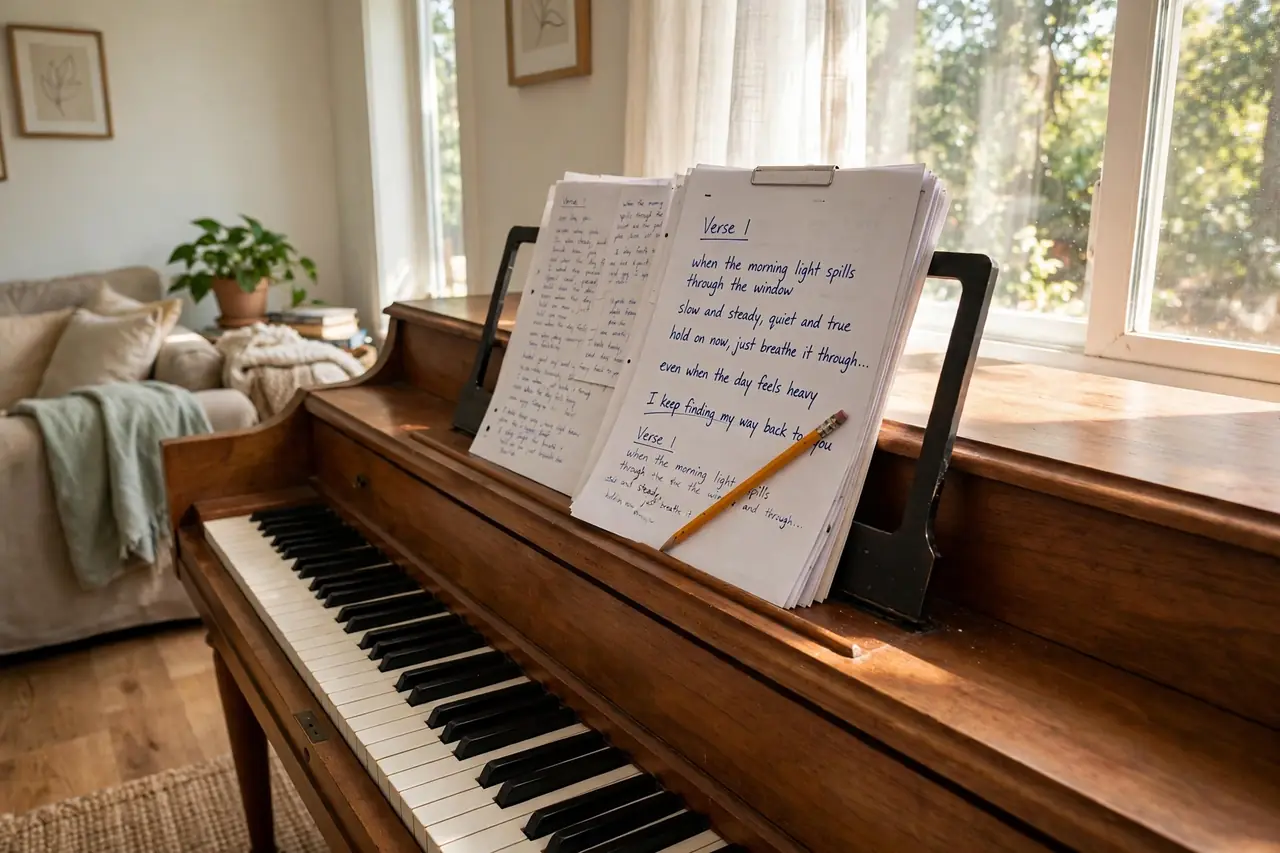
Lyrics on paper and lyrics sung are two different animals. A line that reads beautifully can be unsingable, and a line that looks plain on the page can soar with the right melody. So from draft two onward, sing everything.
Pay attention to stress and syllables. English has a natural rhythm — “I WANT to GO back HOME” — and your melody needs to land its emphasis on the same words a speaker would stress. When the melody fights the natural stress of the words, listeners feel something’s off even if they can’t name it.
Don’t play an instrument? Doesn’t matter. Hum, sing into your phone, use a free piano app to find a chord progression (start with the classics: C–G–Am–F has launched a thousand hits). The melody doesn’t need to be final — it needs to exist so you can test your words against it.
Step 7: The Editing Pass — Kill Your Darlings
First drafts are you telling yourself the story. Editing is you telling the listener. Put the draft away for at least 24 hours, then come back with a red pen and a merciless attitude:
- Cut the throat-clearing. If verse one is just warming up, delete it. Start where the song gets interesting.
- One idea per song. If your chorus is about leaving and your bridge is about your childhood dog, pick one. The dog gets its own song.
- Show, don’t tell. “I was sad when you left” is a diary entry. “Your coffee cup’s still in the sink” is a lyric.
- Read it aloud. Any line you stumble over will trip a singer too.
- Check the title test. Does the song deliver on whatever its title promises? If your song is called “Last Train Home,” the last train better show up.
That line you’re most proud of — the clever one, the one your friends will quote? It’s the most likely candidate for deletion. “Kill your darlings” exists because our favorite lines are usually our most self-indulgent ones. (Mine survived three drafts before I admitted it was showing off. It hurt. The song got better.)
Step 8: Get Feedback Without Losing Your Mind
Play it for someone. Not your mom (she’s contractually obligated to love it), but a fellow musician, a songwriter group, or even an open mic night. Here’s how to take feedback like a pro:
- Ask specific questions: “Did the chorus land?” beats “Did you like it?”
- Listen for the note behind the note. “The middle felt long” usually means the bridge isn’t earning its place.
- You don’t have to take any of it. But if three people flag the same line, the line is the problem, not the people.
And if performing your own songs ever becomes the goal, the stage skills matter as much as the writing — our guide on how to get into acting covers presence and performance fundamentals that transfer directly to playing your songs live. The entertainment industry runs on the same fuel whether you’re on stage or on screen — what Hollywood is today is really just the biggest version of putting your work in front of an audience. And when the songs start getting attention, understanding what a talent agent does will save you from signing things you don’t understand.
Your Next 30 Days
Write for twenty minutes a day. Finish one song a week — finished, not perfect. By the end of the month you’ll have four songs, and I promise you the fourth will embarrass the first. That’s not failure; that’s the whole game. Every songwriter you admire has a drawer full of “fire/desire” rhymes. They just kept going until the drawer started producing keepers.
Now close this tab and go write something terrible. It’s the only way to get to the good stuff.
No. Plenty of great songs use little or no rhyming. Rhyme is a tool for creating musicality and memorability, not a requirement. Near-rhymes, internal rhymes, and rhythmic phrasing can all make lyrics feel musical without end-line rhymes.
Most commercial songs run 2–4 minutes, which typically means 100–300 words of lyrics. Streaming-era songs have gotten shorter, but the real rule is: the song should be exactly as long as its idea needs, and not a line longer.
Either works, and most songwriters do both depending on the song. Starting with the chorus or a melodic hook is often easier for beginners, because a strong melody gives your words a shape to fit into. Try both and see which unlocks more songs for you.
In most countries, including the US and UK, your lyrics are automatically copyrighted the moment you write them down or record them. For stronger legal protection in the US, you can register with the Copyright Office, and joining a performance rights organization helps you collect royalties.
Lyrics are written to be sung — they work with melody, rhythm, and repetition, and they’re experienced in real time with music. Poetry lives on the page and can be re-read and puzzled over. Great lyrics often look plain on paper and only come alive when sung.