


I’ve sat through more improv shows than I can count — the electric ones where a room of strangers laughs itself hoarse, and the painful ones where a scene about sentient toasters dies in real time. That’s the deal with improv: it’s the only art form where failure is built into the ticket price. So what is improv comedy, really? It’s theater made up on the spot — no script, no rehearsal, no safety net — built entirely from audience suggestions and the performers’ training. And when it works, there’s nothing else like it.
Table of Contents
- What Is Improv Comedy, Exactly?
- The Golden Rules Every Improviser Learns
- Short-Form vs. Long-Form: Two Different Sports
- The Schools and Theaters That Built Improv
- Improv’s Greatest Exports: The Famous Faces
- How Improv Quietly Rewired Hollywood
- Your First Improv Class: What to Expect
- Frequently Asked Questions

What Is Improv Comedy, Exactly?
Strip it to the studs: improv comedy is unscripted performance. A group of players takes a suggestion from the audience — a location, an occupation, a word — and builds entire scenes, characters, and stories from nothing, in real time. Nothing is written down. Nothing is rehearsed. The show you see on Tuesday never happened before and will never happen again.
That ephemerality is the whole point. A scripted play is a recording; an improv show is a live wire. The audience isn’t just watching — they’re co-authors. The suggestion they shout out genuinely shapes what happens, which is why improv crowds feel ownership over a great night in a way theater crowds rarely do.
But here’s what outsiders get wrong: improv is not “just winging it.” It’s not stand-up comedians riffing, and it’s definitely not people being randomly wacky. Good improv is built on rigorous training, strict internal rules, and hundreds of hours of practice. The spontaneity is real, but it’s spontaneity with technique — the way a jazz musician’s solo sounds effortless because of ten thousand hours of scales.
The modern form has roots in theater games developed by Viola Spolin in the 1940s and 50s — exercises designed to get actors out of their heads and into the moment. Her son, Paul Sills, turned those games into The Compass Players and later The Second City in Chicago, and that’s the direct line to everything: Saturday Night Live, modern sitcoms, half the comedy you’ve ever loved.
The Golden Rules Every Improviser Learns
Every improv school teaches some version of the same core principles, and they’re worth knowing because they explain why good improv looks the way it does:
“Yes, and…” — The first commandment. Accept what your scene partner offers (“yes”) and build on it (“and”). If your partner says “We’re on the moon,” you don’t say “No we’re not” — you say “Yes, and the oxygen bill is past due.” Denial kills scenes; agreement builds worlds. (Fun fact: “yes, and” has escaped comedy entirely and now shows up in business seminars and therapy offices, which improvisers find both flattering and horrifying.)
Make your partner look good. Improv is a team sport. The glory goes to the player who sets up the brilliant move, not the one who takes it. The best improvisers are generous — they give their partners gifts: interesting characters, juicy details, clear premises to play with.
Don’t try to be funny. This one breaks beginners’ brains. Chasing jokes makes scenes desperate and weird. Playing the scene honestly — treating the absurd premise with total sincerity — is what makes it funny. The comedy is a byproduct of commitment.
Listen. Really listen. Most bad improv comes from a player planning their next line while their partner is talking. The information you need is always in what was just said.
Heighten, don’t abandon. When something gets a laugh, explore it further before moving on. Find the game of the scene — the funny pattern — and play it harder. A scene about a passive-aggressive dentist gets better when the dentistry gets more passive-aggressive, not when someone suddenly introduces a dragon.
These rules sound simple. Executing them at speed, in front of an audience, while your scene partner does something unexpected — that’s the hard part, and the fun part.
Short-Form vs. Long-Form: Two Different Sports
Improv splits into two major formats, and they barely resemble each other:
Short-form is what most people picture: quick games, audience suggestions, scenes that last three to five minutes. Think Whose Line Is It Anyway? — fast, punchy, built for laughs per minute. It’s the most accessible format and the best entry point for beginners, because the games give you structure to lean on. The trade-off: scenes rarely go deep. It’s sketch-adjacent — brilliant, but disposable.
Long-form is the artier sibling: a single suggestion launches a 20-to-45-minute piece — a “set” — where scenes weave together, characters recur, and themes emerge. The Harold, the most famous long-form structure, intercuts three unrelated scenes that eventually connect in ways nobody planned. When a long-form set clicks, it feels like watching a play being written in front of you. When it doesn’t, it feels like watching people be confused in front of you.
The Schools and Theaters That Built Improv
If you want to understand improv’s DNA, you need to know the institutions:
The Second City (Chicago, 1959). The mothership. Founded by Paul Sills, Bernie Sahlins, and Howard Alk, it turned Spolin’s theater games into a commercial art form. Its alumni list reads like a comedy hall of fame — and its training center has taught generations the fundamentals.
iO Chicago. Founded by Del Close and Charna Halpern, this was the laboratory of long-form. Close — a mentor to half of modern comedy — treated improv as a serious art, and the Harold as its sonnet form. iO closed its doors in 2020, which genuinely felt like a death in the comedy family.
Upright Citizens Brigade. Matt Besser, Amy Poehler, Ian Roberts, and Matt Walsh brought Chicago-style long-form to New York in the late 90s and built a comedy empire on it. UCB’s training program became the default path for a generation of comedy writers and performers.
The Groundlings (LA). Sketch-and-improv hybrid, and the single most important pipeline to Saturday Night Live on the West Coast. If you can name a beloved SNL cast member from the last thirty years, there’s a good chance they came through the Groundlings.
What these schools share: they treat improv as training, not just performance. Actors study it to get better at listening and reacting. Writers study it to generate material. Even dramatic actors swear by it — because the core skill, being fully present in an imaginary circumstance, is just… acting.
Improv’s Greatest Exports: The Famous Faces
Here’s a party trick: name a comedy star, and there’s a decent chance they did improv. Tina Fey, Amy Poehler, Steve Carell, Stephen Colbert, Bill Murray, Gilda Radner, John Belushi — all Second City. Will Ferrell, Kristen Wiig, Maya Rudolph — Groundlings. The UCB pipeline gave us half the writers’ rooms in television.
This isn’t coincidence. Improv training produces exactly the skills that modern comedy demands: the ability to generate material fast, to collaborate without ego, to find the funny in the mundane, and to survive bombing in public without flinching. Saturday Night Live has essentially been drafting from improv theaters for fifty years, because a performer who can hold a scene together when a sketch collapses live on air is worth their weight in gold.
And the influence runs deeper than casting. The mockumentary style of The Office and Parks and Recreation? Built for improvisers — loose scripts, room to riff, cameras that keep rolling. Judd Apatow’s film comedies famously shot hours of improvised alt-takes. Even dramatic television has absorbed it: directors now routinely let cameras run after the scripted take ends, because that’s where the unplanned gold lives.
How Improv Quietly Rewired Hollywood
The entertainment industry runs on improv people now, and not just in comedy. Here’s how deep it goes:
Writers’ rooms. The modern TV writers’ room operates on improv principles — pitch freely, build on others’ ideas, kill your darlings. Showrunners actively recruit improv-trained writers because they generate volume and collaborate well. Some of the best filmmaking tips you’ll hear from working directors boil down to “hire improvisers and let them play.”
Auditions. Casting directors increasingly use improv exercises in auditions, even for scripted roles. They want to see how an actor thinks on their feet, how they listen, whether they can take direction mid-scene. An actor with improv training has a quiet superpower in the room.
On set. The biggest shift: directors now budget time for improvisation. The scripted take gets the coverage; the improvised takes get the magic. Some of the most quoted lines in modern film history were never in the script — they were an actor, in the moment, with permission to play. That’s improv’s philosophy colonizing how movies are made, one alt-take at a time.
Your First Improv Class: What to Expect
Thinking of trying it? Here’s the honest preview:
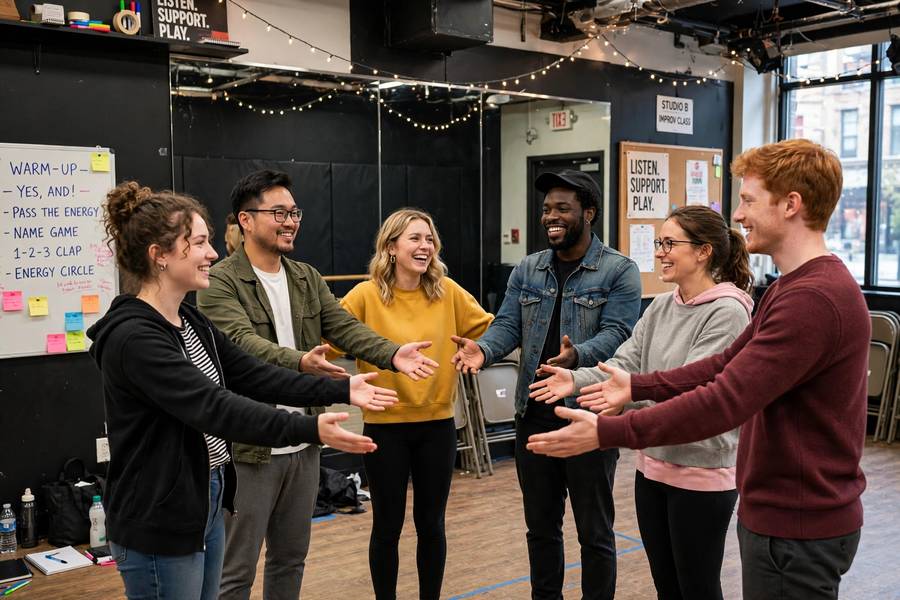
You will be bad at first, and that’s the curriculum. Everyone’s first scenes are clumsy. The class is designed for that. You’ll play warm-up games that feel silly — word association, sound-and-motion circles, group counting exercises — and they’ll secretly be teaching you listening and agreement.
You will not be asked to be funny. A good teacher will stop you the moment you start performing for laughs. The instruction is always the same: play it real, commit to the reality, let the funny find you. Beginners who chase jokes get gently redirected; beginners who commit get celebrated.
The 101 class is the filter. Most schools run an eight-week Level 1. Roughly half the students continue. Not because the rest failed — because improv isn’t for everyone, and that’s fine. But the ones who continue tend to describe it the same way: it changed how they listen, how they handle uncertainty, how they deal with being wrong in public.
Practical notes: classes typically run $200–$400 for an eight-week session in major cities, cheaper elsewhere. Wear comfortable clothes. Bring water. Leave your ego at the door — you’ll need the hands free for “yes, and.”

Frequently Asked Questions
Improv comedy is unscripted theater: performers create scenes, characters, and stories on the spot from audience suggestions, with no script and no rehearsal. Every show is unique and never repeated.
The core rules are “yes, and” (accept your partner’s offer and build on it), make your partner look good, don’t chase jokes, listen actively, and commit fully to the scene’s reality.
Short-form improv uses quick games and short scenes built for fast laughs, like Whose Line Is It Anyway? Long-form builds a single 20-to-45-minute piece from one suggestion, with scenes that weave together and connect.
Modern improv grew from theater games created by Viola Spolin in the 1940s-50s. Her son Paul Sills co-founded The Compass Players and The Second City in Chicago, which became the foundation of the art form.
No — in fact, trying to be funny is the classic beginner mistake. Good improv teachers instruct students to play scenes honestly and commit to the reality; the comedy emerges naturally from commitment and surprise.
A typical eight-week Level 1 class costs $200-$400 in major cities like Chicago, New York, or Los Angeles, and less in smaller markets. Most major schools offer free or cheap drop-in workshops to try it first.