


I’m Jonathan. I’ve been on both sides of business sales — selling and buying — and I’ll tell you what took me years to learn: selling a business is not like selling a house. It’s slower, more emotional, more complex, and the preparation you do in the year before you list determines about 70% of your final price.
Most owners think about selling for the first time when they’re already exhausted and want out. That’s the worst time. The best time to prepare for a sale is when business is good and you’re not desperate. This guide covers the full process, in order.
In This Guide
- When to Sell (Timing Matters Enormously)
- Step 1: Get Your Finances Sale-Ready
- Step 2: Value the Business Realistically
- Step 3: Fix What Buyers Will Discount
- Step 4: Decide How to Find Buyers
- Step 5: Market Confidentially
- Step 6: Negotiate the Deal (Price Isn’t Everything)
- Step 7: Due Diligence and Closing
- Frequently Asked Questions
When to Sell (Timing Matters Enormously)
Businesses sell for the most when three things align: your financials show 2–3 years of growth or stability, your industry is healthy, and you’re not forced to sell. Desperation is the most expensive emotion in dealmaking — buyers smell it, and it costs you 20–30%.
Good times to sell: revenue trending up, industry consolidating (competitors buying), you have energy for a 6–12 month process, interest rates favorable for buyers financing the purchase.
Bad times to sell: declining revenue with no turnaround story, you’re burned out and checked out (buyers notice during diligence), key customer concentration just spiked, or you’re in the middle of a lawsuit or tax mess.
Start preparing 12–24 months before you want to close. That sounds like a lot. It’s the difference between a premium exit and a fire sale.
Step 1: Get Your Finances Sale-Ready
Buyers buy cash flow and can only trust what they can verify. Messy books are the #1 deal-killer I see.
- 3 years of clean financials. Profit & loss statements, balance sheets, tax returns — all reconciled and consistent. If your tax returns show less profit than your internal books, buyers will believe the tax returns.
- Separate personal from business. That car, those family phone bills, the “consulting fees” to yourself — normalize them out with clear documentation. Every dollar of personal expense buried in the business creates doubt about every other dollar.
- Document recurring revenue. Contracts, subscriptions, repeat customers — anything showing future income is already secured. This is the single biggest value driver for most small businesses.
- Clean up the balance sheet. Collect old receivables, clear dead inventory, resolve outstanding liabilities. A tidy balance sheet signals a well-run business.
Hire a good accountant for this phase if you don’t have one. The few thousand dollars it costs returns itself many times over in sale price.
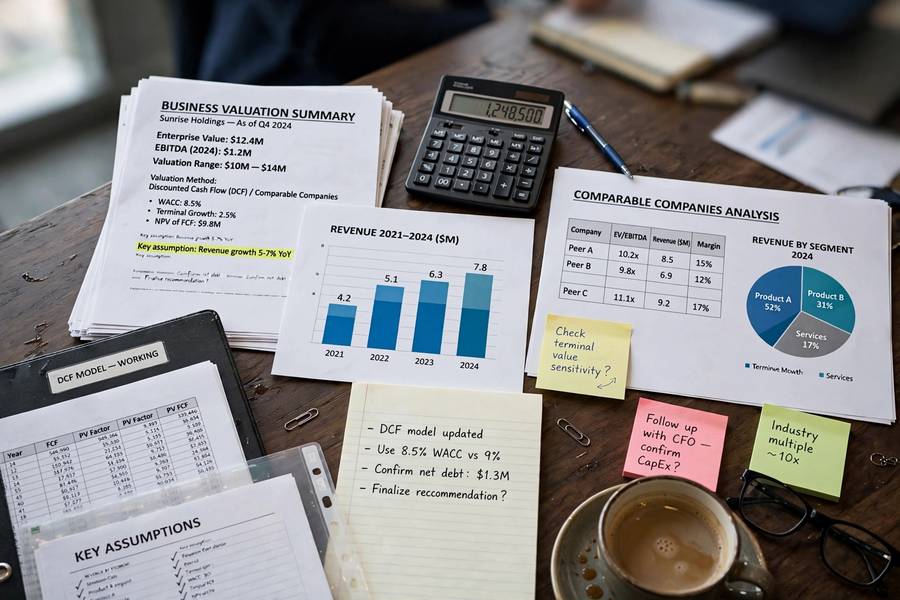
Step 2: Value the Business Realistically
Owners almost always overvalue their businesses — emotionally, it’s your life’s work; financially, buyers don’t pay for your sweat, they pay for future cash flow.
Common valuation methods:
– Multiple of earnings (SDE/EBITDA): small businesses typically sell for 2–4x seller’s discretionary earnings; larger ones 4–8x EBITDA. The multiple depends on growth, risk, and industry.
– Asset value: relevant for asset-heavy businesses (manufacturing, transport).
– Comparable sales: what similar businesses actually sold for — the most grounded anchor.
Get a professional valuation or at least a broker’s opinion of value. Pricing too high means the listing goes stale — and stale listings attract lowball offers. Pricing realistically generates competition, and competition is what drives price up. Common methods: multiples of seller’s discretionary earnings (2–4x for small businesses), EBITDA multiples for larger ones, and comparable sales of similar businesses.
Step 3: Fix What Buyers Will Discount
Walk through your business like a skeptical buyer and fix what you’d flag:
- Customer concentration. If one customer is 40%+ of revenue, buyers see existential risk. Diversify before selling if you can.
- Owner dependence. If the business collapses without you, it’s not a business — it’s a job. Document processes, delegate relationships, make yourself replaceable. This is the hardest and most valuable preparation.
- Key employee risk. Retention agreements or stay bonuses for critical staff, timed to the sale.
- Deferred maintenance. Equipment, facilities, technology — buyers discount heavily for capex they’ll inherit.
- Legal and compliance. Resolve disputes, update contracts, ensure licenses are current. Surprises in diligence kill deals or trigger price cuts.
Every issue you fix before listing is worth more than the same issue “disclosed and discounted” — because disclosed issues make buyers wonder what else you’re hiding.

Step 4: Decide How to Find Buyers
Business brokers (for businesses under ~$5M): they value, market, screen buyers, and manage the process for a commission (typically 8–12%). A good broker earns their fee in higher price and completed deals; a bad one wastes a year. Interview several; check their actual closed deals, not just listings.
M&A advisors (for larger businesses): more sophisticated process, higher fees, appropriate above $5–10M in value.
Selling yourself: possible for very small businesses, but you lose confidentiality control and negotiation leverage. Most owners underestimate how much skill the process requires.
Buyer types to expect: individual owner-operators (buying a job), competitors (strategic premium possible), private equity (for larger, scalable businesses), and existing employees (management buyouts — often the smoothest transitions).
Many of those strategic buyers started exactly where you are — a startup that scaled into an acquisition target. And if you’re on the other side of the table, thinking about building rather than selling, my guide on how to become an entrepreneur walks through the founder’s path from first idea to first revenue.
Step 5: Market Confidentially
Confidentiality isn’t paranoia — it’s value protection. If employees hear the business is for sale, key staff leave. If customers hear, they get nervous. If competitors hear, they poach.
The standard approach: blind listings (“profitable B2B services company, Southeast, $2M revenue”) with details released only after buyers sign NDAs and show financial qualification. Your broker manages this. Never let the fact of the sale become public until the deal is done — I’ve seen sales fall apart because a loose-lipped employee told a customer.
Step 6: Negotiate the Deal (Price Isn’t Everything)
The headline price is one term among many that determine what you actually walk away with:
- Deal structure: all cash at close vs. seller financing vs. earnouts (part of price tied to future performance). A $1M all-cash offer beats a $1.3M offer with $600K in earnouts you may never see.
- Seller financing: common in small deals (10–30% of price). It bridges valuation gaps but makes you the bank — vet the buyer’s ability to pay.
- Non-competes: buyers will require them. Negotiate scope (geography, duration, industry definition) carefully — this affects your next chapter.
- Working capital adjustments: understand exactly what’s included in the sale vs. what you keep. This is where closing-day surprises live.
- Your transition role: most deals include 3–12 months of transition support. Define it precisely — open-ended “consulting” becomes unpaid labor.
Get a deal attorney — not your family lawyer, a transactions attorney who does this weekly. The legal fees are trivial compared to what’s at stake.
Step 7: Due Diligence and Closing
Once terms are agreed (usually in a letter of intent), the buyer investigates everything: finances, contracts, employees, legal, operations, customers. This takes 30–90 days and is where deals die.
Survive diligence by: having everything organized before it starts (data room with all documents), disclosing issues proactively (discovered problems destroy trust; disclosed problems get negotiated), keeping the business performing (a revenue dip during diligence triggers price cuts), and staying calm through the inevitable re-trading attempts.
Closing involves final purchase agreements, fund transfers, and transition handoffs. Then — and only then — tell the team, customers, and the world. Have a communication plan ready: employees first, key customers second, everyone else after.
Selling a business well is a 12–24 month project, not a listing. Clean the finances, reduce owner dependence, value realistically, protect confidentiality, negotiate structure (not just price), and get professional help for the parts outside your expertise. Do that, and you’ll exit with the price — and the peace of mind — the years of work deserve.

Frequently Asked Questions
The active sale process typically takes 6–12 months from listing to closing. However, proper preparation should start 12–24 months before you list — cleaning up finances, reducing owner dependence, and documenting systems. Rushing the process almost always reduces the sale price.
Most small businesses sell for 2–4x seller’s discretionary earnings (SDE) — profit plus the owner’s salary and personal expenses run through the business. Larger businesses use EBITDA multiples (4–8x). The exact multiple depends on growth trends, industry, recurring revenue, and risk factors like customer concentration.
For businesses under ~$5M, a good broker is usually worth their 8–12% commission — they handle valuation, confidential marketing, buyer screening, and negotiation, and typically achieve higher prices and completion rates than owner-led sales. Interview several brokers and check their actual closed deals.
One thing that raises valuation is a team that runs without you — hiring your first employees is a step most owners wish they had taken earlier.
The most common deal-killers: messy or inconsistent financials, heavy owner dependence, customer concentration, undisclosed problems discovered in due diligence, unrealistic pricing that lets the listing go stale, and confidentiality breaches that spook employees or customers.
An earnout ties part of the purchase price to the business’s future performance — e.g., an extra $200K if revenue hits a target in year one. Earnouts bridge valuation gaps but favor buyers, since the seller loses control of the business yet bears performance risk. Treat earnout dollars as uncertain and negotiate the metrics carefully.